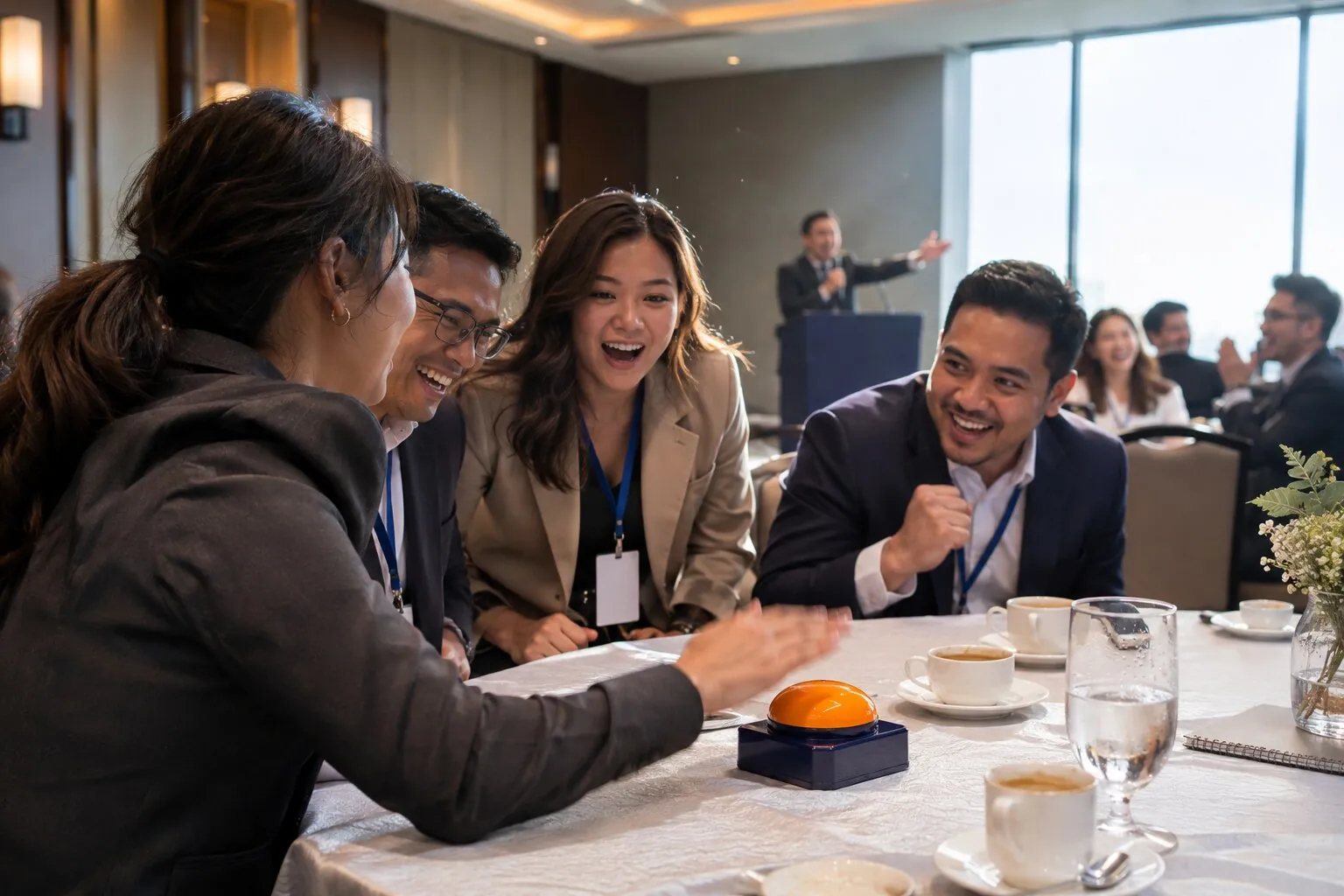
Quick answer: Team building for bank employees works best as one hosted session that brings several branches together at a regional meeting, before opening or after close. Put tellers, bankers, branch managers and back-office colleagues on mixed teams. A professionally facilitated game-show format gives every team a reason to talk across locations.
Your regional meeting puts every branch in one room. Then people sit beside the same coworkers they see every day. The presentations end, the usual groups re-form, and employees leave without meeting the colleagues they call for help.
It’s Playtyme Game Shows turns that shared time into participation with professionally hosted live game-show experiences. For HR Directors, regional leaders and Executive Assistants, the goal is simple: colleagues from different branches talk, contribute and leave knowing more people.
Give Several Branches One Shared Experience
Employees arrive at a regional meeting with relationships already in place. A branch team shares routines, shorthand and recent customer stories, so familiar circles shape every conversation, and colleagues at other locations stay names in an email thread.
The gap is wider between the branch floor and central teams. Tellers and personal bankers depend on operations, lending and fraud colleagues every day, yet most of those exchanges happen through tickets and phone queues. Invite those central teams to the session.
Acquired branches add another layer. After a merger or branch acquisition, legacy and newly joined teams keep to themselves and compare how things used to work. The goal is for both groups to share a result before they share procedures.
Job titles and branch-level competition create further barriers. A newer teller waits for a manager to answer, and one confident employee becomes the spokesperson for every round. Keep the session separate from sales rankings and individual reviews.
Training fatigue shapes expectations too. Employees who have just finished required modules on anti-money laundering or information security arrive expecting another test. Tell them in the invitation that this session is team discussion, not assessment.
Start with the connection you want to build. New hires need introductions across locations, and established teams need contact outside their usual branch circle. Branch managers gain the chance to participate alongside their staff without running every exchange. The shared goal has to cross job titles: in a survey-style round, a teller and a branch manager work toward the same answer.
Write a clear brief before you pick a format. For example: bring neighboring branches together, include recent hires, and give each mixed team repeated chances to discuss an answer.
The session fits inside a broader corporate team-building plan. Place it in a regional meeting, staff kickoff or leadership gathering, and treat participation as a planned part of the agenda.
Choose a Time Every Branch Can Support
A regional meeting is the clearest starting point because employees already have a reason to gather. Before-opening and after-close sessions also work when staffing and travel support them.
Protect branch coverage first
Vault dual-control procedures and minimum staffing levels mean a branch can’t send every employee at once. Ask each branch manager which roles must stay on site before you set a time.
Then choose between two approaches. Run separate regional sessions so coverage holds at every location, or use a day when branches are closed to customers while staff still work, such as a federal holiday your bank sets aside for staff development.
Use an existing regional meeting
Place the session where employees still have the attention to participate. Don’t treat it as leftover time after an agenda that runs late. Agree on the start and finish with the meeting owner, and protect both.
Keep arrival, refreshments and announcements separate from the hosted session. Tell employees when they need to be seated, especially when branches travel different distances.
Check the full before-opening window
A before-opening session takes more than an early start. Account for travel back to each branch, opening preparation and everything employees finish before customers arrive.
Choose this window only after branch leaders confirm the schedule. Keep operational instructions out of the game-show segment so employees get a clean transition back to work.
Plan after-close attendance explicitly
The posted closing time doesn’t tell you when every employee is ready to leave. Ask branch managers for realistic departure times, then add travel and arrival.
Share the finish time in advance. Have HR confirm attendance expectations and internal arrangements before invitations go out. That clarity respects employees and keeps scheduling questions away from the host.
Build Mixed Teams Before Employees Arrive
Assign teams by branch location and job role instead of leaving seating to chance. Put tellers, bankers, branch managers and back-office staff together, with several locations on every team.
Use the registration list to balance teams before the day. Give employees clear table assignments, and ask managers to back the plan instead of rebuilding their branch groups.
- Mix locations: Spread employees from the same branch across different teams.
- Include new hires: Seat newer colleagues with approachable employees from other locations.
- Blend acquired branches: Put legacy and newly joined staff on the same team.
- Seat central teams with frontline staff: Put operations, lending and fraud colleagues on teams with tellers and bankers.
- Share responsibility: Ask the host to rotate who answers for the team.
- Protect discussion time: Let teammates compare answers before a spokesperson responds.
- Check access needs: Confirm seating, sound, visibility and participation requirements during planning.
When designing onboarding activities for new bank employees, keep the opening rounds accessible to hires without institutional banking knowledge. Questions about long-standing internal traditions leave recent hires waiting for someone to explain.
Add workplace context gradually, using approved material. The first objective is a conversation between colleagues who have never worked together.
Mixed teams follow the same logic as cross-functional team building: people who rarely work together solve one problem side by side. Keep one organizer responsible for consolidating decisions and sending the final brief.
Match the Format to Your Participation Goal
The right format gives every employee a clear way to contribute. Choose by how you want teammates to interact, not by which name sounds familiar.
| It’s Playtyme Game Shows format | How teams participate | Best fit for a multi-branch session |
|---|---|---|
| Face-2-Face Feud | Survey-style team format: teammates discuss and agree on one answer | Conversation across branches |
| The Challenge | A board of questions the team works through together | Shared problem-solving across rounds |
| Word Play | A word puzzle the team solves together | One shared task for mixed teams |
| PlayPad Mania | Team responses on tablets or keypads | Larger rooms within the 20 to 300+ range |
Face-2-Face Feud for team discussion
Face-2-Face Feud is a survey-style team format. Teammates discuss possible responses, compare views and agree on one answer while a professional host runs the round.
Use it when conversation across branches is the priority. Keep the content approachable so success depends on discussion, not specialized banking knowledge.
The Challenge for shared problem-solving
The Challenge uses a board of questions. Teams work through them together, so different colleagues contribute across rounds.
Settle the content mix before booking. General-interest questions keep participation broad. Custom rounds tie selected questions to approved company topics, and extensive customization can add cost, so confirm it in the proposal.
Word Play for collaborative answers
Word Play is a word-puzzle format that gives every team one shared task. Colleagues offer suggestions and build the answer together under the host’s direction.
Pick it when you want participation centered on solving a puzzle together. Ask how the room is set up and how each assigned team submits answers.
PlayPad Mania for team responses
PlayPad Mania is a tablet and keypad team format. Review the response setup with the production team, especially for larger groups within the 20 to 300+ range.
The core question is the same for every format: what does each employee do during a round? A strong plan gives every teammate an active role, not a seat watching whoever holds the microphone.
Reinforce Required Training With Approved Content
A game-show segment reinforces required training. It never replaces it. Your bank stays responsible for instruction, approved materials, completion requirements and any formal assessment.
Keep the purpose narrow. Use a refresher round to revisit an approved internal procedure or point to the right resource for a workplace question. Leave interpretation and formal instruction with your training team.
Custom questions should support conversation without exposing confidential information. Use fictional scenarios, leave out customer details, and never identify employees through stories about past mistakes.
Your compliance or training lead approves every custom question, answer and explanation before production. Name the review owner and approval deadline during planning, then keep approved material in one controlled version. Custom compliance-question development is content work, separate from the standard hosted production, and must be scoped and quoted separately in the proposal.
A refresher round sits inside a wider team session. A correct team answer is not evidence that every participant completed or understood required training.
Confirm the Room, Production and Budget Scope
A multi-branch session needs one consolidated production brief. Include the date, venue, attendance estimate, room layout, available time and the connection you want employees to make.
It’s Playtyme Game Shows runs 60-minute or 90-minute shows, with corporate pricing starting at $2,995. Match the duration to the real agenda, including the time employees need to arrive and get back to work.
The hosted production includes a professional host, crew, game-show set, screens, audio/visual equipment and a sound engineer. Setup, breakdown, delivery and travel within NJ, NYC and CT are included. Confirm setup access and crew arrival timing in the production plan, especially for a before-opening session.
A few items can add cost: travel outside NJ, NYC and CT, extensive customization, lodging, multiple event spaces, specialized equipment or extra staffing. Confirm any of them in the proposal.
It’s Playtyme Game Shows was founded in 2012 by a former choreographer who saw that at most events a handful of people participate while everyone else watches, and built the company to change that. It’s Playtyme Game Shows is based in Teaneck, New Jersey, with regional expertise across NJ, NYC and CT.
Booking includes a 100% Satisfaction Guarantee, and no deposit is required. Give your internal approver a clear scope covering the format, production, content approvals and attendance plan.
Pick Your Window and Request a Financial Services Team-Building Plan
Make three decisions before you ask for a proposal. Pick the window: an existing regional meeting, before opening, after close or a day branches are closed to customers. Pick the participation goal: new-hire introductions, frontline and back-office contact, or blending acquired branches. Pick the content owner who approves any custom rounds.
Those answers narrow the format quickly. A discussion goal points to Face-2-Face Feud, where teammates agree on one answer. Shared problem-solving points to The Challenge and its board of questions, one shared puzzle points to Word Play, and team responses on tablets or keypads point to PlayPad Mania.
Request a custom production plan with your date, room size, branch attendance and participation goal. It’s Playtyme Game Shows returns it within two business days. No upsell.
Solve the participation problem
Ready to get the whole room in the game?
Frequently Asked Questions (FAQs)
Do live game-show team building events work for credit unions and community banks?
Yes. Credit unions and community banks use the same plan: mix locations and roles, set one participation goal, and confirm branch coverage before choosing a time. Keep custom content specific to your organization and approved by the right internal reviewer.
How do we schedule one session for several branches?
Start with an existing regional meeting or a shared window outside customer-facing hours. Ask each branch leader which roles must stay on site, plus departure, travel and return times, before you set the session time. Before-opening sessions need time for return travel and opening preparation. After-close sessions need realistic departure times and a clearly communicated finish.
How do live game shows keep quieter tellers and back-office staff engaged alongside branch managers?
Mixed teams and a professional host carry most of it. Teammates discuss each answer before a spokesperson responds, and the host rotates who answers so one confident manager doesn’t speak for every round. Opening rounds that need no institutional knowledge give newer and quieter colleagues an early way in.
How much does a hosted corporate game show cost for a regional bank meeting, and what is included?
Corporate productions are priced starting at $2,995. The price covers a professional host, crew, game-show set, screens, audio/visual equipment, a sound engineer, setup, breakdown, delivery and travel within NJ, NYC and CT. No deposit is required. Travel outside NJ, NYC and CT, extensive customization or extra staffing can add cost.
How many employees can take part?
It’s Playtyme Game Shows hosts groups of 20 to 300+ people, and groups over 300 get a custom production proposal. Mixed teams keep every table involved across that range.
Does a compliance-themed game show replace required training?
No. A game-show segment reinforces approved material and gets teams discussing it, while required training stays a separate responsibility. Your internal reviewer approves all custom questions and answers, and extensive customization can add cost.