

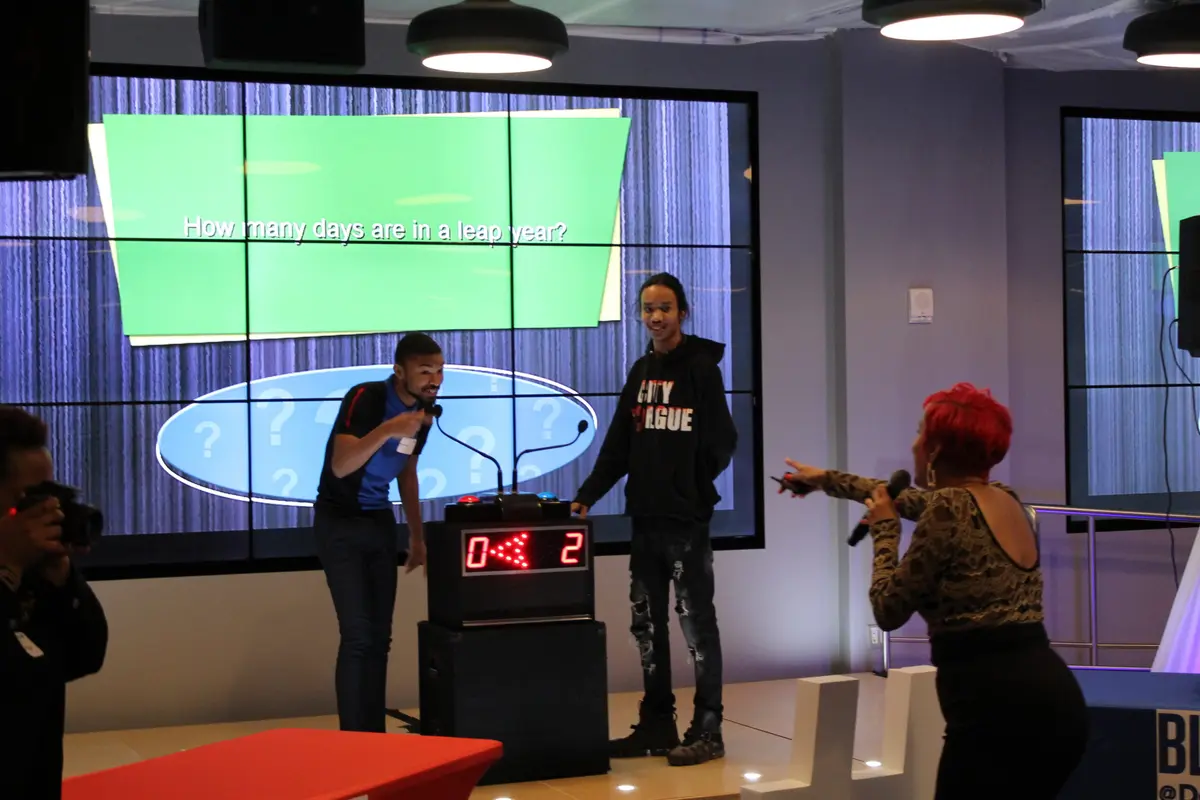
Quick answer: A fair department vs department competition uses a professional host, rules and tie-breakers shared in advance, equal turns for every team and shared prizes. Keep the questions fair for every department and the humor on the game. The result is a lively contest that connects departments instead of deepening old rivalries.
Sales against support. Engineering against marketing. Put two departments on opposite sides of a scoreboard and the energy in the room changes in seconds. Done well, a department vs department competition gives colleagues a reason to learn each other’s names. Done badly, it hands an old grudge a stage.
The reason to bother is that departments rarely talk. A UNC Kenan-Flagler summary of a Global Business Review study reports that 83% of respondents said silos exist within their companies, and 97% saw those conditions as hurting performance. For companies across New Jersey, New York City and Connecticut, a shared live hosted game show is one of the fastest ways to get two silos laughing at the same joke. If you are forwarding this to whoever approves the budget, the outcome is simple: departments that know each other solve problems faster, and one evening starts that.
Any department vs department competition has a built-in problem: rivalry has no brakes of its own. Large teams win by default, the department with the loudest personality dominates, and one bad call from an organizer lingers for a quarter. This guide shows how to form teams, keep the contest fair, score it, protect the mood and choose prizes, so the rivalry ends at the final buzzer and the friendships stay.
Decide What the Department Competition Is For
Pick the goal before the format. A morale lift after a hard quarter wants loud, silly rounds. A cross-team introduction wants mixed groups. A recognition event wants a clear winner and a trophy. The goal decides everything below, and it is the first thing a host needs to hear.
It’s Playtyme Game Shows asks for three details when it plans a show: your date, room size and goal. It returns a custom production plan within two business days, with no deposit required to book. Tell the planner you want a department vs department competition and say why.
Form Teams: Departments, Mixed Groups, or Both
There are two honest ways to build teams, and the choice changes the event.
Teams that are departments
Each department plays as one side. This gives the clearest rivalry and the loudest cheering section. It works best when departments are close in size and the goal is spirit, not introductions.
Teams that mix departments
People play beside colleagues from other departments. This is how It’s Playtyme Game Shows builds teams by default: they are “mixed deliberately, so people end up alongside colleagues from other departments.” The rivalry becomes friendly competition between mixed teams, and the silo breaks down in the process.
A two-part night
Run round one by department, then re-split into mixed teams for a final round. Everyone gets both the home-side pride and the cross-team mix. Ask your host whether the run of the show fits a split like this.
The room size matters here. Hosted shows run for groups from 20 to 300 or more, so even a large company can put every department in one room.
What Breaks Fairness in a Department vs Department Competition
Fairness is the thing people remember. Four problems sink a department contest, and each has a fix.
Unequal department sizes
A team of forty beats a team of six on volume alone. If departments differ widely, split large ones into two teams, or give each department the same number of players on stage at a time and rotate everyone through. Whatever you choose, announce it before the first round, not after the first complaint.
The knowledge edge
Finance wins a question about quarterly reporting, and nobody cheers. Avoid questions that only one department can answer. Pull from company history, pop culture, local trivia and everyday office life, so every team starts level. A good host balances rounds so each department gets a few questions that suit it.
Seniority and the boss on the team
A senior leader on a team changes how juniors play. They hold back, or defer, or stop speaking. Mix leaders across teams, or make the leader a cheerleader for a round. Tell leaders their job is to hand the buzzer to someone else.
Rules that shift mid-game
Nothing sours a room faster than a rule changed after the points are in. Write the rules down, including tie-breakers, and let the host be the final word. Share the rules with department heads a week ahead so no one is surprised.
Score It So Every Team Has a Chance
A scoreboard decides how the room feels in the final ten minutes. Use these principles.
- Several round types. Mix buzzer rounds, survey rounds, physical challenges and guessing games, so speed, knowledge and teamwork each earn points, and quieter people can shine in the survey and guessing rounds. These are the round types the show page describes.
- A comeback round. Keep points high in the last round so a trailing department stays in the fight. A trailing team that has quit costs you the last third of the event.
- Per-person fairness. If team sizes differ, score by the average per player or give every team the same number of turns.
- One visible scoreboard. Everyone sees the same number at the same time. Hidden scoring breeds suspicion.
- A tie-breaker you announce first. A closest-answer round or a sudden-death question settles it in thirty seconds.
Keep the Rivalry Friendly
Trash talk is part of the fun until it is not. Set the tone in three places.
In the invitation, call it a friendly contest and name the real purpose, such as “sales versus support, bragging rights only.” At the start of the event, let the host state the ground rules: cheer loudly, boo nobody, applaud the winners. During the show, a professional host steers the energy. Every It’s Playtyme Game Shows show is “professionally hosted from the first round to the final scores,” which means the organizer is not refereeing a dispute and playing at the same time.
Keep the humor on the game and the group. Jokes about a department’s workload, a recent reorganization or last quarter’s numbers cross the line quickly. Give the host a short list of topics to avoid before the show.
Prizes That Do Not Split the Office
The best prize is something the whole department shares, because individual prizes turn a team contest into a personal one. Good choices include a team lunch, an extra hour of break time, a trophy that moves desks each year, or a charity donation in the winning department’s name. Give the runner-up something too. A consolation prize says that second place was a good night, not a failure.
Prizes are included in every It’s Playtyme Game Shows show, so you do not need a separate budget line for the evening itself. See the pricing page for what is included, with shows starting at $2,995.
Pick the Version Your Departments Can Live With
Choose by asking three questions. Are your departments close in size? If yes, run them as teams. Is the goal introductions between groups? Mix the teams, or run both formats in one evening. Does the history between two departments carry tension? Mix the teams and skip the head-to-head until the relationship has healed.
It’s Playtyme Game Shows brings the show to your location in New Jersey, New York City or Connecticut, in person. Whatever you choose, give the host the goal, the department sizes and the topics to avoid. To build a contest around your departments, start with the game show team building page, or see how the same format works across a whole company on the corporate events page.
Solve the participation problem
Ready to get the whole room in the game?
Frequently Asked Questions (FAQs)
How do you make a department competition fair when departments differ in size?
Give every team the same number of players at a time and rotate everyone through, or split the larger department into two teams. Announce the rule before the first round so no one questions it later.
Should teams be whole departments or mixed groups?
Whole departments give the strongest rivalry and the loudest cheering. Mixed teams build connections across the company. Many organizers run a department round first and a mixed final to get both.
How do you keep a department rivalry from turning personal?
Set ground rules at the start, keep jokes on the game, and hand rulings to a neutral host. Avoid topics tied to a department’s workload, a reorganization or recent results.
What are good prizes for a department competition?
Shared prizes work best: a team lunch, extra break time, a rotating trophy or a charity donation in the winning department’s name. Add a smaller prize for the runner-up.
How many people can take part?
It’s Playtyme Game Shows runs shows for groups from 20 to 300 or more in one room, so most companies fit every department in one event.
What are good department vs department competition ideas?
A hosted game show covers most of them in one night: buzzer rounds, survey rounds, physical challenges and guessing games, scored on one board. Office trivia (Game Show Mania) and a department face-off in Face-2-Face Feud also work for smaller groups.