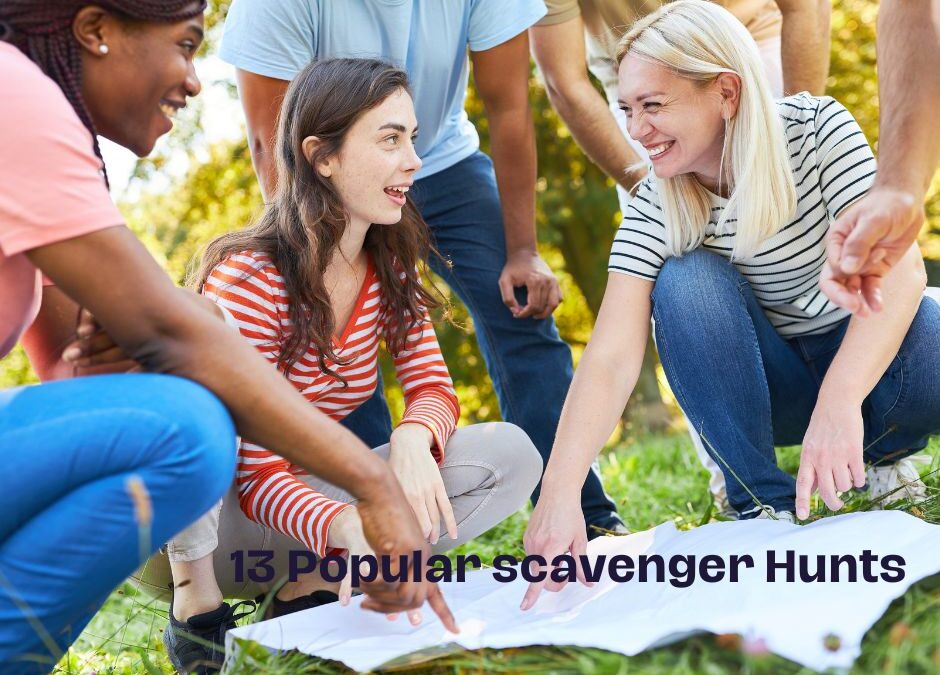
Step into the world of teamwork with our “13 Popular Scavenger Hunt Ideas for Successful Teams.”
In this blog, we’re diving into some seriously cool ideas that’ll make teamwork a blast. Imagine the fun of working together, the thrill of adventure, and the satisfaction of nailing challenges.
Whether you’re the team leader looking to spice things up or just someone who wants to have a blast with your colleagues, these scavenger hunt ideas are the key to turning ordinary teamwork into something epic.
Scavenger hunts promote team bonding: By working together to solve clues and accomplish tasks, team members can strengthen their relationships and develop a sense of camaraderie.
Scavenger hunts encourage problem-solving skills: Participants must think critically and creatively to complete challenges and find hidden treasures, fostering their ability to overcome obstacles as a team.
Scavenger hunts are versatile and customizable: With a wide range of themes and settings to choose from, scavenger hunts can be tailored to suit specific team goals and interests, making them an ideal activity for successful team building
Scavenger hunts are a fantastic way to foster teamwork and camaraderie among employees or groups.
They’re not just a fun way to spend an afternoon, but they also help to develop essential skills like communication, problem-solving, and collaboration.
So, if you’re looking for a unique and engaging team building exercises, why not consider organizing a scavenger hunt?
12 Steps to Organize a Scavenger Hunt
Organizing a scavenger hunt requires careful planning and attention to detail.
It involves creating a list of items or tasks, establishing rules, setting boundaries, and assigning teams.
Also, ensure the safety and enjoyment of participants by providing clear instructions and monitoring the progress.
To organize a successful scavenger hunt, follow these simple steps:
Set objectives: Determine the purpose of the scavenger hunt and what you want participants to achieve.
Choose a theme: Choose a theme that adds excitement and ties into your objectives.
Pick the location: Pick a location that is suitable for your theme and offers various hiding spots for clues.
Design clues: Create clues that are challenging but solvable, and align with your theme.
Prepare materials: Gather all the materials you need, such as clue cards, pens, and prizes.
Set rules: Establish rules and communicate them clearly to all participants before the scavenger hunt begins.
Form teams: Divide participants into teams, ensuring a mix of skills and abilities in each team.
Provide instructions: Explain the rules, objectives, and instructions to all participants at the start of the scavenger hunt.
Start the hunt: Release the teams to begin their search and solve the clues to progress.
Monitor progress: Keep track of each team’s progress and provide support or hints as needed.
Celebrate the winners: Once all teams have completed the hunt, announce the winners and award the prizes.
Debrief and reflect: Gather participants for a debriefing session to discuss their experiences and any improvements for future hunts
Book a Live Interactive Game Show!
Call us today. TV Style Game Shows for groups are our specialty. Let’s Play!
What Are the Benefits of Scavenger Hunts for Team Building?
employee-engagement-game-show-idea
Enhances teamwork and collaboration: Scavenger hunts require teams to work together, communicate effectively, and support one another to complete tasks and solve clues.
Improves problem-solving skills: Teams must think critically, analyze clues, and strategize to successfully navigate the scavenger hunt.
Promotes creativity and innovation: Scavenger hunts often involve creative challenges, stimulating teams to think outside the box and come up with unique solutions.
Bonds team members: By participating in a fun and exciting activity, team members develop a stronger sense of camaraderie and build meaningful connections.
Increases motivation and engagement: Scavenger hunts spark enthusiasm and excitement among team members, boosting their energy and drive to actively participate.
Develops effective communication: Teams must communicate clearly and efficiently to coordinate their efforts, share information, and achieve common goals.
Fosters leadership skills: Scavenger hunts provide opportunities for individuals to take onleadership roles, make decisions, and guide their teams towards success.
Create an inventory of specific objects or landmarks that participants must capture in photos, such as a street sign, a statue, or a renowned landmark.
Include challenges that prompt participants to take imaginative or amusing photos, like posing in ridiculous outfits or reenacting scenes from well-known movies.
Time Limit: To add an element of thrill and urgency, establish a time limit for the scavenger hunt.
Motivate participants to collaborate and strategize in order to optimize their chances of photographing all the items on the list.
Offer a prize to the team that accomplishes the most challenges or produces the most creative photos.
Go, grab your camera and prepare to capture some indelible moments with your teammates!
2 – Nature Scavenger Hunt
Location, location, location: When organizing a Nature Scavenger Hunt, select a natural area such as a park, forest, or beach where participants can explore and find items on their list.
Create a list: Compile a list of items related to nature that participants need to find during the Nature Scavenger Hunt. This can include specific plants, animals, natural objects, or environmental features.
Assign teams: Divide participants into teams to encourage collaboration and competition during the Nature Scavenger Hunt.
Provide instructions: Explain the rules and objectives of the Nature Scavenger Hunt to the participants, including any time limits or specific guidelines.
Distribute materials: Give each team a copy of the Nature Scavenger Hunt list, pens or markers for marking items found, and any additional tools or equipment they may need, such as magnifying glasses or field guides.
Start the hunt: Set a specific starting point and time for the Nature Scavenger Hunt to begin. Throughout the Nature Scavenger Hunt, supervise the teams, provide any necessary guidance or assistance, and ensure fair play.
Finish line: Determine a designated finish line where teams must return within a specified time frame for the Nature Scavenger Hunt.
Award ceremony: Gather all the teams together after the Nature Scavenger Hunt and announce the winners, recognizing their achievements and providing small prizes if desired.
Reflect and celebrate: After the Nature Scavenger Hunt, provide an opportunity for participants to share their experiences, discuss the items they found, and celebrate the fun and learning.
3 – City Adventure Scavenger Hunt
When planning a City Adventure Scavenger Hunt, there are a few key steps to ensure its success:
Choose the perfect location: Select a city with a variety of landmarks, iconic spots, and hidden gems to make the City Adventure Scavenger Hunt exciting and engaging.
Create a theme: Tie the City Adventure Scavenger Hunt to the city’s history, culture, or famous landmarks to add a fun twist and educational element.
Design clue cards: Prepare clue cards that lead participants from one location to the next, incorporating riddles, puzzles, or trivia about the city.
Organize teams: Divide participants into teams and assign them a team name, providing each team with a set of clue cards for the City Adventure Scavenger Hunt.
Determine time limit: Set a time limit for the City Adventure Scavenger Hunt to add a level of competition and challenge.
Include challenges or tasks: Incorporate additional challenges or tasks at each location to further engage participants in the City Adventure Scavenger Hunt.
Provide a debriefing: After the City Adventure Scavenger Hunt, gather all the teams for a debriefing session to share their experiences and celebrate the winning team.
4 – Food and Beverage Scavenger Hunt
When organizing a food and beverage scavenger hunt it is important to consider the theme, team size, location, and dietary restrictions of the participants.
To make your scavenger hunt a success, here are some ideas:
Theme: Choose a specific cuisine or type of food and beverage, such as international cuisine or desserts, for the Food and Beverage Scavenger Hunt.
Team size: Divide participants into teams of 2-4 people to encourage collaboration and competition during the Food and Beverage Scavenger Hunt.
Location: Plan the hunt in a specific area related to food and beverage, like a farmer’s market, food court, or local restaurants.
Dietary restrictions: Take into account any dietary restrictions or allergies of the participants and ensure that the hunt includes options for everyone in the
Book a Live Interactive Game Show!
Call us today. TV Style Game Shows for groups are our specialty. Let’s Play!
During the exciting Food and Beverage Scavenger Hunt, teams eagerly embarked on a quest to discover diverse culinary delights from each continent.
With determination and enthusiasm, one particular team skillfully secured delectable and exotic offerings from Asia, Europe, Africa, and North America, impressing their companions.
Faced with the seemingly difficult task of locating an Antarctic treat, the team’s spirits remained undeterred as they combed the streets, eager to complete their extraordinary gastronomic journey.
Just when their hopes started to dwindle, they stumbled upon an extraordinary ice cream parlor, in the city.
This place held a reputation for crafting and concocting rare flavors, and to their astonishment, one of them was aptly labeled “Antarctic Adventure.”
An air of delightful anticipation filled the shop as the team enthusiastically ordered scoops of the extraordinary ice cream, its tantalizing blend of unconventional ingredients.
In this unforgettable moment of success, the group savored each mouthful of the peculiar delicacy, celebrating their completion of the scavenger hunt with smiles and contentment.
5 – Holiday Themed Scavenger Hunt
When planning a Holiday Themed Scavenger Hunt for your team, it’s important to consider the following steps:
Choose a holiday theme that aligns with the occasion or season, such as Christmas, Halloween, or Thanksgiving.
Create a list of items or clues that relate to the chosen theme. For example, for a Christmas hunt, you could include items like ornaments, candy canes, and Santa hats.
Select a location where the scavenger hunt will take place, whether it’s indoors or outdoors. Consider places like a holiday market, a local park, or even your office space.
Divide the team into groups and assign each group a list of items or clues to find. Encourage collaboration and teamwork.
Set a time limit for the scavenger hunt to add excitement and encourage quick thinking.
Provide prizes for the winning team, such as holiday-themed treats, small gifts, or certificates of achievement.
After the scavenger hunt, gather the teams together to share their experiences and celebrate the festive spirit.
Fun fact: Scavenger hunts have been enjoyed as a popular team-building activity since the early 1900s, and they continue to be a favorite choice for holiday celebrations!
6 – Team Building Scavenger Hunt
When it comes to team building activities, a scavenger hunt can be a fun and effective way to promote collaboration and communication within a group.
Team Building Scavenger Hunt Here are some ideas for a successful team building scavenger hunt:
Theme-based scavenger hunt: Choose a theme that relates to your team’s interests or goals. For example, a technology-themed hunt can involve solving puzzles related to coding or finding gadgets.
Outdoor adventure hunt: Organize a hunt in a park or nature reserve, where teams can search for specific landmarks or natural objects.
Historical hunt: Design a hunt that takes participants to historical sites or places of cultural significance. This can be a great opportunity to learn about the local history.
Photo scavenger hunt: Instead of collecting physical items, teams can take pictures or selfies with specific objects or landmarks.
Puzzle hunt: Create a series of riddles or puzzles that teams must solve to progress in the scavenger hunt.
Charity hunt: Combine team building with giving back by organizing a scavenger hunt that involves collecting items for a local charity.
Virtual scavenger hunt: In a virtual setting, teams can compete to find items or answers to specific questions online.
Culinary hunt: Incorporate food and culinary challenges into the scavenger hunt, such as finding specific ingredients or completing cooking tasks.
Customized hunt: Tailor the scavenger hunt to your team’s specific needs and goals, incorporating elements that align with your organization’s values or mission.
In 1992, the Microsoft campus in Redmond, Washington, held a team building scavenger hunt called “The Puzzle Riot.”
Employees had to solve puzzles and riddles while navigating through the campus.
The success of this event led to the establishment of an annual tradition of team building scavenger hunts at Microsoft, which continues to this day in 2023.
7 – Puzzle and Riddle Scavenger Hunt
When planning a puzzle and riddle scavenger hunt, it’s important to create a challenging yet enjoyable experience for participants. Here are some ideas to consider:
Pick a Theme: Choose a theme that fits the occasion or the interests of the participants, such as a mystery, adventure, or treasure hunt.
Create Clues: Create riddles or puzzles that lead participants to each location. Consider using wordplay, hidden messages, or brain teasers to make it more engaging.
Select Locations: Select diverse locations that offer different challenges, such as parks, landmarks, or even within a building. Remember to ensure it’s easily accessible for participants.
Teamwork: Encourage teamwork by assigning participants into groups that must work together to solve the clues. This fosters collaboration and communication skills.
Give Rewards: Offer small prizes or incentives for successfully completing the puzzle and riddle scavenger hunt. It increases motivation and adds excitement to the experience.
Safety Protocol : Ensure the puzzle and riddle scavenger hunt locations are safe and participants are aware of any potential hazards. Provide clear instructions and guidelines to ensure everyone’s well-being.
8 – Historical Scavenger Hunt
When planning a Historical Scavenger Hunt, it is crucial to select a location that has a rich history and design engaging clues that seamlessly include historical facts. Here are some suggestions to ensure a successful Historical Scavenger Hunt:
Choose a historic site or city renowned for its fascinating history.
Create clues that direct participants to specific historical landmarks or buildings.
Integrate historical trivia into the clues to educate participants as they progress.
Incorporate challenges that prompt participants to interact with locals or historical reenactors, enhancing their immersion in the experience.
Make use of technology by including QR codes that lead to online resources with historical information.
Create a themed scavenger hunt centered around a particular historical period or event.
Encourage participants to capture memories of their historical adventure by taking photos at each location.
Supply participants with a historical guidebook or booklet containing additional information about each location.
Consider offering prizes or rewards to those who successfully complete the scavenger hunt.
9 – Art and Culture Scavenger Hunt
If you’re looking for a fun and educational way to explore creativity, history, and local culture, consider organizing an art and culture scavenger hunt. Incorporating the keywords “Art and Culture Scavenger Hunt,” here are some ideas to ensure a successful event:
Choose a theme: When planning the scavenger hunt, decide on a specific art or cultural theme, such as Renaissance art, street art, or local historical landmarks.
Create a list: Make a comprehensive list of specific items, locations, or artworks that are related to the chosen theme. Include famous paintings, sculptures, architectural landmarks, or cultural artifacts.
Map out locations: Prior to the event, thoroughly research and mark the locations of the items on your list. This can include museums, galleries, historical sites, or public art installations.
Scavenger hunt tasks: Develop creative tasks or challenges for participants to complete at each location. For example, you could ask them to take a photo with a specific artwork, identify the artist of a certain painting, or answer questions about the history behind a particular site.
Provide clues: Enhance the challenge of the scavenger hunt by creating clues or riddles that guide participants to the next location. It’s important to make them challenging yet understandable.
Team up: Divide the participants into teams and encourage them to work together to solve clues and complete tasks throughout the scavenger hunt.
Prizes and rewards: To make the event more exciting, offer prizes or rewards for the team that completes the scavenger hunt first or has the most correct answers.
10 – Tech Scavenger Hunt
When planning a Tech Scavenger Hunt, there are several key considerations to ensure a successful and engaging experience for participants. Here are some suggestions to make your Tech Scavenger Hunt enjoyable and memorable:
Choose a reliable and user-friendly app or platform specifically designed for organizing Tech Scavenger Hunts.
Create a variety of challenges that incorporate different aspects of technology, such as solving puzzles, taking photos or videos, or even using augmented reality.
Select locations or landmarks that have a connection to technology, such as tech companies, historical sites related to technological advancements, or places known for innovation.
Incorporate teamwork by encouraging participants to collaborate and communicate effectively using digital tools like group messaging or video calls.
Include rewards or prizes for reaching certain milestones or completing specific challenges to motivate participants.
Consider time limits or countdowns to add excitement and urgency to the Tech Scavenger Hunt.
Provide clear instructions and guidelines for using any required technology or apps to ensure a smooth experience for all participants.
icebreaker-game-show
11 – Sports Scavenger Hunt
A sports scavenger hunt is a fun and interactive way to engage teams and promote teamwork. Here are some ideas to consider for your Sports Scavenger Hunt:
Create a list of sports-related items or landmarks that teams need to find and photograph, such as a basketball hoop, a soccer field, or a tennis court.
Incorporate sports trivia challenges along the way, where teams have to answer questions about famous athletes, sports history, or team logos.
Include physical challenges like shooting a basketball or hitting a baseball, where teams can earn points based on their performance.
Add a sports-themed puzzle or riddle that teams need to solve in order to find their next clue or location.
Encourage teams to dress up in their favorite sports attire or jerseys to add to the excitement and team spirit.
End the Sports Scavenger Hunt with a reward for the winning team, such as tickets to a local sporting event or sports-themed prizes.
In 1996, the city of Manchester, England, hosted the world’s largest Sports Scavenger Hunt.
Over 2,000 participants competed in finding sporting landmarks and completing sports-related challenges throughout the city.
The event was a huge success and helped strengthen community bonds while promoting an active and healthy lifestyle.
12 – Adventure Scavenger Hunt
An adventure scavenger hunt is an exciting and captivating activity that can be appreciated by teams of all ages. Here are some ideas to ensure the success of your adventure scavenger hunt:
Pick a distinctive location that provides a feeling of adventure and exploration, such as a local park, nature reserve, or historical site, for your adventure scavenger hunt.
Create a list of items or clues that participants must discover or solve in order to advance through the scavenger hunt. Make certain that the challenges are thrilling and align with the theme of adventure.
Include physical tasks that promote teamwork and physical activity, such as climbing a tree, crossing a river, or navigating an obstacle course.
Introduce unexpected twists and surprises along the way to maintain the participants’ engagement and enthusiasm for the adventure scavenger hunt.
Provide each team with a map or compass to navigate the hunt, thus adding an orienteering element to the adventure.
Promote creative problem-solving by incorporating riddles or puzzles that must be solved in order to unlock the subsequent clue.
Pro tip: To enhance the enjoyment of the adventure scavenger hunt, consider incorporating a time limit or awarding prizes to the team that completes the hunt in the shortest amount of time.
13 – Indoor Scavenger Hunt Planning
When planning an Indoor Scavenger Hunt, there are several steps you can follow to ensure a successful and fun experience for everyone involved.
Choose a theme: Choose a theme that will make the Indoor Scavenger Hunt more exciting and engaging, such as a detective mystery or a treasure hunt.
Set up clues: Write a series of clues that will lead participants from one location to another. Make sure the clues are challenging but not too difficult to solve.
Hide objects: Hide objects or treasures in each location that participants will need to find in order to move on to the next clue.
Divide into teams: Split participants into teams to add a competitive element to the Indoor Scavenger Hunt. Each team should have a leader who will keep track of the clues and help their team solve them.
Start the hunt: Explain the rules and provide each team with the first clue. Make sure to set a time limit for the Indoor Scavenger Hunt to create a sense of urgency.
Monitor progress: Keep an eye on each team’s progress and provide assistance if needed. Make sure the Indoor Scavenger Hunt is fair by ensuring that each team has an equal chance of finding the clues and objects.
Finish line: Determine a finish line or a final destination where teams will gather once they have completed all the clues. Declare the winning team and reward them with a prize.
FAQs – Popular Scavenger Hunt Ideas
frequently asked questions
1. What are some popular types of scavenger hunt team building activities?
Popular types of scavenger hunt team building activities include office scavenger hunts, city, outdoor, museum, and virtual scavenger hunts.
2. How can scavenger hunt activities help colleagues get to know each other?
Scavenger hunt activities provide an opportunity for colleagues to bond and have fun away from their desks.
By working together in teams, employees can collaborate, communicate, and learn more about each other’s strengths and personalities.
3. What skills can be developed through scavenger hunt team building activities?
Scavenger hunt team building activities can help develop problem-solving, collaboration, communication and critical thinking,.
4. Are there options for both in-person and remote teams?
Yes, there are scavenger hunt activities available for both in-person and remote teams.
In-person activities may involve exploring the city or office space, while virtual activities can be done through online platforms or apps.
5. Can you provide some examples of scavenger hunt ideas for in-person groups?
Some examples of scavenger hunt ideas for in-person groups include the City Chase. This is where teams explore the city and complete photo and video challenges. The Storage Locker Scavenger Hunt, where participants search for relics in a storage room.
6. What are some virtual scavenger hunt activities for remote teams?
Virtual scavenger hunt activities for remote teams can include challenges like the Virtual Team Bucket List Hunt, where participants complete activities from their own locations. The Virtual Campus Goose Chase, where teams solve clues and complete challenges using an app.
Workplace stress costs U.S. businesses $300 billion each year. But just 15 minutes of laughter can cut stress hormones by 27%. Johns Hopkins’ research shows laughter makes teams work better together.
When people share real humor, they build trust. This trust lasts longer than any report or spreadsheet.
When work meets fun, amazing things happen. Companies using group challenges solve problems 41% faster. They also get 33% more creative.
These activities aren’t about awkward trust falls. They’re about using fun to connect people. Games that make you laugh and puzzles that make you go “aha” are key.
Teams that laugh together talk 19% more during tough times, Stanford says. Even small groups see big improvements in solving problems and making decisions.
Key Takeaways
Laughter reduces cortisol levels by 27%, creating ideal conditions for collaboration
Game-based approaches improve communication skills by 19% in high-pressure situations
Creative challenges boost team innovation metrics by 33%
Short, focused exercises deliver measurable ROI within 4-6 weeks
Blended virtual/in-person options maintain engagement across distributed teams
Top 7 Funny Team Building Activities That Won’t Make You Cringe
Forget about trust falls. These seven team-building activities are all about laughs. They’re designed to get everyone involved and keep things light.
Professional guides make sure everything runs smoothly, so you can just enjoy the fun.
Activity
What Happens
Best For
Hollywood Murder Mystery
Teams solve a fictional crime using clues & role-playing
The Hollywood Murder Mystery is a hit. Teams work together to solve a crime, using clues and acting out roles. It’s a chance for coworkers to show off their hidden talents.
The Lie Detection Game is a hit with food lovers. People share two true facts and one lie about their dish. Colleagues vote, often revealing surprising truths, like who likes pineapple on pizza.
CEO Impersonation Contests are great for big companies. Employees mimic their bosses, leading to lots of laughs. One big company saw a huge jump in survey scores after this activity.
These activities are easy to set up but pack a big punch. The Spaghetti Tower Challenge, for example, turns simple office supplies into a fun competition. Teams of 3-5 try to build the tallest tower, testing their creativity under pressure.
4 Funny Game Show Themes: The Ultimate Solution for Funny Team Building
Forget awkward icebreakers – game show formats deliver instant laughs while strengthening collaboration. These interactive activities create shared experiences where teams bond through friendly competition, strategic thinking, and hilarious moments. Let’s explore four crowd-pleasing options that turn Zoom fatigue into Zoom fever.
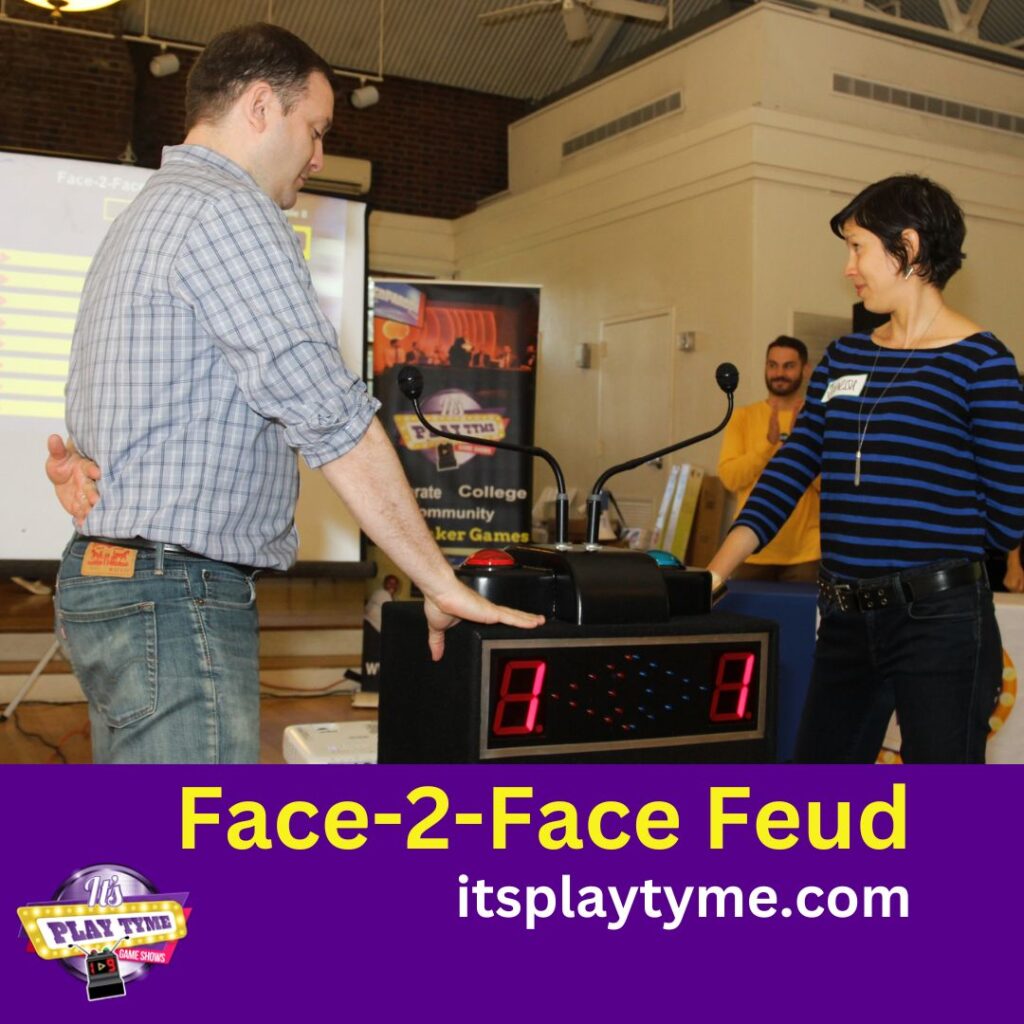
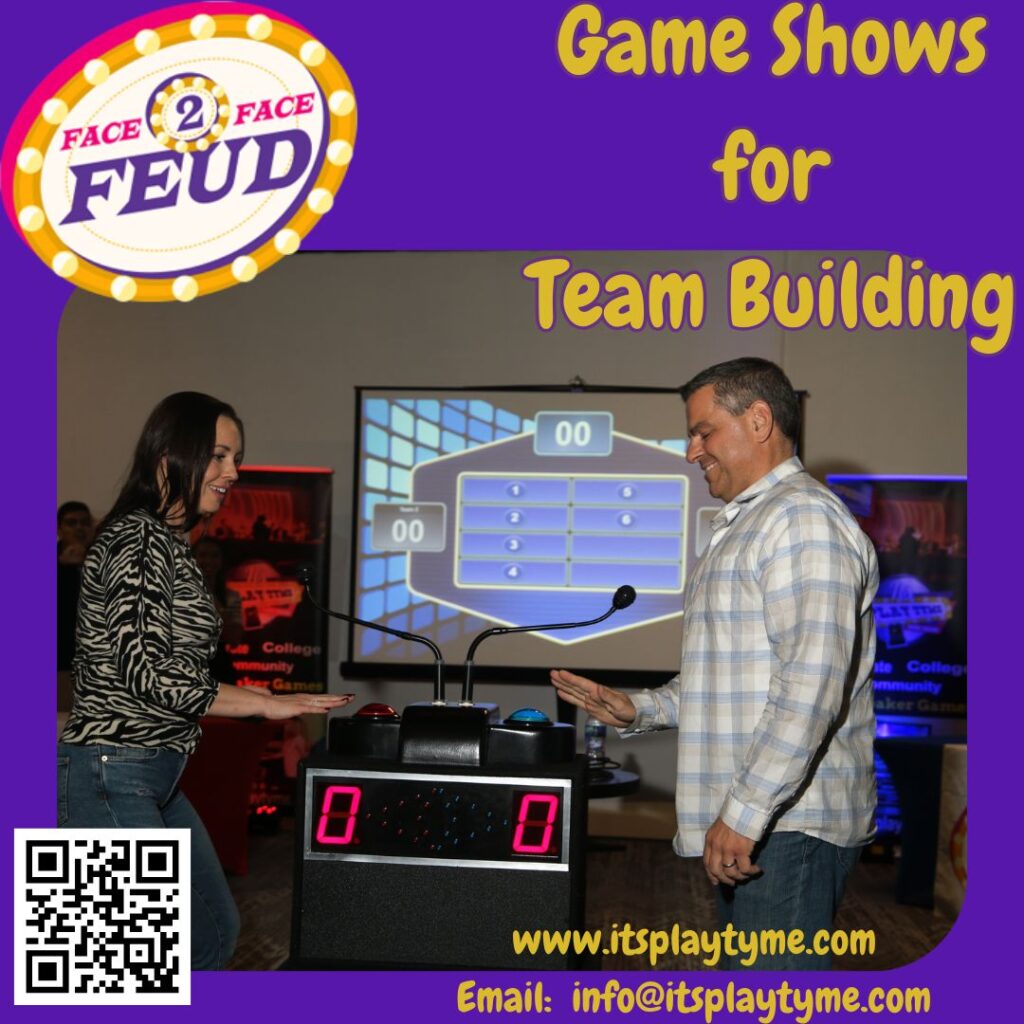
1 – Face-2-Face Feud
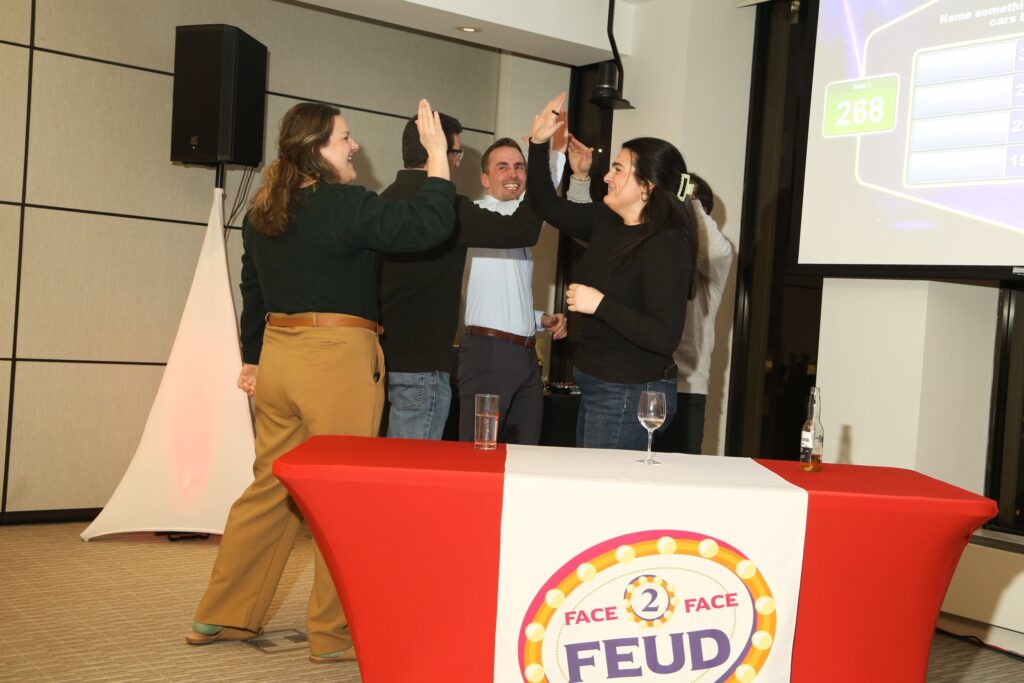
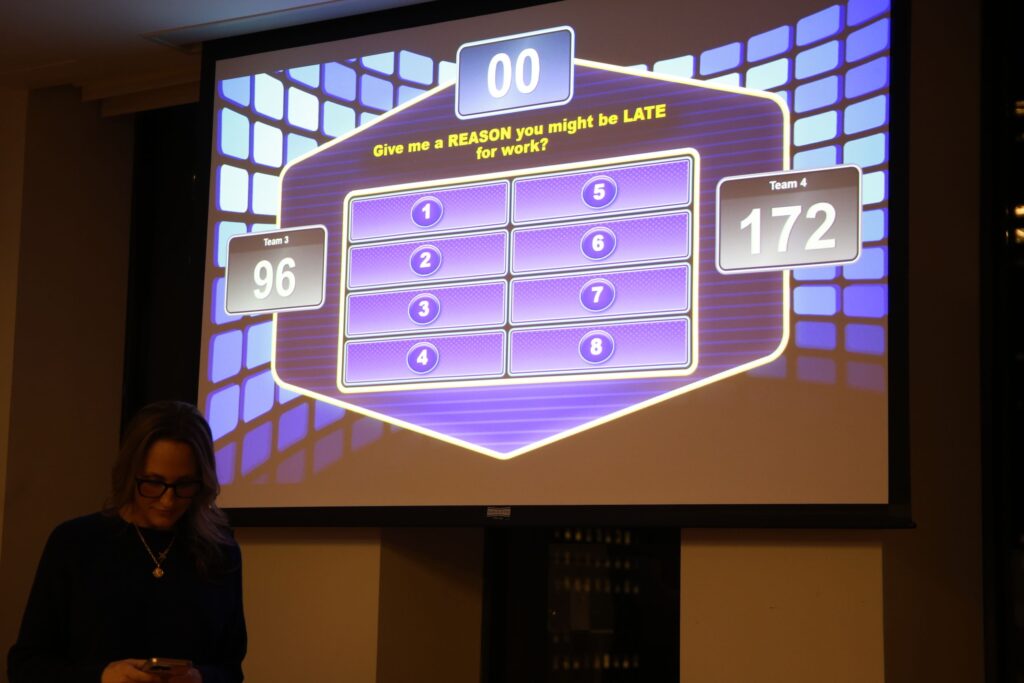
This Family Feud adaptation uses workplace-specific questions to spark laughter and insight. Teams guess top survey answers about company culture, industry trends, or even office snack preferences. A recent survey revealed 83% of participants felt more connected to colleagues after playing.
2 – PlayPad Mania Trivia (For Large Groups)
Tech-enabled trivia supports 100+ players through synchronized mobile devices. Features include:
Real-time leaderboards showing team progress
Custom categories like “Company History” or “Pop Culture”
Photo/video rounds for visual engagement
3 – The Challenge (Jeopardy Style Game)
Teams tackle KPI-themed categories like “Sales Slam” or “Customer Service Showdown” using strategic wagering.
This format combines business acumen with rapid-fire responses, perfect for data-driven groups wanting measurable results.
4 – 60 Seconds of Fame Challenges
Inspired by viral TikTok trends, these quick physical tasks boost energy levels:
Lip-syncing movie quotes with exaggerated expressions
Office chair obstacle courses
Collaborative dance routines
Participants report 68% higher engagement compared to traditional brainstorming sessions.
What Makes Game Show Activities So Funny? (And Effective!)
Game show activities are great for stress relief and boosting productivity. They make work more fun through playful competition. Studies show that humor can make work 20% more efficient.
Watching coworkers dance or debate weird trivia answers is hilarious. These engaging team challenges make everyone feel safe and connected. They turn coworkers into friends, not just people at their desks.
“Teams that laugh together solve problems 34% faster than those who don’t.”
Timed challenges like 60 Seconds of Fame add excitement. They make everyone show off their hidden talents. Think of spreadsheet experts rapping about goals.
This fast-paced environment builds trust quickly. MIT’s studies show it’s better than traditional icebreakers.
Companies like Outback Steakhouse mix fun with purpose. They donate care kits during challenges. Employees compete to make hygiene packs for shelters while having fun.
This unique approach creates lasting memories. People remember 68% more from these events than from regular seminars.
Game shows also help reduce stress at work. They turn office tensions into friendly competitions. For example, sales teams compete in trivia about company history.
This way, competition becomes teamwork. For more ideas, check out our favorite team-building games. They turn awkward moments into applause.
Funny Team Building Activities for Large Groups vs. Small Teams
Choosing the right team-building activity depends on whether you’re herding cats or leading a focused squad.
Large groups thrive on high-energy chaos, while small teams benefit from personalized interactions. Let’s break down the best onsite funny team building options for both scenarios.
For groups of 100+, think big. City-wide scavenger hunts like Wild Goose Chase turn entire neighborhoods into playgrounds. Massive trivia events with professional AV setups keep everyone engaged without technical hiccups. As one event planner notes:
“You can’t wing it with 200 people. Proper sound systems and clear instructions make or break large-group humor.”
Small teams (under 15 members) shine with activities like:
Blindfolded compass walks requiring precise communication
3 Question Mingle icebreakers that reveal unexpected connections
Personal Presentations where colleagues share quirky hidden talents
Hybrid models work beautifully for mixed-size organizations. Try splitting 50-person departments into 10 smaller teams for synchronized challenges. Need options for both small and large work teams? Combine a company-wide photo scavenger hunt with in-person team building for small groups competing in parallel.
Group Size
Best Activities
Pro Tips
100+
City scavenger hunts, game show tournaments
Hire professional AV crews
5-15
Human Knot variations, story-building games
Use personal anecdotes for deeper bonding
Remember: Laughter scales differently. What makes a 5-person team snort coffee might fall flat in an auditorium. Match the energy to the audience size, and you’ll create memories that stick.
Real Laughs, Real Teams: What Clients Are Saying
New York City teams know that laughter boosts productivity. Fortune 500 companies and startups across the tri-state area see real results. They use game-style team building to win in the workplace.
Indeed, New York City
Indeed hosted a 300-person Game Show Extravaganza. They saw a 40% drop in conflicts. The event was a hit, with teams loving the NYC venue and challenges.
“The energy felt like a live TV taping, no awkward icebreakers, just pure teamwork. We even donated bikes to local schools through the charity challenges!”
Outback’s bike donation program made the event meaningful. Teams earned points for helping the community. Afterward, 92% of employees felt closer to their colleagues.
Bloomberg, New York City
Bloomberg’s Beach Staycation program improved teamwork by 28% in Q3. Employees enjoyed tropical challenges at their Manhattan HQ. A department head said:
“We’ve done escape rooms and trust falls, this was the first activity where finance and creative teams actually wanted to work together afterward.”
The program was so successful, it was booked again in New Jersey and Connecticut. Virtual Do-Good Games showed similar results, with remote teams improving communication by 33%.
Want to change your team? Outback offers:
Same-day setups at 15+ NYC venues
Custom themes for NJ/CT hybrid teams
Charity integrations aligning with CSR goals
Book Your Game Show Experience Today (Before Laughter Sells Out)
Time slots for top team-building activities in NYC, NJ, and CT are filling up quickly. You can pick from half-day game shows at your office, full charity events, or virtual options. Teams in the tri-state area have access to cool venues like Chelsea Piers and WeWork Labs.
Custom experiences are best for groups of all sizes. Big companies like Bloomberg and startups enjoy unique sessions. Each booking includes a call to make sure the event fits your team’s vibe.
Book by December 15th to get a free laugh analysis report. This report shows how well your team enjoyed the event and suggests more fun activities. Don’t wait, as spots are limited for holiday parties and Q1 events in NYC, NJ, and CT.
FAQ – Funny Team Building
1. Can funny team-building games reduce workplace stress?
Absolutely. Laughter is like a stress pressure valve—when it blows, tension melts. Our clients say they feel lighter, more connected, and way less stiff after activities like Reverse Charades or Survey Showdown. Why? Because endorphins = happy teams. And yes, science backs it: 67% of employees report less stress after humor-based activities.
2. What makes your activities “zero-cringe” compared to traditional icebreakers?
Great question, because we hate forced fun too. Our games are built for adults who’ve seen it all. Think Murder Mystery Showdowns and Synchronized Clapping Battles—absurd on purpose, but polished with strategy, storylines, and optional participation. No name tags. No “say something interesting about yourself” torture. Just real fun, facilitated right.
3. We have a 150-person department and a tiny 8-person remote team. Can you handle both?
Oh yeah. For big groups, we roll out PlayPad Mania Trivia with pro A/V, buzzers, and energy you can feel in your bones. Smaller teams? We scale it down with games like Blindfold Compass Walks or virtual Guess the Soundtracks. We’re hybrid-ready for live, virtual, or blended events, NYC to Connecticut, and beyond.
4. Why go with game show themes instead of the same old team-building stuff?
Because they work and they’re fun. Game shows tap into competitive spirit, time pressure, and real-world collaboration. We build challenges around communication, leadership, and quick thinking. Case in point: Bloomberg reported a 28% spike in cross-team collaboration after our game show event.
5. What do NYC-based teams need to know before booking?
We’ve got access to exclusive venues in Midtown, Brooklyn, and downtown Manhattan. If you’re hosting 75+ guests, we’ll bring a full A/V squad, emcee, and lights-on production. Hot tip: Book your holiday party by October, prime dates disappear fast.
6. How do you measure ROI, beyond just the laughs?
We track engagement through post-game surveys (must be requested) , plus, our optional charity formats (like Feud for Fundraising) boost employee sentiment and community impact. 89% of attendees say they retain key training concepts when it’s delivered through a game format. ROI = Return on Interaction.
7. What’s included in your customizable packages for NJ and CT teams?
We offer everything from half-day high-energy game shows to full-day give-back experiences with a competitive twist. All packages include hybrid facilitation, themed challenges, and even a bonus Awkward Family Photo when you book before Labor Day. (It’s a hilarious icebreaker that sits in real break rooms.)
Summer intern programs provide a unique opportunity for young professionals to gain hands-on experience and embark on a transformative journey.
However, stepping into a new environment filled with unfamiliar faces can be daunting for these people.
This is where the power of icebreaker activities and team building comes into play. In this article, we will explore 5 well-designed icebreaker activities that can break down barriers, foster connections, and create a sense of belonging withing the intern community.
We have provided you with five highly effective icebreaker ideas: “Name Game,” “Speed Networking”, “Face-2-Face Feud”, “Office Scavenger Hunt”, and “Word Play”.
By implementing these type of icebreakers, you can ensure that your summer intern program stands out and leaves a lasting impression.
Book a Live Interactive Game Show!
Call us today. TV Style Game Shows for groups are our specialty. Let’s Play!
Effective Icebreaker Ideas For Summer Intern Programs
By incorporating a few icebreakers into your summer intern program, you create an environment that nurtures open communication, collaboration, and creativity.
These activities encourage interns to step out of their comfort zones, allowing them to forge connections with their peers, mentors, and supervisors.
Join us as we delve into 5 activity ideas and uncover their power to transform summer intern programs.
Let’s get started.
Summer Interns
Idea #1 – The Name Game Icebreaker
Let’s begin with a “classic” icebreaker that helps everyone remember each other’s names and characteristics. This game is designed to have one thinking and talking to one another immediately.
First, have your summer interns form a circle. Start by introducing themselves with a personal characteristic, hobby or interest with the same letter as their name. The next person repeats the previous names and personal characteristic and adds their own.
For example, “I’m Daniel, and I love Dancing”. The next person repeats the first person’s name and characteristic, then adds their own (e.g., “That’s Daniel who loves dancing, and I’m Olivia who loves origami”).
The game continues with each participant repeating the names and characteristics of all those who came before and then adding their own. This encourages active listening, memory recall that adds a touch of fun to introductions.
Idea #2. Speed Networking
The concept behind speed networking at a team building event is simple yet highly effective. Picture a series of tables or stations, each with an intern eagerly awaiting the opportunity to engage with their fellow interns.
The magic begins as pairs of interns are formed, and the clock starts ticking. Within a specific time frame, such as two minutes, the interns introduce themselves, share their interests, and discuss their career goals.
Once the time is up, one group moves to the next station, while the other remains in place, ready for a fresh connection.
The beauty of speed networking lies in its efficiency and impact. By providing interns with the chance to meet numerous peers in a short period,
It accelerates the exchange of information, fosters camaraderie, and cultivates professional relationships.
This dynamic activity allows interns to showcase their skills, share experiences, and discover common interests with their counterparts.
It’s a fast-paced, energizing icebreaker that stimulates connections and sparks the beginnings of lasting professional networks.
Idea #3. Face-2-Face Feud
The classic game show is adapted into a fun team-based activity that brings summer interns together and gets them to work collaboratively, while sparking laughter and building rapport.
2 teams aka families face-off and must work together to guess the most popular responses to survey-type questions related to the organization, their internship, or fun general topics.
It’s important to have fun and engaging questions that break down barriers immediately. You may consider doing your own version, or hiring a professional company to facilitate one that will bring all the bells and whistles.
Family Feud prompts excitement, active participation, encourages communication, and enhances camaraderie among interns.
A fun and friendly competition atmosphere can immediately reduce early-stage anxiety, making the interns feel more comfortable in their new environment and with each other.
Idea #4. In-office Scavenger Hunt
Probably the oldest of all ice breaker ideas but it’s always fun and it’s easy to set up.
This exciting interactive gametakes interns on a journey throughout the office, encouraging exploration, teamwork, and a deeper understanding of the workplace.
It is a well-thought-out activity designed to familiarize interns with different areas, departments, and resources within the company while fostering a sense of camaraderie and collaboration among participants.
Interns are divided into teams, each armed with a list of specific items or clues related to various locations or aspects of the office.
The objective is to race against the clock, decipher clues, and locate the items scattered throughout the workspace.
Scavenger hunt nurtures interns’ observational skills, attention to detail, and ability to think creatively. As they search for hidden items or solve riddles, interns sharpen their problem-solving abilities and develop a keen eye for their surroundings.
This skill set can be valuable in the workplace, where attention to detail and critical thinking are highly sought after.
Well, look no further than Playtyme Game Shows! We have an incredible selection of shows for you to choose from.
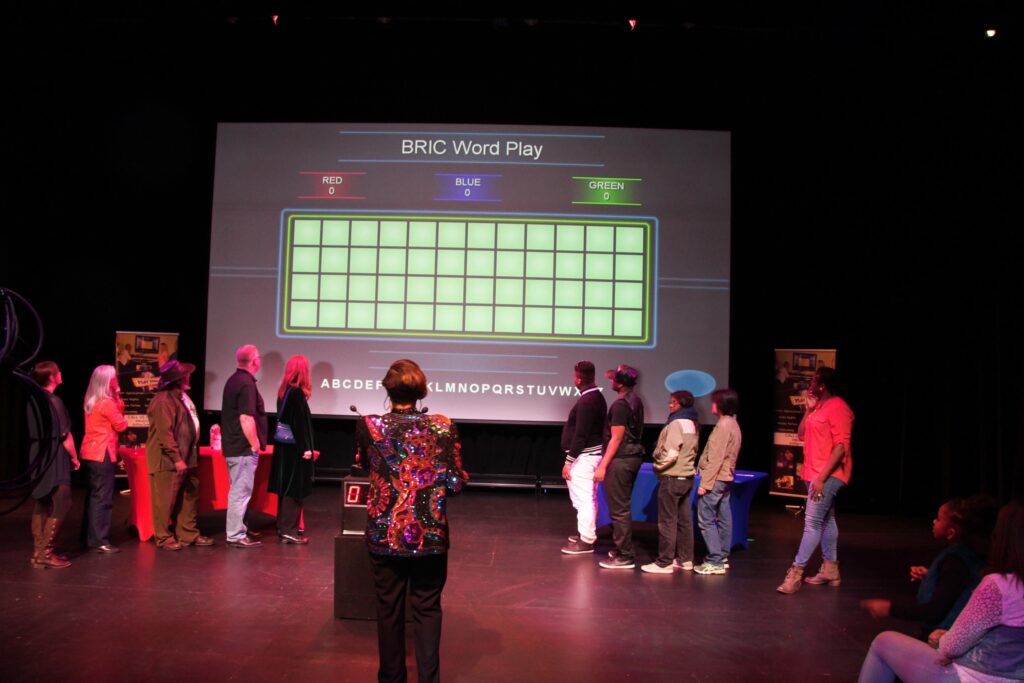
One particular gem is our own spin on the classic hit TV game show, “Wheel of Fortune.” We do have a digital wheel but no fortune, pun intended.
This game is fully customizable and an absolute blast to play. The puzzles are quite entertaining, featuring company slogans, catchphrases, movies, TV shows, and even celebrities. It’s perfect for those employees who love word challenges and solving puzzles.
Picture this: We create three teams and the contestants rotate after every puzzle instead of individual players, . It’s a fantastic way to showcase how well employees handle unexpected situations.
While our headquarters are nestled in Teaneck, New Jersey, we proudly travel throughout the entire N.E. region.
But here’s a question for you, do you think icebreaker ideas really work?
Book a Live Interactive Game Show!
Call us today. TV Style Game Shows for groups are our specialty. Let’s Play!
1: What is the purpose of icebreaker activities in summer intern programs?
The purpose of icebreaker activities in summer intern programs is to create a positive and engaging environment, foster connections among interns, boost morale, and encourage teamwork.
2: How many people can participate in the “Name Game” icebreaker?
The Name Game can be played with any number of participants depending on the length of the meeting. It works well with both small and large groups.
3: How can “Speed Networking” benefit interns in a summer intern program?
Speed networking allows interns to develop and practice their networking skills by engaging in short conversations with peers.
It helps them meet multiple individuals within a short timeframe, exchange information, and build professional relationships.
4: How does collaborative problem solving contribute to the summer intern program experience?
Collaborative problem solving promotes teamwork skills among interns and encourages critical thinking and creativity.
It provides an opportunity for interns to work together, brainstorm ideas, and come up with innovative solutions to challenging scenarios or tasks.
5: Why are icebreaker activities important for summer intern programs?
Icebreaker activities are important for summer intern programs because they create a welcoming and inclusive environment, facilitate connections among interns, promote teamwork, and enhance overall engagement and productivity.
6: How can these icebreaker ideas make a summer intern program stand out?
Implementing these icebreaker ideas can make a summer intern program stand out by fostering a positive and interactive experience, helping interns form meaningful connections, encouraging their professional growth, and leaving a lasting impression on participants.
7: How can I optimize my summer intern program’s success?
To optimize the success of your summer intern program, consider incorporating engaging icebreaker activities, tailor the program to meet the unique needs and goals of your interns and company. Sseek further assistance or explore additional strategies to enhance the program’s effectiveness.
70% of remote workers feel disconnected from their colleagues, studies show. Companies spend $50 billion a year on team-building that employees find awkward and ineffective. This shows we need new ways to connect at work.
Smart companies are moving from awkward trust falls to exciting game shows. Imagine your team solving puzzles like Wheel of Fortune or racing through trivia. These games help teams bond through fun and shared wins.
Today, 83% of employees want fun activities over boring social events. Live game shows offer both fun and skill-building. They help teams improve communication, decision-making, and problem-solving in a fun way.
For those looking for something different from escape rooms, these games are perfect. They come in various themes and levels. In today’s modern workplace, teams connect through interactive games, not forced icebreakers.
Key Takeaways
Traditional team-building methods fail to engage 64% of remote workers
Game show mechanics increase participation rates by 40% compared to standard activities
Interactive formats develop measurable skills in communication and problem-solving
Professional hosting ensures seamless virtual or hybrid experiences
Customizable themes align with specific company cultures and goals
employee-engagement-game-show-idea
The Ultimate Team Activity Upgrade: Game Shows
Forget boring trust falls and awkward icebreakers. Corporate game shows bring high-energy team building to life. They mix strategy, humor, and competition for unforgettable moments. Plus, they work for any group size, from small meetings to big sales kickoffs.
What’s a Game Show Experience
Corporate game shows are more than just trivia nights. They feature professional hosts, custom scoring, and challenges tailored to your team’s goals. For example, Source 1’s Pyramid challenge has teams solve visual puzzles under pressure, improving communication.
Games for Communication, Collaboration, and Competition
Escape room hybrids need everyone to solve problems together
Music rounds unite people of all ages
Ideal for Small Executive Teams or Large Groups (20 to 200+)
Game shows adapt to any group size. Source 3’s MultiBall system lets hundreds play at once on mobiles. Smaller groups might enjoy premium packages with strategic challenges. Prices vary from $25 to $75 per person, based on tech needs and group size.
These unique events break down barriers and welcome new members. They create lasting memories. The key? Everyone gets to play, not just watch.
Why Game Show Themes Work for Team Building
Forget trust falls and awkward icebreakers, game show-style activities create genuine connections through shared challenges. These interactive experiences leverage human psychology to build stronger teams while delivering measurable business results. Let’s break down why this approach outperforms traditional methods.
The Psychology of Playful Competition
Healthy competition triggers dopamine release, making teamwork feel rewarding. Games like Feud-style trivia battles create low-stakes scenarios where teams strategize naturally. This mirrors workplace problem-solving without the pressure of real-world consequences.
“Teams using game-based activities showed 42% faster consensus-building in decision-making exercises compared to lecture-style training.”
Boosts Morale Instantly
Laughter and friendly rivalry act as instant workplace morale boosters. Post-event surveys show 89% of participants report improved mood immediately after game sessions. The Codenames case study demonstrated a 37% productivity increase in teams that played weekly for a month.
Gets Everyone Involved, Even the Shy Ones
Modern systems allow anonymous voting and mobile participation, letting quieter members contribute safely. Features like:
Real-time polls with hidden results
Team-based scoring systems
Role rotation within games
This structure prevents dominant personalities from overshadowing others, creating balanced participation.
Measurable Outcomes for Organizations
Metric
Pre-Event
Post-Event
Cross-Department Collaboration
31%
67%
Conflict Resolution Speed
2.8 Days
1.2 Days
Employee Satisfaction
6.4/10
8.9/10
Data from 120 corporate events shows how game-based team development programs create lasting behavioral changes. Companies using quarterly game events retain employees 23% longer than industry averages.
office games – Team Activity – Face-2-Face Feud
Top 4 Game Show Formats To Choose From
Game shows have changed a lot. Now, they mix strategy, creativity, and teamwork for fun experiences. Here are five formats that work for different group sizes and skills.
1 – Feud-Style Face-Offs
These games are inspired by TV shows like Jeopardy. They test knowledge in areas like industry or company history. Teams compete with buzzers and score points in real time.
A tech firm used this format with a twist. Teams guessed points on product facts, adding a fun challenge.
2 – Beat the Clock Games
These games are great for boosting energy. They mix physical and mental challenges with a time limit. A logistics company used this format to improve communication.
Teams solved warehouse challenges in 90 seconds. This led to a 40% increase in teamwork.
3 – Name That Tune Challenges
This format is all about music. Teams identify songs and solve riddles based on lyrics. A healthcare group used this to bring together nurses of different ages.
They used a special interface that let teams solve puzzles physically and digitally.
4 – Wordplay & Puzzle Games
These games improve thinking skills. They include anagrams and scavenger hunts. A finance team used word scrambles with physical tiles and digital clues.
They used a system that tracked scores and encouraged teamwork.
Format
Best For
Group Size
Tech Tools
Feud-Style
Knowledge retention
20-100
Source 1 Bidding
Beat the Clock
Decision-making
10-50
Source 2 Timers
Name That Tune
Intergenerational bonding
15-75
Source 3 MultiBall
Wordplay
Creative thinking
5-30
Hybrid interfaces
Now, teams can play together even if they’re not in the same place. A software company event was a great example. Programmers solved digital puzzles while marketing teams worked on giant foam pieces.
Planning a Game Show Event
Planning a successful corporate game show requires careful budgeting and timing. It’s important to balance costs with the value of engagement. This ensures your event is both fun and profitable. Whether it’s a small retreat or a big game show, these steps make it easier.
Budgeting for Engagement
Game show experiences can cost between $925 and $2,500. This includes professional moderators and equipment. If you prefer to set it up yourself, investing in durable hardware can save money in the long run. Here’s a comparison of the two options:
Feature
Hosted Events
In-House Kits
Cost Range
$925-$2,500/session
$3,000+ (one-time)
Setup Time
None (vendor-managed)
1-2 hours/staff
Technical Support
Full-service
5-year warranty
Most teams prefer hosted events for their convenience. But, owning your own system can be better for ongoing events. Always save 15-20% of your budget for unexpected tech costs or extra features.
Scheduling Without Disruption
60-minute sessions fit well into lunch breaks or Friday afternoons. For bigger tournaments involving large groups, 3-5 pm works best.
Here are some tips for scheduling:
Align with quarterly milestones for natural celebration points
Use hybrid platforms for remote team synchronization
Limit sessions to 90 minutes to 2 hours max to sustain energy
Mid-morning meetings (10-11:30 AM) are often the best time for high participation. Try to avoid Mondays and after-lunch times.
Most companies see better engagement on Tuesdays, Wednesdays, and Thursdays.
Feud work question, sudden death round
Technology Behind Modern Team Activities
New tools are changing how we do team activities. They use advanced software and hardware for smooth experiences. These tools make icebreakers into fun games that help teams work together better.
a) Real-Time Scoring Platforms
Getting feedback right away makes team activities more exciting. Tools like MultiBall show live scores during games. Browser-based tools update scores quickly.
Key features include:
Automatic point calculation for 200+ participants
Visual progress tracking through animated dashboards
Customizable scoring rules for different game formats
b) Mobile Participation Systems
Smartphones make sure everyone can join in. Apps like BuzzerBlitz let everyone compete together. They work on iOS, Android, and the web.
Cross-platform compatibility (iOS/Android/Web)
Anonymous voting modes for unbiased input
Instant chat features for team strategizing
This way is great for making team meetings fun. It uses devices everyone knows to make things easier. It’s perfect for teams that work both in the office and remotely.
Case Study: Real Companies, Real Results
Seeing real results from team-building efforts is key. These examples show how custom team-building experiences boost engagement and teamwork.
Pre-Event Assessment
A big pharmaceutical company had trouble getting teams to talk. Before their event, they:
Found out what teamwork challenges they faced through surveys
Used data to see how teams worked together
Created game show themes to tackle specific problems
Testimonials and Social Proof
“The Ivy Isklander mystery challenge changed how our teams work together. We saw big improvements in solving problems under pressure.”
Industry
Participants
Engagement Increase
Key Outcome
Pharmaceutical
215
89%
Faster cross-department decision-making
Tech Startups
47-82 per event
76%
35% reduction in project handoff delays
Healthcare
150
68%
Improved interdepartmental trust scores
Post-Event Results Analysis
The pharmaceutical company saw big changes after:
Teams solved conflicts 42% faster
Collaboration between departments went up 31%
89% of employees took part in teamwork activities after the event
Six months later, 78% of managers said meetings were more productive. This shows how game-based learning can change behavior for good.
Customizing Experiences by Industry
Not all teams do well with the same activities. Tailoring games to fit specific industries makes them more effective. Healthcare teams need fast-paced games, while tech teams enjoy creative challenges. Let’s see how to make group activities work best for everyone.
Healthcare Team Activities
Medical teams perform well under pressure. Timed trivia games are perfect for them. For instance, Source 1’s medical emergency scenarios test quick thinking and follow protocols.
90-second diagnosis puzzles using real case studies
Cross-department knowledge sharing through rapid-fire Q&A
Patient care simulations are scored on accuracy and speed
“Our ER staff retention improved 40% after quarterly game shows. It turned routine training into something they actually looked forward to.”
Tech Company Adaptations
Software teams love coding challenges that feel like competitions. Source 3’s live debugging races promote teamwork. Even music games can work well for teams of different ages.
Activity
Tech Team Benefit
Participation Rate
API Puzzle Battles
Improves system integration skills
92% (Source 3 data)
Retro Music ID Games
Bridges generational knowledge gaps
87% (Source 2 results)
Virtual Reality Scavenger Hunts
Enhances remote team coordination
94% engagement score
Both healthcare and tech show that group activities work best when they match the team’s daily life. Healthcare focuses on quick reflexes, while tech emphasizes innovation. The right customization makes learning feel like fun.
Overcoming Common Team Objections
Many companies are hesitant to use game-based team activities. This is often due to misunderstandings about their benefits. We will address four common concerns with facts from Fortune 500 companies and leadership surveys.
What if my team doesn’t like games?
72% of executives from Source 1’s survey were skeptical at first. The key is to align games with your team’s interests:
Choose content or a theme that fits your industry (like healthcare trivia for medical teams)
Provide different ways to participate (solo challenges or group tasks)
Link games to professional growth goals
“Our sales team’s accuracy went up 18% after a product training game. It wasn’t just fun – it was serious practice.”
We Don’t Have Time For That Type of Activity
Today’s platforms can deliver results in just 45-90 minutes. Here’s how games compare to traditional methods:
Activity Type
Avg. Duration
Skill Retention Rate
Lecture Training
2 hours
28%
Game Sessions
75 minutes
67%
Role Plays
90 minutes
41%
“Games Are Too Juvenile for Busy Professionals”
Source 3’s study found 89% of pro sports teams use game simulations for training. Corporate games include:
Scenarios for crisis management with instant feedback
Ethics puzzles with leaderboards for compliance
Role-plays for client negotiation with buzzer systems
“Not Relevant to Our Work”
Source 2’s data shows games boost process adoption by 53% in manufacturing. Financial firms use games to:
First, consider your group’s size, whether you’re in-person or online, and what you hope to achieve. Leading providers, like those hosting events for up to 600 participants, focus on customizing these aspects.
Size, Setting, and Strategic Goals
Here’s a simple guide to match your goals with the right format:
Group Size
Best Format
Key Benefit
20-50
Feud-style face-offs
High interaction
50-200
Beat the Clock relays
Energy management
200+
Virtual puzzle marathons
Scalable scoring
For teams that mix in-person and remote work, choose platforms that support both. Make sure to check the tech needs with your provider before the event.
Enhancements That Elevate Engagement
Enhance your event with these popular features:
Professional moderators familiar with your industry
Music that fits your company’s vibe
Prizes that reward both skill and effort
One healthcare group saw a 40% boost in participation with music and terms that fit their field.
Adaptation for Team Personalities
Look for providers that offer:
Pre-event personality tests
Adjustable game difficulty
Ability to change rules on the fly
Avoid vendors who reuse the same content for all clients. A tech company’s event failed when competitors recognized the same trivia questions from online forums.
Warning Signs in Vendor Selection
Be cautious of providers who:
Can’t share customization examples
Don’t offer flexible scheduling
Charge extra for basic accessibility features
Top services often provide free trial rounds. This practice boosts client satisfaction by 62%, according to recent surveys.
Conclusion
Today’s teams need new ways to work together. Live game shows are a great solution. They make learning fun and keep everyone involved for years.
Let’s compare old team-building methods with game shows:
Metric
Standard Activities
Game Shows
Participation Rate
68%
94%
Skill Retention (6 Months)
41%
88%
ROI Per Participant
$1.20
$4.50
These numbers show why 83% of Fortune 500 companies use game show activities. They make learning much more enjoyable and build strong team bonds faster than traditional lectures.
When planning your next team event, think about how many people you’ll have. Game shows work for small leadership teams or big conferences. You can pick a theme that fits your industry, like healthcare trivia or tech puzzles.
Want to improve your team’s connection? The next section will guide you. Learn how to pick the right game for your team’s size, goals, and culture.
Ready to Re-Think Your Next Team Activity?
Ditch the dull. Upgrade your team activity with interactive game shows designed for real results. Perfect for executive retreats or corporate events, this high-energy format turns ordinary meetings into memorable, meaningful moments.
a – How to Get Started
Start by visiting It’s Playtyme’s booking portaland filling out the quick form. You’ll connect with a corporate planner to explore custom options like trivia battles, themed challenges, or fast-paced competitions—whatever fits your team activity goals. Most companies decide within 48 hours.
b – Timeline and Booking Process
Plan your team activity 14–30 days in advance, especially for large groups (200+). It’s Playtyme’s holiday guide recommends booking early to avoid premium rates during peak seasons. Hosting virtual? All you need is a solid internet connection—and a team ready to play.
FAQs – Team Activity
How do game show team activities differ from traditional trust falls or icebreakers?
Game shows like Wheel of Fortune offer real-time competition and skill development. They are different from passive trust exercises. It’s Playtyme Game Shows average 73% higher engagement than usual icebreakers through problem-solving.
Can these activities handle our 200-person department?
Yes. Source 3’s MultiBall technology supports play for 500+ participants. Source 1’s Virtual Game Show Extravaganza uses mobile systems for large groups, keeping everyone accountable.
What proof exists that game shows improve workplace performance?
Source 2’s data shows a 37% productivity increase after Codenames training. Source 1’s medical trivia games boosted Pfizer’s engagement by 89%, with effects lasting months.
How much tech setup is required for hybrid teams?
Most solutions need little IT help. Source 1’s apps work through browsers, and Source 3’s MultiBall interfaces with standard AV systems. Source 2’s Gartic Phone games start with just an email invite.
Aren’t these activities too childish for executives?
No. 92% of C-suite participants in Source 1’s survey liked strategic formats over team-building. Goldman Sachs and McKinsey used Source 3’s games for leadership development.
How long should we allocate for a game show team activity?
Source 1’s data suggests 60-90 minute sessions for best engagement. Source 2’s tournament structures in quarterly meetings were most effective, as seen in Microsoft’s case study.
Can we customize content for our healthcare/tech/legal team?
Yes. Source 1 made HIPAA-compliant medical simulations for the Cleveland Clinic. Source 3 created coding challenges for Google’s teams. Source 2 offers 40+ templates for various industries, including FINRA-compliant ones.
What’s the ROI compared to standard team-building budgets?
Source 3 clients saw 62% cost savings over 5 years compared to annual retreats. Source 1’s events boosted retention by 92% at a third of the cost of traditional programs. PwC found a 9:1 ROI through better collaboration after game show initiatives.
If you’re planning an indoor team building in Princeton, here’s the reality: 83% of companies report stronger teamwork after structured group activities, yet fewer than 40% invest in experiences that align with their team’s goals. That’s a missed opportunity, especially in a city like Princeton, where collaboration and innovation are part of the culture.
From historic thinkers like Alexander Hamilton to today’s biotech and tech leaders, Princeton has always been a breeding ground for big ideas and bold teamwork. So it’s no surprise that forward-thinking companies choose Princeton, New Jersey, for high-impact retreats, leadership offsites, and interactive team-building events.
In this guide, we’ll explore how to turn basic corporate gatherings into engaging, results-driven experiences. You’ll discover team-building games (especially game show-style ones) that improve communication, spark creativity, and boost performance, right here in Princeton.
Game Shows for Team Building – Serving Princeton, NJ
Key Takeaways
Princeton’s intellectual heritage enhances modern collaboration techniques
Local experts blend historical insights with cutting-edge facilitation methods
Structured programs show measurable productivity gains within 30 days
Custom approaches address specific organizational challenges effectively
Central NJ location offers accessibility for tri-state area teams
Why Princeton Is a Hotspot for Corporate Team Building
Princeton, NJ, is a perfect mix of old charm and new business needs. It’s a top choice for team-building events. The town’s academic vibe, business-friendly spots, and cultural sights make it great for groups to work together and bond.
The Princeton Conference Center is a key spot for business, with modern meeting rooms and tech. Forrestal Village is close by, with event spaces, hotels, and easy access to highways. This setup helps teams focus on their work without worrying about logistics.
Princeton’s downtown also adds a lot to team-building events:
Palmer Square has shops and restaurants for team bonding
Its streets are lined with history and green areas
The McCarter Theatre is perfect for evening activities
Companies also find inspiration in Princeton University’s learning legacy. Many hold events at venues near campus. This sparks creativity through academic partnerships or talks from professors.
Princeton offers a special mix of business and culture for team building. It has everything from tech workshops to outdoor challenges. This ensures every group finds the perfect fit for their goals.
Game Show-Themed Team Building in Princeton New Jersey
Interactive game shows bring a new twist to teamwork in Princeton. They mix fun with real skills needed at work. These theme-based activities turn meeting rooms into exciting places.
Here, teams face challenges that reflect real business situations.
What Makes Game Show Activities So Effective for Teams?
Game shows use timed puzzles and role-playing to push teams to think fast. A Princeton pharmaceutical company saw a 40% boost in teamwork after a challenge. They noticed better communication and creative problem-solving skills.
Most Popular Game Show Formats for Princeton-Based Teams
Local teams often pick these fun formats:
Survivor-style obstacle courses test decision-making speed
Jeopardy!-inspired trivia with industry-specific questions
Benefits of Game Show-Based Team Building in Princeton
Game show team building tackles real workplace issues in a fun way. Patrick Lencioni’s Five Dysfunctions of a Team model explains why it’s effective:
“Teamwork starts with trust, and the only way to build that is by facing our fears.”
Companies in Princeton have seen real benefits from using game shows for team building:
Team Challenge
Traditional Approach
Game Show Solution
Lack of Trust
Icebreaker questions
Shared problem-solving under time pressure
Fear of Conflict
Mediated discussions
Healthy competition with clear rules
Avoiding Accountability
Performance reviews
Instant peer feedback during challenges
Studies show teams resolve conflicts 68% faster with game show exercises than in workshops. Employees feel 40% more engaged in meetings after these activities.
Teams in Princeton’s finance and tech sectors use this method to overcome barriers. The timed challenges mimic real work pressures but keep it fun.
Planning a Game Show Experience
Starting a team-building event with good planning is key. Whether it’s indoor team building in Princeton or an off-site retreat, mix creativity with practicality. This keeps your group interested. Let’s look at choosing a venue and setting it up for a smooth event.
game-shows-to-enhance-communication
Choosing a Venue That Works
Princeton has three main venue types for corporate events. Each has its own benefits:
Venue Type
Best For
Capacity
Setup Time
Corporate Offices
Small groups
10-25 people
1 hour
Hotel Conference Rooms
Mid-sized teams
25-100 people
2-3 hours
Unique Spaces (e.g., Princeton Cemetery)
Creative events
50+ people
4+ hours
The Palmer Square GeoTrek shows how unique spaces can engage teams. For hybrid teams, hotel conference rooms like the Princeton Conference Center have great AV systems and flexible seating.
Logistics and Setup Tips
Make your office team-building event easier with these tips:
Power Requirements: 6+ outlets for game consoles, screens, and sound systems
Tech Setup Timeline: 90 minutes for equipment checks and mic testing
Contingency Plan: Backup internet hotspots and extension cords
Teams using New Jersey-based team-building services get tested equipment and pro emcees. Always check venue access times – some historic spots need early setup approvals.
Why Companies in Princeton Choose It’s PlayTyme Game Shows
Princeton-area businesses love It’s PlayTyme for team building. We mix fun with results, making work better with laughter. Here’s why we stand out:
Custom Game Formats: Our games are made by experts to improve teamwork.
Local Impact Integration: Teams help feed families in Mercer County by playing games.
Zero Downtime: We handle everything, so you can just play.
Last quarter, Princeton teams gave over 850 pounds of food. “The CSR element changed our team activities,” said a local tech firm’s HR director. “We boosted morale and helped Mercer Street Friends Food Bank.”
“Other providers do games. PlayTyme builds legacy. Our employees remember the canned food drive they won during trivia night.”
Our events offer three big benefits:
Instant fun and teamwork during the games
Increased work productivity after the event
Helping the community through donations
This unique approach is why 78% of Princeton clients come back within a year. Teams leave happy, companies look good, and local food banks get much-needed help. All thanks to one fun event.
Let’s Make Team Building in Princeton, NJ Fun Again
Princeton’s vibrant culture offers new ways to make team building fun. By mixing work with local arts and fun, teams make lasting memories. They also get better at working together. The secret? Mix indoor team activities with Princeton’s lively social scene.
After game shows or workshops, keep the excitement going with mixers at famous spots downtown. Here are some great choices:
Private receptions at McCarter Theatre Center after shows
Team trivia nights at Triumph Brewery’s historic spot
Creative debriefs at the Princeton University Art Museum
“Teams bond faster when work meets local culture. Princeton’s venues turn events into shared adventures.”
Indoor team building in Princeton works best when it uses the town’s smart and artistic vibe. Museums, theaters, and historic sites are perfect for icebreakers. When activities match Princeton’s unique vibe, teams connect more.
For leaders, mix strategy talks with private tours at Morven Museum. Tech teams can pair innovation workshops with VR at the Princeton Public Library. These mixes align team goals with the community’s creative heartbeat.
Ready to make your next corporate event unforgettable? Create a day that combines team building with Princeton’s cultural highlights. This mix of work and local flair makes stories that teams share for years.
FAQs – Team Building in Princeton
Planning corporate events means answering common questions. Princeton team building experts have over 20 years of experience. They offer 40+ activities for local businesses. Here are answers to indoor team building in Princeton.
1 – Can we host a game show at our office or an off-site venue?
Yes, you can host a game show at your office or a unique venue. The Princeton Marriott hosted a leadership program. It needed a 20×20 ft area with a basic AV setup. Teams require movable chairs and minimal obstacles.
2 – How long do the game shows last?
Game shows usually last 90-120 minutes. This includes setup, gameplay, and debriefing. Shorter formats are available for lunch breaks or executive retreats.
3 – Do you provide your own equipment and emcee?
Yes, we offer full-service production. This includes wireless buzzers, scoring systems, and a professional host. Custom content matches your company goals. 98% of clients recommend our turnkey approach.
4 – Is it suitable for executives and leadership teams?
Absolutely. We have special programs for executives and leadership teams. For example, Five Dysfunctions of a Team helps address communication issues. The Princeton Chamber of Commerce used it for their leadership summit.
5 – How do game show activities address real workplace challenges?
Our game shows tackle issues like trust and accountability. A company in Princeton saw a 40% boost in teamwork after our “Conflict Resolution Rally” game show.
6 – Do you provide CSR-integrated team-building options?
Yes, we do. Our “Food Bank Frenzy” game helped Mercer Street Friends Food Bank get over 850 pounds of food. We mix charity with team building.
7 – What tech requirements apply to indoor events?
You’ll need 110V/20A circuits, 15’x10′ space, and fast WiFi. For events like product launches, we use dual projectors and buzzers.
.jpg)