One of the best forms of holiday party entertainment in Hackensack NJ is the kind your whole team joins in, not the kind they sit and watch. A live, hosted game show turns a year-end dinner into a party where everyone plays, and It’s PlayTyme Game Shows brings the entire production to your restaurant, venue, or office.
If you’re the one planning this year’s party, you already know the usual script: people show up, eat, sit with the same coworkers they see every day, listen to a toast, and head home early. It’s fine. Nobody remembers it. Your team worked hard all year, and the party should feel like a celebration of that, not another obligation on the calendar.
Dinner feeds people. It doesn’t connect them. At most holiday parties, the room breaks into the same small groups that already exist at work: the front office at one table, the managers at another, and the new hires wondering where to sit.
Passive entertainment doesn’t fix that. A DJ plays to whoever feels like dancing. A band is background noise. A speaker is one more presentation in a year full of them.
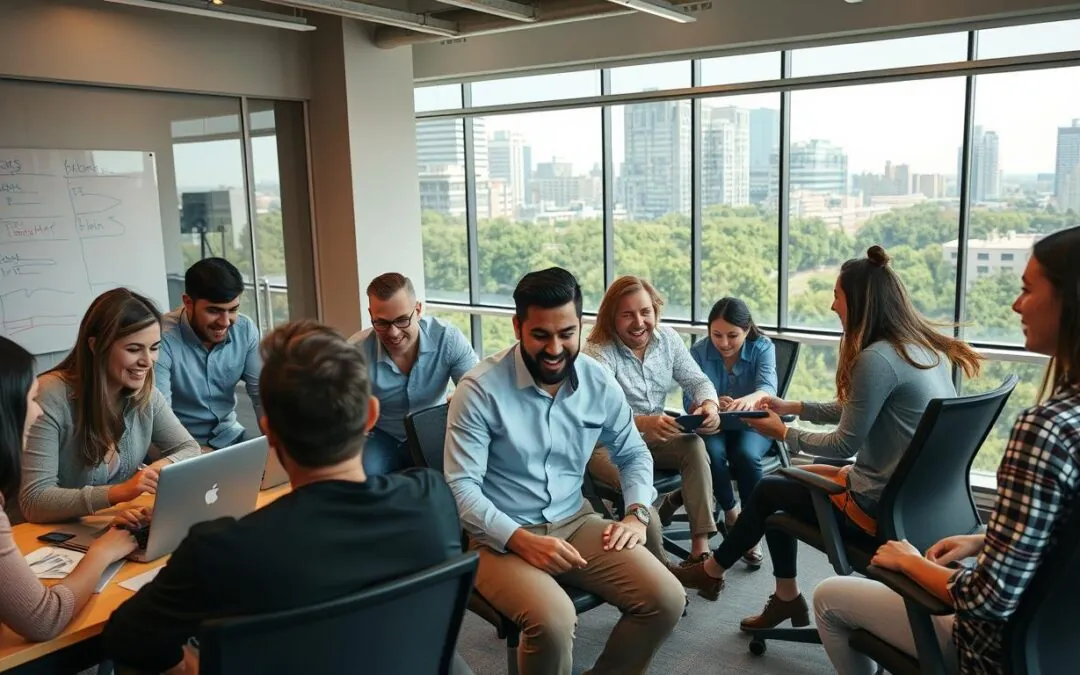
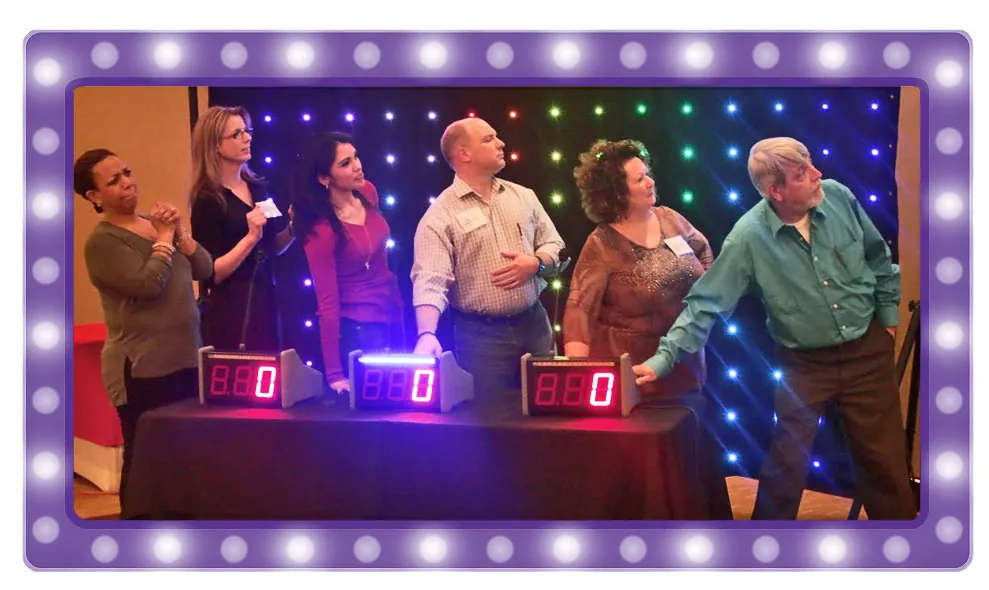
A hosted game show changes the room. Guests are mixed into teams, a professional host drives the energy, and within ten minutes people who barely know each other are cheering, strategizing, and arguing over survey answers. Everyone plays, not just a vocal few.
A Holiday Celebration, Not Another Work Exercise
Nobody wants a trust exercise at the holiday party. Your team wants to relax, celebrate, and have a good time with the people they spent the year with.
That’s why a holiday game show works when a typical team builder doesn’t. It doesn’t feel like work. There are no worksheets, no debriefs, and no one gets put on the spot. It’s a celebration with a scoreboard. The connection happens on its own, because people open up in play faster than they ever will in a meeting.
And the end of the year is the perfect time for it. The game can look back on the year your team just had: the wins, the busy seasons, and the moments everyone remembers.
Inside a Hackensack Holiday Game Show at Maggiano’s
Medical teams in the area have booked us for their end-of-year celebrations at Maggiano’s in Hackensack. They wanted more than dinner and a toast: an activity that brought the whole staff together to celebrate the year.
For one of those parties, a private practice of about 50 people, we coordinated the production logistics with the venue ahead of time. Maggiano’s had the banquet room set when we arrived, and our crew transformed one area of it into a game show set. By the time our client walked in, the show was ready to go. Guests never had to leave their seats: they played on our PlayPads right from their dinner tables.
One of the rounds was Office Shenanigans, a majority-rules game where the staff answers poll questions about how they feel about their daily work environment, and then the room sees what the majority said. The laughs were nonstop, because everyone recognized the answers.
Near the end of the round, one of the leaders leaned over to a colleague and asked, “Do you think they were trying to tell us something?”
That’s what a year-end game show can do that dinner can’t. The staff got a night to celebrate, and leadership got an honest look at how their team experienced the year, without a single survey or speech.
The biggest question planners ask us is simple: will everyone play, or will the same five people run the show while the rest of the room watches? Here’s how we keep every guest in the game.
Guests play from their tables. Every guest answers on a PlayPad, so nobody has to leave their seat, line up, or walk to a stage to take part.
Everyone is on a team. Team-based formats mean there are no spectators. Every table is competing, so every guest has a reason to pay attention.
Quieter guests are never put on the spot. They answer on their PlayPad along with everyone else, so they’re part of every round without being called up in front of the room.
The format fits your group size. The show works for about 20 guests up to 300+. Smaller groups can play Face-2-Face Feud head-to-head from the start.
Big groups get a finale. For groups over 50, everyone starts in PlayPad Mania, and the top players move up to a live Face-2-Face Feud finale. The whole room plays first, then cheers on their champions.
Which Holiday Game-Show Format Fits Your Group?
For holiday party entertainment that gets every table playing, these are the four formats we recommend most:
PlayPad Mania puts a device in every guest’s hands, so the whole room answers every round, even the people who never raise their hand.
Face-2-Face Feud is our survey-style buzzer showdown. It’s loud, competitive, and a holiday favorite.
Game Show Mania Trivia is fast-paced team trivia for crowds that love to show what they know. It’s easy to jump into, fun to cheer for, and a great fit for mixed groups where not everyone knows each other yet.
Holiday Game Show Mix combines seasonal rounds and fan-favorite games into one festive show.
We can also build rounds around your company and your year, so the game feels like it was made for your team.
Is Your Hackensack Venue Game-Show Ready?
Most company holiday parties in Hackensack happen in a restaurant banquet room, a hotel function room, or the office itself. Before the big night, run through this checklist with your venue:
Confirm the load-in entrance. Ask the venue which entrance our crew should use to bring in equipment. At Maggiano’s in Hackensack, we load in right at the entrance.
Have the venue set the room first. Ask your venue to set tables and seating before we arrive. We then transform one area of the room into the game show set, so guests can play from their tables.
Give us 2 hours of room access. We set up before your guests arrive and bring our own sound, screens, and equipment.
Ask about insurance early. If the venue needs a certificate of insurance, send us their required wording, and we’ll turn it around in 1 to 2 business days.
Schedule the show after dinner, before dessert. Once plates are cleared, guests are relaxed and ready to play, and dessert becomes the celebration after the final round. A 60-minute show fits that window, and evening start times work for teams that can’t leave early.
How Much Does Holiday Party Entertainment Cost?
Live game shows start at $2,995. Published pricing is approximate: your event day, time, and the game show you choose can move the price up or down. To see the range for your group size, use the pricing slider. There’s no deposit required, and every show is backed by our 100% satisfaction guarantee.
The best dates for holiday party entertainment in Hackensack go fast. Book 6 to 8 weeks out if you can, because December Thursdays and Fridays go first. We can sometimes take bookings on shorter notice, depending on availability, but not same-day or next-day.
Planning your company’s holiday party in Hackensack? Send us your date, estimated attendance, venue or neighborhood, and preferred show length. We’ll tell you which game-show format fits the room and whether your date is available.
Frequently Asked Questions About Holiday Parties in Hackensack, NJ
What is the best holiday party entertainment in Hackensack NJ?
One of the best options gets your whole team playing instead of watching. A live hosted game show mixes guests into teams, works for groups of 20 to 300+, and comes to your restaurant, banquet room, or office. Guests can even play from their tables, so the party never has to stop for people to move around.
Can a game show fit inside a restaurant's private room?
Yes. We’ve run holiday parties at Maggiano’s in Hackensack, where the venue set the banquet room before we arrived and we transformed one area into a game show set. Guests played on PlayPads right from their tables. We need access to the room 2 hours before showtime and can provide a certificate of insurance in 1 to 2 business days once we have the venue’s required wording.
How far in advance should we book holiday party entertainment?
Book 6 to 8 weeks ahead if you can. December Thursdays and Fridays are the first dates to go, so companies that want a prime night should reserve early. Shorter notice is sometimes possible depending on availability, but we don’t take same-day or next-day bookings. There’s no deposit required, and your date is confirmed once the agreement is signed.
How much does holiday party entertainment cost in Hackensack?
Live game shows start at $2,995. Published pricing is approximate, and your event day, time, and the game show you choose can move the price up or down. Use the pricing slider on our website to see the range for your group size, or send us your date and headcount for a quote built around your party.
Will it feel like a team building exercise?
No. It’s a party. There are no worksheets, no debriefs, and no awkward exercises, and our host never singles anyone out. Guests play on teams, cheer each other on, and celebrate the year together. The connection still happens, because people open up in play, but it feels like a celebration with a scoreboard, not a work session.
How long is the show?
Most holiday parties book our 60-minute show, which runs after dinner and before dessert. That timing works because guests are relaxed and fed, and dessert becomes the celebration after the final round. A longer 90-minute show is also available for groups that want more rounds.
That someone is a team building facilitator. The role goes far beyond standing at the front of a room and reading trivia questions. A skilled facilitator wears five distinct hats across three phases of every event: before, during, and after. Organizations that treat facilitation as a nice-to-have end up with forgettable offsites and unchanged team dynamics. The ones that treat it as a core function get measurable improvements in communication, trust, and collaboration.
If your team building events feel flat, if participation drops off after the first 20 minutes, or if nothing changes once everyone goes back to their desks, the problem is almost never the activity itself. It is the absence of intentional facilitation. Understanding each team building facilitator role is the first step toward running events that produce lasting results.
The Fast Version
Only 20% of employees worldwide are engaged at work, according to Gallup.
75% of cross-functional teams are dysfunctional on at least three of five performance measures.
A skilled facilitator wears five distinct roles across three phases: before, during, and after.
Treating facilitation as a core function drives measurable gains in communication, trust, and collaboration.
Getting people into the same room without a facilitator leaves team dynamics unchanged.
What a Team Building Facilitator Actually Does
A team building facilitator is the person responsible for designing, directing, and measuring the impact of a group experience. This is not the same as an event coordinator who handles logistics, or a keynote speaker who delivers a presentation. A facilitator actively shapes group behavior in real time.
The role requires reading a room, adjusting the energy, drawing out quiet participants, and redirecting dominant ones. It demands preparation before the event, active management during the event, and structured follow-up after the event. Each of these phases involves a specific role that the facilitator fills. When all five roles work together, a team building event becomes a turning point rather than a checkbox.
The Five Team Building Facilitator Roles: A Complete Framework
Every successful team building event depends on five facilitator roles distributed across three phases. Here is how they break down:
Role
Phase
Primary Function
Key Outcome
Planner
Before
Set objectives, design format, tailor to group
Aligned expectations and structure
Guide
During
Direct flow, manage transitions, keep energy high
Smooth execution and full participation
Coach
During
Encourage growth, challenge comfort zones
Individual and team development
Conflict Mediator
During
Address tension, reframe disagreements
Psychological safety and trust
Evaluator
After
Measure outcomes, gather feedback, report results
Accountability and continuous improvement
Each role builds on the others. Skip the planning phase and the guide has no roadmap. Skip evaluation and the organization has no way to justify the investment or improve the next event.
Before the Event: The Planner Role
The planner role starts weeks before anyone walks into the room. This is where the facilitator interviews stakeholders, identifies team dynamics, and defines measurable objectives. A planner asks: What is this team struggling with? Is it communication breakdowns between departments? Low morale after a restructuring? A new team that has never worked together in person?
Based on those answers, the planner selects the right format. A team dealing with trust issues needs a different structure than a team celebrating a strong quarter. The planner also handles practical considerations:
Group size and how to divide into sub-teams
Physical space requirements and room layout
Time allocation for each segment
Accommodations for different personality types (introverts, remote employees, new hires)
Materials, technology, and backup plans
At It’s PlayTyme Game Shows, the planning phase includes a detailed consultation where facilitators learn about the group’s goals, culture, and dynamics before recommending a specific game show format. This preparation is what separates a generic icebreaker from a targeted team building experience.
During the Event: The Guide Role
Once the event begins, the facilitator shifts into the guide role. The guide controls the pace, manages transitions between activities, and keeps the group focused on the objective. This role is part traffic director, part storyteller.
A strong guide does three things simultaneously. First, they maintain energy levels throughout the session. Energy naturally dips after 30 to 45 minutes, so the guide introduces variety and movement at the right moments. Second, they give clear instructions that every participant understands, regardless of their familiarity with the activity. Third, they create a sense of narrative arc so the event feels purposeful from start to finish, not like a random collection of games.
The guide role is especially visible in game show formats, where the facilitator serves as the host: introducing rounds, explaining rules, building suspense, and keeping score. It’s PlayTyme’s professional hosts are trained to adapt their pacing and energy to each audience, whether it’s a group of 15 executives or 200 sales representatives at a national conference.
During the Event: The Coach Role
While the guide keeps the event running, the coach works on a deeper level. The coach watches for opportunities to push individuals and teams just past their comfort zones. This role focuses on growth, not just entertainment.
A coaching facilitator notices when a naturally quiet team member starts contributing and reinforces that behavior. They spot when a dominant personality is shutting down input from others and redirect without embarrassing anyone. They design moments where teams must rely on each other’s strengths: one round that rewards quick thinking, another that rewards careful strategy, a third that rewards creativity.
The coach role is what separates a team building event from a company party. Parties are fun. Team building with coaching produces observable shifts in how people interact after they return to the office. The best facilitators embed coaching moments into competitive formats so participants experience growth without feeling like they are in a training session.
During the Event: The Conflict Mediator Role
Competition brings out strong emotions. Disagreements surface. Old tensions between departments or personalities bubble up under pressure. The conflict mediator role is the facilitator’s ability to handle these moments constructively.
Effective mediation during a team building event looks subtle. The facilitator restructures teams mid-event to break up a negative dynamic. They reframe a heated exchange as healthy competitive spirit. They use humor to defuse tension without dismissing the underlying issue. In rare cases, they pull a participant aside for a quick one-on-one reset.
This role requires experience and emotional intelligence that no activity guide or instruction manual provides. A facilitator who has run hundreds of events recognizes the early signals of group conflict: crossed arms, side conversations, eye rolls during instructions, or one sub-team disengaging entirely. Catching these signals early and responding with skill is what keeps an event productive instead of letting it spiral.
After the Event: The Evaluator Role
The fifth and most overlooked team building facilitator role is the evaluator. Once the event ends, the evaluator gathers data on what worked, what fell flat, and what changed. This phase turns a single event into part of a larger strategy.
Evaluation takes several forms:
Immediate feedback: short surveys or verbal check-ins right after the event
Behavioral observation: notes on team dynamics, participation levels, and breakthrough moments
Follow-up reporting: a summary delivered to the organizer with recommendations for next steps
Long-term tracking: connecting the event to changes in engagement scores, retention, or collaboration metrics over the following weeks
Without evaluation, organizations repeat the same mistakes. They book the same generic activity year after year because no one measured whether it worked. The evaluator role closes the loop and gives leadership the information they need to invest wisely in future team development.
The Awkward Hour Problem Teams Face Without Facilitation
When organizations try to run team building without a professional facilitator, predictable problems emerge. Recognizing these patterns helps explain why the investment in skilled facilitation pays for itself.
The “Awkward Hour” Problem
Without a confident guide at the front of the room, events start slowly and never build momentum. Participants check their phones, side conversations take over, and the organizer spends more time managing logistics than engaging the group.
One Voice Dominates
In unfacilitated group activities, the loudest person in the room controls the outcome. Quieter team members disengage, and the event reinforces existing power dynamics instead of breaking them down. A facilitator in the coach and mediator roles actively balances participation.
No Connection to Real Work
DIY team building often defaults to generic activities pulled from a quick internet search. These activities have no connection to the team’s actual challenges. Without the planner role, objectives are vague or nonexistent, and participants leave wondering what the point was.
Zero Follow-Through
The most common failure: the event ends and nothing happens next. No debrief, no feedback, no action items. Without the evaluator role, the experience evaporates within a week, and the organization has no data to show for its investment.
Conflict Goes Unmanaged
Competitive activities surface real tensions. Without a mediator, those tensions either go unaddressed (building resentment) or escalate publicly (creating an uncomfortable scene). Both outcomes damage trust rather than build it.
Why It’s PlayTyme Game Shows Fills All Five Roles
It’s PlayTyme Game Shows brings trained facilitators who operate across all five roles for every corporate event. Before the event, their team conducts a planning consultation to understand objectives, group dynamics, and logistical requirements. During the event, their professional hosts serve as guide, coach, and mediator simultaneously, managing energy, encouraging full participation, and handling competitive tensions with experience earned across thousands of events.
Their game show formats (including Face-2-Face Feud, trivia challenges, and customized rounds) are specifically designed to give the facilitator natural coaching moments. Rounds rotate the skills being tested so every personality type gets a chance to contribute. The competitive structure creates the pressure that surfaces real team dynamics, while the facilitator’s skill keeps that pressure productive.
After the event, organizers receive feedback on how the group performed, which activities generated the strongest engagement, and what to consider for future events. This evaluation component is what makes It’s PlayTyme a partner in team development rather than a vendor that shows up, performs, and leaves.
How to Select the Right Team Building Facilitator
Choosing a facilitator is a decision that directly affects whether your event produces results or wastes everyone’s afternoon. Here is what to look for:
Ask about their planning process. A facilitator who jumps straight to activity selection without asking about your team’s goals is skipping the planner role. Look for someone who starts with questions, not a sales pitch.
Check their experience with your group size. Facilitating a group of 12 is fundamentally different from facilitating a group of 200. The guide and mediator roles scale differently, and your facilitator needs proven experience at your scale.
Look for adaptability. The best facilitators adjust in real time. Ask for examples of when they changed their plan mid-event because the group needed something different. Rigid facilitators miss coaching and mediation moments.
Request post-event deliverables. If a facilitator does not offer any form of evaluation or follow-up, they are filling three roles at best. The evaluator role is what turns a one-time event into ongoing improvement.
Prioritize format variety. Facilitators who only offer one type of activity (ropes courses, escape rooms, lecture-style workshops) are limited in their ability to match the format to your team’s needs. Look for providers with multiple formats and the expertise to recommend the right one.
It’s PlayTyme Game Shows checks every box on this list, with a range of team building activities designed for groups of all sizes across New Jersey, New York City, and Connecticut. Their facilitators bring the planning, guiding, coaching, mediating, and evaluating that transform a corporate event from an obligation into an investment that pays off in stronger teams.
What are the main roles of a team building facilitator?
A team building facilitator fills five roles: planner (before the event), guide, coach, and conflict mediator (during the event), and evaluator (after the event). Each role targets a different aspect of the team experience, from setting objectives and managing energy to resolving tensions and measuring outcomes.
How is a facilitator different from an event coordinator?
An event coordinator handles logistics: booking the venue, ordering food, managing the schedule. A facilitator shapes the group experience itself, actively directing participation, reading the room, coaching individuals, and ensuring the activity produces a measurable outcome. The two roles complement each other but require different skill sets.
Does every team building event need a professional facilitator?
Small, informal gatherings (like a team lunch) do not require formal facilitation. However, any event with a specific objective, such as improving communication, integrating new team members, or rebuilding trust after a difficult period, benefits directly from a trained facilitator who fills all five roles. The larger the group, the more critical professional facilitation becomes.
How do I measure whether a facilitator was effective?
Look at three indicators: participant engagement during the event (were people actively involved or checking out?), immediate feedback scores after the event, and observable changes in team behavior over the following weeks. A strong facilitator in the evaluator role provides this data as part of their service.
What makes It’s PlayTyme Game Shows different from other team building providers?
It’s PlayTyme’s facilitators are trained to operate across all five roles, not just the guide role that most providers focus on. Their game show formats create natural opportunities for coaching and conflict mediation, and their pre-event consultation and post-event feedback cover the planner and evaluator roles that other providers skip. They serve corporate groups of all sizes across NJ, NYC, and CT.
What are the three phases a team building facilitator works across?
A skilled facilitator is active before, during, and after every event. Pre-event work shapes the design, live facilitation guides the experience, and post-event follow-through connects the activity to lasting team dynamics.
Why do so many cross-functional teams fail even when they meet regularly?
Harvard Business Review research found that 75% of cross-functional teams are dysfunctional, failing on at least three of five key performance measures. Getting people into a room together is not enough without someone actively shaping the experience.
Only 20% of employees worldwide are actively engaged at work, according to Gallup’s latest global workplace report. Meanwhile, research from MIT’s Human Dynamics Laboratory, published in Harvard Business Review, found that communication patterns predict up to 35% of a team’s performance variation. Those numbers tell the same story: most teams need structured, hands-on experiences that force real interaction, not another icebreaker that everyone forgets by lunch.
Team building puzzle activities fill that gap. They put groups under shared time pressure, require back-and-forth communication, and reward collective problem-solving over individual speed. The result is genuine collaboration, not performative socializing.
But picking the right puzzle format is harder than it sounds. Many organizers default to a single escape room booking or a generic trivia night, only to watch half the group disengage within minutes. Remote and hybrid teams face an additional barrier: most physical puzzle activities exclude anyone not in the room. Large groups over 30 people overwhelm formats designed for pods of six. And without a trained facilitator, even a well-designed puzzle devolves into one or two people solving everything while the rest watch.
What Are Team Building Puzzle Activities?
Team building puzzle activities are structured group exercises built around a problem that requires collective reasoning to solve. Unlike open-ended brainstorming or trust falls, puzzles have a defined answer (or set of answers), a time constraint, and a clear win condition. That structure creates urgency and accountability.
The category is broad. It includes physical jigsaw relays, cryptic clue sequences, logic grids, trivia rounds with layered hints, codebreaking challenges, and collaborative brainteaser segments where each team member holds a different piece of the solution. What unites them is that no single person has enough information or time to solve the puzzle alone. The group either communicates and delegates, or it loses.
This makes puzzle activities distinct from competitive games (where one person’s skill dominates) and from passive team outings (where interaction is optional). Puzzles enforce participation by design.
Why Puzzle Activities Outperform Standard Team Building Exercises
Standard team building formats (bowling, happy hours, rope courses) create proximity without requiring collaboration. People talk, but they don’t solve anything together. Puzzle activities reverse that dynamic.
Cognitive load forces communication
When a group faces a multi-step puzzle under time pressure, members naturally divide labor. Quiet employees who fade into the background during social events become essential when they hold a clue nobody else has. The puzzle structure surfaces skills and voices that standard formats suppress.
Defined outcomes create shared memory
Teams remember whether they solved the puzzle or not. That shared success (or failure) creates a reference point that persists far longer than a catered lunch. Groups that solve a difficult puzzle together develop inside references, shorthand, and a collective confidence that carries back to the workplace.
Scalable difficulty matches any group
A well-designed puzzle format adjusts its difficulty curve. Entry-level rounds get everyone participating before harder rounds test the group’s ability to organize under pressure. This progression keeps both puzzle veterans and newcomers engaged throughout the event.
Where Puzzle Activities Fall Apart for Bigger Groups
Not every puzzle activity delivers results. Several common problems undermine the experience.
The spectator problem. In small-format puzzles (especially escape rooms), dominant personalities take over while quieter members stand back. A puzzle designed for six people does not work for a department of 40.
One-note formats. A single puzzle type (all trivia, all physical, all logic) only engages people who are strong in that specific area. Mixed formats reach broader skill sets and keep energy high across rounds.
No facilitation. DIY puzzle setups lack pacing, scoring, and the ability to read the room. Without a facilitator who adjusts timing and energy, groups stall on one problem or rush through without reflection.
Excluding remote participants. Physical-only puzzles shut out hybrid and remote team members entirely. Any modern team building puzzle activity needs a format that works across locations, or a deliberate plan for inclusion.
Low stakes, low engagement. Puzzles without competition, time pressure, or meaningful scoring feel like homework. The best formats add game-show energy: buzzers, leaderboards, music, and live hosts who raise the stakes.
Types of Team Building Puzzle Activities
The right format depends on group size, venue, objectives, and how much energy you want in the room. Here are the primary categories.
Escape room challenges
Small groups (4 to 8 people) work through a series of interconnected puzzles in a themed environment. Escape rooms build intense collaboration within small pods, but they scale poorly. A 50-person department needs multiple rooms, staggered timing, and a way to unify the experience afterward.
Scavenger hunts with puzzle checkpoints
Teams move through a physical or virtual space, solving clues at each stop to unlock the next location. These work well for mid-size groups (15 to 50) and add a physical component. The downside: logistics get complex in unfamiliar venues, and outdoor hunts depend on weather.
Logic and brainteaser workshops
Facilitated sessions where teams tackle lateral-thinking problems, pattern recognition tasks, and collaborative logic grids. These are cerebral and work well for analytical teams, but they lack the competitive energy that keeps large groups engaged over 60 or more minutes.
Trivia relay rounds
Teams answer questions across rotating categories, with bonus rounds that layer in physical or creative challenges. Trivia relays scale to large groups and keep energy high, but generic pub trivia formats often lack the puzzle depth that forces real teamwork.
Game-show puzzle rounds
The highest-energy format. A live host runs teams through cryptic clue sequences, collaborative brainteaser segments, and multi-round puzzle challenges with buzzers, scoring, music, and audience interaction. It’s PlayTyme Game Shows specializes in exactly this format, combining the intellectual engagement of puzzle activities with the production energy of a live game show. Teams solve problems together under stage-lit, time-pressured conditions that transform a standard team building event into a memorable experience.
Format
Best Group Size
Energy Level
Facilitation
Scales to 50+
Game-Show Puzzle Rounds (It’s PlayTyme)
20 to 300+
High
Professional live host
Yes
Escape Rooms
4 to 8 per room
Medium-High
Room-specific guide
No
Scavenger Hunts
15 to 50
Medium
Self-guided or facilitator
Limited
Logic Workshops
8 to 30
Low-Medium
Workshop leader
No
Trivia Relays
10 to 100
Medium-High
Host or app-based
Yes
What Makes Game-Show Puzzle Rounds the Highest-Energy Option
Game-show puzzle rounds combine the intellectual rigor of escape rooms with the scale and spectacle of live entertainment. Here is what sets this format apart from every other puzzle activity.
Professional hosting and pacing
A trained game-show host reads the room in real time. They speed up rounds when energy peaks, slow down for strategic segments, and keep every team engaged regardless of whether they are leading or trailing. This live facilitation is something no app, worksheet, or DIY setup replicates.
Multi-format puzzle integration
Instead of one puzzle type for 90 minutes, game-show formats rotate through cryptic clue sequences, visual brainteasers, rapid-fire trivia, physical relay challenges, and collaborative decoding rounds. Each format rewards a different skill set, so different team members lead at different moments. Nobody rides the bench.
Built-in competition and scoring
Leaderboards, buzzers, countdown timers, and round-by-round scoring inject urgency that casual puzzle formats lack. Teams that are behind get “comeback” rounds. Teams that are ahead face harder challenges. The scoring design keeps every group invested through the final round.
Scales without losing intimacy
It’s PlayTyme runs game-show puzzle events for groups ranging from 20 to 300+ across New Jersey, New York City, and Connecticut. The format works because puzzle rounds happen within small teams (4 to 8 people), while the game-show wrapper ties everyone into a shared competition. A group of 200 gets the same collaborative puzzle experience as a group of 20.
How to Adapt Puzzle Activities for Different Team Scenarios
No single puzzle format fits every situation. Match the activity to the team’s real constraints.
New teams or post-merger groups
Start with collaborative (not competitive) puzzles that require every member to contribute information. Avoid formats where experienced employees dominate and new hires observe. Game-show rounds with rotating team captains work well here because leadership shifts every few minutes.
Remote and hybrid teams
Use puzzle formats with digital components: virtual clue boards, shared screens for logic grids, and live video hosting. The key is ensuring remote participants solve problems alongside in-room teams, not as a separate track watching a stream.
Large corporate events (50 or more people)
Escape rooms and small-group workshops collapse at this scale. Game-show puzzle formats are one of the few options that maintain energy and participation above 50 people. Round-robin scoring and team-versus-team brackets keep the full room active.
Executive retreats and leadership teams
Use higher-difficulty puzzles with strategic layers: resource allocation under time pressure, multi-step cryptic sequences where teams must decide what information to share and what to withhold. These formats surface decision-making patterns and communication styles that executive coaches reference long after the event.
How to Pick the Right Team Building Puzzle Activity
Start with three questions before booking anything.
How many people are participating? If your group exceeds 30, eliminate formats that max out at 8 per session. Game-show puzzle rounds and trivia relays are the only formats that maintain quality above that threshold without running parallel sessions.
What outcome matters most? If the goal is deep collaboration within small pods, escape rooms and logic workshops deliver. If the goal is company-wide energy, shared memories, and cross-department interaction, a facilitated game-show format wins every time.
Who is facilitating? DIY puzzle setups save money but sacrifice pacing, energy management, and the ability to adjust difficulty on the fly. A professional host transforms the experience from “an activity we did” into “the event everyone talks about.”
For corporate groups across New Jersey, NYC, and Connecticut looking for team building puzzle activities with real production value, It’s PlayTyme’s corporate game show events deliver the combination of intellectual challenge and high-energy entertainment that standard formats lack. Reach out to book your event and see how game-show puzzle rounds transform your next team day.
What are the best team building puzzle activities for large groups?
Game-show puzzle rounds are the strongest option for groups over 30 people. They combine small-team puzzle solving with a large-group competitive format hosted by a professional emcee. Trivia relays also scale well, though they lack the multi-format variety that keeps energy high across a full event.
How long do team building puzzle activities typically last?
Most puzzle-based team building events run 60 to 120 minutes. Game-show formats typically fill 90 minutes with multiple rounds, which is long enough for meaningful collaboration without losing group attention. Escape rooms run 45 to 60 minutes per session but require staggered scheduling for larger groups.
Do puzzle activities work for teams that have never met?
Yes, and they often work better than social mixers for new teams. Puzzles give strangers a shared task and a reason to communicate immediately. Formats that rotate team roles or require every member to contribute a unique clue ensure nobody sits on the sidelines during the first interaction.
What is the difference between puzzle activities and escape rooms?
Escape rooms are one specific type of puzzle activity, limited to small groups in a themed room. Team building puzzle activities is the broader category, including trivia relays, brainteaser workshops, scavenger hunts, and game-show puzzle rounds. The broader formats offer more flexibility in group size, venue, and energy level.
How much do team building puzzle activities cost?
Costs vary by format and group size. DIY puzzle setups cost under $100 in materials. Escape rooms run $25 to $45 per person. Professional game-show experiences with a live host, AV equipment, and custom content typically start at a flat event rate that covers groups of 20 to 300+, making the per-person cost drop significantly for larger teams. Contact your provider directly for exact pricing.
Why are structured puzzle activities more effective than typical icebreakers?
Puzzle activities put groups under shared time pressure, require back-and-forth communication, and reward collective problem-solving over individual speed. MIT research published in Harvard Business Review found that communication patterns predict up to 35% of a team’s performance variation, which is exactly what puzzle formats are built to improve.
Strong teams do not build themselves. Gallup reports that only 31% of U.S. employees were engaged at work in 2024, the lowest level in a decade. That means roughly seven out of every ten people on your team are showing up without full commitment. The right words at the right moment shift that energy, and leaders who understand timing use quotes not as decoration but as tools.
Yet most leaders struggle with the “how.” They find a quote online, paste it into a slide deck, and watch the room stay flat. The problem is not the quote itself. It is the absence of context, connection, and follow-through. A motivational phrase without a shared experience behind it is just words on a screen. Teams need something to rally around before the quote lands, and that is where intentional pairing of words with action changes the outcome.
Why Leadership Quotes Get Tuned Out by Teams
Leaders face real obstacles when trying to use quotes for team motivation. Understanding these challenges is the first step toward making quotes work instead of falling flat.
Quote fatigue: Teams have seen the same “inspirational” posters and email signatures for years. Generic quotes from unknown sources get ignored because they feel mass-produced rather than personal.
No connection to the moment: A quote about perseverance does not resonate during a planning meeting. Timing and relevance matter more than the quote’s literary quality.
Missing the experiential bridge: Reading a quote is passive. Without a shared activity that reinforces the message, the words evaporate within minutes.
One-size-fits-all delivery: Different teams respond to different styles. A sales team needs competitive energy. A cross-functional project group needs trust-building language. Using the same quote for both misses the mark.
Quotes on Leading by Example (With Team Activities)
The strongest leadership quotes for team motivation address the standard leaders set through their own behavior. These quotes open conversations about accountability and action.
“A leader is one who knows the way, goes the way, and shows the way.” — John C. Maxwell
Use this before: a team challenge where the manager participates alongside the group. At It’s PlayTyme Game Shows, corporate game shows put leaders and team members on equal footing. When the boss is answering trivia under pressure just like everyone else, Maxwell’s words about “going the way” become visible and real.
“Before you are a leader, success is all about growing yourself. When you become a leader, success is all about growing others.” Jack Welch
Use this during: a post-game debrief. After a competitive team activity, ask each participant to name one teammate who surprised them with a skill they had not seen before. Welch’s quote reframes the debrief from “who won” to “who grew.”
Quotes on Trust and Collaboration
Trust is the foundation of every high-performing team. These leadership quotes for team motivation work best at retreats, offsite meetings, and the opening moments of a team-building event.
“Alone we can do so little; together we can do so much.” Helen Keller
Use this as: an event opener. Display the quote on screen before the first round of a group game show. It sets the expectation that collaboration, not individual performance, is the goal for the session.
“The strength of the team is each individual member. The strength of each member is the team.” Phil Jackson
Use this during: a round-robin activity where teams rotate members. Jackson coached dynasties by making interdependence visible, and rotating team members during a game show round does the same thing. People quickly realize they contribute differently in different groups.
“Coming together is a beginning, staying together is progress, and working together is success.” Henry Ford
Use this at: the start of a multi-round competition. Read the quote, then assign teams for the full session (not just one round). Ford’s three stages play out in real time as teams move from awkward introductions to genuine coordination.
Quotes on Resilience and Perseverance
Every team hits walls. These quotes acknowledge difficulty without sugarcoating it, making them ideal for teams in the middle of a tough quarter or a major transition.
“It’s not whether you get knocked down, it’s whether you get up.” Vince Lombardi
Use this after: a round where a team loses badly. Lombardi’s words land hardest when the sting is fresh. Follow the quote with a “redemption round” where the losing team gets a second chance with modified rules. The experience of getting back up becomes physical, not theoretical.
“Success is not final, failure is not fatal: it is the courage to continue that counts.” Winston Churchill
Use this during: a mid-event break. When energy dips between rounds, this quote resets the room. Pair it with a quick 60-second trivia sprint so the team immediately practices “continuing” rather than sitting with the words passively.
Quotes on Vision and Purpose
Teams that understand why they are working together outperform teams that only know what they are doing. These quotes are best suited for leadership offsites, annual kickoffs, and strategic planning retreats.
“If your actions inspire others to dream more, learn more, do more and become more, you are a leader.” John Quincy Adams
Use this as: a leadership offsite opening. Ask each leader to write down one action they took in the past month that fits Adams’s four categories (dream, learn, do, become). Share in pairs before starting the day’s activities.
“The task of leadership is not to put greatness into people, but to elicit it, for the greatness is there already.” John Buchan
Use this before: a game show round that features hidden talents (music identification, pop culture trivia, word puzzles). Buchan’s quote sets up the reveal: team members will surprise each other with knowledge nobody expected. The game becomes proof of the quote.
Quotes on Communication and Listening
Poor communication costs teams time, morale, and results. These leadership quotes for team motivation open the door to honest conversation about how a team talks (and listens) to each other.
“The art of communication is the language of leadership.” James Humes
Use this before: a game show format that restricts communication. Assign one round where only the team captain speaks for the group. The forced constraint makes Humes’s words immediate: when communication breaks down, leadership gaps become obvious in seconds.
“Most people do not listen with the intent to understand; they listen with the intent to reply.” Stephen R. Covey
Use this during: a reflection exercise between rounds. Ask each team to spend 90 seconds in silence while one person shares a work challenge. No responses allowed. Then display Covey’s quote. The experience of genuine listening makes the words stick.
How to Pair Quotes With Team-Building Formats
Not every quote fits every moment. The table below matches common team-building formats with the types of quotes that work best and the ideal timing for delivery.
Team-Building Format
Best Quote Theme
When to Deliver
Why It Works
Competitive game show
Resilience, perseverance
After a losing round
Emotional stakes make the quote real
Collaborative trivia
Trust, collaboration
Event opener
Sets the tone before competition starts
Leadership offsite
Vision, purpose
Morning kickoff
Frames the day’s strategic conversations
Sales kickoff
Leading by example
After team introductions
Connects individual ambition to group goals
Retreat or multi-day event
Communication, listening
Between sessions
Creates reflection space in a busy agenda
Making Quotes Stick: The Experience-First Approach
A quote printed on a slide is forgotten by lunch. A quote delivered after a shared, high-energy experience stays with your team for months. The difference is the experiential anchor: when people associate words with a moment they lived through together, the message becomes a memory rather than a slogan.
This is why pairing leadership quotes with interactive team-building activities produces better results than sending a motivational email. The It’s PlayTyme approach puts teams through competitive, laughter-filled game show rounds first. Then, when the facilitator shares a quote during the wrap-up, every person in the room has a shared reference point. They remember the quote because they remember the moment.
Three rules for making quotes stick
Experience first, words second. Run the activity before sharing the quote. The shared experience gives the words weight.
Keep it to one quote per session. Multiple quotes dilute impact. Choose the single message that matches the team’s current reality.
Follow up within 48 hours. Send the quote to the team in a follow-up message along with one photo from the event. The visual triggers the memory and reinforces the lesson.
Diagnosing the Moment Before You Pick a Quote
Picking the right leadership quote for team motivation starts with diagnosis, not browsing. Before you scroll through a list, ask three questions: What is my team struggling with right now? What do I want them to feel at the end of this event? And what shared experience will connect the words to reality?
If your team lacks trust, choose a collaboration quote and pair it with an activity that forces interdependence. If your team just went through a tough quarter, a resilience quote delivered after a competitive comeback round hits harder than any pep talk. If your leaders need a reset on vision, open the offsite with a purpose quote and a reflective writing exercise.
The formula is simple: diagnose the need, select the quote, design the experience, deliver the words at the moment of peak emotional connection. That sequence turns a line of text into a turning point for your team.
Ready to give your team an experience that makes these quotes land? Contact It’s PlayTyme Game Shows to book a corporate game show that pairs high-energy competition with real leadership moments. Explore team-building activities designed for groups of every size across New Jersey, New York City, and Connecticut.
Frequently Asked Questions (FAQs)
How do you use leadership quotes during a team-building event?
Share the quote after a hands-on activity, not before. The shared experience gives the words context and emotional weight. Display the quote on screen during a debrief or wrap-up moment when the team is already energized and engaged.
What types of leadership quotes work best for corporate teams?
Quotes about trust, resilience, and collaboration resonate most with corporate groups. The best fit depends on the team’s current situation: a team rebuilding after turnover responds to trust quotes, while a high-performing sales team connects with competitive perseverance themes.
Do motivational quotes actually improve team performance?
Quotes alone do not move the needle. Quotes paired with shared experiences do. Research consistently shows that experiential learning produces stronger retention and behavioral change than passive content. A quote anchored to a lived moment becomes a reference point the team returns to during real work challenges.
Only 20% of employees worldwide reported feeling engaged at work in 2024, according to Gallup’s State of the Global Workplace report. That disengagement costs the global economy trillions in lost productivity each year. Meanwhile, research published in Harvard Business Review found that social time among colleagues accounts for more than 50% of positive changes in communication patterns, making structured group bonding one of the strongest performance drivers available to any organization.
Those numbers tell a clear story: getting people together works. But when your group includes 50, 100, or even 500 employees — the standard trust-fall exercises and breakout icebreakers fall apart. People stand around. Half the room checks their phones. The energy fizzles before anything meaningful happens.
If you organize events for companies across New Jersey, New York City, or Connecticut, you already know the real struggle. Large groups split into cliques. Introverts disappear into the background. Activities designed for 10 to 15 people leave dozens of participants watching from the sidelines. The challenge is finding formats that keep every single person involved, not just the loudest voices in the room.
The Participation and Logistics Problems at Scale
Planning team building for big groups introduces problems that smaller gatherings never face. Understanding these obstacles upfront saves time, budget, and frustration.
Participation gaps: In groups over 30, a handful of extroverts dominate while quieter team members disengage entirely. Standard activities reward volume over contribution.
Logistical complexity: Coordinating 100+ people in a single venue requires space, timing, and a facilitator who controls the room. Most DIY activities buckle at this scale.
One-size-fits-all boredom: What excites the marketing team might bore the engineering department. Large groups contain diverse personalities, abilities, and energy levels.
Setup and prep burden: Event planners and HR teams already have full calendars. Activities that demand hours of material prep, custom supplies, or complicated rules rarely get executed well.
Measurable impact: Leadership wants proof the event built something real. Generic mixers produce smiles in photos but no lasting change in how teams communicate or collaborate.
The best team building ideas for large groups solve all five of these problems at once. Here are eight formats that do exactly that.
Activity
Best Group Size
Indoor/Outdoor
Prep Required
Energy Level
Live Game Show (It’s PlayTyme)
20-300+
Indoor
None (fully hosted)
High
Team Trivia Tournament
30-200
Indoor
Moderate
Medium
Company-Wide Scavenger Hunt
40-300
Both
High
High
Outdoor Field Day
50-250
Outdoor
High
Very High
Collaborative Mural Project
30-150
Indoor
Moderate
Low
Charity Build Challenge
40-200
Indoor
High
Medium
Cooking Competition
20-80
Indoor
High
Medium
Drum Circle
30-300
Both
Moderate
Medium
Live Game Show Experience
A live, hosted game show is the single most scalable team building format for large corporate groups. It’s PlayTyme Game Shows runs high-energy, professionally hosted game show events for 20 to 300+ participants across NJ, NYC, and CT. Their formats (including word puzzle competitions and lip-sync battle shows) keep the entire room engaged because the audience participates alongside the competing teams, not just watches.
Why It Works for Large Groups
Zero prep for the organizer. It’s PlayTyme brings all equipment, hosts, and production. You book, they deliver.
Every person in the room has a role. Audience members solve puzzles, vote, and cheer, so nobody sits idle.
The competitive format naturally draws in introverts and extroverts alike. Low-pressure participation meets high-energy entertainment.
Over 3,000 events hosted and 14+ years of experience with Fortune 500 companies means the format is tested at scale.
No upfront payment required. You pay after the performance.
For companies running leadership retreats, annual kickoffs, or holiday parties in the tri-state area, a hosted game show eliminates the biggest risk of large-group events: dead air and disengaged attendees.
Team Trivia Tournament
Trivia tournaments work for large groups because they break a big crowd into small teams of four to six players, giving everyone a voice within their table. The competitive structure keeps energy up across rounds, and you tailor questions to your industry, company history, or pop culture to match the audience.
How to Scale It
Use a digital platform (Kahoot, TriviaMaker) projected on a large screen so every team sees questions and scores simultaneously.
Assign a dedicated emcee. Without one, the room drifts during score tallies.
Add physical challenges between rounds (paper airplane distance, stack-the-cups) to break up the sitting.
Trivia is affordable and simple to organize, but it does require someone to write quality questions and manage the tech. For groups over 150, the format starts to drag unless a skilled host keeps the pace tight.
Company-Wide Scavenger Hunt
Scavenger hunts force teams to move, communicate, and problem-solve under time pressure. They work indoors (across an office building or hotel) or outdoors (parks, city blocks, campuses). Teams of six to ten people compete to complete photo challenges, solve riddles, and find hidden items.
Logistics for Large Groups
Use a mobile app (GooseChase, Scavify) to distribute clues, collect submissions, and track leaderboards in real time.
Stagger start times by five minutes per wave to prevent bottlenecks at early checkpoints.
Set a firm boundary zone so teams stay within a manageable area, especially in urban settings like Manhattan or downtown Newark.
Scavenger hunts deliver high engagement but require significant advance planning: route design, clue creation, app setup, and safety considerations for outdoor routes. Budget at least two weeks of prep.
Outdoor Field Day and Relay Races
A corporate field day turns adults into enthusiastic competitors with sack races, tug-of-war, water balloon tosses, and obstacle courses. The physical nature of the activity levels the playing field. Job title and department stop mattering when everyone is sprinting through an inflatable obstacle course.
Best Practices
Rotate teams through stations every 15 minutes so everyone tries every event.
Include low-intensity stations (corn hole, giant Jenga) alongside high-intensity ones so all fitness levels participate comfortably.
Reserve a rain date or have an indoor backup plan. In the northeast, weather changes fast between April and October.
Field days are weather-dependent and require open space, portable equipment, and liability waivers. They shine for summer company picnics and offsite retreats with access to a park or campus lawn.
Collaborative Art or Mural Project
Each team paints one panel of a larger mural. When all panels connect at the end, the group sees their collective work form a single image. The reveal moment generates genuine pride and a tangible artifact that goes back to the office.
Works well for groups of 30 to 150. Beyond that, the logistics of panels, paint, and drying time become unwieldy.
Pairs naturally with a company mission or values theme (each panel represents a core value).
Requires art supplies, drop cloths, a facilitator, and a space that tolerates wet paint. Hotels and conference venues often restrict this.
This format is ideal for slower-paced retreats where the goal is reflection and shared purpose rather than high-energy competition.
Charity Build Challenge
Teams assemble care packages, build bikes for children, or pack school supply kits for a local nonprofit. The activity combines teamwork with a tangible community impact, giving the event a purpose that outlasts the day itself.
Works for 40 to 200 people. Larger groups need a logistics partner or a dedicated charity-build vendor.
Adds a meaningful story for internal communications and employer branding.
Requires sourcing materials, coordinating with the nonprofit recipient, and managing assembly-line stations.
Charity builds resonate deeply with purpose-driven cultures but carry a higher cost per participant (materials, delivery, coordination) than entertainment-based formats.
Cooking Competition
Teams receive identical ingredients and a time limit, then race to create a dish judged by taste, presentation, and teamwork. Cooking competitions naturally assign roles (prep, cook, plate, present) so every team member contributes.
Best for groups under 80, because kitchen space and equipment limit how many teams operate at once.
Requires a venue with cooking stations or a mobile kitchen setup. Several NJ and NYC venues offer dedicated culinary team building spaces.
Dietary restrictions and food allergies demand careful menu planning.
Cooking competitions deliver strong engagement for mid-size groups but hit a hard ceiling when headcounts climb above 100.
Drum Circle or Group Music Session
A professional facilitator hands out percussion instruments and guides the group through rhythm-building exercises that start simple and grow complex. Within 20 minutes, 200 strangers are creating music together without any prior skill.
Scales well from 30 to 300 participants. The facilitator controls energy and complexity.
Works indoors or outdoors and requires minimal space per person (just a seat and a drum).
The nonverbal, physical nature of drumming draws in people who dislike traditional icebreakers.
Drum circles are a strong option for diverse groups because they require zero language proficiency and no competitive pressure. They work best as a 30 to 45 minute opener or closer rather than a full-day event.
What Actually Decides the Right Large Group Activity
Choosing the right activity comes down to four factors: headcount, venue constraints, your team’s energy profile, and how much prep time you have.
Start with Headcount
If your group exceeds 100 people, eliminate any activity that caps participation (cooking competitions, escape rooms, most art projects). Focus on formats designed to scale: game shows, trivia tournaments, scavenger hunts, or drum circles.
Match the Venue
Indoor conference spaces favor game shows and trivia. Outdoor retreats open the door to field days and scavenger hunts. Hybrid venues (hotel ballrooms with outdoor patios) give you the most flexibility.
Assess Energy and Culture
High-energy, competitive cultures thrive with game shows and field days. Reflective, mission-driven teams gravitate toward charity builds and collaborative art. A mixed group benefits most from a format that includes both active and observational roles, which is exactly why a hosted game show with audience participation covers the widest range of personalities.
Factor in Prep Time
If your event is two weeks away and you have no bandwidth for setup, a fully hosted experience is your only realistic option. Corporate game show events from It’s PlayTyme require zero prep from your team. They arrive, set up, run the show, and pack out. That is a decisive advantage for busy event planners and HR directors across the tri-state area.
Ready to lock in the right team building experience for your large group? Get in touch with It’s PlayTyme Game Shows to discuss formats, availability, and pricing for your next corporate event in NJ, NYC, or CT. Browse their full menu of team building activities to find the format that fits your group size and goals.
What are the best team building ideas for large groups over 100 people?
Live game shows, team trivia tournaments, company-wide scavenger hunts, and drum circles all scale effectively past 100 participants. Game shows are the strongest option because they keep both competing teams and the broader audience actively involved throughout the event.
How do you keep everyone engaged during large group team building?
Choose formats that assign a role to every person, not just a small team on stage. Audience participation mechanics (voting, solving along, cheering) prevent spectators from checking out. A professional host who controls pacing and energy is the single biggest factor in sustained engagement.
How much does team building for a large group cost?
Costs vary by format. DIY trivia runs under $500 in materials. Fully hosted 90-minute game shows start at $3,595 for corporate groups of 20 or more in the NJ, NYC, and CT area (see our pricing estimator). Charity builds and cooking competitions run higher per person due to materials and venue requirements.
Do large group team building activities work for remote or hybrid teams?
Most large-group formats are designed for in-person events. Trivia and scavenger hunts adapt to virtual platforms, but they lose much of the energy and spontaneity that make them effective. For hybrid teams, in-person game show events during company-wide gatherings deliver the strongest bonding results.
How long should a team building event last for a big group?
Plan for 60 to 90 minutes of active programming. Shorter sessions feel rushed and longer ones cause fatigue, especially after a full day of meetings. A focused, high-energy 60 or 90-minute game show fits naturally into a conference agenda or post-lunch time slot without losing the room.