Layoffs reshape a company overnight, but the hardest work begins the morning after. According to research cited by SHRM, 74% of employees who survive a layoff report that their own productivity declined in the weeks that followed. The damage goes well beyond output numbers.
A separate study from the O.C. Tanner Institute found that layoffs increase employee anxiety by 139% and reduce feelings of belonging by 34%. These figures reflect a workforce in distress, not one ready to rally around new objectives.
The remaining team members face a specific set of difficulties: heavier workloads with fewer people to share them, guilt about still having a job when colleagues lost theirs, eroded trust in leadership, and genuine uncertainty about whether more cuts are coming. Rebuilding team morale after layoffs requires addressing all of these realities directly, not papering over them with pizza parties or motivational posters.
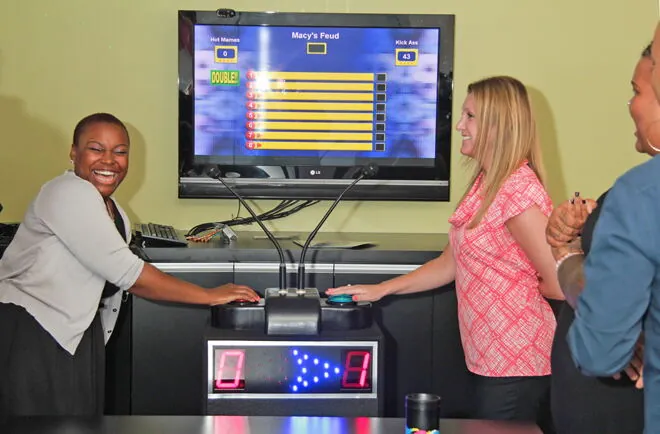
Rebuilding morale after layoffs? A hosted game show gives your team a gentle way to reconnect, anywhere in NJ, NYC and CT.
What Survivor Syndrome Looks Like in Your Workplace
Psychologists call it “survivor syndrome.” It shows up as disengagement, irritability, risk aversion, and a quiet withdrawal from collaboration. Employees stop volunteering for projects. Meetings grow silent. People update their resumes during lunch and mentally check out by 3 PM.
The symptoms are predictable because the causes are universal. Surviving employees process a mix of relief, guilt, anger, and fear simultaneously. Relief that they kept their job. Guilt that a colleague with kids did not. Anger at leadership for how the layoffs were handled. Fear that they are next. This emotional cocktail makes productive teamwork nearly impossible without intentional intervention.
What Breaks Inside Teams After a Layoff
Broken Trust in Leadership
Employees who watched coworkers escorted out question whether management was honest about the reasons, the process, or the future. Trust, once fractured, does not repair through memos or town halls. It rebuilds through consistent, small actions over time.
Guilt and Social Fractures
Survivor guilt creates invisible walls between team members. People avoid mentioning laid-off colleagues, which leads to a strange silence where everyone pretends nothing happened. This silence prevents natural grieving and stalls any genuine reconnection.
Workload Overload and Resentment
Fewer people doing the same amount of work breeds exhaustion and resentment. When employees feel stretched thin and underappreciated, morale drops further. The cycle feeds itself: low morale leads to lower productivity, which increases individual workloads, which pushes morale down again.
Fear of the Next Round
Until employees genuinely believe the cuts are over, they operate in self-preservation mode. That means minimal risk-taking, reduced collaboration, and a focus on personal visibility over team outcomes.
Why Forced Fun Makes Everything Worse
The instinct to “do something fun” for the team after layoffs is understandable. The execution, however, often backfires. Mandatory happy hours, trust falls, and overly enthusiastic team-building exercises feel tone-deaf to employees processing grief and anxiety.
The problem is not fun itself. The problem is manufactured positivity. When an organization asks grieving employees to act excited about a scavenger hunt two weeks after their friends were let go, it signals that leadership does not understand what the team is actually feeling. Effective morale rebuilding meets people where they are, not where management wishes they were.
What Actually Works: Low-Stakes Shared Experiences
Research on group recovery consistently points to one principle: shared positive experiences that do not demand emotional performance. The activity needs to be genuinely enjoyable, voluntary in spirit, and free of workplace hierarchy dynamics.
The best morale-rebuilding activities share these traits:
They create laughter without requiring anyone to pretend everything is fine
They put everyone on equal footing, regardless of title or tenure
They produce organic conversation and inside jokes that carry back into daily work
They respect the emotional state of the room rather than trying to override it
Approach
Emotional Safety
Team Connection
Planning Effort
Best For
Live Game Shows
High
High
Low (turnkey)
Teams in grief or transition
Volunteer Events
Medium
Medium
High
Teams ready for external focus
Off-Site Retreats
Medium
High
High
Larger budgets, stable teams
Workshops / Training
Low
Low
Medium
Skill-focused recovery
Happy Hours
Low
Medium
Low
Already-cohesive groups
Want an event that feels supportive, not forced? Our hosts keep every round light and easy to join.
How Live Game Shows Create Safe Reconnection Moments
This is where It’s PlayTyme Game Shows stands apart from standard team-building providers. Their corporate game show events are built around a simple insight: people reconnect naturally when they are laughing together, competing in lighthearted challenges, and sharing an experience that carries zero workplace stakes.
A live game show format works for post-layoff teams because it removes the two biggest barriers to reconnection. First, it eliminates forced vulnerability. Nobody has to share feelings, do trust exercises, or participate in awkward icebreakers. The game itself creates natural interaction. Second, it flattens hierarchy. When the VP competes alongside the junior analyst in a trivia round, the usual power dynamics dissolve temporarily. That temporary leveling creates space for genuine human connection.
It’s PlayTyme brings professional hosts, studio-quality production, and a range of game formats to companies across New Jersey, New York City, and Connecticut. The events are turnkey: the team shows up, plays, laughs, and leaves with something that forced team building rarely produces (actual good memories together).
Practical Steps for Managers Leading a Smaller Team
Rebuilding team morale after layoffs is not a single event. It is a sustained effort that unfolds over weeks and months. These steps create the conditions for genuine recovery.
Acknowledge What Happened
Do not pretend the layoffs did not occur. Name them directly. Acknowledge the loss. Give people permission to feel conflicted. A simple, honest statement from a manager carries more weight than any corporate communication.
Redistribute Work Transparently
Show the team how responsibilities are being reallocated and what is being deprioritized. When employees see that leadership recognizes the increased burden, resentment decreases significantly.
Create Small Wins Early
Set achievable short-term goals the team accomplishes together. Shared accomplishment rebuilds collective confidence faster than individual recognition programs.
Invest in a Shared Experience
Schedule a genuinely enjoyable group activity within the first month. Not a working lunch or a strategy session disguised as fun. A real, dedicated experience where the only goal is to enjoy each other’s company: a live game show, a cooking class, an afternoon of bowling. The format matters less than the intention. This time is for your people, not for the company.
Rebuilding Trust Through Consistent Action
Morale and trust are connected but not identical. A great team event lifts spirits in the short term. Sustained trust requires managers to follow through on promises, communicate openly about the company’s direction, and advocate visibly for their team’s well-being.
Three practices accelerate trust repair:
Radical transparency about decisions. Explain the “why” behind every significant change, even when the answer is uncomfortable.
Protecting boundaries. Refuse to normalize 60-hour weeks as the new expectation for a smaller team. Advocate for realistic timelines and staffing.
Following words with action. If leadership says “we value this team,” back it up with visible investment: professional development, upgraded tools, or a memorable team experience like a live game show from It’s PlayTyme.
How to Select Your Post-Layoff Recovery Approach
Not every team needs the same intervention. Consider where your group falls on three dimensions before selecting an approach.
Emotional Temperature
If the layoffs happened within the past two to four weeks, your team is still in acute distress. Choose low-pressure, high-laughter activities. Skip anything that asks people to reflect, share, or “process.” A live game show hits the right tone here because it gives people permission to simply enjoy themselves.
Team Size
Smaller teams (under 20) often recover faster with intimate, in-person experiences. Larger groups benefit from structured formats like game shows that keep everyone engaged simultaneously rather than breaking into awkward small groups where silence takes over.
Budget and Logistics
A multi-day retreat is not realistic for most post-layoff budgets. Look for high-impact, single-session options that deliver memorable experiences without the overhead. It’s PlayTyme’s corporate events require minimal planning from your side and deliver maximum engagement in a focused two-hour window.
If your team is working through the aftermath of layoffs and you want to bring people back together without the forced positivity, reach out to It’s PlayTyme Game Shows. Their professional live game show experiences give teams across New Jersey, NYC, and Connecticut a reason to laugh together again. That shared laughter is where real recovery begins.
How long does it take to rebuild team morale after layoffs?
Most teams need three to six months of consistent effort to regain a stable sense of morale and trust. The timeline depends on how the layoffs were communicated, how workloads were redistributed, and whether leadership actively invests in reconnection. Early interventions like shared team experiences shorten the recovery window.
How do you address survivor guilt on a team?
Start by acknowledging it openly. Let employees know that mixed feelings are normal and expected. Create opportunities for the team to reconnect through shared positive experiences rather than grief-focused discussions. Over time, new shared memories and accomplishments help the team form a fresh identity together.
What is the best team-building activity for a team that just went through layoffs?
Activities that produce genuine laughter and put everyone on equal footing work best. Live game shows are particularly effective because they require no emotional performance, eliminate hierarchy, and create organic bonding moments. The goal is connection through enjoyment, not forced reflection or manufactured positivity.
A game show party in New Jersey answers that question with something most corporate socials, school fundraisers, and holiday gatherings never deliver: genuine, full-room participation. Not a laptop on a projector running a free quiz app. Not a microphone passed awkwardly around a banquet hall. A professional, stage-quality production that turns any venue into a live game show set.
The real challenge is that most group entertainment falls flat. You book a DJ or set up a Kahoot quiz, and half the room checks their phones within ten minutes. Introverts retreat to the corners. Extroverts dominate the conversation. The “team building” becomes another forgettable hour on the company calendar. Planning committees at schools face the same problem: assemblies that lose student attention before the first question is asked. And fundraiser organizers struggle to find entertainment that keeps donors engaged long enough to actually raise money.
Planning a game show party in New Jersey? We host live game shows for 20 to 300+ guests across the state.
What Makes a Game Show Party Different from a Trivia Night
The difference between a game show party and a standard trivia night is the difference between watching a football game on TV and being in the stadium. Trivia nights rely on one host reading questions while tables quietly discuss answers. A game show party from It’s PlayTyme Game Shows puts participants on stage with professional podiums, electronic buzzers, large-screen projection, studio-quality sound, and a trained host who controls the energy of the room.
DIY options like Kahoot or free online quiz platforms work for a quick icebreaker in a conference room. They do not work when you need to entertain 50, 100, or 300 people for an hour or more. There is no stage presence, no physical interaction, no competitive drama. Everyone stares at their own phone screen instead of connecting with the people around them.
A professional game show setup changes the group dynamic entirely. Audience members cheer for their team. Contestants react to buzzer-beater answers in real time. The host reads the room, adjusts pacing, and keeps energy high from the first round to the final question. That is the gap between “we did a quiz” and “that was the best event we’ve ever had.”
Why Mixed Energy Levels Complicate NJ Event Planning
Finding entertainment that works for a diverse group is harder than most planners expect. Here are the specific obstacles NJ event organizers face:
Mixed energy levels: Every group has introverts and extroverts. Most entertainment caters to one or the other, leaving half the room disengaged.
Venue limitations: New Jersey event spaces range from hotel ballrooms to school gymnasiums to outdoor pavilions. Entertainment that requires a specific room setup often falls apart in non-standard venues.
Group size unpredictability: Corporate holiday parties and fundraisers often have RSVPs that fluctuate by 30% or more. Entertainment that only works for a narrow headcount creates logistical headaches.
Age and audience diversity: A company picnic includes executives, interns, and their families. School events mix grades K through 12. The entertainment needs to land across every demographic in the room.
Budget pressure: Planners need something impressive enough to justify the spend, but affordable enough to leave room for food, venue, and decor.
The Full Production Setup: Podiums, Buzzers, and a Professional Host
It’s PlayTyme brings a complete production package to every event. This is not a host with a laptop and a portable speaker. The setup includes:
Professional podiums with built-in electronic buzzers for contestants
Large-screen projection so every person in the room sees questions, answers, scores, and gameplay in real time
Studio-quality sound systems calibrated to the venue size
A trained, professional host who manages pacing, audience interaction, humor, and competition
Custom content tailored to your organization, industry, school curriculum, or event theme
The host is the single biggest differentiator. A skilled game show host does what no app or playlist does: reads the crowd, adjusts on the fly, pulls shy participants into the action, and builds momentum toward a high-energy finale. It’s PlayTyme’s hosts are experienced performers who specialize in corporate, school, and private event audiences across New Jersey, New York City, and Connecticut.
Game Show Formats Explained with Group Size Guidance
It’s PlayTyme offers multiple game show formats, each designed for different group dynamics. Choosing the right one depends on your audience size, event type, and energy goals.
Format
Style
Best Group Size
Best For
Face-2-Face Feud
Family Feud style survey game
30-300+
Corporate parties, holiday events, fundraisers
Game Show Mania
Fast-paced trivia rounds
20-300+
Team building, company socials
PlayPad Mania
Live polling (everyone plays via phone)
20-300+
Large conferences, all-hands meetings
60 Seconds of Fame
Minute-to-Win-It physical challenges
20-150
School assemblies, team offsites
The Challenge
Jeopardy-style question board
20-100
Academic events, leadership retreats
Name That Hit Song
Music identification game
30-300
Holiday parties, private celebrations
Face-2-Face Feud
The most requested format. Two teams face off at the podiums, guessing top survey answers while the audience cheers (or groans). Questions are customized to match your company, school, or event theme. Works for almost any group size because the audience stays invested in every answer reveal.
PlayPad Mania
The best option for very large groups. Every person in the room plays simultaneously using their phone, with live results projected on screen. No one sits out. Scores update in real time, creating competitive energy across the entire venue.
60 Seconds of Fame
Physical challenges (stack cups, bounce ping pong balls, build towers) bring contestants on stage for one-minute bursts of action. High energy, lots of laughs, and perfect for younger audiences or groups that want to move, not just answer questions.
Want a party everyone plays? Our hosts bring the buzzers, the board and the prizes.
NJ Event Types That Work Best with a Game Show Party
A game show party format adapts to nearly every event category booked across New Jersey. Here are the types where it delivers the strongest results:
Corporate Parties and Team Building
Quarterly socials, end-of-year celebrations, sales kickoffs, and leadership retreats all benefit from structured competition. Game shows break departmental silos because teams are mixed intentionally. A 90-minute game show does more for cross-team relationships than a full day of trust falls.
Holiday Parties
The December corporate party is the single most common booking for game show entertainment in New Jersey. Christmas Family Feud and holiday-themed trivia replace the tired DJ-and-dance-floor formula with something every attendee participates in, regardless of whether they like dancing. Check out It’s PlayTyme’s holiday party entertainment for themed options.
School Assemblies and Fundraisers
Schools across New Jersey use game show assemblies for end-of-year celebrations, spirit weeks, anti-bullying programs, and fundraising events. The format keeps students engaged because they are active participants, not passive listeners. Fundraiser galas add game show rounds between auction segments to keep donor energy high throughout the evening.
Private Celebrations
Birthday milestones, graduation parties, family reunions, and bar/bat mitzvahs all work with game show formats. The host customizes questions around the guest of honor, family inside jokes, or group history to make the experience personal.
What to Expect When You Book a Game Show Party in New Jersey
The booking process with It’s PlayTyme follows a straightforward timeline:
Initial consultation: Share your event date, venue, group size, audience type, and goals. The team recommends the best format (or a combination of formats for longer events).
Content customization: Questions, challenges, and themes are built around your organization. Corporate clients submit company trivia. Schools provide curriculum topics. Private parties share personal details about the guest of honor.
Day-of setup: The crew arrives early to install podiums, projection, sound, and lighting. Setup and teardown are fully handled, so your venue coordinator has nothing extra to manage.
The show: A professional host runs the entire program. You and your guests participate, compete, and enjoy the event without managing a single detail.
Events typically run 60 to 90 minutes, though longer programs with multiple game show rounds are common for corporate offsites and all-day school programs.
Which Game Show Format Fits Your NJ Event
Start with three questions: How many people are attending? What is the average age of your group? Do you want everyone playing at once or watching contestants compete on stage?
For groups under 50, stage-based formats like Face-2-Face Feud and The Challenge keep the room intimate and competitive. For groups over 100, PlayPad Mania ensures nobody is left watching from the sidelines. For mixed-age audiences (company picnics, family events), 60 Seconds of Fame and Name That Hit Song work across generations because they rely on physical fun and music recognition rather than specialized knowledge.
If your event is in New Jersey, New York City, or Connecticut, It’s PlayTyme serves the entire tri-state area with the same full production setup at every venue. No scaled-down packages for smaller events. No extra fees for travel within the service area.
Ready to book a game show party for your next NJ event? Contact It’s PlayTyme Game Shows to lock in your date and start customizing your show.
How much does a game show party cost in New Jersey?
Pricing depends on the format, group size, and event duration. It’s PlayTyme provides custom quotes after an initial consultation. Most corporate and school events fall within standard entertainment budget ranges for the NJ market.
How many people participate in a game show party?
Groups range from 20 to 300+ depending on the format. Face-2-Face Feud works for 30 to 300+ guests. PlayPad Mania scales to 300+ because every attendee plays on their phone simultaneously.
Is a game show party appropriate for school assemblies?
Yes. It’s PlayTyme runs game show assemblies for elementary, middle, and high schools across New Jersey and New York City. Content is age-appropriate and customized to curriculum topics, school spirit themes, or character-building programs.
What is the difference between a game show party and hiring a DJ?
A DJ provides background music and a dance floor. A game show party provides structured, interactive entertainment where every guest participates. Engagement rates are significantly higher because the format requires active involvement rather than passive listening.
How far in advance should I book a game show party in NJ?
Book at least three to four weeks in advance for most events. Holiday season dates (November and December) fill quickly, so corporate holiday party bookings should be made six to eight weeks ahead. Contact It’s PlayTyme early to secure your preferred date.
The disconnect is real. Companies invest thousands of dollars in team building events each year, yet a large share of those employees walk away feeling annoyed, drained, or embarrassed rather than connected. The problem is not the concept of bringing people together. The problem is how most organizations execute it.
If your team rolls their eyes every time an HR email announces the next “fun mandatory activity,” you are not alone. Employees resist team building because past experiences taught them to expect awkward icebreakers, wasted afternoons, and activities that ignore their actual preferences. Understanding the specific reasons behind that resistance is the first step toward choosing something your team will genuinely enjoy.
Want team building your employees will enjoy? Our hosted game shows feel like a party, not a workshop, anywhere in NJ, NYC and CT.
Before blaming employees for being “negative,” it helps to look at what they are actually reacting to. The frustration rarely comes from laziness or antisocial attitudes. It comes from repeated exposure to poorly designed experiences that ignore basic human needs: autonomy, relevance, and respect for time.
Loss of control: Employees are told when, where, and how to “have fun.” No input, no opt-out.
Irrelevant activities: Generic exercises that have nothing to do with the team’s actual work or interests.
Time pressure: People already feel stretched. Adding a half-day event to a packed schedule creates resentment, not bonding.
Social discomfort: Not everyone thrives in forced social settings, especially introverts or newer employees.
Lack of follow-through: One afternoon of trust falls does nothing if the workplace culture remains unchanged on Monday.
These are not personality flaws. They are rational responses to a broken approach. The sections below break down each reason in detail and explain what to do instead.
1. “Mandatory Fun” Feels Like a Contradiction
Nothing kills enjoyment faster than being told you must enjoy something. When attendance is required and the activity is framed as a reward, employees feel manipulated. They showed up because they had to, not because they wanted to. That forced compliance strips away the sense of autonomy people need to actually relax and engage.
The fix is straightforward: choose activities that are genuinely entertaining on their own merits, not just “good for the team.” When people are laughing because the activity is inherently fun (not because the boss is watching), the bonding happens organically. It’s PlayTyme Game Shows builds every event around competitive, TV-style game show formats that get people invested because they want to win, not because a memo told them to participate.
2. The Activities Are Embarrassing or Childish
Trust falls. Blindfolded obstacle courses. Sharing your “spirit animal” with the group. These activities put adults in vulnerable, awkward positions in front of their coworkers and supervisors. The cringe factor is real, and it does lasting damage to how employees perceive future team events.
Embarrassment does not build trust. It builds walls. Employees remember being put on the spot, and they carry that memory into the next invitation. The result: lower participation, more excuses, and growing cynicism about anything labeled “team building.”
Effective activities give people a chance to shine without forcing vulnerability. Game show formats work because the structure is familiar (everyone has watched a quiz show), the roles are clear, and the humor comes from the competition itself rather than from putting individuals in uncomfortable spotlight moments.
3. It Feels Like Wasted Time
Time is the most valuable resource your employees have, and they know it. When an entire afternoon disappears into an activity that feels pointless, the message they receive is: “We don’t respect your time.” That breeds resentment, not camaraderie.
The worst offenders are long, unstructured events with vague goals. A four-hour “collaboration workshop” with no clear outcome feels like a meeting that should have been an email. Employees mentally check out within the first 30 minutes and spend the rest of the time thinking about the work piling up on their desks.
High-energy, structured events with built-in pacing solve this problem. A 60 to 90 minute game show event moves fast, keeps everyone active, and ends before attention fades. People leave energized instead of drained.
4. The Activity Ignores Different Personalities
Not every employee is an extrovert who thrives on group hugs and loud brainstorming. Introverts, neurodivergent employees, and people with social anxiety experience traditional team building very differently from the outgoing sales rep who volunteers for everything.
When activities demand constant small talk, physical contact, or public performance, a significant portion of the team shuts down. They are not being difficult. They are protecting themselves from an environment that does not account for how they operate.
What accommodating different personalities looks like:
Activities with defined roles so everyone contributes without being singled out
Team-based formats where quieter members strategize while louder ones present
Short, high-energy rounds that keep engagement high without exhausting anyone
A professional host who reads the room and adjusts the energy level in real time
Game show events naturally accommodate this range. Teams collaborate on answers, so every personality type has a way to contribute. The trivia nerd, the pop culture fan, the quiet strategist: they all find their lane.
5. There Is No Professional Facilitation
Asking a manager to run team building is like asking the pilot to also serve the drinks. Managers carry authority. When the boss leads an icebreaker, the power dynamic never disappears. Employees censor themselves, perform enthusiasm, and count the minutes.
Professional facilitation changes the dynamic entirely. A skilled host who is not part of the company hierarchy creates a neutral space where people feel comfortable being themselves. The host manages energy, timing, and group dynamics so the organizer and the team both get to participate rather than perform.
It’s PlayTyme provides a dedicated, experienced emcee for every event. With over 3,000 professionally hosted events across New Jersey, New York City, and Connecticut, their hosts know how to engage skeptical audiences, keep energy high, and make sure no one feels singled out or left behind.
Ready to win over the skeptics? Tell us about your team and we will plan a game show they will want to join.
Building a spaghetti bridge has nothing to do with launching a product. When team building activities are completely detached from the actual work environment, employees see them as performative. The “teamwork” displayed during a scavenger hunt rarely transfers back to the office because the context is too different.
The best activities mirror real collaboration patterns without feeling like work. Competitive trivia, for example, requires communication, quick decision-making, and working under pressure: the same skills teams use every day. The difference is that the stakes are fun (bragging rights, a small prize) instead of stressful (a quarterly deadline).
7. One Bad Experience Ruins the Next Ten Invitations
Employee resistance to team building is cumulative. One cringeworthy event creates skepticism. Two create active avoidance. By the third, employees are drafting excuses before the invitation even arrives. Past trauma (and that word is not too strong for some people’s karaoke memories) poisons the well for future events, even good ones.
Breaking this cycle requires a dramatically different format. You are not going to win back skeptics with the same category of activity that burned them. That is why game show events work for resistant teams: the format is so different from traditional team building that employees walk in curious rather than defensive. The TV game show framework signals “entertainment,” not “corporate exercise.”
8. Leadership Does Not Participate Authentically
Nothing signals “this is for you, not for us” like a leadership team that watches from the sidelines, checks their phones during activities, or leaves early. Employees notice. If the executives are not fully in, the implicit message is that this activity is not actually important.
The most successful team events put leaders and entry-level staff on equal footing. In a game show format, the CEO answering trivia questions alongside a junior analyst creates genuine moments of leveling. When a VP gets buzzed out on the first round and laughs about it, that does more for approachability than a year of open-door policies.
Approach
Employee Reaction
Engagement Level
Repeat Appeal
Trust falls & icebreakers
Embarrassment, eye-rolls
Low
None
Unstructured “hang out” time
Cliques form, some feel excluded
Low to moderate
Limited
Escape rooms
Fun for some, stressful for others
Moderate
Moderate
Professional game show events
Competitive fun, inclusive participation
High
Strong
How to Select a Format Employees Will Actually Enjoy
Stop guessing what your team wants and start applying a simple filter. The right team building format meets four criteria:
It is genuinely entertaining.
Would your employees do this activity voluntarily on a weekend? If the answer is no, it is not fun enough. Game shows pass this test because people already watch them for entertainment.
It respects everyone’s comfort level.
The activity should not require singing, dancing, physical contact, or sharing personal stories. It should offer ways for every personality type to participate comfortably.
It has professional facilitation.
A dedicated host removes the manager-as-entertainer problem and creates a level playing field. Look for companies with extensive experience and a track record with corporate events.
It fits your time and space constraints.
The best format adapts to your venue (office, hotel, restaurant, offsite) and your schedule. A tight 60 to 90 minute event often outperforms a full-day retreat because it maximizes energy and minimizes time away from work.
It’s PlayTyme checks every box. Their live game show events run across New Jersey, NYC, and Connecticut, adapting to groups of 20 to 300+ in virtually any venue. With 14+ years of experience and thousands of events, they specialize in turning skeptical teams into enthusiastic participants.
Ready to replace the groans with genuine laughter? Get in touch to book a game show event your team will actually talk about afterward, or explore the full lineup of team building activities available for your group.
Why do employees dislike team building activities?
Employees dislike team building when activities feel forced, embarrassing, or disconnected from their actual work. The core issue is a lack of autonomy: people are told to have fun rather than given genuinely enjoyable options. Poor facilitation, awkward icebreakers, and disregard for different personality types compound the problem.
How do you make team building fun for introverts?
Choose activities with defined team roles so introverts contribute through strategy rather than public performance. Game show formats work well because team members collaborate on answers privately before a spokesperson shares them. Short rounds and professional hosting also prevent energy drain.
What is the best team building activity for large corporate groups?
Live game show events scale effectively from 20 to 300+ participants because the format uses team-based competition with a professional host managing the room. The structure keeps everyone engaged simultaneously, unlike activities that require small breakout groups or one-at-a-time participation.
Are team building activities actually worth the investment?
Yes, when done correctly. The key is choosing activities that generate authentic positive experiences rather than forced participation. Teams that share a genuinely fun, memorable experience show improved communication and stronger working relationships in the weeks that follow. The return depends entirely on the quality of the event format and facilitation.
The first five minutes of a meeting set the tone for everything after. A quick Family Feud icebreaker turns a quiet, distracted room into an alert, smiling group ready to work. That shift matters, because Gallup reports that only 20% of employees feel engaged at work, and engagement starts the moment people walk in.
Connection is the fast win here. Pew Research found that most workers value the social side of their jobs, and a short, playful warm-up taps that instantly. Family Feud icebreakers work because the format is familiar, the rounds are quick, and nobody has to perform alone. The questions below run in five to ten minutes flat.
Meeting leaders face a familiar problem. You have a few minutes, a mix of personalities, and people who joined the call or walked in cold. You need something that warms the room without eating the agenda, without putting shy people on the spot, and without props you do not have. Family Feud icebreakers solve that, and this guide gives you the questions and the method to run them today.
Want a Family Feud icebreaker for your next meeting or event? We host it live with buzzers and a pro host across NJ, NYC and CT.
Only 20% of employees feel engaged at work, and engagement starts the moment people walk into the room.
Family Feud icebreakers work because the format is familiar and no one has to perform alone.
Most workers value the social side of their jobs, making a short warm-up an instant win.
A round runs five to ten minutes and leaves the rest of the agenda untouched.
The format handles mixed personalities without putting shy people on the spot or requiring preparation.
Why Family Feud Works as an Icebreaker
A full game show fills an hour. An icebreaker version runs in minutes and earns the same laughs. The format is built for fast warm-ups for a few reasons.
Familiar rules: everyone knows the show, so there is nothing to explain.
Team play: guesses come from a group, so no one stands alone.
Quick rounds: one or two questions deliver energy without a time sink.
No props required: a whiteboard or a shared screen is all you need.
Use it at the top of a staff meeting, a project kickoff, a training session, or a quarterly all-hands. It fits in-person rooms and video calls equally well. The format also flexes to the size of your group, from a six-person stand-up to a room of fifty, without changing the rules. Because the structure does the social work, the warm-up never depends on one outgoing person to carry the energy. That reliability is why teams return to the feud format week after week instead of hunting for a new game each time.
How to Run a Five-Minute Version
Keep it tight so it warms the room without stalling the agenda.
Split the group into two teams, left and right of the room or two breakout columns on a call.
Read one question and give teams ten seconds to shout a guess.
Reveal the ranked answers and award points off the board below.
Run one or two questions, name a winner, and move into your agenda.
The point values listed with each question act as your board. They are written to feel like real survey results from a typical workplace crowd.
Office and Meeting Icebreaker Questions
Start here because everyone recognizes the daily routine.
Name something people always bring to a meeting.
A laptop (34)
Coffee (27)
A notebook (18)
Their phone (13)
A list of excuses (8)
Name a reason a meeting runs long.
Too many tangents (32)
One person talks too much (26)
Tech problems (19)
No clear agenda (15)
It started late (8)
Fun and Personal Icebreaker Questions
These get people laughing and learning small things about each other.
Name something people do on a Monday morning to wake up.
Drink coffee (40)
Hit snooze (22)
Take a shower (17)
Check their phone (13)
Complain about Monday (8)
Name a hobby coworkers talk about most.
Cooking (28)
Working out (24)
Watching sports (20)
Travel (17)
Gaming (11)
Ready to warm up the room in five minutes? Our host runs quick Feud rounds that get every group talking.
Use these to open a project meeting on a high note.
Name something every successful project needs.
A clear goal (33)
Good communication (27)
A deadline (18)
The right team (14)
Enough coffee (8)
Name something that slows a project down.
Scope creep (30)
Waiting on approvals (25)
Unclear roles (20)
Too many meetings (16)
Last-minute changes (9)
Common Challenges With DIY Icebreakers
A short warm-up sounds easy, yet leaders hit the same snags. Naming them keeps your five minutes on track.
Falling flat: a weak question gets blank stares instead of laughs, and the room cools further.
Running long: without a hard stop, two questions stretch into fifteen minutes and eat the agenda.
Uneven participation: the same two extroverts answer while everyone else stays quiet.
No clear scoring: arguments over what counts as a match derail the energy fast.
Repetition fatigue: the same questions every week lose their spark, so the bank needs refreshing.
When to Bring in a Professional Host
For a weekly stand-up, a self-run icebreaker is perfect. For a kickoff event, a retreat, or a company-wide gathering, a professional host turns the warm-up into a centerpiece. It’s PlayTyme Game Shows brings a polished emcee, real buzzers, and broadcast-style screens to venues across New Jersey, New York City, and Connecticut, with custom questions tuned to your team.
A pro host reads the room, pulls quiet people in without pressure, and keeps scoring fair and fast. The format scales from a ten-minute opener to a full hour, so the same energy that warms a meeting can anchor an entire event. Your leaders skip the prep and join the fun.
Match the question to the moment. Open a routine meeting with office and Monday questions, since they need no setup. Open a project with kickoff questions that point the team toward the work ahead. Keep it to one or two rounds with a firm stop so the warm-up never swallows the agenda. Refresh your bank every few weeks so the questions stay fresh. For a big event, hand the format to a host who can scale it into the main attraction. Pick well, and your first five minutes will carry the whole meeting.
Frequently Asked Questions (FAQs)
Do family feud icebreakers work on video calls?
Yes. Split the group into two teams using breakout columns or a simple roster, share the question on screen, and reveal answers as teams guess. The familiar format and team play translate cleanly to remote and hybrid meetings.
How many people do I need for a feud icebreaker?
It works for groups as small as six and as large as a full all-hands. For small teams, two players per side keeps it quick. For larger rooms, split into two big teams and let anyone shout a guess.
When should I hire a host instead of running it myself?
Run it yourself for routine meetings. Hire a host for kickoffs, retreats, and company-wide events where you want the warm-up to become a memorable centerpiece. A pro brings equipment, custom questions, and fair scoring that scales to any group size. For a full company conference or multi-session event, see our conference entertainment for large groups options to scale the same energy across the whole day.
Here is the concrete challenge most managers face. You have talented people in marketing, sales, finance, and operations who barely interact. New hires struggle to feel welcome. Remote and in-office staff drift into separate worlds. You want connection, but forced icebreakers feel awkward and a single happy hour fades by Monday. The fix is a set of repeatable activities that put everyone on equal footing and give people a reason to root for each other.
Looking for team unity activities? Our hosted game shows bring departments together, on site anywhere in NJ, NYC and CT.
Unity is the shared sense that everyone is on the same side. When it exists, people ask for help sooner, share credit freely, and cover for each other during crunch weeks. When it is missing, small misunderstandings grow into turf wars. Activities that build unity work because they create shared memories and low-stakes moments of trust outside of daily deadlines.
The strongest activities share three traits. They include everyone regardless of title. They reward teamwork over individual stardom. They are fun enough that people talk about them afterward. Keep those traits in mind as you read the options below.
Interactive Game Shows That Unite Departments
A hosted game show is one of the fastest ways to bring a divided office together. Picture a Family Feud-style format where the accounting team faces the sales team, a buzzer in hand, the whole room laughing. Because the questions are about the company, pop culture, or fun trivia, no department holds an unfair edge. A junior coordinator can win the round for a group of senior managers.
This is where It’s PlayTyme Game Shows stands out. The company designs and hosts high-energy game show experiences across New Jersey, New York City, and Connecticut, built specifically to break down departmental silos. A professional host keeps the pace tight, manages the scoring, and pulls quiet team members into the action. You get the unity benefit of a structured competition without anyone needing to plan or run it.
Equal footing: trivia and quick rounds put every department on the same starting line.
Built-in inclusion: a skilled host makes sure introverts and new hires get the spotlight too.
Lasting memory: inside jokes from game day fuel conversations for weeks.
Shared Goals and Friendly Cross-Department Competitions
Beyond hosted shows, recurring challenges keep unity alive between big events. The goal is a shared target that requires cross-department cooperation. Try a month-long step challenge, a charity fundraising race, or a build-something contest where mixed teams assemble a project from scratch.
Examples worth running
Mixed-team scavenger hunts that send sales and engineering out together.
A cooking or bake-off where each table cooks one dish as a unit.
Quarterly trivia leagues with rotating team rosters so people meet new colleagues.
Rotate the rosters often. When the same four friends always team up, unity stalls. Fresh groupings force new conversations and widen everyone’s internal network.
Everyday Rituals That Reinforce Connection
Unity is not built only at events. Small daily and weekly rituals do steady work. A shared lunch table with no phones, a Friday shout-out round, or a five-minute Monday check-in all signal that people matter beyond their output. These rituals cost little and repeat often, which is exactly why they stick.
Recognition rituals carry extra weight. When a manager names a specific win in front of the group, the recognized person feels seen and the rest of the team learns what good work looks like. Make praise public and frequent, and unity grows on its own schedule.
Want every department on the same team? Our game rounds mix groups so everyone plays together.
Unity efforts often stall for predictable reasons. Knowing them in advance keeps your plan on track.
Awkward participation: forced fun backfires when people feel watched. A professional host or a clear, optional structure removes the pressure.
Cliques that exclude: activities that let friends self-select reinforce existing groups. Assign mixed teams instead.
One-and-done events: a single retreat fades fast. Pair big events with small weekly rituals for staying power.
Remote and hybrid gaps: in-person staff bond while remote staff watch. Choose formats that include screens and rooms at once.
No follow-through: momentum dies without a next date on the calendar. Book the next activity before the current one ends.
Address these head-on and your activities deliver real connection instead of a forgettable afternoon.
Building a Simple Quarterly Plan
The best results come from rhythm, not a single splash. A practical cadence looks like this. Run one large shared event each quarter, such as a hosted game show or a field day. Hold one mid-size cross-department challenge each month. Keep weekly recognition and check-in rituals running the whole time. This layered approach keeps unity visible all year without overwhelming anyone’s calendar.
Track the effect with quick pulse surveys. Ask two questions after each event: did you feel included, and did you meet someone new. Rising scores tell you the plan is working. Flat scores tell you to change the format or the groupings.
Matching the Activity to Your Team’s Biggest Gap
Start with your biggest gap. If departments rarely talk, pick a mixed-team competition that forces cooperation. If new hires feel lost, choose an inclusive hosted event where a facilitator pulls everyone in. If energy is low after a hard quarter, a high-laughter game show resets the mood fast.
Next, weigh your bandwidth. If your team has no time to plan and run an event, a professional host pays for itself by removing every logistics headache. Finally, match the format to your group size and space, then book a date before motivation cools.
Ready to bring your office together with a game show built for equal-footing fun? Explore the options on our team building programs, then contact our team to plan an event across New Jersey, New York City, or Connecticut. The right activity turns separate departments into one connected group.
Frequently Asked Questions (FAQs)
What are the best team unity activities for the office?
The best options put everyone on equal footing and reward teamwork over individual stars. Hosted game shows, mixed-team challenges, and weekly recognition rituals all build unity. A blend of one big event each quarter and small weekly habits works best.
How often should we run team unity activities?
Run one large event each quarter and one mid-size challenge each month. Keep small rituals like shout-outs and check-ins going every week. This rhythm keeps connection visible all year without crowding anyone’s schedule.
Do team unity activities work for hybrid offices?
Yes, as long as you choose formats that include both screens and rooms at the same time. Hosted game shows and trivia leagues adapt well to remote and in-person players together. The key is making sure remote staff compete, not just watch.
How do game shows build team unity?
Game shows use trivia and quick rounds where no department holds an unfair edge. A professional host pulls in quiet members and keeps energy high. The shared laughter and inside jokes create memories that fuel connection for weeks.
How do I measure if unity activities are working?
Run a short pulse survey after each event with two questions: did you feel included, and did you meet someone new. Rising scores confirm progress. Flat scores signal a need to change the format or the team groupings.
What is the business case for investing in team unity activities?
Harvard Business Review found that people at high-trust companies report 74% less stress and 50% higher productivity than those at low-trust ones, making strong team unity a direct driver of performance, not a soft perk.
How can unity activities help new hires feel welcome faster?
New hires often struggle to feel part of an established office. Team unity activities give them a structured, low-stakes way to meet colleagues across departments before daily work routines set in.