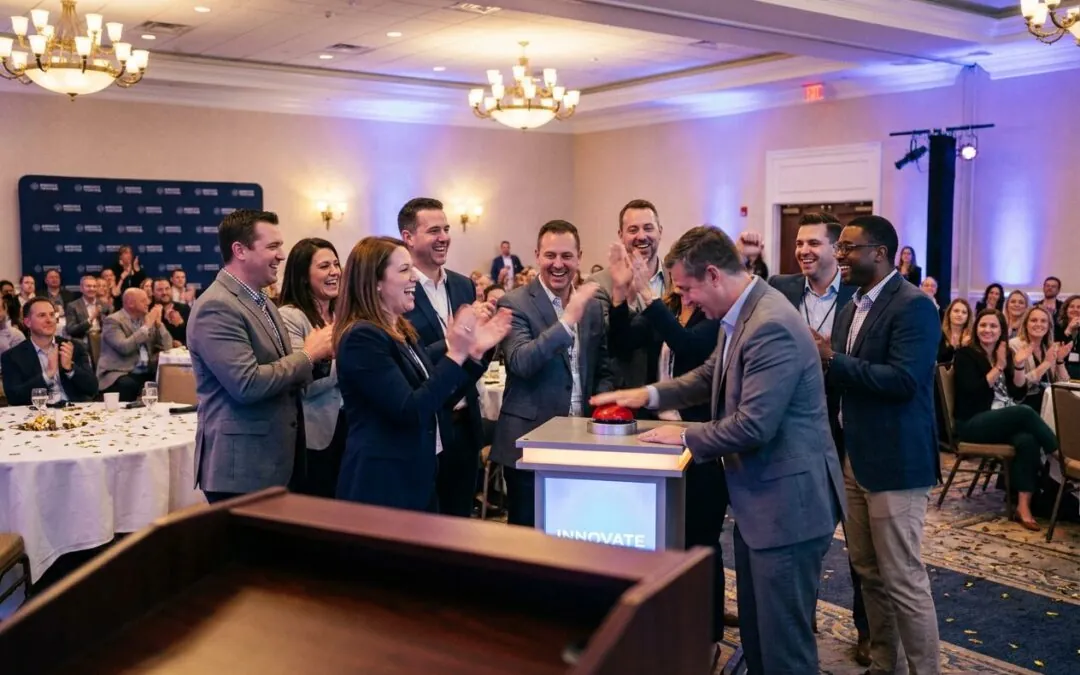
A plaque and a catered lunch will not move those numbers. People remember the night they went head to head with their own CFO on stage. They forget the gift card.
The ideas below are ranked by one test: how many people in the room actually play.
What You Need to Know
Participation beats attendance: Count how many people play, not how many walk through the door.
Group size picks the format: A cooking class fits a dozen people. A hosted game show holds 300.
A professional host removes the awkward part: Your organizer plays along instead of working the microphone.
Shared experiences outlast branded merchandise: Inside jokes come back to the office on Monday. Water bottles do not.
Why Most Employee Appreciation Events Miss the Mark
Everyone reassembles into their usual cliques. A standard happy hour puts accounting in one corner and sales in another. Nobody crosses the room without a reason to.
The entertainment turns the staff into an audience. A magician or a slideshow gives people something to watch. It gives them nothing to do with each other.
The format breaks at scale. Amateur trivia works for a department of twelve. Run it for a hundred and the back half of the room checks their phones.
The organizer works the whole night. When the HR director books the venue, writes the questions, and runs the microphone, one person leaves without a single good memory.
Hybrid and remote staff get stranded. Teams that fly in once a quarter need structured interaction, not free time in a ballroom where they know three people.
Dry venues lose the crutch. Alcohol-free events, school buildings, and daytime programs need real content, because the open bar is not there to carry the energy.
Finance wants to know what the spend bought. Morale on its own rarely survives a budget review, so the request has to connect to something the CFO already tracks: employee retention, cross-department communication, and the company culture leadership keeps describing in all-hands meetings.
The activity quietly excludes part of the staff. A 24-year-old and a 62-year-old, a marathon runner and a colleague who uses a wheelchair, all have to be able to play the same game. Bar crawls, physical challenges, and pop-culture trivia written for one generation are not inclusive team activities, however well they are meant.
The department that needs it most calls it forced fun. A team coming off a rough quarter reads any scheduled activity as an obligation. Competition and a professional host give skeptics cover, because they are playing a game rather than attending a morale exercise.
1. Interactive Live Hosted Game Shows
It’s PlayTyme Game Shows runs professionally hosted live game shows for large groups across New Jersey, New York City, and Connecticut. Formats include Face-2-Face Feud, Jeopardy Challenge, Name That Hit Song, and Game Show Mania.
The game show is the vehicle. The product is a room full of people competing, laughing, and talking to colleagues they normally email. Founder Lisa Lawrence has run this format since 2012, across more than 3,000 events.
A professional host controls the pace, so your office manager sits with a team and plays.
Best for: appreciation nights, holiday parties, executive retreats, and interactive team building activities in New Jersey and Connecticut for groups of 20 to 300+ people.
Pricing: our shows start around $2,995 for groups of 20 or more. Use our pricing estimator to see the range for your group size. A 60-minute show is also available, and half-day and full-day team building programs are custom-priced through a rep.
Standout features: turnkey setup and sound, whole-room formats where every table competes, and content customized with your company’s own inside jokes and milestones. Planners building a longer evening of corporate event entertainment in NYC pair the show with other corporate entertainment ideas by group size before or after dinner.
2. Private Culinary Classes and Food Tours
A private cooking class or a guided neighborhood food tour treats a small department well. Attendees cook alongside a chef or walk between local restaurants, and conversation happens naturally over the work of the meal.
Best for: executive retreats and single departments of 10 to 30 people.
Pricing: not publicly listed. Kitchens and tour operators quote per head, and the menu plus alcohol drive the final number.
Standout features: hands-on instruction, a full meal included, and a relaxed room for unstructured conversation.
Advantages:
A shared task starts conversation on its own, with no forced opening exercise.
Everyone leaves with a new skill and a dinner they remember.
Disadvantages:
Cost and logistics break down above roughly thirty people.
Allergies, dietary restrictions, and religious requirements add real planning work.
3. Corporate Escape Rooms
Escape rooms drop small teams into a themed set and give them a clock. Employees solve puzzles together, and quiet problem solvers often lead the room.
Most facilities now sell corporate packages with private bookings and a debrief space for drinks afterward.
Best for: small teams that want pure problem solving under time pressure.
Pricing: not publicly listed. Venues quote per person and add a fee for a private buyout.
Standout features: a hard time limit, immersive sets, and a clear win condition that keeps focus.
Advantages:
Forces tight communication between people who rarely work together.
The physical sets and puzzle themes stick in memory for months.
Disadvantages:
Room capacity splits a large group into separate games that never reconnect.
Time pressure stresses some employees instead of rewarding them.
4. Casino Night Rentals
Casino nights bring blackjack, roulette, and poker tables into a rented venue or a cleared office floor. Professional dealers run the games while employees play with chips instead of cash.
The format pairs well with cocktail attire and a December party, and it gives a large ballroom a clear visual centerpiece.
Best for: large holiday parties and end-of-year galas.
Pricing: not publicly listed. Rental companies quote by table count, dealer hours, and delivery.
Standout features: real casino equipment, trained dealers, and a social floor people move through at their own pace.
Advantages:
Guests join and leave the action whenever they want.
Chip counts create an easy prize structure at the end of the night.
Disadvantages:
Interaction stays fragmented, because people only talk to the five others at their table.
The room never shares one moment together.
5. Comedy or Improv Shows
A corporate comedian or improv troupe delivers a performance written around workplace humor. Strong acts take suggestions from the audience so the material sounds specific to your company.
Most companies slot this after dinner at an annual retreat or kickoff.
Best for: audiences that want to sit, watch, and laugh rather than compete.
Pricing: not publicly listed. Fees track the performer’s profile, the date, and travel.
Standout features: custom material, professional crowd work, and zero physical demand on attendees.
Advantages:
Attendees do nothing but take a seat.
One auditorium holds hundreds of people without splitting the group.
Disadvantages:
The audience stays passive and leaves with no new connections.
Finding material that lands with every department, and stays appropriate, is hard.
Adapting These Ideas for Schools and Community Groups
The same rule holds outside the office. A staff appreciation morning, a professional development day, or a student assembly collapses the moment the audience becomes a spectator.
Formats that pull people out of their seats work in a gym at 9 a.m. exactly the way they work in a hotel ballroom at 7 p.m. The host and the run of show change. The mechanic does not.
How to Choose Between a Happy Hour and a Hosted Experience
Pick the format by the outcome you want, not by the budget line.
Under 20 people: A dinner, a class, or an escape room gives everyone airtime.
50 people and up: An unstructured mixer splits into cliques. Structured play holds the room.
Departments that never interact: Team-based competition mixes them faster than any seating chart.
A mixed-age or mixed-ability staff: Choose a format where sitting at a table is the only physical requirement.
An organizer who is also an attendee: Hire the host. Nobody enjoys their own event from behind a microphone.
A dry or daytime event: The program has to carry the energy on its own.
Ready to stop worrying about your next staff appreciation event? It’s PlayTyme Game Shows hosts large-group game show experiences across NJ, NYC, and CT, backed by a 100% satisfaction guarantee. Get a quote and book your date.
Frequently Asked Questions (FAQs)
What makes an employee appreciation event successful?
Active participation. The best events give every person something to do within the first ten minutes, so nobody stands at the edge of the room. Success shows up on Monday, when people are still repeating jokes from the night before.
How do you include employees who dislike team building or have different ages and abilities?
Give them competition instead of exercises, and pick a format where sitting at a table is the only physical requirement. A live game show reads as entertainment rather than a workshop, the stakes stay low and funny, and questions written across several decades of reference points keep a 24-year-old and a 62-year-old in the same game. A professional host also draws in quiet people without singling anyone out.
What group size works best for a live hosted game show?
Anything from 20 to 300+ people. Pricing is set in five group-size bands from 20 to 300+, and the show format stays the same across every band. Larger headcounts simply run more teams.
Do these ideas work for remote or hybrid teams?
They work best when hybrid teams gather in person. A shared room produces energy that a video call cannot match, so use the offsite for the interaction and save the screen time for the update. Book the live activity early in the agenda, before people drift.
Planning a holiday party that actually pulls your team together can feel like Midtown during the Rockefeller Center tree lighting: crowded, expensive, and stressful. You are not just booking a room. You are trying to create real connection for a team spread across the boroughs, New Jersey, and Connecticut. Employee engagement is stuck. Only 32% of U.S. employees report being engaged. A catered lunch will not change that.
The goal is not just a party. You want an event where people put their phones down, talk to colleagues they never see, and leave feeling part of the team. New York gives you plenty of options, from in-office experiences that skip the travel to outings across the city. Here are the best Christmas team building activities NYC has to offer, built for real participation.
Your office (Manhattan, Brooklyn, Queens) or any venue
20-300+
October
Holiday Culinary Class
Dedicated kitchens (various boroughs)
15-40
September
Corporate Volunteering
Partner charities across all boroughs
10-100+
August/September
Holiday-Themed Escape Room
Dedicated venues (various boroughs)
5-10 per room
October
Holiday Market Scavenger Hunt
Bryant Park, Union Square, Columbus Circle
15-60
October
In-Office Craft Workshop
Your office
10-100
September
Private Museum Tour
Museum Mile, The Met, MoMA
10-50
August
Ice Skating Outing
Rockefeller Center, Bryant Park, Wollman Rink
10-40
October
1. Hosted Game Show Experience
A hosted game show turns your office or venue into a live TV studio. You get a professional host, buzzers, and a format like Face-2-Face Feud (a survey-style team game) or music trivia. Everyone plays. Instead of asking people to mingle, the format gives them a reason to team up and compete. That is why it stands out among interactive team building options in NYC: it skips the headache of moving a big group across the city in December.
At It’s PlayTyme Game Shows, we specialize in large-group engagement, and we bring the whole experience to you. Our founder, Lisa Lawrence, has spent more than a decade perfecting a model where everyone plays, not just a handful of volunteers. We handle the sound, the visuals, and the facilitation, so you get to enjoy the event with your team. We serve companies across NJ, NYC, and CT with corporate team-building events. And every event is backed by a 100% satisfaction guarantee.
Where it works in NYC: Your office in Manhattan, Brooklyn, or Queens, a rented loft, or a hotel conference room. No travel time for your team.
Ideal group size: 20 to 300+. The format scales so the whole room stays in the game.
The December advantage: Weather-proof, no transit chaos, and it fits any office layout. It is the simplest high-energy option for a packed month.
2. Holiday Culinary Class
A hands-on cooking or baking class puts your team together in a fresh setting. Decorate holiday cookies, roll fresh pasta, or mix craft cocktails. The work is collaborative, and the mood stays relaxed enough for real conversation while everyone picks up a new skill. NYC has plenty of culinary studios that run private corporate events.
Where it works in NYC: Cooking schools and studios in SoHo, the Flatiron District, and Williamsburg.
Ideal group size: Usually 15 to 40 people, since most kitchens run tight on space.
The December catch: These studios fill fast for holiday parties and book months out. Pricing runs at a premium, and large groups rarely fit.
3. Corporate Volunteering Day
Giving back as a team builds connection and helps your community at the same time. Groups like New York Cares and Food Bank For New York City run corporate projects, from sorting donations to serving meals or wrapping gifts for families in need. This one lines your company values up with your team-building.
Where it works in NYC: Charity headquarters, food banks, and community centers across all five boroughs.
Ideal group size: Anywhere from 10 to 100+.
The December catch: Holiday volunteer slots go fast and often fill by early fall. It also takes real advance planning with the nonprofit.
4. Holiday-Themed Escape Room
Escape rooms push small groups to communicate under pressure and solve puzzles before the clock runs out. Many venues run holiday-themed rooms in December for a festive twist. It is a strong pick for problem-solving and collaboration in smaller teams.
Where it works in NYC: Dozens of escape room venues across Manhattan, Brooklyn, and Queens.
Ideal group size: 5 to 10 people per room. Larger companies book multiple rooms and stagger start times, which splits the team.
The December catch: A big group rarely shares one experience when it is spread across rooms. There is also little chance for everyone to mingle.
5. Holiday Market Scavenger Hunt
This one turns a trip to a famous NYC holiday market into a game. Teams get clues, photo challenges, and items to track down at Union Square, Bryant Park, or Columbus Circle. It gets people exploring the city and working together in a fun, competitive format.
Where it works in NYC: Outdoor public markets. A third-party facilitator runs the game best.
Ideal group size: Best for 15 to 60. Bigger groups get hard to manage in a crowded public space.
The December catch: Weather makes or breaks it. A cold, rainy, or snowy day can sink the whole thing, and the market crowds make it tough to keep a group together.
6. In-Office Wreath-Making or Craft Workshop
Bring the festive part to your team by hiring a pro to lead a craft workshop in your office. Popular picks include wreath-making, ornament decorating, and terrarium building. Everyone takes something home, and the setting stays relaxed enough for easy conversation.
Where it works in NYC: Your own office, which cuts travel and venue costs.
Ideal group size: 10 to 100, depending on the facilitator and the craft.
The December catch: You handle supplies, setup, and cleanup. It is relaxing, but it rarely hits the high energy of a fully interactive event.
7. Private Museum Tour
For a quieter, culture-first outing, book a private guided tour at The Met, MoMA, or the Brooklyn Museum. Many run corporate tours built around themes like leadership or innovation seen through art. For the right team, it makes a memorable afternoon.
Where it works in NYC: Major museums and smaller galleries, mostly in Manhattan and Brooklyn.
Ideal group size: Best for smaller groups of 10 to 50.
The December catch: It runs expensive and books far ahead. The format is passive, so it will not land with every personality.
8. Ice Skating at an Iconic Rink
A trip to an iconic rink like Rockefeller Center, Wollman Rink in Central Park, or the Winter Village at Bryant Park is a classic NYC holiday tradition. It gets the team out of the office for something active. You can often book a private slot and finish with hot chocolate.
Where it works in NYC: Outdoor rinks in Midtown and Central Park.
Ideal group size: Best for smaller groups of 10 to 40, since rinks pack up fast.
The December catch: Public sessions are packed, so skating together gets hard. There is a real injury risk, and it depends on good weather. For a large group, it is one of the tougher options.
Key Challenges of Planning Holiday Team Events in NYC
Memorable holiday team building events in NYC come with a specific set of obstacles. Know them ahead of time, and you plan a smoother event.
Venue Scarcity and Peak Pricing
From mid-November through December, every restaurant, bar, and event space in New York is booked solid. Prices jump and availability drops. Wait past late summer, and you may find few options left, especially for a large group.
Most corporate budgets run on the calendar year. You need financial sign-off and often a deposit before Q4 closes. Drag your feet, and you lose your preferred vendor as other companies lock in their dates.
Holiday PTO and Attendance
December is prime time for time off. Schedule too close to Christmas or New Year’s, and attendance drops. Target that early-to-mid-December window when most of the team is still in the office.
Complex City Logistics
Moving 50 or 100 people from Midtown to Brooklyn in December is a real hurdle. You are up against holiday traffic, subway delays, and general seasonal chaos. Activities that require heavy travel add stress and delays that can sour an event before it starts.
Scaling One Activity Across a Big Team
An activity that clicks for 20 people can fall flat for 200. Small-format options like escape rooms split a large group into disconnected pods, while a single shared experience keeps everyone in the same game. Matching the format to your headcount is one of the hardest calls a planner makes.
Keeping It Inclusive for Everyone
A room full of different physical abilities, introverts and extroverts, and drinkers and non-drinkers needs an activity that does not leave anyone on the sidelines. Options built around a bar tab or heavy physical activity quietly exclude part of your team.
Avoiding the Forced-Fun Trap
Nothing lowers morale faster than an activity that feels mandatory and awkward. When people are pushed into something that does not fit, participation drops and the event backfires. A structured format with a professional host gives everyone permission to join in without the cringe.
How to Choose the Right Holiday Team Building Activity in NYC
The right holiday activity comes down to your goals and your constraints. A great event is measured by how many people take part, not just how many show up. Use these points to guide your call.
Define your primary goal: Do you want a high-energy, competitive event that breaks down silos, or a relaxed social gathering? A game show delivers a different result than a museum tour. Get clear on what success looks like.
Consider your group’s logistics: Where is everyone coming from? An in-office activity is usually the most inclusive, since it removes travel for people in different boroughs or commuting from NJ and CT.
Weigh your capacity: Do you have time to manage vendors, supplies, and RSVPs? When one partner handles everything, you focus on your team instead of event production.
Think about inclusivity: The best events are the ones where everyone feels comfortable joining in. Account for physical limits, introverts and extroverts, and different interests. The goal is everyone in.
Ready to plan a holiday event your team will talk about for months? Let’s build an experience that gets everyone participating, with zero stress for you. Get in touch with It’s PlayTyme Game Shows today.
What is the simplest holiday team building option for a Manhattan office with no event space?
Bring the activity to the venue you are already booking for the party, or to a large conference room. That avoids moving a big group across the city during the busiest weeks of December.
How do we plan for a team that commutes from New Jersey and Connecticut?
Pick a venue close to the main train lines and start the event early enough in the evening for people to get home. Planning ahead also helps, since December is a busy month for company events in the city.
Is ice skating or a holiday market realistic for a large team?
Both work best for smaller groups or as an add-on, since rinks and markets are crowded in December and the weather is unpredictable. For a large team, pair an outdoor outing with an indoor main event.
What does a hosted game show need from an NYC venue?
Mostly a room and power. It’s PlayTyme brings the host, sound engineer, game-show set, podiums, buzzers, lighting, screens and audio, and sets up a quick discovery call before preparing your proposal.
Frequently Asked Questions (FAQs)
How far in advance should we book a holiday team building activity in NYC?
Book by September or early October for the best availability and pricing. Popular venues and high-demand activities are often full for December by Halloween.
What is a good budget for a holiday team event in NYC?
Budgets range widely, from $75 to $300+ per person. An in-office event usually costs less because it cuts venue rental and trims catering. Look for an activity with high perceived value that gets the most engagement for your spend.
How do you make an in-office holiday party feel special?
The setting matters less than what happens in it. A professional production, like a fully hosted game show, turns a familiar conference room into a live studio with a host, buzzers, and real competition. It removes the “just another day at the desk” feeling and gives people a reason to show up.
How do you engage a diverse team with different interests?
Pick a structured, interactive format that does not lean on one shared interest. Team-based games give everyone a common goal, which unites people across departments and backgrounds. Friendly competition is a universal connector.
What are the best team building activities for large corporate groups in NYC?
For groups of 50, 100, or more, look for a single format that keeps everyone in the same experience at once. A hosted game show scales from 20 to 300+ people without splitting the room, which is why it works better for large corporate groups than escape rooms or dinners that break the team into small tables.