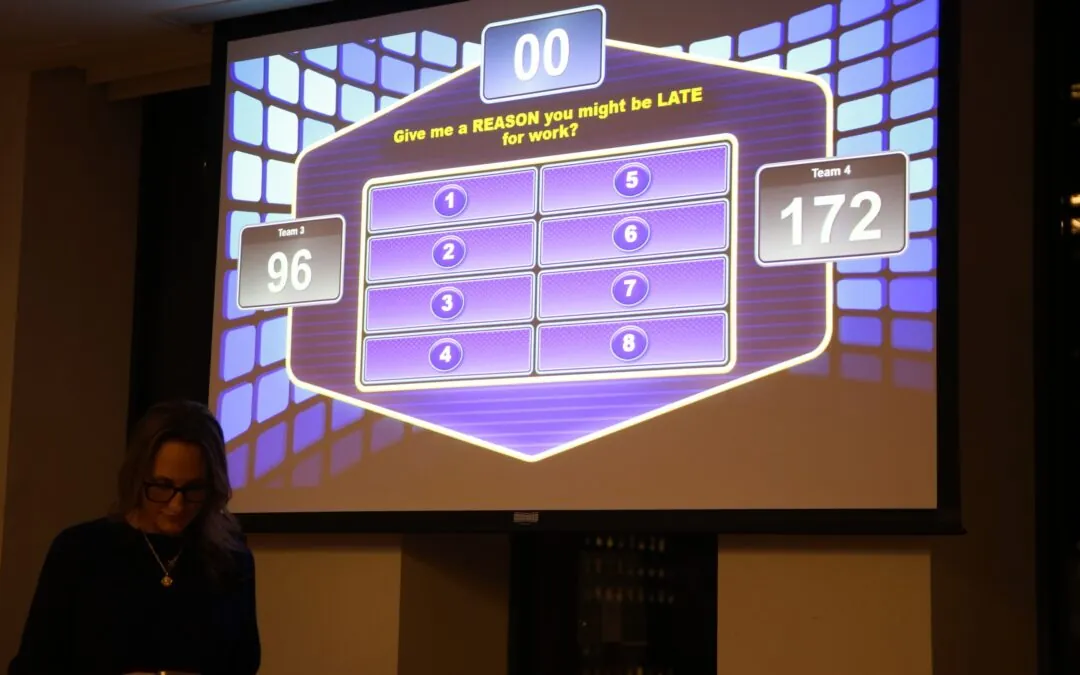
A good office party turns coworkers who barely speak into a team that laughs together. That matters more than most managers admit, because Gallup reports that only 20% of employees feel engaged at work. A fast, funny game built around your own coworkers fixes that energy in an afternoon.
People remember the moments they took part in, not the ones they watched. Pew Research found that most workers value the social side of their jobs, which is exactly what a Family Feud style game delivers. The format is simple, the laughs are guaranteed, and the questions below are ready to play.
Most organizers hit the same wall. You want questions that land with sales reps and accountants alike, answers that feel fair, and a game that runs on time without dead air. You do not want anything that singles out a quiet teammate or sparks an awkward joke. The categorized bank below solves all of that, with ranked answers you can read straight off the page.
The Fast Version
Only 20% of employees feel engaged, and a fast shared game can shift that energy in one afternoon.
A Family Feud style game turns coworkers who barely speak into a team that laughs together.
Pew Research found most workers value the social side of their jobs, which this format directly delivers.
The game works across departments, with sales reps and accountants competing on equal, familiar ground.
A categorized question bank lets you run the whole event without writing questions from scratch.
How to Run Family Feud at Your Work Party
The rules stay close to the TV show. Split the room into two teams. One player from each team faces off on the first question. Whoever guesses the highest-ranked answer controls the round. That team keeps guessing until they reveal every answer or collect three strikes, at which point the other team steals with a single guess.
Read the question, then count down from five for the buzz-in answer.
Award the points listed next to each answer.
Use a whiteboard or screen to reveal answers as teams call them.
Run six to eight questions, then a fast-money final round.
Each answer below shows a sample point value out of 100. Treat those as your board. They are written to feel like real survey results from a typical office crowd.
Office Life Questions
These warm up the room because everyone recognizes the daily routine. Start here.
Name something coworkers do when they are bored at their desk.
Check their phone (38)
Browse the internet (24)
Get coffee or a snack (18)
Chat with a neighbor (12)
Stare out the window (8)
Name a sound everyone hears in an open office.
Typing on keyboards (31)
Phone ringing (26)
People talking loudly (21)
The printer running (14)
Someone eating chips (8)
Name something people pretend to do during a long meeting.
Take notes (40)
Pay attention (27)
Agree with the boss (16)
Read the slides (11)
Stay awake (6)
Coworker and Personality Questions
These spark friendly finger-pointing across teams, which is half the fun.
Name a type of coworker every office has.
The one who is always late (33)
The office gossip (25)
The overachiever (19)
The fridge food thief (14)
The one who never replies to email (9)
Name something a coworker borrows and never returns.
A pen (36)
A phone charger (28)
Money for lunch (18)
A stapler (11)
A book or document (7)
Name a phrase coworkers say to sound busy.
“I am swamped” (35)
“Let me circle back” (27)
“I am in back-to-back meetings” (20)
“Per my last email” (12)
“I will look into it” (6)
Break Room, Food, and Lunch Questions
Food questions unite every department because everyone eats. Use these in the middle of your game.
Name the most popular item in the office vending machine.
Chips (34)
Candy bar (26)
Soda (20)
Crackers (12)
Gum (8)
Name a food that stinks up the whole break room when reheated.
Fish (42)
Broccoli (23)
Popcorn, burnt (18)
Curry (11)
Eggs (6)
Name something people fight over at a work potluck.
The last slice of pizza (37)
Dessert (25)
The good parking near the food (18)
Who brought the best dish (13)
Leftovers to take home (7)
Remote Work and Tech Questions
Hybrid teams love these because they name the shared chaos of video calls.
Name something that always goes wrong on a video call.
Someone is on mute (39)
Bad internet freezes the screen (27)
A pet or kid interrupts (17)
Background noise (10)
The wrong screen gets shared (7)
Name a reason people keep their camera off in a meeting.
They are not dressed for it (34)
They are eating (24)
Their room is messy (20)
They are multitasking (14)
Slow connection (8)
Holiday and Party Questions
Close with these to set up a fast-money finale.
Name something you always find at an office holiday party.
Awkward dancing (32)
Free food (28)
A gift exchange (19)
The boss giving a speech (14)
Someone who had too much eggnog (7)
Name a gift nobody wants in a Secret Santa.
A mug (35)
Re-gifted candle (26)
Office supplies (19)
A gift card for the wrong store (13)
Socks (7)
Key Issues Hosts Run Into Every Time
The questions are easy. Hosting cleanly is the hard part. Planners run into the same obstacles every time.
Keeping score under pressure: tracking strikes, steals, and points while reading the room splits your attention fast.
Pacing the room: a slow host kills momentum, and dead air loses the crowd within two questions.
Reading answers fairly: debates over what counts as a match stall the game and frustrate teams.
Managing energy: shy coworkers freeze without a host who pulls them in with a smile, not a spotlight.
Equipment gaps: buzzers, a big screen, and a sound setup make the difference between a real show and a quiet quiz.
Why a Hosted Game Show Beats DIY
Running this from a printout works for a small team over lunch. For a full party, a professional host changes the result. It’s PlayTyme Game Shows brings a polished emcee, real buzzers, broadcast-style screens, and a tested set of custom questions to venues across New Jersey, New York City, and Connecticut. You play as a guest instead of working as the host.
The pros also tailor the board to your company. They swap in inside jokes, department names, and your own survey results, which lands far harder than generic questions. Scoring, pacing, and fairness are handled, so the only thing your team does is laugh and compete.
Ready to turn your next office party into the event people talk about for months? Contact It’s PlayTyme to check dates, or explore our corporate event game shows built for teams across NJ, NYC, and CT.
Match the bank to your people. A casual team loves the coworker and food questions, while a mixed corporate group plays safer with office life and tech rounds. Skip anything that targets one person or division. Test six to eight questions, keep two spares, and end on a holiday or party question that everyone can answer for a strong finish. If your party runs past 40 guests, hire a host so the game holds the room instead of fading. Pick the questions that fit your culture, and the laughs follow.
Frequently Asked Questions (FAQs)
How many family feud questions do I need for a work party?
Plan six to eight main questions plus one or two fast-money questions for the finale. That fills about 30 to 45 minutes of play. Keep two extra questions ready in case a round moves faster than expected.
What questions work best for a mixed department crowd?
Office life, food, and tech questions land with everyone because the experiences are universal. Avoid questions that single out a role or person. Shared topics like video call mishaps and break room food keep every team laughing together.
Should we hire a host or run it ourselves?
Run it yourself for a casual small-team break. Hire a host for a real party, especially past 40 guests, where pacing, scoring, and inclusion get hard to manage solo. A pro brings equipment and custom questions that make it feel like the real show.
Nearly 64% of companies plan holiday celebrations each year, according to the Challenger, Gray & Christmas annual survey. Yet many event planners and office managers walk into the process without a structured budget, leading to overspending in one area and cutting corners in another. Meanwhile, Gallup’s State of the Global Workplace report shows global employee engagement sits at just 20%, making well-planned recognition events more important than ever for morale and retention.
Quick answer: Most companies budget $75 to $200 per person for an office Christmas party, covering venue, food, drinks, and entertainment. A hosted game show from It’s PlayTyme starts at $2,995 for 60 minutes or $3,595 for 90 minutes (see pricing) and replaces several separate vendor costs with one high-energy experience.
The typical office christmas party budget falls between $75 and $200 per person when you factor in venue, food, drinks, entertainment, and extras. That range sounds wide because it is. A pizza-and-playlist gathering in the break room costs a fraction of a seated dinner at a downtown venue with a live entertainer. The question is not “how much should we spend?” but “where should each dollar go to get the best reaction from our team?”
Most planners face the same set of challenges: a fixed budget handed down from leadership, rising catering costs that eat into other categories, pressure to top last year’s event, and zero guidance on how to split funds across venue, food, entertainment, and decorations. Without a framework, you end up guessing, and guessing leads to either a forgettable event or a bill that triggers a tough conversation with finance.
The Essentials
Nearly 64% of companies host holiday parties, but most planners start without a structured budget.
Gallup puts global employee engagement at 20%, making well-planned parties matter more than ever.
The typical per-person budget runs $75 to $200 once venue, food, drinks, and entertainment are included.
The range is wide because a break-room pizza night and a seated dinner sit at opposite ends.
The key question is not how much to spend but where each dollar creates the best reaction.
Where Office Christmas Party Budgets Go Wrong
Before diving into the numbers, acknowledge what makes this process difficult. Recognizing these obstacles early prevents budget blowouts later.
No historical baseline. If your company has never tracked party spending by category, you have no reference point. Everything feels like a guess.
Catering inflation. Food and beverage costs have risen sharply since 2022. A per-head catering quote that was $45 two years ago is closer to $60 today.
The “one size fits all” trap. A 20-person startup and a 200-person department need completely different budget structures, yet most online advice gives a single number.
Entertainment as an afterthought. Many planners allocate nearly everything to food and venue, then scramble for cheap entertainment. The result is a dinner that feels like an obligation, not a celebration.
Pressure to impress without overspending. Leadership wants a memorable event. Finance wants a reasonable receipt. Balancing both requires a clear, category-by-category plan.
Step 1: Determine Your Total Per-Person Budget
Start with the number that matters most: how much your company will spend per attendee. Use these benchmarks as a starting point.
Budget-friendly tier ($40 to $75 per person): In-office or casual venue, buffet-style food, DIY decorations, a curated playlist or simple activity.
Mid-range tier ($75 to $150 per person): Rented event space, catered meal with a drink package, professional entertainment, themed decorations.
Premium tier ($150 to $200+ per person): Upscale venue, plated dinner with open bar, headline entertainment, party favors, and full event production.
Multiply your per-person target by your expected headcount to set the total budget ceiling. Add a 10% contingency buffer for last-minute costs like additional guests or AV rentals.
Step 2: Allocate for Venue Rental
Venue costs range from $0 (your own office) to $50+ per person for a private event space. In the NJ, NYC, and CT tri-state area, expect to pay $1,500 to $5,000 for a mid-size venue that holds 50 to 150 guests.
Ways to reduce venue costs
Book a restaurant with a private dining room instead of a standalone event hall. Many waive the room fee if you meet a food and beverage minimum.
Host the party at your own office. A conference room or open floor plan transforms easily with the right decorations and entertainment.
Choose a weekday evening (Tuesday through Thursday) over a Friday or Saturday. Venues often discount midweek bookings by 15% to 30%.
If you host in-office, reallocate the venue savings toward better catering or a standout entertainment experience. The venue is the container; the content inside it is what people remember.
Step 3: Budget for Catering and Drinks
Food and beverages typically consume the largest share of your office christmas party budget, roughly 40% to 50% of total spending. Here is what to expect per person in the tri-state area.
Appetizers and light bites: $15 to $25 per person. Works for cocktail-style events lasting two to three hours.
Buffet dinner: $30 to $55 per person. The most common format for office parties. Offers variety without the cost of plated service.
Plated sit-down dinner: $50 to $100+ per person. Best for smaller, more formal gatherings.
Drink packages: $15 to $35 per person for a two-hour open bar. A beer-and-wine-only option cuts this by roughly 40%.
Cost-saving tips for catering
Order platters from a local caterer instead of using the venue’s in-house kitchen. Ask about family-style service, which costs less than plated meals but feels more upscale than a buffet line. Set a drink ticket limit (two to three per guest) to control bar costs without eliminating the open-bar feel.
Step 4: Invest in Entertainment That Delivers
Entertainment is where most office party budgets either shine or fall flat. A DJ playing background music while people eat is not entertainment. It is ambiance. True entertainment gives people something to do together, something to talk about on Monday morning.
Here is a realistic cost comparison for common entertainment options:
A live, interactive game show stands out because it involves every person in the room, not just the extroverts. It’s PlayTyme Game Shows runs TV-style competitions (think Face 2 Face Feud, The Challenge trivia rounds, and Name That Hit Song music challenges) that turn a standard holiday dinner into a high-energy team event. At a per-head cost comparable to hiring a DJ and renting a photo booth separately, a game show replaces two line items with a single experience that gets the entire room laughing and competing together.
For groups of 30 to 300 across New Jersey, New York City, and Connecticut, this format works at your office, a restaurant, a hotel ballroom, or any venue with enough space and a screen. The entertainment doubles as team building, which means you get two outcomes (celebration and connection) for one budget line.
Step 5: Set Aside Funds for Decorations, Favors, and Extras
These categories are smaller but still matter. Budget roughly 10% to 15% of your total for the finishing touches.
Decorations ($200 to $1,500)
A few well-placed elements do more than covering every surface. Focus on the entrance, the main table or stage area, and a photo backdrop. String lights, greenery, and candles create atmosphere without a huge cost. Skip balloon arches and elaborate centerpieces unless your budget lands in the premium tier.
Party favors ($5 to $15 per person)
Optional but appreciated. Branded mugs, small gift boxes, or scratch-off lottery tickets are popular choices. If the budget is tight, skip individual favors and invest that money into a few raffle prizes instead. A $200 raffle prize pool generates more excitement than $5 trinkets at every seat.
Extras to budget for
AV equipment rental (projector, speakers, microphone): $150 to $500 if your venue does not include it.
Printed materials (invitations, signage, name tags): $50 to $200.
Transportation or parking subsidies for downtown venues: $10 to $25 per person.
Step 6: Build Your Budget Spreadsheet
Take the categories above and plug in your numbers. Here is a sample allocation for a mid-range office christmas party budget of $100 per person with 75 guests ($7,500 total).
Venue: $1,500 (20%)
Catering and drinks: $3,375 (45%)
Entertainment: $1,500 (20%)
Decorations and favors: $750 (10%)
Contingency: $375 (5%)
Adjust the percentages based on your priorities. If you host in-office and eliminate the venue cost, shift that 20% into entertainment or catering upgrades. If your team values experiences over food, pull 10% from catering and add it to the entertainment line.
Step 7: Lock in Vendors Early
Holiday party season runs from late November through mid-December. The best venues, caterers, and entertainers book out weeks in advance. Follow this timeline to stay ahead.
8 to 10 weeks before: Set the date, confirm headcount range, and book the venue.
6 to 8 weeks before: Book entertainment and finalize the catering menu. Request tastings if available.
4 weeks before: Send invitations, confirm AV needs, and order decorations.
2 weeks before: Confirm final headcount with the venue and caterer. Brief the entertainment provider on any special requests (awards, speeches, team names).
Day of: Arrive early, walk the venue, test AV, and do a final check with each vendor.
Early booking also protects your budget. Vendors charge rush fees for last-minute requests, and limited availability forces you into pricier alternatives.
How to Get the Most Value From Every Dollar in Your Party Budget
The difference between a forgettable party and a talked-about one is rarely the total spend. It is where the money goes. Three principles guide smart allocation.
Prioritize shared experiences over individual perks. A hosted game show that 75 people play together creates a stronger memory than a bag of individual swag. Shared laughter and friendly competition build connections that individual gifts do not.
Cut what no one notices; protect what everyone remembers. No one leaves a holiday party raving about the napkin rings. People remember the food quality, whether they had fun, and how the event made them feel about their workplace. Spend accordingly.
Combine line items when possible. An interactive team building game show replaces a DJ, a photo booth, and an icebreaker activity with a single, higher-impact experience. Fewer vendors means fewer coordination headaches and often a lower combined cost.
Ready to lock in entertainment that makes your office christmas party budget work harder? Reach out to It’s PlayTyme Game Shows to get a quote for your holiday event. The team brings everything (host, equipment, music, energy) to your venue across NJ, NYC, and CT, so you check entertainment off the list and focus on the rest of your plan.
What share of the budget should go to entertainment?
The sample allocation in this guide sets aside about 20% for entertainment, which is a sensible starting point. If team bonding is a goal for the party, entertainment is usually the line worth protecting when other costs rise.
How much does a hosted game show cost?
Hosted game shows from It’s PlayTyme are starting at $2,995. The final figure depends on your group size and whether you choose the 60-minute or 90-minute show.
Is a per-person budget or a fixed total easier to manage?
A per-person figure makes it easier to adjust when headcount changes, while a fixed total is usually easier to get approved. Many planners set the total first, then check that the per-person amount still covers catering.
What costs do planners forget most often?
Service charges and gratuity on catering, AV rentals and transportation for guests. A contingency line, like the 5% in the sample allocation, absorbs these without forcing cuts elsewhere.
Frequently Asked Questions (FAQs)
How much should a company spend per person on a Christmas party?
Most companies spend between $75 and $150 per person for a well-rounded office holiday party. This range covers a rented venue, catered food with drinks, professional entertainment, and basic decorations. Smaller teams with tighter budgets still deliver strong events in the $40 to $75 range by hosting in-office and focusing spending on food and entertainment.
What percentage of the budget should go to catering?
Plan to allocate 40% to 50% of your total office christmas party budget to food and beverages. Catering is the single largest expense and the one guests notice most. A buffet at $35 to $55 per person hits the sweet spot between quality and cost control for most mid-size corporate events.
Is it worth hiring professional entertainment for a holiday party?
Professional entertainment transforms a dinner into an event people talk about for weeks. Interactive formats like game shows generate full-room participation and double as team building, giving you two outcomes for one line item. The cost (starting at $2,995 for a hosted game show, see our pricing estimator) competes favorably with hiring a DJ and photo booth separately.
How far in advance should I book vendors for a Christmas party?
Book your venue, caterer, and entertainment provider at least six to eight weeks before the event. Planning early to mid-December events well ahead gives you more choice and more time for custom content. Starting in October gives you the best selection and the strongest negotiating position on pricing.
What is the easiest way to cut costs without a noticeable drop in quality?
Host the party at your own office instead of renting a venue. This single change frees up 15% to 25% of the total budget, which you redirect into better food or standout entertainment. Choosing a weekday evening, offering beer and wine instead of a full open bar, and replacing individual favors with a raffle prize pool are three additional moves that trim costs while keeping the experience strong.
Most group events in Midtown, the Financial District, or Brooklyn end the same way. People drift into the cliques they already sit with, and the open bar handles the rest. Gallup found that 20% of employees worldwide were engaged in 2025, down from a peak of 23%, at a cost of $10 trillion in lost productivity to the global economy.
Connection is the piece most companies skip. Gallup also reports that two out of 10 U.S. employees strongly agree they have a best friend at work, and estimates that organizations moving that ratio to six in 10 would see 12% higher profit. Team building activities NYC planners book should build those relationships on purpose, not leave them to chance. That is the case for interactive corporate event entertainment NYC staff actually take part in, rather than another room where they stand and sip.
Why Most Corporate Outings in New York City Miss the Mark
Bring it to your New York office
We host across Manhattan, Brooklyn, Queens, the Bronx and Staten Island, plus Westchester and Long Island. No venue to hire, because we come to your space. Groups of 20 to 300+ on published pricing.
Passive Formats Reward the Loudest People in the Room
Happy hours and catered lunches run on organic conversation. In a group of 60, the same eight extroverts carry the night while everyone else checks their phone. Quiet employees, new hires, and anyone outside the core clique go home having spoken to nobody they did not already know. The event reinforces the silos you were trying to break.
Manhattan Logistics Eat the Budget Before Anyone Plays
Private venue minimums near Midtown and the Financial District climb fast, and the calendar tightens months out. Then you move 80 people across town at 5:30 p.m. Half the group arrives late and the schedule collapses. Indoor team building activities NYC teams can run inside their own office or a booked ballroom take that risk off the table completely.
High-Exertion Activities Leave People on the Sidelines
Obstacle courses and outdoor endurance challenges read well in a proposal. In practice they exclude anyone with a mobility limitation, a bad knee, or no interest in competing physically in front of coworkers. An activity that sidelines part of your staff is not a team experience, and the people it excludes are usually the ones you most wanted to pull in.
Hybrid and Onsite Staff Never Actually Mix
A quarterly all-hands is often the only time remote employees stand in the same room as the colleagues they message every day. A cocktail hour does not close that gap, because remote staff head straight for the two people they already know. Employee engagement activities for work only pay off when the structure forces cross-group interaction instead of hoping for it.
Headcount Moves Right Up to the Day Of
Corporate RSVPs shift constantly. Escape rooms and cooking classes lock you into fixed capacity slots, so a swing of 15 people breaks the plan and triggers a rebooking call. Room-scale formats absorb the change without anyone noticing.
Nobody Can Say Whether the Event Worked
Leadership approves the spend and then hears nothing measurable back. Without a format where participation is visible, the only feedback is a few thank-you emails from the people who were going to enjoy it anyway. Planners need an event where you can watch the whole room take part in real time.
Comparing Team Building Activity Formats in New York City
The right format comes down to three things: how many people you have, where you can put them, and how many of them actually participate. Here is how the common New York City options compare.
Activity Format
Group Size
Room Participation
Venue Flexibility
Planning Load
Live Hosted Game Shows (It’s PlayTyme Game Shows)
20 to 300+ people
Everyone in the room plays
Your office, hotel ballroom, or offsite
Host, sound, and gear included
Escape Rooms and Scavenger Hunts
10 to 30 people
Small squads only
Offsite travel required
Heavy coordination
Cooking and Culinary Workshops
10 to 40 people
Depends on station count
Dedicated kitchen venue
High venue cost
Physical Adventure Courses
10 to 25 people
Low to moderate
Outdoor or sports facility
Weather and injury risk
Cocktail Receptions
Any size
Passive mingling
Bar, restaurant, or private suite
Low effort, no structure
Live Game Shows: Everyone Plays, Nobody Watches
At It’s PlayTyme Game Shows, the game show is the vehicle, not the point. The point is connection, camaraderie, and a room full of people interacting on purpose. The company has been hosting since 2012 and has run 3,000+ events across New Jersey, New York City, New York State, and Connecticut.
For corporate team building, offsites, and staff kickoffs, a hosted show gives you structure that a happy hour never will. Formats like Face 2 Face Feud, 60 Seconds of Fame, and Word Play put employees on stage in front of their peers. Everyone else votes, answers, and cheers. Departments end up competing with each other and laughing about it a week later.
Scale is where onsite team building games for large groups usually break down, and it is the specific thing a hosted show is built to handle. Audience voting and team-based scoring keep a 250-person ballroom as active as a 30-person conference room, because nobody sits waiting for a turn that never comes.
A professional host also protects your leadership team. Managers stop running the event and start playing in it, which is where the real connection happens. Nobody remembers the VP who read questions off a clipboard. They remember the VP who lost a round to the intern.
Seasonal and Themed Programs Across Midtown Manhattan and Beyond
Timing drives demand. Autumn kickoffs and Q4 celebrations book heavily, and the same trivia format gets stale if you run it twice a year unchanged.
Themed shows solve that. Halloween team building events in New York City work better as a hosted competition than as a costume party where three people dress up and the rest keep their coats on. Custom rounds built on company milestones, executive trivia, or your own industry turn a themed night into something employees quote back to each other for months.
HR leaders, executive assistants, and office managers own this decision. Four questions separate a good booking from an expensive one.
Inclusivity: Can every employee take part regardless of mobility, fitness, or comfort speaking in front of a group?
Logistics: Does the provider bring the sound system, buzzers, and displays to your venue, or are you renting and hauling equipment?
Facilitation: Does a professional run the pacing and the energy, so your leaders participate instead of hosting?
Scale: Does the format hold up from 20 people to 300 without losing the back of the room?
The Deciding Factor: Does Every Person in the Room Get to Play?
Answer that one question and the shortlist shrinks fast. Formats built around small squads or physical ability will always leave part of your staff watching from the side. A hosted game show puts the entire group in the same competition at the same time, and that is the version people still talk about on Monday.
Tell us your headcount, your date, and your venue, and we will build the show around it. Contact our team to check availability for your date. Every event comes with a 100% satisfaction guarantee.
Frequently Asked Questions (FAQs)
What group sizes work for team building activities in NYC?
Hosted game show packages run from 20 people up to 300. Audience voting, on-stage rounds, and team-based scoring keep the back of the room involved at every size, so a 250-person ballroom plays as actively as a 30-person conference room.
How does a hosted game show compare to DIY office trivia or a happy hour?
DIY trivia puts hosting on an internal manager who then spends the night reading questions instead of connecting with the team. A professional host handles audio, pacing, and game mechanics. Your leaders compete alongside their staff, and the format guarantees the whole room participates.
Can a game show run inside our existing Manhattan office?
Yes. Shows are fully portable and run in conference rooms, cafeterias, hotel ballrooms, and offsite venues across New York City. The crew brings the sound system, buzzers, and visual displays, so you do not rent equipment or move your team across town.
What seasonal options are available for autumn and Q4 events?
Halloween-themed shows, autumn kickoffs, and holiday trivia are all available for Q3 and Q4 gatherings. Rounds get customized with company milestones, industry questions, and inside references your staff will recognize.
How much does a corporate game show cost in NYC?
Our shows start around $2,995 for groups of 20 or more. Use our pricing estimator to see the range for your group size. A 60-minute show is also available, and half-day and full-day team building programs are custom-priced through a rep. Every package includes the host, the production gear, setup, and breakdown, while extensive customization and travel outside NJ, NYC and CT may be quoted separately.
Bring it to your New York office
We host across Manhattan, Brooklyn, Queens, the Bronx and Staten Island, plus Westchester and Long Island. No venue to hire, because we come to your space. Groups of 20 to 300+ on published pricing.
The annual corporate holiday party puts planners on the spot. You need an event that feels fresh and worth leaving the house for on a cold December night. The usual catered lunch, awkward happy hour, or predictable company Christmas party rarely gets people to connect. Instead you get small cliques, phones out, and a room full of people counting the minutes. That disconnect points to a bigger problem. Gallup’s 2023 report found that only 20% of employees are engaged at work, so standard morale efforts are missing the mark.
Quick answer: Unique corporate holiday party ideas go beyond a catered lunch by giving every employee one shared activity to play, not just watch. A hosted TV-style format like Face 2 Face Feud or a trivia board turns a standard holiday party into a memorable event for groups of 20 to 300 or more.
Real connection drives retention, not just morale. McKinsey found that 51% of employees who left their jobs pointed to a lack of belonging. Your end of year party is a prime opportunity to build that camaraderie, but only when the activity itself provides genuine interactive entertainment. Here are seven corporate holiday party ideas for your 2026 event across NJ, NYC, and CT that put participation ahead of passive attendance.
Book Now for 2026: Start planning before the fall. The best venues and experiences book up months in advance. Secure your date now for a smooth planning season. Contact us to check availability.
Instead of hoping guests will mingle, make interaction the main event. A professionally hosted, live game show puts your employees at the center of the action. This isn’t entertainment you watch. Your team becomes the stars of a familiar, high-energy TV-style format like Face-2-Face Feud, The Challenge trivia board, or fast-paced team challenges. The whole experience gets the room laughing, competing, and connecting from the first question to the final round.
At It’s PlayTyme Game Shows, we measure great events by how many people take part. Founder Lisa Lawrence has built a craft out of engaging large groups across New Jersey, New York, and Connecticut. We handle everything: a professional host, a dynamic format, and all the audio-visual gear to transform your office, conference hall, or rented venue. The focus is 100% participation, so everyone from the quietest intern to the CEO joins a team and has a role to play. The same formats power memorable school events, from interactive assemblies for students to staff professional development and project graduation celebrations that stay safe and exciting. Best of all, every event is backed by our 100% satisfaction guarantee.
2. An Axe-Throwing Tournament
What it is: Axe-throwing venues give teams a safe, controlled space to learn hatchet technique on wooden targets, then compete in a tournament. A coach stays on hand to teach form and manage safety.
Why it’s different: It’s active, a little edgy, and delivers a real thrill. It cuts through typical corporate small talk and creates instant shared focus. For a team that loves friendly rivalry, it ranks among the better competitive outings.
Group size: Best for 15 to 80 people. Most venues run a structured tournament around that range based on their lane count.
What can go wrong: The main risk is mismatched enthusiasm. For every person eager to throw a sharp object, another feels intimidated or simply can’t take part, which splits the group into players and spectators. Venues manage safety tightly, but the activity still makes some attendees anxious.
3. A Culinary Competition
What it is: Your group heads to a commercial kitchen or cooking school, splits into teams, and takes on a set dish or full meal. A chef teaches, then judges the results before everyone digs into the feast they made.
Why it’s different: This one is hands-on, collaborative, and sensory. Teams have to communicate, split up roles like chopping, mixing, and plating, and pull together toward a tangible goal. The payoff is built in: you eat your work.
Group size: Best for smaller groups of 10 to 60. Larger groups fit, but the experience feels less personal.
What can go wrong: Kitchen chaos is real. Uneven skill levels can leave one person doing the work while others watch. Managing dietary restrictions and allergies in a competitive cooking setting takes careful planning with the venue.
4. An Escape Room Gauntlet
What it is: You split the company into small teams of five to eight, and each team tackles a different themed room at the same time. The goal: solve the puzzles and escape inside a 60-minute limit.
Why it’s different: It’s an intense, cerebral test of communication, logic, and problem-solving under pressure. You quickly see how different personalities work together.
Group size: Works for 10 to about 50 people. The cap is the number of rooms at a single venue.
What can go wrong: Your large group splinters right away. Teams sit isolated in separate rooms for the whole activity, which blocks cross-team mingling. Teams also finish at very different times, so fast groups wait around for 20 to 30 minutes while others grind on.
5. A “Give-Back” Volunteering Event
What it is: Instead of a traditional party, the company teams up with a local nonprofit. The group spends the day volunteering, whether that means sorting food at a food bank, building bikes for kids, or cleaning up a park, then shares a casual meal.
Why it’s different: This idea ties the team to a shared purpose beyond the bottom line. Meaningful work builds camaraderie, strengthens your community reputation, and leaves everyone feeling good about their contribution.
Group size: Flexible, from 15 to 100+, based on the charity partner’s needs and capacity.
What can go wrong: Some employees read it as work rather than a reward, so it may not feel celebratory enough for a holiday event. The logistics also run deep, since you coordinate with an outside organization months ahead to keep the day organized and worthwhile.
6. A Custom City Scavenger Hunt
What it is: A professional company builds a custom scavenger hunt for your team and sends them across a neighborhood or a full city district in NYC. Teams use their phones to get clues, solve riddles, and complete photo challenges for points.
Why it’s different: It gets people out of the office and into the streets, pairing teamwork with active exploration. The competitive format rewards strategy and keeps energy high. It’s a great way to see a familiar city in a new light.
Group size: Scales well from 20 to 300+ people.
What can go wrong: The weather runs the show. A December hunt in the tri-state area gambles against rain, snow, and biting cold that can sink the mood fast. You also risk losing track of teams, and groups that fall behind tend to disengage.
7. A Private Theater & Awards Night
What it is: Rent a small local movie theater for a private screening of a holiday classic or a recent blockbuster. Before the film, run a short, fun awards ceremony on the stage.
Why it’s different: This option feels relaxed and nostalgic. It gives people a shared experience without forcing interaction. The awards ceremony is your moment to make it personal, celebrating individual and team wins from the year. Get creative with playful, funny award names, since the trophies don’t need to be extravagant. The goal is recognition, so make each prize feel special and specific to the person.
Group size: Best for 30 to 150 people, depending on the size of nearby independent theaters.
What can go wrong: The activity is passive. People sit in the dark for two hours without interacting. Picking a movie everyone likes is tough, and the night can feel impersonal when the awards ceremony falls flat.
What Makes Unique Holiday Parties Hard to Execute
Stepping past the standard dinner party brings new complications. Start with budget: unique experiences often carry per-person costs well above a simple catering bill. Then there’s the logistical load. Coordinating third-party vendors, managing waivers, arranging transportation, and planning for bad weather all land on the organizer. There is also the fear of forced fun, where an activity meant to loosen people up instead reads as awkward or cringe-worthy and leaves employees checking their watches. Distributed teams add another wrinkle, since remote and hybrid staff are spread across locations and one event has to include everyone, which is exactly why a high-energy, in-person format earns its keep for the days the whole company is together. Leaders also increasingly expect proof that the spend was worth it, so you need an event that produces visible outcomes like stronger cross-department communication and genuine post-event buzz rather than a line item no one can justify. On top of all that sits the people problem. Finding one activity that works for a wide range of ages, physical abilities, and interests is close to impossible. A fear of heights, a distaste for competition, or a simple wish for a low-key evening can turn even a creative idea into a stress point for some employees.
Choosing the Right Holiday Party for Your Culture
The best holiday party isn’t the flashiest one. It’s the right fit for your culture and goals. Before you book, ask three questions:
What is our goal? Are you rewarding a hard year with relaxation, improving communication between departments, or just giving people a good time? Your goal should drive the choice. A scavenger hunt suits competition, while a volunteer day builds shared purpose.
Who is on our team? Be honest about your group’s personality. Are they adventurous and competitive, or do they prefer something social and low-key? Weigh age range, activity levels, and the introvert-extrovert mix, then pick the activity with the broadest participation.
What is our capacity for planning? A multi-vendor, off-site event eats up planning hours. A fully hosted option, where one partner runs every detail of the core activity, saves time and cuts stress. Be realistic about what you can handle during a busy fourth quarter.
Answering these questions helps you cut through the endless list of holiday party ideas and land on the one that makes your 2026 event a real win.
Ready to plan a holiday party where everyone takes part and the planning stays simple? Let’s build a custom game show experience for your team. Reach out today to lock in your date.
How do we choose one idea when leadership wants something different?
Start with the guest count and the room, then rule out anything that only a few people can do at once. Axe throwing and escape rooms often run in small rotations, while a hosted game show includes the whole room together.
Which of these ideas works for a group of 150 or more?
The ideas that happen in one room at one time scale best, such as a hosted game show or an awards night. Scavenger hunts and escape rooms can work for large groups but usually have to be split into waves.
Can we combine two ideas in one holiday event?
Yes, as long as one is the main event and the other stays short. A volunteering activity earlier in the day followed by a game show at the party is a pairing that keeps the schedule manageable.
How do we make a unique party feel personal to our company?
Build it around your own year, including milestones, wins and department moments. It’s PlayTyme writes custom questions about your company into the game, so the content is about your team rather than generic trivia.
Frequently Asked Questions (FAQs)
What kind of lead time is needed for a corporate holiday party?
For unique venues or experiences, start planning three to six months out. Thursday and Friday nights are the most popular choices for December parties. A fully hosted provider like a game show host often has more flexibility, but booking two to four months ahead is still smart.
How do I plan a company party that employees actually want to attend?
Skip the passive setups people tune out and choose one shared activity the whole group joins at once. Employees show up for events that promise real interaction and a few laughs, not another catered sit-down. A familiar, high-energy format like a hosted game show works because everyone already knows how to play, so the barrier to jump in is low and no one feels put on the spot. Match the activity to your team’s personality, keep it participatory, and give people a reason to talk to someone they don’t normally sit next to.
What is the biggest mistake planners make with holiday parties?
The biggest mistake is focusing on the ‘what’ (food, venue, music) instead of the ‘who’ (your employees). A great party isn’t measured by the fanciness of the venue but by the quality of the interactions. Get your people talking, laughing, and connecting in a way they don’t during a normal workday.
How much should we budget for a unique holiday party?
Costs vary widely. Budget between $100 and $250 per person for an all-inclusive experience in the NJ, NYC, and CT area. Simpler on-site events with a host cost less than complex off-site activities that add venue rental, transportation, and catering.
What event ideas work for large, diverse corporate groups?
Large, mixed groups need an activity that scales without splintering into cliques or leaving anyone out. Escape rooms cap at a handful of people per room and separate your teams, while cooking classes lose their charm past a certain headcount. A hosted game show is built for the opposite: it folds 20 to 300+ people into one shared experience, gives every age and energy level a role, and keeps the whole room engaged at once. When your group spans departments, generations, and comfort levels, pick the format with the widest on-ramp.