Quick answer: The game show formats that work best at corporate events are the ones where every person plays on a team: Face-2-Face Feud (survey-style), The Challenge (trivia board), Word Play (word puzzles), 60 Seconds of Fame (one-minute challenges) and PlayPad Mania (room-wide keypads). A professional host runs each one as a team-building session for 20 to 300+ people.
Only 20% of employees worldwide feel engaged at work, according to Gallup’s State of the Global Workplace report. One of the fastest ways to build connection at work is a shared experience that gets people laughing, competing, and collaborating outside their usual roles.
Game show ideas for corporate events give planners a format that works across departments, personality types, and group sizes. Unlike passive activities or forced opening activities, a well-run game show puts every attendee in the action and creates natural conversation long after the event ends. If team connection is the goal, game show team building is the place to start.
But choosing the right format is harder than it sounds. Groups of 20 need a different setup than groups of 200. Some teams thrive on trivia while others shut down the moment you mention “quiz.” Remote employees, mixed departments, and tight event timelines all create real planning headaches that generic team-building options rarely solve.
What You Need to Know
- Only 20% of employees worldwide feel engaged, making intentional social connection a business priority.
- Organizations with strong social connection programs report 56% lower employee turnover.
- Game show formats work across departments, personality types, and group sizes from 20 to 300+.
- Unlike passive activities, a well-run game show puts every attendee directly in the action.
- Matching format to group size and preference matters since not every team responds to trivia.
Challenges of Choosing Team Building for Corporate Events
Event planners consistently run into the same problems when booking corporate team building. The format either skews too competitive (alienating quieter team members) or too passive (everyone checks their phone). Finding game show ideas for corporate events that land in the middle requires understanding your audience.
Here are the most common obstacles:
- Mixed energy levels: Executives, new hires, and remote workers all respond differently to high-energy physical games versus cerebral trivia rounds.
- Group size mismatch: Activities designed for small teams fall apart at 100+ people, and large-group formats feel impersonal at 15.
- Customization limits: Off-the-shelf trivia kits lack company-specific content, making the event feel generic rather than tailored to your culture.
- Logistics and space: Conference rooms, hotel ballrooms, and outdoor venues each demand different setups, equipment, and timing.
- Engagement drop-off: Long formats lose attention. Short ones feel rushed. Getting the pacing right takes experience most in-house planners don’t have.
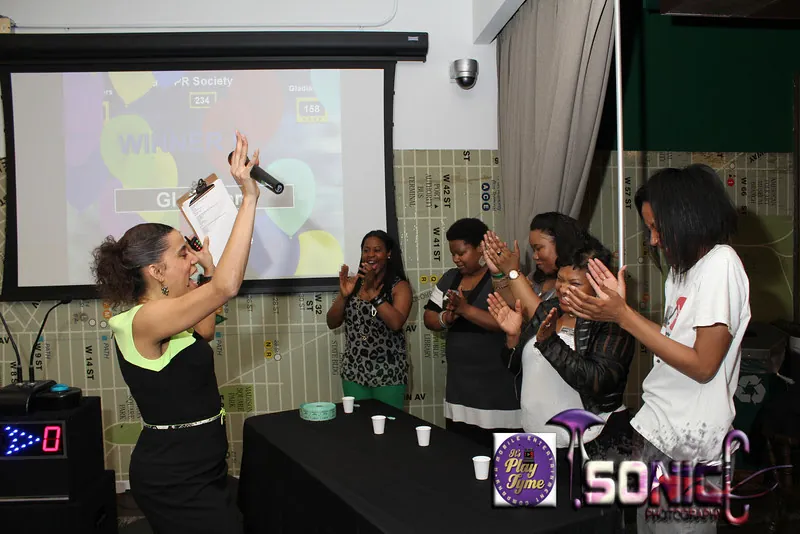
It’s Playtyme Game Shows solves these problems by bringing professional hosts, full production equipment, and a roster of proven formats to events across New Jersey, New York City, and Connecticut. Every show listed below is one they actually deliver, not a theoretical suggestion.
The Challenge: Trivia Board Showdown
The Challenge uses a trivia-board format most guests already know, and that familiarity makes it an instant crowd-pleaser at corporate events. Teams select categories and point values from a digital board and compete across multiple rounds, with a final wager at the end.
- Ideal group size: 20 to 300+ (teams of 4 to 8)
- Energy level: Medium. Cerebral and strategic with bursts of excitement on Daily Doubles.
- Customization: Categories built around company history, industry knowledge, product lines, or pop culture. Add inside jokes and executive trivia for extra laughs.
- Best for: Annual meetings, onboarding events, and teams that value knowledge and quick thinking. Works especially well when you want every department to feel competitive regardless of physical ability.
Face-2-Face Feud: Survey Battle
Face-2-Face Feud is the game show format with the broadest appeal. Two teams face off guessing the most popular survey answers, and the “survey says” reveal generates immediate reactions from the entire room. No specialized knowledge required, just common sense and a willingness to shout answers.
- Ideal group size: 20 to 300+ (rotating teams of 5)
- Energy level: High. The face-off buzzer, audience participation, and “strike” sounds keep energy up throughout.
- Customization: Surveys written about your company, your industry, or general pop culture. Pre-event employee surveys add a personal twist (“We surveyed 50 of your coworkers…”).
- Best for: Holiday parties, sales kickoffs, and large mixed groups. The format naturally includes the audience because everyone shouts suggestions. Works for groups where not everyone knows each other.
60 Seconds of Fame: Physical Challenges
60 Seconds of Fame uses simple household objects (cups, ping pong balls, cookies, tissues) in timed 60-second challenges. Contestants race the clock while teammates cheer them on. The tasks are deliberately silly, which strips away corporate formality fast.
- Ideal group size: 10 to 150 (individual contestants with team backing)
- Energy level: Very high. Physical movement, loud cheering, and visible countdown timers create arena-level energy.
- Customization: Challenge difficulty scaled to the group. Mix individual speed rounds with team relay challenges. Add branded props or company-themed tasks.
- Best for: Team building days, outdoor company picnics, and younger or high-energy teams. The physical component breaks people out of “meeting mode” faster than any other format.
Word Play: Word Puzzle Competition
Word Play brings word puzzle strategy into the corporate event space. Teams spin the wheel, call out letters, and race to solve phrases before their opponents. The combination of luck (the wheel) and skill (the puzzle) keeps every round unpredictable.
- Ideal group size: 15 to 100 (teams of 3 to 6)
- Energy level: Medium to high. The wheel spin adds suspense, and “Bankrupt” reversals keep underdogs in the game.
- Customization: Puzzles built around company slogans, product names, industry terms, or motivational phrases tied to the event’s theme.
- Best for: Conference breakout sessions, department meetings, and groups that enjoy wordplay. The slower pace between spins gives introverts time to contribute without shouting over extroverts.
Music and Performance Rounds
Name That Hit Song
Short clips of songs play through the sound system, and teams race to identify the title and artist. Rounds organized by decade, genre, or theme (movie soundtracks, one-hit wonders, songs from the year you were hired) keep the competition fresh.
- Ideal group size: 20 to 300+
- Energy level: Medium to high. Music triggers instant reactions and sing-alongs.
- Customization: Playlists matched to the audience demographic. Add a “company anthem” round using songs employees associate with team moments.
- Best for: Social mixers, an after-dinner team-building session, and multigenerational teams.
Lip Sync Challenge
Teams or individuals perform lip sync routines to songs of their choice, judged on energy, creativity, and crowd reaction. This format turns attendees into performers and the rest of the room into a cheering audience. It works because the bar for “talent” is zero: commitment beats ability every time.
- Ideal group size: 30 to 150
- Energy level: Very high. Pure energy with no wrong answers.
- Customization: Props and costumes provided. Themes like “decades” or “movie characters” add structure. Leadership participation gets the biggest reactions.
- Best for: Holiday parties, end-of-year celebrations, and teams that want a break from structured competition.
Digital Buzzer Games and Interactive Trivia
PlayPad Mania
Every participant gets a wireless buzzer pad, turning the entire audience into active players rather than spectators. Questions flash on screen, and the fastest correct answer wins points. Real-time leaderboards projected on screen drive friendly rivalry across the room.
- Ideal group size: 20 to 300+
- Energy level: High. Individual scoring means everyone competes, not just team captains.
- Customization: Question categories, difficulty progression, and bonus rounds all adjustable. Works with text, image, and video questions.
- Best for: Large conferences, all-hands meetings, and events where you need 100% participation from every seat. The technology scales without losing the personal competitive edge.
Trivia Mania
This format drops the TV show parody and builds a trivia game entirely around your organization. Questions cover company milestones, employee fun facts, industry knowledge, and inside references only your team would understand. It works as a standalone show or as a round within a larger game show event.
- Ideal group size: 10 to 100
- Energy level: Medium. More conversational and collaborative than buzzer-based formats.
- Customization: Fully custom by definition. Pre-event questionnaires gather material so every question resonates with the specific audience.
- Best for: Onboarding events, milestone celebrations, and smaller department gatherings where personal connection matters more than spectacle.
| Game Show Format | Group Size | Energy Level | Best For |
|---|---|---|---|
| The Challenge | 20 to 300+ | Medium | Annual meetings, onboarding |
| Face-2-Face Feud | 20 to 300+ | High | Holiday parties, sales kickoffs |
| 60 Seconds of Fame | 10 to 150 | Very High | Team building days, picnics |
| Word Play | 15 to 100 | Medium-High | Conferences, department meetings |
| Name That Hit Song | 20 to 300+ | Medium-High | Social mixers, after-dinner events |
| Lip Sync Challenge | 30 to 150 | Very High | Holiday parties, celebrations |
| PlayPad Mania | 20 to 300+ | High | Large conferences, all-hands |
| Trivia Mania | 10 to 100 | Medium | Onboarding, department gatherings |
How to Pick the Right Game Show for Your Corporate Event
Start with three questions: How many people are attending? What is the energy level you want to create? And what does success look like for this specific event?
A 30-person leadership retreat calls for something strategic and conversational, like Trivia Mania with custom office questions. A 200-person holiday party needs high-energy, low-barrier formats like Face-2-Face Feud or 60 Seconds of Fame. Conference breakout sessions work best with Word Play or The Challenge, where the pace allows reflection between rounds.
Consider your audience mix. If attendees span multiple departments and don’t know each other well, survey-based games (Face-2-Face Feud) and music rounds (Name That Hit Song) level the playing field because they don’t require specialized knowledge. If the group already has strong rapport, performance formats like Lip Sync Challenge reward the existing comfort level.
Customization separates a memorable event from a forgettable one. The best game show ideas for corporate events use company-specific content: inside jokes in trivia questions, employee survey data in Face-2-Face Feud rounds, product knowledge woven into Word Play puzzles. That level of personalization turns a generic activity into something people actually talk about afterward.
The simplest path is working with a provider that owns the equipment, trains the hosts, and has run hundreds of corporate shows. It’s Playtyme Game Shows brings full production setups (buzzers, screens, sound systems, branded graphics) to venues across NJ, NYC, and CT. Every format on this list is one they run regularly, so the logistics, timing, and audience management are already dialed in.
It’s Playtyme Game Shows brings the host, the game-show set and the sound engineer to your office or venue in New Jersey, New York City, New York State and Connecticut, for groups of 20 to 300+ people. Each format runs as a 60 or 90 minute team-building session. Tell us the date, room size and goal, and you’ll get a custom production plan within two business days: plan your corporate team-building game show.
Solve the participation problem
Ready to get the whole room in the game?
Frequently Asked Questions (FAQs)
How long does a corporate game show event typically last?
Most corporate game shows run 60 to 90 minutes, though the timing adjusts based on group size and format. A single-format show (just The Challenge or just Face-2-Face Feud) fits into a one-hour block. Multi-round events combining two or three formats fill a 60 or 90 minute team-building session without losing audience attention.
Do game shows work for remote or hybrid teams?
Yes. Formats like trivia, Face-2-Face Feud, and Name That Hit Song translate to virtual platforms with live hosts managing remote participants through video. Hybrid setups connect in-person and remote players on the same leaderboard. The key is choosing a provider with experience running both formats simultaneously.
How many people participate in a corporate game show?
Group sizes range from 20 to 300+ depending on the format. Buzzer-based games like PlayPad Mania scale to hundreds because every person plays individually. Team formats like The Challenge and Face-2-Face Feud work best with groups of 20 to 300+, divided into competing teams of 4 to 8 people each.
What types of corporate events are game shows best suited for?
Game shows fit team building days, holiday parties, sales kickoffs, annual meetings, team building at a conference, onboarding events, and end-of-year celebrations. The format adapts to the event’s tone: competitive for sales teams, collaborative for cross-department mixers, celebratory for milestones and holidays.
How far in advance should you book a corporate game show?
Most groups book 4 to 8 weeks ahead, and shorter notice often works when the date is free. For December parties, entertainment is usually booked last, after the venue and catering, so short notice is normal for us (we need at least 72 hours). Popular December dates can already be booked, though, so send your date as soon as you know it. Earlier booking gives you more format and date flexibility.
Can a corporate game show help reduce employee turnover?
SHRM research shows that organizations with strong recognition and social connection programs report 56% lower turnover, and a shared game show experience directly builds that social connection.
How is a game show different from other corporate team-building options?
Unlike passive activities or forced opening activities, a well-run game show puts every attendee in the action and creates natural conversation that continues long after the event ends.