Quick answer: The best pep assembly themes give students a role, not a seat. Pick by goal: Color Wars or a decades throwback for school spirit, an academic awards ceremony or STEM challenge for achievement, Kindness Week or unity themes for character, and a game show assembly when you want every grade level competing and cheering.
Student engagement at school is dropping — and traditional assemblies are part of the problem. A Gallup K 12 survey found that fewer than half of students say their schoolwork positively challenges them. Yet the upside of getting engagement right is enormous: according to Gallup’s follow-up research, the most engaged students are more than four times as likely to strongly agree they have a great future ahead of them.
Pep assembly themes are one of the most direct tools a school coordinator has for turning a gym full of distracted teenagers into a room that actually pays attention. The right theme gives an assembly structure, energy, and a reason for students to participate instead of scrolling their phones under the bleachers.
But choosing the right pep assembly themes is harder than it sounds. Coordinators deal with shrinking budgets, short planning windows, pressure to align with school values, and the reality that what excited students five years ago falls flat today. A theme that works for elementary schoolers bombs in a high school gym. An idea that sounds great in a planning meeting turns out to be impossible to execute with available staff and space. These are real problems, and they deserve real solutions.
Planning a pep assembly? Our hosted game shows get students off the bleachers and into the action, anywhere in NJ, NYC and CT.
Why Pep Assembly Themes Matter More Than a Pre-Game Hype Session
There is a meaningful difference between a pep rally and a pep assembly. A pep rally exists to build excitement before an athletic event. A pep assembly serves a broader purpose: reinforcing school culture, recognizing achievement, building community across grade levels, and delivering messages around character, safety, or academic goals. The theme is what ties the whole event together and gives it purpose beyond “everyone sit in the gym for 45 minutes.”
Strong pep assembly themes also give teachers and staff a framework for participation. When there is a clear theme, faculty know how to dress, what to reference in class beforehand, and how to connect the assembly to ongoing instruction. Students arrive with expectations and context instead of confusion. The theme transforms a scheduling block into a shared experience.
Assembly performance ideas work best when they connect to a theme rather than standing alone. A dance routine, a skit, or a musical number hits harder when it reinforces a message the whole school is rallying around. Disconnected performances feel like a talent show. Themed performances feel like a movement.
Key Issues Coordinators Hit When Planning Pep Assemblies
Planning a pep assembly that actually lands is a coordination challenge. Here are the obstacles that trip up even experienced organizers:
Engagement across grade levels. A theme that captivates sixth graders often bores seniors. Finding assembly performance ideas that bridge that gap requires careful selection.
Budget constraints. Schools rarely have dedicated assembly budgets. Coordinators piece together funding from student council funds, PTA contributions, and whatever they find in the supply closet.
Time pressure. Most coordinators plan assemblies on top of their regular teaching or administrative duties. A theme needs to be executable without weeks of rehearsal or custom set design.
Relevance fatigue. Students see through recycled ideas. The same spirit week formula repeated every semester loses its impact. Fresh pep assembly themes require ongoing creativity.
Measuring impact. Administrators want to know that assembly time is well spent. Without a clear theme tied to school goals, it is difficult to justify pulling students from class.
School Spirit and Pride Themes
The classic category of pep assembly themes centers on school spirit. These work best when tied to a specific moment in the school calendar: homecoming week, rivalry games, or the start of a new school year.
Color Wars
Divide the school by grade level or house and assign each group a color. The assembly becomes a series of competitive challenges (relay races, trivia, cheer-offs) where points accumulate throughout the event. Color Wars assemblies generate visible energy because students have a team to represent.
Decades Throwback
Pick a decade (the ’80s, ’90s, or 2000s work best) and build the assembly around music, fashion, and pop culture from that era. Students and staff dress in costume. Assembly performance ideas include lip-sync battles, decade-themed trivia, and choreographed group dances to era-specific songs.
School Pride Showcase
Dedicate the assembly to highlighting what makes the school unique. Feature student clubs, athletic teams, academic achievers, and community service projects in rapid-fire presentations. This format works especially well at the start of the year when new students need orientation to school culture.
Academic Achievement and Recognition Themes
Pep assembly themes do not have to center on athletics. Some of the most effective assemblies celebrate academic accomplishment and intellectual curiosity.
Academic Awards Ceremony
Turn honor roll recognition into an event students look forward to. Add music, stage lighting, and short video profiles of top achievers. When academic success gets the same production value as a sports pep rally, it sends a clear message about school priorities.
STEM Challenge Assembly
Host a live science or engineering challenge on stage. Teams of students compete to build the tallest tower, solve a logic puzzle, or complete a coding task in real time. The audience watches the clock and cheers for their favorites. This format turns passive viewers into invested spectators.
Character Education and Social Themes
Schools increasingly use assemblies to address character development, anti-bullying, and social-emotional learning. The right theme makes these messages stick without feeling like a lecture.
Kindness Week Kickoff
Launch a school-wide kindness initiative with an assembly featuring student testimonials, a pledge wall, and interactive activities. Students sign a banner, write anonymous compliments to classmates, or participate in a “kindness chain” challenge. The assembly sets the tone for the entire week.
Unity and Inclusion
Celebrate the school’s diversity through student performances representing different cultures, languages, and traditions. This theme works well during heritage months and creates space for students who rarely see themselves represented in school programming.
Want school spirit that lasts past the assembly? We build team rounds around your theme, your teams and your goals.
Interactive formats consistently outperform passive ones when it comes to student engagement. Game show-style assemblies turn students from an audience into participants, and the competitive energy keeps attention high from start to finish.
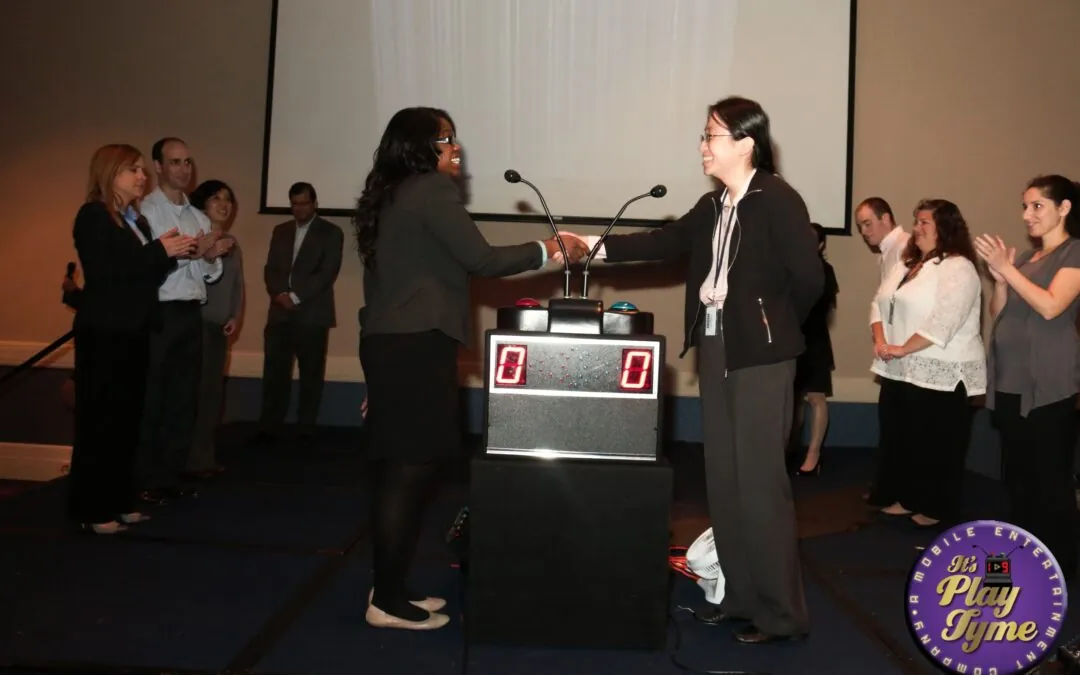
It’s PlayTyme Game Shows specializes in exactly this format. Their live, interactive game show assemblies bring professional-grade production (big screens, sound systems, and hosted competition) directly into school gyms across New Jersey, New York City, and Connecticut. What sets them apart is customization: coordinators choose the subject matter (spelling, math, science, history, character education) and It’s PlayTyme builds the game around it. Students compete in teams, answering questions and completing challenges on stage while the entire student body cheers them on.
This format solves several coordinator headaches at once. The production is handled by professionals, so staff are not stuck building sets or running sound. The content aligns with school goals because it is customized to the curriculum. And the game show structure works across every grade level, from elementary through high school, because competition is universally engaging.
Why Game Show Assemblies Work as Pep Assembly Themes
Game shows create natural dramatic tension. Students watch classmates compete, root for their grade or section, and react in real time to correct and incorrect answers. That emotional investment is exactly what traditional assemblies struggle to produce. The format also provides built-in assembly performance ideas: the competition itself is the performance, and every round brings new energy.
Seasonal and Event-Driven Themes
Tying pep assembly themes to the calendar gives coordinators a natural planning rhythm and ensures assemblies feel timely rather than arbitrary.
Back-to-School Rally
Set the tone for the year with an assembly that introduces new staff, previews upcoming events, and gets students excited about the months ahead. Include a mix of performances, competitions, and announcements to establish the school’s energy from day one.
End-of-Year Celebration
Cap the school year with an assembly that highlights the year’s biggest moments: athletic championships, academic milestones, service projects, and memorable events. Student-produced video recaps and live performances make this a send-off students remember over the summer.
Holiday and Seasonal Themes
Winter holidays, spring testing season kickoffs, and fall harvest events all provide natural assembly themes. A winter assembly with a giving-tree initiative combines entertainment with community service. A spring “finish strong” rally builds momentum for final exams.
Picking the Right Pep Assembly Theme for Your School
Choosing between pep assembly themes comes down to four practical questions:
What is the goal? Every assembly should have a purpose beyond filling time. If the goal is school spirit, choose a competitive or pride-based theme. If the goal is character education, choose a values-driven theme. If the goal is academic motivation, bring in an interactive format like a game show that ties competition to curriculum content.
Who is the audience? A K-5 assembly has different energy than a 9-12 assembly. Themes that require audience participation work across age groups. Themes that rely on student-led performances work best when the performers are peers the audience admires.
What are the resources? Some themes require minimal setup (Color Wars needs colored t-shirts and a scoreboard). Others require professional production. Know the budget and staff availability before committing to a theme. Bringing in an outside provider like It’s PlayTyme shifts the production burden off school staff entirely.
How does it connect to the bigger picture? The best pep assembly themes reinforce something the school is already working on. An anti-bullying assembly during kindness week has more impact than the same assembly in isolation. A STEM challenge during science fair season reinforces classroom learning. Alignment multiplies impact.
If you are planning a pep assembly for a school in New Jersey, New York City, or Connecticut and want an interactive, game show-style experience that students talk about for weeks, reach out to It’s PlayTyme to discuss your school’s needs. Their school assembly programs are built to fit your theme, your curriculum, and your schedule.
Frequently Asked Questions (FAQs)
What are the best pep assembly themes for high school students?
High school students respond best to competitive and interactive themes. Color Wars, decade throwbacks, and game show-style assemblies consistently generate high engagement because they give students a role beyond sitting and watching. Themes tied to school rivalries or senior traditions also perform well.
How do pep assembly themes differ from pep rally themes?
Pep rallies focus on building excitement before a specific athletic event. Pep assembly themes serve broader goals: academic recognition, character education, community building, or school culture. Assemblies are structured programs with intentional messaging, while rallies center on energy and school spirit for a game.
What assembly performance ideas work for elementary schools?
Elementary assemblies work best with high-energy, participatory formats. Interactive game shows, sing-alongs, dance-alongs, and live demonstrations keep younger students engaged. Themes around kindness, reading, or science exploration give the performance educational value while keeping the energy high.
How much does it cost to hire a professional assembly provider?
Professional assembly providers typically charge between $500 and $2,500 depending on the format, duration, group size, and customization level. Interactive game show providers like It’s PlayTyme include all production equipment and a professional host, which eliminates the need for schools to rent or set up their own A/V gear.
How often should schools hold pep assemblies?
Most schools benefit from three to five themed assemblies per year, spaced throughout the calendar. Monthly assemblies work for schools with strong student council programs and administrative support. The key is quality over quantity: a few well-produced, themed assemblies have more lasting impact than frequent, unstructured gatherings.
Quick answer: The best leadership icebreakers are purpose-driven, low on embarrassment, and done in ten to fifteen minutes. For an executive team of six to fifteen, use a sharp prompt like a one word check-in or best decision, worst decision. For 25 or more managers, a hosted, team-based format like Leadership Feud holds the whole room.
Leadership meetings carry a quiet tension. Senior managers walk in guarded, protective of their time, and skeptical of anything that feels like forced fun. The right icebreaker cuts through that in minutes, which matters because Gallup reports that only 20% of employees feel engaged, and leaders set the tone for everyone below them.
Anyone who runs leadership meetings knows the obstacles. Executives resist anything that feels childish, the group is often large enough to fracture into side conversations, and a few dominant voices can swallow the room. You need an opener that respects rank, includes the quieter directors, and produces real energy in under fifteen minutes. These leadership icebreakers do exactly that.
Planning a leadership meeting? A hosted game show icebreaker gets leaders talking fast, on site anywhere in NJ, NYC and CT.
An opener for a leadership room follows different rules than one for new hires. Senior people read intent quickly, and they disengage the moment an activity feels like filler. The goal is not to fill time, it is to shift the room from guarded to candid before the real decisions begin. A strong leadership opener also signals respect: it shows you planned the meeting with care rather than improvising. Get these traits right and senior people lean in instead of checking their phones.
Purpose-driven: it ties to strategy, decisions, or the meeting goal, not random trivia.
Low embarrassment: no one is asked to dance, sing, or share something deeply personal.
Time-boxed: ten to fifteen minutes, with a clean stop before the agenda.
Inclusive of rank: the loudest VP and the quietest director get equal airtime.
Game-Show-Style Icebreakers for Large Leadership Groups
When a leadership offsite gathers 30, 50, or 100 managers, a facilitated game-show format holds the whole room in a way that round-the-table sharing cannot. These run with a host, teams, and a points board.
Leadership Feud
Run a Family Feud format where teams of managers guess the top-ranked answers to leadership-themed questions. Sample: “Name a trait of a great leader” ranks communication, vision, honesty, decisiveness, and empathy. Teams compete, the host keeps score, and cross-department leaders mix on the same side. It scales cleanly to a hundred people.
Strategy Trivia Showdown
A hosted trivia round mixes company history, market facts, and a few light questions about the leadership team. Big screens and buzzers keep energy high, and the competition gives reserved executives a reason to speak up.
Two Truths and a Strategy
Each leader shares two real facts and one fictional plan for the year. Teams vote on the fake. It surfaces priorities and personality at once, and a facilitator keeps it moving so no one rambles.
Quick Discussion Icebreakers for Smaller Leadership Teams
For an executive team of six to fifteen, a sharp prompt does the work without a full game.
One word check-in: each leader names one word for how the quarter feels, then explains in a single sentence.
Best decision, worst decision: each person shares one of each from the past month, building candor fast.
If our company were a competitor: leaders name which rival they admire and why, surfacing strategy views.
The thirty-second win: each leader shares one team win, spotlighting their people and setting a positive tone.
Want an icebreaker that fits a busy leadership agenda? Our hosts keep rounds quick, sharp and on schedule.
The strongest leadership openers feed directly into the meeting. Use these to warm the room and prime the work at once.
Headline the quarter: each leader writes a newspaper headline for the next 90 days, framing priorities.
Stop, start, continue: a one-line round on what the leadership team should stop, start, and continue.
Rose and thorn: one highlight and one obstacle from each leader, surfacing risks before they hit the agenda.
Why Leadership Icebreakers So Often Fall Flat
Even good intentions stumble in a room full of senior people. Plan around these obstacles.
Executive skepticism: leaders disengage instantly from anything that feels like a forced game.
Dominant voices: one or two senior people can monopolize the round and silence the rest.
Large-group fracture: past 25 people, a casual icebreaker splinters into side chats without a facilitator.
Rank pressure: junior directors hold back honest answers when the CEO speaks first.
Time slippage: with strong personalities, a ten-minute opener stretches into thirty without a firm host.
Why Leadership Teams Bring in a Facilitator
For a small executive check-in, a self-run prompt works. For a leadership offsite or a large management gathering, a professional facilitator changes the result. It’s PlayTyme Game Shows brings a polished host, buzzers, and broadcast-style production to leadership events across New Jersey, New York City, and Connecticut, with questions tuned to your company and strategy.
A neutral host solves the rank problem. Executives compete as equals, the facilitator gives every voice airtime, and the format holds a room of a hundred managers as easily as fifteen. Scoring and pacing are handled, so your senior team plays instead of managing the activity. The energy carries straight into the real agenda.
What to Consider When Choosing a Leadership Icebreaker
Start with group size and goal. For a small executive team, a sharp discussion prompt tied to the quarter does the work in ten minutes. For 25 or more managers, a facilitated game-show format holds the room and mixes departments without fracturing. Always pick something purpose-driven, low on embarrassment, and time-boxed with a firm stop. When the stakes or the headcount are high, bring in a host so rank, dominant voices, and timing are managed for you. Choose with intent, and the opener will set the tone for a sharper meeting.
Frequently Asked Questions (FAQs)
What makes a good icebreaker for a leadership meeting?
It ties to the meeting goal, avoids embarrassment, stays under fifteen minutes, and gives every rank equal airtime. Senior leaders engage when an opener feels purposeful rather than childish. Purpose-driven prompts and facilitated game formats work best.
How do I run an icebreaker for a large management group?
Use a facilitated, game-show-style format with teams, a host, and a points board. Round-the-table sharing fractures past 25 people, while a hosted competition holds a room of fifty or a hundred. Teams also mix leaders across departments naturally.
How do I keep dominant executives from taking over?
Use structured formats where everyone answers in turn or on a team, and consider a neutral facilitator to manage airtime. Team-based games spread participation by design. A host can also redirect long talkers without it feeling personal.
How long should a leadership icebreaker last?
Ten to fifteen minutes is ideal for a leadership room. That is long enough to warm the group and short enough to respect senior schedules. Set a firm stop, because strong personalities will otherwise stretch the round.
Should we hire a facilitator for a leadership offsite?
For large offsites and management summits, yes. A professional facilitator handles rank dynamics, dominant voices, timing, and scoring, so your leaders participate instead of managing the activity. For a small executive check-in, a self-run prompt is usually enough.
Why does a poorly run leadership icebreaker cost more than just awkward silence?
Harvard Business Review notes that poorly designed team activities waste both money and goodwill. In a leadership room that goodwill is especially hard to recover, because senior managers enter already guarded and skeptical of anything that feels like forced fun.
Quick answer: The best office party games for employees match the group. Small teams do well with quick icebreakers, mid-size groups enjoy team competitions, and groups of 20 to 300 or more get the most out of a hosted survey-style team game or trivia board that a professional host runs from start to finish.
The trick is matching the game to your group. A small team needs a different format than a 200-person all-hands, and a tired afternoon crowd needs different energy than a Friday celebration. This guide organizes office party games by format, from quick icebreakers to team competitions to hosted game shows, with tips on choosing the right one for your group size and energy level.
Planners run into the same obstacles every time. Some employees dread forced fun and hang back. Mixed groups of new hires and veterans do not know each other. Games that work for ten people fall apart with a hundred. And the energy in the room can sag if nobody owns the pace. The formats below solve those problems by giving every personality an easy way to join in.
Planning office party games for employees? We host game shows for 20 to 300+ guests, on site anywhere in NJ, NYC and CT.
Icebreakers lower the social barrier at the start of an event. They are short, low-pressure, and perfect for groups where people do not know each other yet.
Two Truths and a Lie: each person shares three statements and the group guesses the false one.
Human Bingo: cards with traits like “has run a marathon” send people mingling to find matches.
Would You Rather: quick either-or questions spark easy laughs and conversation.
Name Story: people share the story behind their name to reveal personality fast.
These games take minutes and prime the room for everything that follows. They work best at the start, before the main activity.
Team Competition Games
Once the ice is broken, friendly competition raises the energy. Team games build collaboration and give departments a reason to mix.
Trivia: themed rounds on pop culture, company history, or general knowledge split the room into teams.
Office Olympics: a series of silly desk-friendly challenges crowns a department champion.
Scavenger hunt: clue-based searches send teams across the office or venue.
Minute to win it: fast, simple challenges that anyone can attempt and everyone can watch.
Competition pulls in quieter employees because the team carries the moment, not any one person. The shared goal does the social work for you.
Hosted Game Show Formats
For the highest energy and zero planning, a hosted game show leads the field. A professional host owns the pace, so the room stays engaged from the first round to the last.
Face 2 Face Feud style: two teams guess the top survey answers in a fast, funny showdown.
Quiz show: buzzers and rounds turn trivia into a true competition.
Price-guessing and challenge mashups: varied rounds keep every personality involved.
Hosted formats are the premium choice because they remove the burden from your team and guarantee energy. Someone else runs the show while your people simply enjoy it.
Choosing Games by Group Size
Group size changes everything. A game that delights ten people can collapse with a hundred, so match the format to your headcount.
Small groups (under 20): icebreakers and casual games work because everyone gets a turn.
Medium groups (20 to 75): team competitions like trivia and Office Olympics keep everyone busy.
Large groups (75+): a hosted game show scales best, since a pro host commands a big room.
When in doubt, choose a format with a host for larger crowds. A professional keeps a hundred people engaged in a way a self-run game cannot.
Choosing Games by Energy Level
Read the room before you pick. The same group needs different games at different moments, and matching energy keeps people engaged.
Low energy (after lunch or a long week): start with light icebreakers to ease people in.
Medium energy: team trivia or a scavenger hunt builds momentum without overwhelming.
High energy (celebrations and milestones): a hosted game show matches and amplifies the mood.
A skilled host adjusts energy in real time, reading the crowd and shifting the pace so the room never drags.
Want a party game the whole office joins? Our hosts run team rounds, scoring and prizes from start to finish.
Among all these formats, a hosted game show delivers the most reliable fun for the least planning, and that is where It’s PlayTyme Game Shows stands out. A professional host runs a high-energy, Face 2 Face Feud style competition that mixes departments into friendly teams, breaks the ice instantly, and gives quiet employees an easy way to take part.
The format flexes to any group size and any energy level, and the host owns the pace so your team does not have to. It scales from a small office to a large ballroom, and it keeps a big room engaged from start to finish. For companies across New Jersey, New York City, and Connecticut, a local host travels to your venue, which removes the production headache and guarantees a polished show. It is the difference between a party people tolerate and one they talk about for weeks.
The Problems Office Party Games Have to Solve
Choosing games sounds easy until you face the room. Reluctant participants hang back from anything that feels forced. Mixed groups of strangers need formats that include everyone. Scaling a game to a large crowd is hard, and so is keeping the energy steady when no one owns the pace. Get these wrong, and the games fall flat.
Each challenge has a clear answer. Choose inclusive, team-based formats so reluctant employees feel safe joining in. Start with icebreakers to bridge mixed groups. Pick a hosted format for large crowds, since a pro scales where a self-run game cannot. And bring in a host to own the energy so the room never sags. Plan for these, and the games carry the whole party.
Book Game Show Entertainment for Your Next Party
The right games make the party, and a hosted game show is the safest bet for energy, inclusion, and zero planning. To book one, use the contact page and explore the corporate events options for teams across New Jersey, New York City, and Connecticut. If you are planning specifically for the holidays, see our office holiday party entertainment options. Give your employees games they will actually look forward to.
A Short Checklist Before You Pick Office Party Games
Start with your group size and energy level, then work backward. Small, casual groups thrive on icebreakers, while medium teams enjoy competitions and large crowds need a hosted show. Read the energy in the room and match it, easing in low-energy groups and amplifying high-energy ones. Favor inclusive, team-based formats that welcome every personality, and lean on a professional host for big rooms. The right match turns a party from awkward to unforgettable.
What are the best office party games for large groups?
A hosted game show scales best for large crowds, because a professional host can command a room of 75 or more. Self-run games tend to lose energy at scale, while a pro keeps everyone engaged from the first round to the last.
How do I get shy employees to join office party games?
Choose team-based and hosted formats where the group carries the moment rather than any one person. Start with quick icebreakers to lower the social barrier, then move into team competitions so reluctant employees feel safe taking part.
What office party games work for small teams?
Small groups under 20 do well with icebreakers like Two Truths and a Lie, Human Bingo, and casual team games. These formats give everyone a turn and build connection quickly without needing a large production.
How do I match games to the room’s energy?
Read the crowd first. Use light icebreakers for tired or low-energy groups, team trivia for medium energy, and a hosted game show for high-energy celebrations. A skilled host can also adjust the pace in real time.
Do you bring office party games to NJ, NYC, and CT?
Yes. A regional host travels to offices and venues across New Jersey, New York City, and Connecticut. Local coverage means no production hassle and a polished, reliable game show wherever your team gathers.
Can office party games actually help with employee engagement long-term?
Gallup research finds that employees with a close friend at work are far more engaged and productive. Good party games create the shared, low-stakes moments that help those friendships form quickly, directly influencing how connected employees feel to their team and workplace.
Quick answer: The best team building brain teasers build from easy to hard. Open with riddles like “What has keys but no locks?” (a piano), move to medium logic puzzles, and finish with harder ones like the three light switches. Use teams of 4 to 6, give 30, 60 and 90 seconds per round, and talk through the reasoning between rounds.
Only 20% of employees worldwide are actively engaged at work, according to Gallup’s State of the Global Workplace report. That disengagement costs organizations hundreds of billions in lost productivity every year. One of the fastest ways to re-energize a group is to get them solving problems together, and brain teasers are purpose-built for that.
Research published in Harvard Business Review found that teams with higher cognitive diversity solve problems significantly faster than homogeneous groups. Brain teasers force exactly this kind of thinking: they reward different perspectives, lateral logic, and the willingness to speak up with an unconventional answer. That makes them one of the most effective (and cheapest) team building tools available.
Still, most teams never use brain teasers beyond a single awkward icebreaker question. Facilitators pick puzzles that are too easy (everyone groans) or too obscure (nobody speaks). There is no structure, no scoring, and no connection to larger team goals. The result is a flat activity that people forget within the hour. This guide fixes that. Below you will find 21 tested brain teasers organized by difficulty, complete answer explanations, and a practical playbook for turning them into a high-energy team session.
Planning a brain teaser round for your team? We host puzzle and trivia game shows for 20 to 300+ people across NJ, NYC and CT.
Brain teasers succeed where many corporate activities fail because they strip away hierarchy. A new hire and a senior director stand on equal footing when the question is “What has keys but no locks?” Nobody’s job title gives them an edge. That dynamic opens communication channels that stay shut during normal work hours.
They also build three skills that transfer directly to the workplace:
Lateral thinking – teasers train people to look beyond the obvious first answer, which is the same muscle used in creative problem solving on real projects.
Active listening — in a team setting, solving a tricky riddle requires hearing and building on other people’s ideas rather than waiting for your turn to talk.
Comfort with being wrong – brain teasers normalize trial and error. Teams that practice failing fast on a riddle carry that resilience into higher-stakes work.
Where Standard Team Icebreakers Fail to Include Everyone
Most icebreaker activities suffer from the same set of problems. Understanding these makes it clear why brain teasers, done right, are a stronger alternative.
Low participation: “Tell us a fun fact about yourself” puts introverts on the spot. Half the room checks out immediately.
No shared objective: Without a puzzle to solve together, there is no reason for teammates to actually collaborate. The activity becomes a series of solo performances.
Difficulty mismatch: Activities designed for small groups fall apart at 30, 50, or 100 people. Facilitators rarely adjust the format for group size.
Zero follow-through: Even when an icebreaker lands, there is no bridge connecting the warm-up energy to the rest of the event. The momentum dies.
Brain teasers solve each of these when you organize them into rounds with escalating difficulty, team-based scoring, and a competitive format. That structure turns a simple riddle into a genuine team experience.
Easy Team Building Brain Teasers (Warm-Up Round)
Start every session here. These teasers get people talking without intimidating anyone. Give teams 30 seconds per question.
1. I speak without a mouth and hear without ears. I have no body, but I come alive with the wind. What am I?
Answer: An echo. Sound waves bounce off surfaces and return to the listener. The “wind” clue points to how sound travels through air. This teaser teaches teams to focus on the metaphor rather than taking the words literally.
2. What has keys but no locks?
Answer: A piano. The word “keys” triggers an assumption about doors and security. Teams that solve this quickly have already started thinking laterally.
3. What gets wetter the more it dries?
Answer: A towel. The verb “dries” pulls attention toward evaporation. The trick is recognizing that “dries” here means “dries something else.”
4. What has a head and a tail but no body?
Answer: A coin. This one rewards the team member who thinks about everyday objects instead of animals. It is a good early confidence builder.
5. What has hands but cannot clap?
Answer: A clock. Another misdirection based on a double meaning. Teams start to see the pattern: brain teasers exploit the gap between a word’s common meaning and its alternate meaning.
6. What travels around the world while staying in a corner?
Answer: A postage stamp. This teaser rewards general knowledge. It also works well as a conversation starter because most people under 30 have barely used physical stamps.
7. If you have me, you want to share me. If you share me, you no longer have me. What am I?
Answer: A secret. This riddle sparks group debate because the logic feels paradoxical. It is an ideal bridge into the medium round because teams realize the puzzles are getting trickier.
Medium Team Building Brain Teasers (Group Discussion Round)
These require teams to talk through the logic together. Give 60 seconds per question and encourage groups to discuss before locking in an answer.
8. A man looks at a photograph. Someone asks, “Whose picture is that?” He replies: “Brothers and sisters I have none, but that man’s father is my father’s son.” Who is in the photograph?
Answer: His son. “My father’s son” is the man himself (he has no siblings). So “that man’s father is me” means the person in the photo is his son. This teaser exposes how groups handle complex sentence structures and whether they slow down to parse the logic.
9. You see a boat filled with people, yet there is not a single person on board. How is that possible?
Answer: All the people on the boat are married. The word “single” is the trap. This teaser always gets a laugh and rewards the teammate who catches the double meaning first.
10. What disappears as soon as you say its name?
Answer: Silence. Short, elegant, and surprisingly difficult under time pressure. Teams that overthink this one learn a useful lesson: sometimes the simplest answer is correct.
11. I have cities but no houses, forests but no trees, and water but no fish. What am I?
Answer: A map. This teaser tests whether teams think abstractly about representations versus physical reality. It is a strong discussion prompt.
12. A farmer has 17 sheep. All but 9 die. How many sheep does the farmer have left?
Answer: 9. The phrasing “all but 9” tricks people into doing subtraction (17 minus 9). The answer is stated directly in the question. Teams learn to read carefully before calculating.
13. Two fathers and two sons sit down for breakfast. They eat exactly three eggs, each person eating one egg. How is that possible?
Answer: They are three people: a grandfather, a father, and a son. The father is both a son (to the grandfather) and a father (to his own child). This teaser rewards teams that question assumptions about the number of people involved.
14. What comes once in a minute, twice in a moment, but never in a thousand years?
Answer: The letter M. This is a pure wordplay teaser. It shifts teams from logical reasoning to pattern recognition, which keeps the session from feeling one-dimensional.
Want a championship round your team will remember? Our host runs the puzzles, the timer and the scoring.
Hard Team Building Brain Teasers (Championship Round)
Save these for the final round. Give teams 90 seconds to two minutes per question. These teasers reward structured thinking and genuine collaboration.
15. You are in a room with three light switches. Each controls one of three bulbs in the next room. You get to enter the next room only once. How do you figure out which switch controls which bulb?
Answer: Turn on switch 1 and wait several minutes. Turn it off, then immediately turn on switch 2. Enter the room. The lit bulb connects to switch 2. Touch the remaining two: the warm bulb connects to switch 1, and the cold bulb connects to switch 3. This teaser introduces the idea of using multiple senses (sight and touch) to gather data, which mirrors real-world problem solving where the answer requires more than one source of information.
16. A man pushes his car to a hotel and tells the owner he is bankrupt. Why?
Answer: He is playing Monopoly. The entire scenario describes a board game, not real life. This teaser tests whether teams challenge the assumed context of a problem, a skill that directly applies to workplace decision making.
17. You measure my life in hours, and I serve you by expiring. I am quick when I am thin and slow when I am fat. The wind is my enemy. What am I?
Answer: A candle. Each clue maps to a physical property of a candle. “Quick when thin” refers to how a thin candle burns faster. This teaser rewards methodical, clue-by-clue analysis over guessing.
18. I am not alive, but I grow. I do not have lungs, but I need air. I do not have a mouth, but water kills me. What am I?
Answer: Fire. Every line contains a contradiction that points to the same answer. Teams that assign each clue to a different member and then compare notes solve this fastest.
19. Three boxes are labeled “Apples,” “Oranges,” and “Apples & Oranges.” Every label is wrong. You draw one fruit from one box without looking inside. How do you correctly label all three boxes?
Answer: Draw from the box labeled “Apples & Oranges.” Since every label is wrong, this box contains only one type of fruit. If you draw an apple, this box is “Apples.” The box labeled “Oranges” cannot actually contain oranges (wrong label) and cannot contain only apples (that label is taken), so it must be “Apples & Oranges.” The remaining box is “Oranges.” This teaser teaches constraint-based reasoning: eliminating impossible options to find the answer.
20. You have 8 identical-looking balls. One is slightly heavier. Using a balance scale only twice, how do you find the heavier ball?
Answer: Divide the balls into three groups: 3, 3, and 2. Weigh the two groups of 3 against each other. If they balance, the heavier ball is in the group of 2 (weigh them to find it). If one side is heavier, take those 3 balls, weigh 1 against 1. If they balance, the third ball is the heavy one. If one side drops, that ball is heavier. This teaser rewards teams that think in decision trees rather than brute-force trial and error.
21. Three guests check into a hotel room that costs $30. Each pays $10. The manager realizes the room is only $25 and gives $5 to the bellhop to return. The bellhop keeps $2 and gives $1 back to each guest. Each guest has now paid $9 (totaling $27), plus the $2 the bellhop kept equals $29. Where is the missing dollar?
Answer: There is no missing dollar. The $27 the guests paid already includes the $2 the bellhop kept ($25 for the room plus $2 tip). Adding the $2 to $27 double-counts it. The correct accounting: $25 (room) + $2 (bellhop) + $3 (returned) = $30. This teaser is a masterclass in how framing distorts perception, a lesson every team benefits from when reviewing budgets, timelines, or project scopes.
How to Run a Brain Teaser Round in a Real Team Session
Having great brain teasers is only half the equation. The format determines whether your session feels electric or awkward. Follow this structure for groups of 20 to 300+ people.
Step 1: Split Into Teams
Divide participants into groups of 4 to 6. Mix departments and seniority levels. Assign each team a name (or let them choose one in 60 seconds for an instant bonding moment).
Step 2: Set the Rounds
Run three rounds matching the difficulty tiers above. Display each teaser on a screen or read it aloud. Teams write their answer on a whiteboard or buzzer system.
Round
Difficulty
Questions
Time per Question
Points per Correct Answer
1
Easy
7
30 seconds
1
2
Medium
7
60 seconds
2
3
Hard
7
90 seconds
3
Step 3: Reveal and Discuss
After each round, walk through the answers. Ask a team to explain their reasoning, not just their answer. This is where the real team building happens: people learn how their colleagues think.
Step 4: Crown a Winner
Tally scores and announce the winning team. A small prize (bragging rights, a trophy, first pick at lunch) keeps the competitive energy high without making it feel corporate.
Running a brain teaser session yourself takes preparation, timing, and a facilitator who reads the room. It’s PlayTyme Game Shows handles all of that. Their corporate game show format includes brain teaser rounds alongside trivia, physical challenges, and multimedia questions, all run by a professional host with full sound, lighting, and scoring technology.
The difference between a DIY brain teaser session and an It’s PlayTyme event is production quality and pacing. Their hosts adjust difficulty on the fly based on how the group responds. They rotate puzzle types so energy never dips. And they handle groups from 20 to 300+ people across New Jersey, New York City, and Connecticut, bringing all equipment to your venue. Brain teasers become one high-energy segment inside a complete team building experience rather than a standalone activity you have to design from scratch.
Getting Brain Teaser Difficulty Right for Your Group
Not every brain teaser works for every audience. The right selection depends on three factors: group size, familiarity level, and session goals.
For new teams or onboarding groups, stick to easy and medium teasers. The goal is conversation, not competition. Teasers 1 through 14 from this list work well because they generate discussion without making anyone feel lost.
For established teams looking for a challenge, jump straight to the medium and hard rounds. These teasers reward structured reasoning and collaboration, both skills that strong teams want to sharpen.
For large events (50+ people), a hosted game show format works far better than a self-run session. Professional facilitators keep the energy consistent across the room and make sure every team stays engaged, not just the loudest table. That is exactly what It’s PlayTyme delivers at corporate events and team building trivia sessions throughout the tri-state area.
If you want to turn brain teasers into a full team building event your group actually remembers, get in touch with It’s PlayTyme and let their team design a custom game show around your goals.
Frequently Asked Questions (FAQs)
How many brain teasers should I use in a team building session?
Plan for 15 to 21 brain teasers split across three difficulty rounds. This gives you 45 to 60 minutes of content with time for answer reveals and group discussion between rounds. Fewer than 10 teasers makes the session feel too short to build real momentum.
Do brain teasers work for large corporate groups?
Yes. Brain teasers scale well because teams of 4 to 6 people discuss each question internally before submitting an answer. Groups of 100 or more run smoothly with a professional host, a visible scoreboard, and a buzzer or whiteboard system for answers.
What is the best team size for brain teaser activities?
Groups of 4 to 6 people produce the best results. Smaller teams lack enough perspectives to solve harder teasers. Larger teams (8+) often have members who disengage because they cannot contribute to the conversation.
Are brain teasers appropriate for all industries and departments?
Brain teasers are industry-neutral. They test logic, wordplay, and lateral thinking rather than domain expertise. This makes them ideal for cross-departmental events where participants have different professional backgrounds and knowledge bases.
How do I keep competitive brain teaser rounds from getting too intense?
Use a scoring system that rewards collaboration over speed. Award bonus points when a team explains their reasoning clearly, not just when they answer correctly. Mixing easy rounds between hard ones also keeps the mood fun and prevents frustration from building up.
Quick answer: Large group team building works when you pick a format built for scale, split the room into sub-teams of 6 to 10 with set roles, hire a professional host, pace the energy in rounds, and close with a debrief. Hosted game show formats handle 20 to 300+ people and keep everyone participating.
Most team building falls apart the moment the group exceeds 30 people. Side conversations drown out instructions, half the room checks their phones, and the post-event survey reads like a hostage note. Yet the data shows that getting this right is worth the effort. According to Gallup’s State of the Global Workplace report, only 20% of employees worldwide are actively engaged at work. And a separate Gallup meta-analysis of over 2.7 million workers found that highly engaged business units see 21% greater profitability.
Large group team building activities, when designed properly, move the needle on both numbers. The problem is that most organizers treat a 200-person event the same way they would a 15-person workshop: one facilitator, one activity, one prayer that it all holds together.
If you have organized (or been stuck in) a company-wide event where a third of the room mentally checked out before the first round ended, you already know the frustration. Coordinating schedules across departments is hard enough. Getting hundreds of people to participate at the same time, in the same space, with roughly equal energy is a different challenge entirely. Add in mixed personality types, varying physical abilities, and the skeptics who think every team builder is trust falls and forced fun, and the degree of difficulty jumps again.
Planning large group team building? Our hosted game shows keep 20 to 300+ people playing, on site anywhere in NJ, NYC and CT.
Biggest Obstacles to Running Large Group Team Events
Scaling from a small team exercise to a large group event introduces problems that no amount of enthusiasm fixes on its own. Here are the ones that trip up even experienced event planners:
Uneven participation. In groups of 100 or more, extroverts dominate and quieter employees fade into the background. Without a structure that gives every person a defined role, half the room becomes spectators.
Energy drop-off. Large rooms lose momentum fast. A single long activity with no variation leads to disengagement by the 20-minute mark.
Logistical complexity. Audio has to reach the back row. Materials have to be distributed quickly. Timing across sub-groups has to stay synchronized. One bottleneck stalls the entire event.
The “this is cheesy” factor. Adults at a corporate event resist anything that feels forced or juvenile. The format has to earn their buy-in within the first five minutes, or the skeptics set the tone.
Unclear outcomes. If participants walk away unsure of what the event was supposed to accomplish, the investment in time and money is wasted.
Secret 1: Choose a Scalable Format From the Start
The first operational secret is format selection. Not every team building activity scales. A ropes course tops out at 20. An escape room caps at 10. Trivia nights work for medium groups but get chaotic past 80. The format you choose has to be engineered for scale from the ground up.
Game show-style formats are purpose-built for large audiences. They borrow from a structure that already works: television. Everyone in the room understands how a game show operates. There are rounds, there is a host, there are winners. That shared understanding removes the “wait, what are we doing?” friction that kills momentum in the opening minutes.
It’s PlayTyme Game Shows runs live, interactive game show events built specifically for groups of 20 to 300+ people across New Jersey, New York City, and Connecticut. Their format is designed from the ground up for scale: professional AV, a trained host, and rounds that keep every person in the room engaged simultaneously. It is exactly the kind of activity that solves the problems outlined above.
Secret 2: Build a Sub-Team Structure That Gives Everyone a Role
The fastest way to lose a large group is to let individuals blend into a faceless crowd. The fix is sub-teams. Break the room into groups of 6 to 10, give each team a name or number, and assign specific roles within each group: a captain, a timekeeper, a spokesperson.
This approach does three things at once:
It creates accountability. When your answer matters to seven teammates sitting around you, you pay attention.
It builds connections across departments. Assigning teams deliberately (mixing departments, locations, or seniority levels) forces introductions that never happen in a hallway.
It generates friendly competition. A leaderboard visible to the entire room turns passive observers into invested players.
It’s PlayTyme’s events use this exact sub-team structure. Their hosts divide the room into competing teams, each with buzzers or response systems, and run multiple rounds so that every person contributes to their team’s score. Nobody sits on the sideline.
Secret 3: Invest in Clear, Professional Facilitation
A large group team building activity is only as strong as its facilitator. With 200 people in a room, the host is not just reading questions off a card. They are reading the crowd, adjusting pacing, managing energy, handling technical cues, and keeping the event on schedule down to the minute.
This is where DIY approaches fall apart. An HR manager handed a microphone and a list of icebreakers does not have the stage presence, timing, or crowd-control skills that a professional emcee brings. The difference between a flat event and one that people talk about for months is almost always the person at the front of the room.
What professional facilitation looks like
A host who projects confidence and humor without being over the top
Professional sound and visuals so the back row is as engaged as the front
Real-time score tracking displayed on screens the entire room sees
Smooth transitions between rounds with zero dead air
It’s PlayTyme provides a professional host and full AV production as part of every event. Their hosts are experienced performers who specialize in corporate and school audiences, not DJs filling time between songs.
Secret 4: Manage Energy With Intentional Pacing
Energy management is the secret most planners overlook entirely. A 90-minute event for 300 people requires deliberate peaks and valleys. Open high to grab attention. Drop into a round that requires strategic thinking. Spike the energy again with a speed round. Give people a moment to laugh and talk to their teammates before the next challenge.
The worst thing an organizer does is run one long, unbroken activity. Attention spans in a large room are shorter than you think. Research on adult attention consistently shows that engagement drops sharply after 10 to 15 minutes of the same stimulus. The antidote is variety within a single event framework.
A sample energy arc for a 90-minute event
Minutes 1 to 5: High-energy opening, team formation, rules explained
Minutes 5 to 20: Round 1, moderate difficulty, gets teams talking
Minutes 20 to 35: Round 2, higher stakes, faster pace
Minutes 35 to 45: Halftime break, scores displayed, quick team huddles
Minutes 45 to 65: Round 3, hardest content, biggest point values
Minutes 65 to 80: Speed round or lightning challenge, highest energy
Minutes 80 to 90: Final scores, recognition, debrief
Game show formats naturally follow this arc. Each round is a self-contained burst of engagement, and the competitive structure keeps attention locked in between rounds as scores update.
Secret 5: Close With a Debrief, Not Just a Winner
The final secret separates a fun hour from a meaningful team building experience. A structured debrief at the end connects the activity back to workplace goals. It takes five to ten minutes and answers three questions for participants:
What did we just experience together?
What did it reveal about how we communicate, collaborate, or compete?
What is one thing we take back to the office on Monday?
Without this step, the event is entertainment. With it, the event becomes a reference point that teams recall when they face real challenges in the weeks that follow. The debrief is also the moment where leadership reinforces a message: a company value, a quarterly theme, or a cultural shift they are driving.
Want a format built to scale? Our hosts run team rounds that work for any room and any size.
Why the Game Show Format Outperforms Other Large Group Options
Not all large group team building activities deliver the same results. Here is how the most common formats compare on the factors that matter most for groups of 50 or more:
Format
Group Size
Participation Level
Setup Complexity
Energy Sustainability
Live Game Show (It’s PlayTyme)
20 to 300+
100% active
Handled by provider
High (round-based pacing)
Outdoor Field Day
30 to 200
Varies by station
High (weather dependent)
Moderate (fatigue sets in)
Trivia Night (DIY)
20 to 80
Moderate
Low
Low (single format fatigue)
Escape Room (Off-Site)
8 to 12 per room
High within room
Moderate (transport needed)
High but very small groups
Cooking Challenge
20 to 60
High
Very high (venue, supplies)
Moderate
Volunteer/Service Project
30 to 150
Varies by task
High (coordination)
Moderate
The game show format stands out for three reasons: it handles the largest group sizes without losing participation, the provider handles all logistics and equipment, and the round-based structure prevents the energy collapse that plagues single-activity events.
Practical Tips for Planning Large Group Team Building Activities
Beyond format selection, these operational details determine whether a large group event succeeds or stumbles:
Venue and logistics
Book a room with a clear sightline to the front. Pillars and L-shaped rooms kill engagement for anyone who cannot see the host or screens.
Confirm the AV setup in advance. A wireless microphone, speakers that reach every corner, and a projector or large screens are non-negotiable for groups over 50.
Arrange seating in round tables or clusters, not theater rows. Teams need to face each other, not the back of someone’s head.
Timing and scheduling
Avoid scheduling immediately after lunch. Energy is lowest between 1:00 and 2:00 PM. Mid-morning (10:00 AM) or late afternoon (3:30 PM) slots get better engagement.
Keep the core activity between 60 and 90 minutes. Shorter feels rushed. Longer tests patience.
Build in 10 to 15 minutes of buffer for late arrivals and transitions.
Communication
Tell participants what to expect in advance. A one-paragraph email the day before reduces anxiety and raises anticipation.
Frame it as competition and fun, not “mandatory team building.” Language matters.
What to Ask Before Signing a Team Building Contract
The decision comes down to five questions. Ask each one before signing a contract:
What is the largest group they have handled? If they have never run an event for more than 40 people, your 200-person conference is not the place for them to learn.
Do they provide their own AV and production? A provider who shows up with a laptop and expects your venue to supply everything else will deliver a weaker experience.
Is the facilitator a trained performer or a volunteer? Ask for video of a past event. Watch how they handle the crowd, not just the content.
Does the format naturally include everyone? If half the room watches while the other half plays, it is not a team builder. It is a spectator sport.
Do they customize for your goals? The best providers tailor questions, themes, or rounds to your company’s industry, values, or current initiatives.
It’s PlayTyme checks every box. They bring full production, a professional host, and a format that keeps 20 to 300+ people engaged from the first buzzer to the final score. Their events are fully customizable and they have run programs for corporate teams, schools, and organizations throughout the tri-state area. Get in touch to discuss your upcoming event, or explore their full range of event options to find the right fit for your group.
What are the best large group team building activities for over 100 people?
Live game show formats are the strongest option for groups over 100 because they keep every person actively participating through sub-team competition and round-based pacing. Other scalable options include outdoor field days and large-scale scavenger hunts, though both require significantly more logistical coordination.
How long should a large group team building event last?
The ideal length is 60 to 90 minutes for the core activity. Events shorter than 45 minutes do not allow enough time for teams to bond, and events longer than two hours lead to significant energy drop-off. Build in 10 to 15 minutes of buffer time for setup and transitions.
How do you keep everyone engaged during large group activities?
Three elements keep engagement high: sub-team structures that give every person a role, professional facilitation that reads and responds to crowd energy, and round-based formats that reset attention every 10 to 15 minutes. A visible leaderboard also drives participation by making every answer feel consequential.
How much does a large group team building event cost?
Costs vary based on group size, location, and whether the provider supplies AV equipment and production. Professional game show providers typically offer packages that scale with headcount. Contact providers directly for accurate pricing based on your specific group size and event requirements.
Are large group team building activities effective for remote or hybrid teams?
Yes, when the format supports it. Some providers offer virtual or hybrid game show experiences where remote participants join via video and compete alongside in-person teams. The key is choosing a provider with the technology and facilitation experience to keep both audiences equally engaged throughout the event.