School assemblies shape campus culture, but only when students actually participate. A 2025 Gallup study found that students with five or more engaging school experiences show a 65% thriving rate, compared to just 38% among those with fewer. Meanwhile, research from CASEL shows that interactive, social-emotional learning experiences raise academic performance by 11 percentile points, with gains persisting years after participation.
Those numbers tell a clear story: passive assemblies waste time, and interactive ones produce measurable results. The challenge is knowing which interactive assembly ideas fit your school, your students, and your schedule.
Most administrators face real obstacles when planning assemblies. Budgets are tight, gym time is limited, and teachers worry about losing instructional minutes to programs that feel like “just entertainment.” Coordinating 300 to 1,000 students in one space creates logistical headaches. And choosing the wrong format for a grade level turns excitement into chaos. These challenges keep many schools stuck in the lecture-and-clap assembly model, even when staff know it falls flat.
Why Traditional Assemblies Fall Short
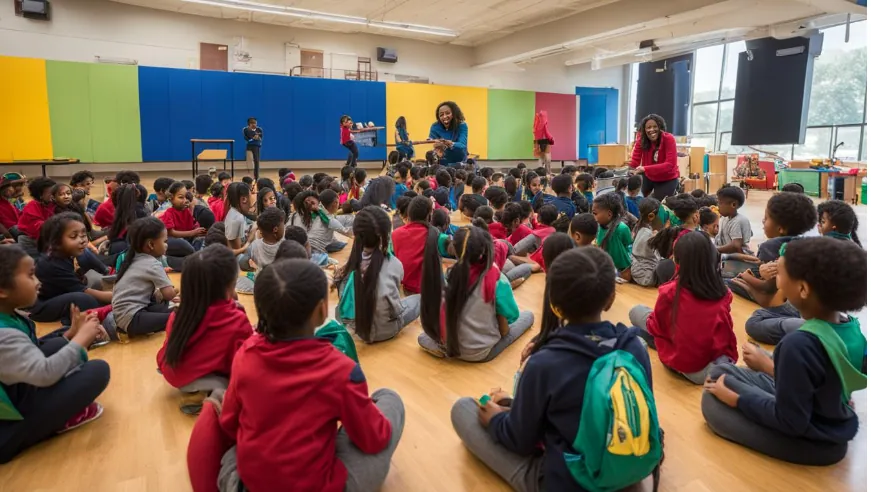
The standard assembly formula puts students in rows, a speaker at the front, and asks everyone to sit still for 45 minutes. Elementary students fidget. Middle schoolers tune out. High schoolers pull out phones. The format itself works against engagement because it treats students as an audience, not participants.
Interactive assembly ideas flip that dynamic. When students answer questions, compete in teams, vote on outcomes, or move through stations, their brains shift from passive reception to active processing. That shift is what produces the retention and behavioral outcomes administrators actually want from assembly time.
What Makes Interactive Assemblies Hard to Plan
Recognizing the value of interaction is the easy part. Execution is where schools struggle.
Budget constraints: Many districts allocate minimal funding for assembly programming, forcing coordinators to choose between quality and frequency.
Time pressure: Assemblies compete with instructional hours. Administrators need programs that deliver educational value, not just fun.
Age-range gaps: A format that works for second graders often bombs with eighth graders. Schools serving K-8 or K-12 populations need adaptable programs.
Logistics at scale: Moving hundreds of students into a gym or auditorium, keeping energy high without losing control, and wrapping up on time requires tight coordination.
Teacher buy-in: If faculty see assemblies as wasted time, they disengage, and students follow their lead.
The best interactive assembly ideas address every one of these issues by building educational content into high-energy formats that require minimal setup from school staff.
Game Show Assemblies: The Format Students Request Again
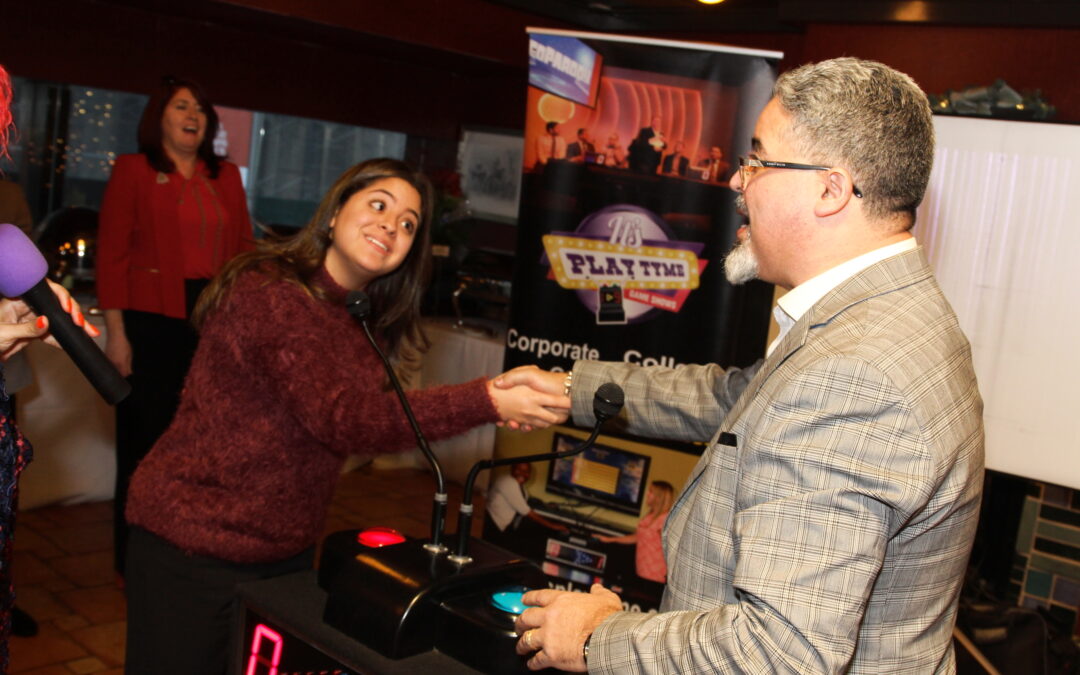
It’s PlayTyme Game Shows has built its reputation on exactly this format. Their live, hosted game show assemblies put students on stage as contestants, turn the audience into active participants through crowd voting and team competition, and wrap educational messaging into every round. Schools across New Jersey, New York City, and Connecticut bring them back year after year because the format works for every grade level.
Game show assemblies succeed because they use a structure students already understand. Formats modeled on popular TV shows (team feud rounds, trivia challenges, physical minute-to-win-it contests) create instant recognition. Students know the rules before the host explains them. That familiarity removes the awkward warm-up period and gets energy high from the first minute.
What Makes This Format Different
A professional host manages the room, so teachers observe rather than facilitate.
Content themes (anti-bullying, STEM, health and wellness, Black History, reading incentives) align with curriculum goals.
Team-based play means every student participates, not just the loudest volunteers.
Setup and teardown happen without pulling staff away from their responsibilities.
Interactive Assembly Ideas by Grade Level
Not every interactive format fits every age group. Here is what works and why.
Elementary (K-5)
Young students respond to movement, music, and call-and-response energy. Effective formats include dance-along competitions, sing-along challenges with educational lyrics, and simple trivia rounds with physical answer zones (students move to corners labeled A, B, C, or D). Keep rounds short (2 to 3 minutes each) and rotate activities frequently. Visual props and sound effects hold attention far better than spoken instructions alone.
Middle School (6-8)
This age group craves social status and peer recognition. Assemblies that let students compete on stage in front of classmates tap into that motivation. Game show formats, lip-sync battles, and team relay challenges with a leaderboard all drive participation. The key: give middle schoolers a reason to care about winning without singling out anyone for embarrassment.
High School (9-12)
Older students respond to production value and authenticity. Low-budget assemblies with a teacher reading from a script get tuned out instantly. High schoolers engage when the assembly feels like an event: professional sound, lighting, a skilled host, and stakes that matter (even small ones like a pizza party for the winning homeroom). Interactive polling through phones, live scoring displays, and student-vs-teacher rounds all generate genuine excitement.
Theme-Based Assembly Ideas That Reinforce Curriculum
The strongest interactive assemblies tie entertainment to educational outcomes. When administrators pair a format with a theme, the assembly earns its place in the school calendar.
Anti-Bullying and Character Education
Scenario-based game rounds present real situations and ask teams to choose the best response. The competitive format keeps students engaged while reinforcing empathy, bystander intervention, and digital citizenship. These assemblies align with state-mandated character education requirements in New Jersey, New York, and Connecticut.
STEM and Academic Incentive
Trivia assemblies built around science, math, and technology content reward students for academic knowledge in a public, celebratory setting. Schools use these as capstone events for reading challenges, science fairs, or testing season motivation.
Cultural Celebration and Heritage Months
Interactive trivia and music-identification rounds centered on Black History Month, Hispanic Heritage Month, or other cultural celebrations educate the entire student body while honoring the communities within the school. The game format prevents these assemblies from becoming passive lectures.
Health, Wellness, and Prevention
Substance abuse prevention, distracted driving awareness, and mental health topics land better when students discuss scenarios in teams rather than sit through a keynote. The interactive format creates peer-to-peer conversation, which research shows is more influential than adult-delivered messaging for adolescents.
Planning an Interactive Assembly: A Step-by-Step Approach
Good interactive assembly ideas need good execution. Follow this sequence to avoid the most common planning failures.
Define the outcome first. Decide what students should think, feel, or do differently after the assembly. Every format decision flows from this answer.
Match format to audience. A K-2 assembly and a high school assembly should never use the same format. Choose a provider or structure that adapts to your specific grade range.
Secure the space and schedule early. Gym and auditorium availability drives timing. Book the date before selecting the program, not after.
Brief the staff. Teachers who understand the assembly’s purpose participate actively. Send a one-page overview at least a week in advance with the theme, format, and their role (which should be minimal).
Let professionals handle production. Schools that try to DIY game-show-style assemblies spend weeks on preparation and still get uneven results. Professional providers like It’s PlayTyme bring equipment, a trained host, and a tested program. The school provides the space and the students.
Measuring Whether Your Assembly Worked
Interactive assemblies justify their cost and calendar space when schools track results. Three simple measures tell the story.
Student feedback: A three-question survey (paper or digital) immediately after the assembly captures engagement levels while the experience is fresh. Ask what students learned, what they enjoyed, and what they would change.
Behavioral data: Track discipline referrals, bullying reports, or attendance patterns in the weeks following a themed assembly. Schools that run anti-bullying game show programs often see measurable drops in office referrals.
Rebooking rate: The simplest indicator of success is whether teachers and students ask for the program again. Programs that produce genuine engagement get requested by name for the following year.
What to Ask Before Booking a School Assembly
Start with three questions. First, what is the educational or cultural goal for this assembly? Second, what grade levels will attend (and does the program adapt to that range)? Third, does the provider handle all logistics, or will your staff absorb the setup and facilitation burden?
The right program checks all three boxes: it delivers a message that matters, it engages the specific age group in the room, and it runs without pulling teachers away from their students. Schools that prioritize these criteria consistently report stronger assembly outcomes and higher rebooking rates.
What are the best interactive assembly ideas for elementary students?
Movement-based games, call-and-response activities, and simple team trivia work best for elementary students. Formats that use music, props, and short rounds (2 to 3 minutes) keep young learners focused. Game show assemblies with audience participation sections give every student a role, not just the volunteers on stage.
How long should an interactive school assembly last?
Most effective interactive assemblies run 45 to 60 minutes. Shorter sessions feel rushed and limit participation. Longer sessions risk losing student attention, especially for younger grades. Professional providers pace their programs to maintain energy throughout the full time block.
How much does a professional interactive assembly cost?
Pricing varies by provider, format, and group size. Schools should request a direct quote based on their specific needs. Many providers offer bundled pricing for multiple assemblies per year, which reduces the per-event cost and allows schools to build a consistent assembly calendar.
Do interactive assemblies count as instructional time?
When assemblies are tied to curriculum standards, character education mandates, or state-required prevention programming, they qualify as instructional time in most districts. Schools that pair assemblies with pre- and post-activities (classroom discussions, writing prompts, or follow-up lessons) strengthen the instructional case for administrators and boards.
What topics work best for interactive school assemblies?
Anti-bullying, STEM enrichment, reading motivation, cultural heritage celebrations, and health and wellness are the most requested themes. The format matters as much as the topic. A well-produced interactive assembly on any of these subjects outperforms a passive lecture on the same material because students process information more deeply when they participate actively.
Organizations that invest in sustained team building see measurable returns. According to Gallup, business units with highly engaged teams experience 21% greater profitability compared to those with disengaged workforces. Separately, McKinsey Global Institute research shows that improved collaboration raises the productivity of knowledge workers by 20 to 25 percent. These numbers point to a straightforward reality: team building strategies for the workplace produce results when they become part of daily operations, not just annual outings.
Yet most organizations treat team building as a checkbox. A single afternoon event, a quarterly happy hour, an icebreaker tacked onto a Monday meeting. These efforts disappear from memory within days because they exist in isolation. Without a strategic framework connecting team building to broader organizational goals, the energy never sticks.
The real struggles facing teams today are structural. Remote and hybrid schedules have fragmented everyday communication. Departments operate in silos with almost no cross-functional interaction. New hires onboard without forming genuine relationships. Employee turnover disrupts group chemistry right when a team finds its rhythm. These conditions demand a sustained approach, not a one-time fix.
At a Glance
Gallup links highly engaged teams to 21% greater profitability than disengaged counterparts.
McKinsey finds improved collaboration raises knowledge-worker productivity by 20 to 25 percent.
One-off events disappear from memory within days because they exist in isolation.
Without a strategic framework, team-building energy never sticks past the event itself.
Why a Single Retreat Cannot Build Lasting Teams
Before choosing a strategy, it helps to name the obstacles that derail most team building efforts.
Inconsistency: A single retreat or workshop generates enthusiasm, but the momentum vanishes without follow-through. Teams revert to old patterns within a week.
Lack of leadership buy-in: When managers view team building as a distraction from “real work,” employees pick up that signal and disengage before the activity even starts.
One-size-fits-all programming: Activities designed for extroverts alienate introverts. Events that work for a sales floor fall flat in an engineering department. Strategy requires audience awareness.
No connection to business goals: If no one explains why the team is doing an exercise, participants treat it as mandatory fun rather than professional development.
Budget without direction: Companies allocate money for “culture” spending without a plan for what outcomes that spending should produce.
Recognizing these obstacles is the first step toward building a framework that actually works long-term.
Why One-Off Events Are Not a Strategy
There is a meaningful difference between a team building event and a team building strategy. An event is a single moment: a ropes course, a trivia night, a cooking class. A strategy is a plan that weaves team-strengthening activities into the regular rhythm of work across months and years.
One-off events serve a purpose. They break routines, create shared memories, and give people a reason to interact outside of task-based conversations. But they do not, on their own, change how a team communicates, resolves conflict, or collaborates under pressure. Treating a single event as the entirety of your team building plan is like expecting one gym session to change your health.
The organizations that get results treat events as components within a larger system. The system includes communication norms, recognition practices, feedback loops, and periodic experiential activities that reinforce those norms.
Building a Strategic Framework for Team Development
A strong team building strategy for the workplace rests on four pillars:
1. Define the Outcome
Start with what you want to change. Is cross-department collaboration weak? Is new-hire integration too slow? Is remote communication creating misunderstandings? Each of these problems calls for a different set of activities. Naming the outcome prevents you from defaulting to generic programming.
2. Set a Cadence
Map team building touchpoints across the calendar year. This includes small weekly practices (structured check-ins, peer shout-outs), monthly activities (lunch-and-learns, cross-team projects), and quarterly or biannual larger events (off-site experiences, interactive game shows, team competitions). The cadence keeps momentum alive between big moments.
3. Match Activities to Your Team’s Profile
Consider team size, work arrangement (in-office, hybrid, fully remote), personality distribution, and physical accessibility. A strategy that ignores these variables wastes time and money.
4. Measure and Adjust
Use pulse surveys, engagement scores, retention data, and direct feedback to evaluate what works. Drop what doesn’t. Double down on what does. Strategy without measurement is guesswork.
Communication-Centered Strategies
Communication is the foundation of every high-performing team. These strategies focus on improving how team members share information, give feedback, and resolve disagreements.
Structured daily standups: Brief 10-minute meetings where each person shares priorities and blockers. This keeps everyone aligned without requiring lengthy status meetings.
Retrospectives: Borrowed from agile methodology, regular retrospectives give teams a forum to discuss what went well, what didn’t, and what to change. The structure removes the awkwardness of unsolicited criticism.
Communication agreements: Written norms that clarify response-time expectations, preferred channels for different message types (urgent vs. informational), and meeting etiquette. These reduce friction in hybrid environments.
Communication strategies are low-cost and high-impact, making them the best starting point for any organization.
Experiential Team Building as a Strategic Tool
Experiential activities put teams in unfamiliar situations that require collaboration, creativity, and quick thinking. When chosen well, these events reinforce the communication and trust skills that daily strategies build.
It’s PlayTyme Game Shows specializes in exactly this kind of programming for organizations across New Jersey, New York City, and Connecticut. Their interactive corporate game shows, including Face-2-Face Feud, create high-energy, competitive environments where colleagues work together under time pressure, solve problems as a unit, and celebrate wins collectively. The format works because it mirrors real workplace dynamics (collaboration, delegation, decision-making) in a setting that feels like play rather than work.
What sets It’s PlayTyme apart from generic team building vendors is the focus on full-group participation. There are no spectators. Every person is involved in every round, which eliminates the common complaint that team building activities only engage the loudest personalities in the room. Their programs scale from small departments to company-wide events of several hundred people, and they bring all equipment and production to your venue.
Scheduling experiential events quarterly gives teams a shared reference point: inside jokes, collaborative victories, and stories that become part of the group’s identity. That social glue strengthens everyday interactions for weeks afterward.
Recognition and Feedback Systems
People stay engaged when they feel seen. A recognition strategy formalizes that visibility so it does not depend on any single manager’s habits.
Peer-to-Peer Recognition
Allow team members to publicly acknowledge each other’s contributions through a shared channel (Slack, Teams, a physical board). Peer recognition carries a different weight than top-down praise because it signals that colleagues notice and value each other’s work.
Milestone Celebrations
Mark work anniversaries, project completions, and personal achievements. These moments reinforce belonging and signal that the organization pays attention to individuals, not just outputs.
Constructive Feedback Loops
Train managers and team leads to deliver regular, specific feedback. Replace annual reviews with frequent one-on-one conversations. Teams that normalize feedback reduce the anxiety around performance discussions and resolve small issues before they grow.
Cross-Department Collaboration Strategies
Silos are one of the most persistent barriers to organizational health. These strategies break them down intentionally.
Cross-functional project teams: Assign people from different departments to short-term projects. The work creates relationships that outlast the assignment.
Job shadowing programs: Let employees spend a half-day observing a colleague in a different department. Understanding what other teams do builds empathy and reduces blame when processes slow down.
Shared social events: Company-wide game show competitions, interdepartmental trivia leagues, or collaborative volunteer days give people across the org chart a reason to interact as equals.
Cross-department strategies are especially valuable after mergers, reorganizations, or rapid hiring periods when the existing social fabric has been disrupted.
Comparing Team Building Strategy Approaches
Strategy Type
Focus Area
Frequency
Best For
Communication Protocols
Daily interaction patterns
Daily/Weekly
Remote & hybrid teams
Experiential Activities
Shared challenges & play
Monthly/Quarterly
Cross-department bonding
Recognition Systems
Peer acknowledgment
Ongoing
Morale & retention
Mentorship Programs
Knowledge transfer
Ongoing
Onboarding & growth
Feedback Loops
Continuous improvement
Bi-weekly/Monthly
Team performance
Measuring the Impact of Your Team Building Strategy
If you cannot measure it, you cannot improve it. Here are the metrics worth tracking:
Employee engagement scores: Use quarterly pulse surveys with consistent questions so you can track trends over time.
Retention rates: Compare turnover before and after implementing your strategy. Strong team cultures reduce voluntary departures.
Collaboration frequency: Track how often cross-functional teams form organically or how frequently employees outside a project offer input.
Manager feedback: Ask team leads to report on communication quality, conflict frequency, and willingness to ask for help within their groups.
Post-event surveys: After experiential activities, gather specific feedback. Did participants feel included? Did they learn something about a colleague? Would they recommend the activity?
Review these data points every quarter. Adjust your strategy based on what the numbers and qualitative feedback tell you.
How to Choose Team Building Strategies That Fit Your Organization
The right strategy depends on your team’s specific situation. Start by auditing where your team struggles most: communication, trust, cross-department collaboration, or new-hire integration. That audit points you toward the right category of strategies.
For organizations in the NJ, NYC, and CT region looking to add high-impact experiential events to their strategy, It’s PlayTyme Game Shows offers corporate event programming that keeps every participant engaged from start to finish. Their game show format is designed for teams of all sizes and works for both in-office groups and hybrid teams gathering for an off-site day.
Build your plan by layering daily communication practices, ongoing recognition systems, and periodic experiential events into a 12-month calendar. Review results quarterly. Adjust as your team evolves. And when you’re ready to book the experiential component, get in touch with It’s PlayTyme to bring a professionally produced game show experience to your next team event.
What makes a team building strategy different from a team building activity?
A strategy is a long-term plan that integrates multiple activities, communication practices, and measurement systems into daily operations. An activity is a single event. Strategy produces lasting change because it addresses root causes of team dysfunction rather than offering a temporary morale boost.
Do team building strategies work for remote and hybrid teams?
Yes. Communication-centered strategies (structured standups, feedback loops, communication agreements) are especially effective for distributed teams. Periodic in-person experiential events give remote colleagues the face-to-face interaction that video calls cannot replicate, reinforcing relationships built online.
How do you measure whether a team building strategy is working?
Track employee engagement scores, retention rates, collaboration frequency, and qualitative manager feedback on a quarterly basis. Compare these metrics against your baseline from before the strategy was implemented. Consistent improvement across two or more quarters indicates the strategy is producing results.
What is the best team building strategy for large organizations?
Large organizations benefit most from a combination of department-level communication strategies and company-wide experiential events that break down silos. Interactive formats like game shows ensure full participation regardless of group size. Pair these with cross-functional project assignments and a formal recognition program for comprehensive coverage.
Corporate retreats are supposed to build stronger teams — but the wrong activities turn a promising offsite into an awkward afternoon. According to Gallup’s ongoing meta-analysis, business units with highly engaged employees are 23% more profitable than those with low engagement. Meanwhile, research published in the Harvard Business Review found that face-to-face socialization patterns are the single greatest predictor of a team’s success, accounting for roughly 35% of the variation in performance.
Those numbers explain why so many organizations invest in offsite retreats. The return is real when people connect outside their daily routines. But the size of your group determines whether that connection happens or falls flat.
Here is where most retreat planners hit a wall. The internet is full of retreat game ideas designed for 10 to 20 people: trust falls, two-truths-and-a-lie, scavenger hunts with handwritten clue cards. Try running any of those with 150 sales reps or 300 conference attendees, and the energy collapses. Half the room stands around waiting for a turn. Instructions get lost in the noise. Introverts disappear to check email. Finding retreat games for large groups that keep every person in the room genuinely involved is a different problem entirely, and it requires a different solution.
The Structural Flaws in Standard Large Group Games
Before exploring what works, it helps to understand exactly why standard retreat activities break down at scale. These are not minor inconveniences. They are structural problems baked into the format of most small-group games.
Participation bottlenecks. Games built for small circles give each person a turn. At 50+ people, turns take forever. Most attendees become spectators, not participants.
Volume and visibility. A facilitator speaking without professional audio equipment loses half the room past row five. Visual aids designed for a conference table are invisible at ballroom scale.
Energy management. Large groups have wider ranges of personality types, energy levels, and comfort zones. A single activity format (all physical, all trivia, all improv) alienates portions of the audience.
Logistics and timing. Splitting 200 people into small breakout teams requires space, extra facilitators, printed materials, and transition time that eats into the schedule.
Inclusivity gaps. Physical relay races exclude participants with mobility limitations. Language-heavy word games exclude non-native speakers. Without intentional design, large-group games leave people out.
What Makes Retreat Games Work for 20 to 300+ People
Effective retreat games for large groups share a handful of design principles. They are not just bigger versions of small-group activities. They are built from the ground up for scale.
Simultaneous participation
The best large-group formats let every person play at the same time. Wireless buzzers, handheld response devices, and team-based scoring systems mean nobody waits for a turn. Everyone is active from the first question to the final round.
Professional production value
Large-screen displays, stage lighting, a live host with a wireless microphone, and a sound system sized for the venue: these elements transform a retreat game from a classroom exercise into an event. Production quality signals that the organization invested in its people, and it keeps attention locked in.
Mixed-format rounds
Rotating between trivia, physical challenges, music rounds, and visual puzzles ensures that different strengths get their moment. The trivia expert shines in one round. The extrovert thrives in the physical challenge. The music lover dominates the name-that-tune segment. Variety keeps energy high across a diverse group.
Game Show Formats Built for Large Retreat Groups
It’s PlayTyme Game Shows specializes in exactly this scenario: professionally hosted, fully produced game show experiences designed for groups of 20 to 300+ people across New Jersey, New York City, and Connecticut. Their formats solve the scale problem because they were engineered for it from day one.
Team-based trivia competitions
Tables or assigned teams compete through multiple rounds of trivia covering pop culture, company history, industry knowledge, or custom categories. Wireless scoring keeps results live on a big screen. Every table plays every round. No one sits idle.
Survey-style showdowns
Inspired by classic TV game shows, these formats pit teams against each other to guess popular survey answers. The host works the room, pulling volunteers for face-off rounds while entire teams shout suggestions. It is loud, fast, and instantly familiar.
Music and media rounds
Name-that-tune segments, movie clip identification, and decade-themed audio challenges break up knowledge-heavy rounds with pure entertainment. These work especially well for multigenerational groups where pop culture references span different eras.
Minute-to-win-it physical challenges
Quick, silly physical tasks (stack cups, bounce ping pong balls, move cookies from forehead to mouth using only facial muscles) bring volunteers on stage while teams cheer. The challenges are inclusive because they test coordination and humor, not athletic ability.
Game Format
Best Group Size
Energy Level
Participation Style
Setup Needs
Team Trivia Competition
20-300+
Medium-High
Full-room simultaneous
AV + scoring system
Survey-Style Showdown
50-300
High
Team + volunteer hybrid
AV + display board
Music & Media Rounds
20-300+
Medium
Full-room simultaneous
AV + sound system
Minute-to-Win-It
50-200
Very High
Volunteer + team cheering
Stage + props
DIY Icebreaker Games
10-30
Low-Medium
Sequential turns
Minimal
How Professional Facilitation Changes Everything
The host makes or breaks a large-group game. A professional emcee reads the room in real time, adjusts pacing when energy dips, draws out quieter teams, and keeps transitions tight. This is not a skill most HR managers or team leads have practiced, and there is no reason they should have to improvise it during a retreat they also need to attend.
It’s PlayTyme provides trained hosts who specialize in corporate audiences. They know how to handle the executive who wants to win too badly, the table in the back that starts slow, and the moment when the room needs a quick physical challenge to reset its energy. That read-and-react ability is what separates a professional game show from a DIY activity that stalls halfway through.
Customizing Retreat Games for Your Organization
Generic trivia is fine. Custom trivia built around your company is better. The strongest retreat games for large groups weave in content specific to the organization: founding stories turned into questions, product knowledge challenges, or “guess which department” rounds based on fun facts submitted by employees beforehand.
Customization does three things at once. It rewards people who know the company well. It teaches newer employees things they would not learn in onboarding. And it signals to the entire group that leadership put thought into the event, not just a budget.
It’s PlayTyme works with organizers ahead of the event to build custom question sets, brand the scoring displays, and tailor the format to the retreat’s goals. Whether the objective is celebrating a milestone, reinforcing values after a merger, or simply giving people a reason to laugh together, the content adapts.
Planning Retreat Games for Large Groups in NJ, NYC, and CT
Venue logistics matter as much as the activity itself. A 200-person game show needs a room with enough space for team tables, clear sightlines to a screen, and electrical access for AV equipment. Hotels, conference centers, and corporate campuses across New Jersey, New York City, and Connecticut all work, but the layout affects the format.
It’s PlayTyme handles site visits and load-in coordination for venues throughout the tri-state area. Their team arrives with all production equipment, sets up before guests enter the room, and breaks down after the event. The retreat organizer does not need to rent speakers, screens, or microphones separately.
For outdoor retreats, adapted formats work on lawns, patios, and pavilions with portable equipment. Indoor venues with fixed theater seating require a different configuration than banquet rounds. The format flexes to match the space, not the other way around.
Why DIY Retreat Games Struggle at Scale
There is nothing wrong with DIY games for a team of 12. Printed trivia sheets, a Bluetooth speaker, and a willing volunteer host get the job done. But the same approach at 100+ people creates friction that undermines the retreat’s purpose.
Printed answer sheets require collection, manual scoring, and a long wait before results. The volunteer host runs out of energy or material after 30 minutes. Teams in the back of the room cannot hear questions. Scoring disputes break the flow. The activity that was supposed to bring people together instead highlights how disconnected the logistics are.
Professional retreat game providers exist because this gap is real. The cost of a facilitated game show is a fraction of what most organizations spend on venue rental, catering, and travel for the retreat itself. Skipping the entertainment line item and defaulting to DIY saves a small budget while risking the entire event’s impact.
Which Game Format Fits Your Retreat Size
Start with three questions. How many people are attending? What is the physical setup of your venue? And what do you want people to feel when the game ends?
For groups of 50 to 100, a single game show format with three to four rounds fills 60 to 90 minutes. For groups of 150 to 300, a multi-format event (trivia plus physical challenges plus a music round) keeps variety high enough to sustain energy across a longer session. For 300+, professional AV becomes non-negotiable, and the host needs experience managing crowd dynamics at concert-level scale.
If your goal is pure fun and stress relief, lean toward music and physical challenges. If the retreat has a learning objective, build custom trivia around the content you want reinforced. If team bonding across departments is the priority, assign cross-functional teams and design rounds that require collaboration.
Ready to plan retreat games for your next large-group event in New Jersey, New York City, or Connecticut? Reach out to It’s PlayTyme to discuss your group size, venue, and goals. Their team builds a custom game show format that fits your retreat perfectly. Explore corporate event options to see what’s possible.
What are the best retreat games for large groups over 100 people?
Team-based game show formats work best for groups over 100. Trivia competitions, survey-style showdowns, and music rounds let every person participate simultaneously through team play. Professional hosts and AV equipment keep the energy high and the logistics smooth.
How long do large-group retreat games typically last?
Most professionally facilitated game shows run 60 to 90 minutes. Multi-format events with breaks between rounds stretch to two hours. The ideal length depends on your overall retreat schedule and the energy level of your group.
Do retreat game shows work for outdoor venues?
Yes. Portable AV equipment, wireless scoring systems, and battery-powered sound gear make outdoor game shows possible on lawns, patios, and covered pavilions. The host and production team adapt the format to the space and weather conditions.
How much do professional retreat game shows cost?
Pricing varies based on group size, event length, travel distance, and customization level. For the NJ, NYC, and CT area, professional game show packages are typically a small fraction of the total retreat budget covering venue, catering, and travel.
Are large-group game shows appropriate for all ages and abilities?
Professional game shows are designed for inclusivity. Trivia, music, and survey rounds require no physical ability. Physical challenge segments use volunteers only, and the tasks test coordination and humor rather than strength or speed. Hosts adjust content for the audience, whether that is a corporate team or a school assembly.
Why does face-to-face interaction at retreats matter for team performance?
Harvard Business Review research found that face-to-face socialization patterns are the single greatest predictor of a team’s success, accounting for roughly 35% of the variation in performance.
Quick answer: Choose a motivational speaker when older students need one serious message delivered well. Choose an interactive game-show assembly when you need every grade involved, because participation is what holds a full gym. The deciding factor is simple: how many students actually take part, not how many attend.
Hundreds of students fill the gym, and half the room checks out inside ten minutes. A microphone alone never holds that crowd.
So the real question is participation. Do you want students listening to one person, or playing alongside each other? That single decision shapes how the whole school remembers the day, and it is the part a department head or principal has to answer before any budget gets approved.
Speakers work for older students who will sit through a long personal story. Interactive assemblies reach every grade because the students become the show. Competition, teamwork, and direct involvement hold attention from the first minute to the last.
Assembly Format
Participation Level
Best Grade Fit
Classroom Follow-Up
Interactive Game Show (It’s Playtyme Game Shows)
High: the whole room plays
K-12
High: a shared experience to build on
Traditional Motivational Guest Speaker
Low: the audience listens
Middle and high school
Moderate: discussion prompts
Magic or Stunt Show
Moderate: stage volunteers only
Elementary
Low: spectacle only
Educational Theater Troupe
Low: the audience watches
Elementary to middle
High: study guides and SEL tie-ins
The Logistics of Keeping a Whole School Focused
Booking one program for a kindergartener and a fifth grader at the same time is hard. Attention spans differ, maturity levels differ, and a loud gymnasium swallows sound. Passive formats lose the room the moment the novelty wears off.
The default move is hiring someone to talk at students for an hour. The front rows listen. Everyone else drifts, teachers spend the event policing behavior instead of enjoying it with their classes, and an unproven presenter who fails to connect with a digitally native audience costs you both the budget and the period. Neither one comes back.
Approval is the other hurdle. Plenty of schools now have to show that an assembly supports PBIS reward criteria or an SEL goal before the spend clears. A passive format hands you a receipt and a thank-you note. An active format produces teamwork, turn-taking, and positive reinforcement that staff can observe in the room and describe afterward.
Sensory load matters too. A packed, loud gym is rough on students who are sensitive to noise and crowds, and a one-way format leaves them nothing to do but absorb it. A hosted program gives every student a team, a role, and a reason to be there, and the host controls volume and pacing throughout.
A strong format commands the room without constant shushing. The message lands, the staff relaxes, and students walk out with a shared memory instead of a lost period. Start by asking how many students actually get involved.
1. Interactive Game-Show Assemblies (It’s Playtyme Game Shows)
In 14 years of hosting live game shows, It’s Playtyme Game Shows has run professionally hosted programs for large groups across New Jersey, New York City, New York State, and Connecticut. Great events are not measured by how many students attend. They are measured by how many take part.
Whether the day carries an anti-bullying message or runs as a straight reward assembly, the host puts real students on stage and works the entire crowd. The game show is the method, not the point: the point is a whole school competing, laughing, and connecting in the same hour.
Grade fit: K-12. The host sets question difficulty and energy to match the age group in the room.
Formats: Face-2-Face Feud, The Challenge, and Word Play all run as whole-room competitions rather than stage demonstrations.
Participation: Everyone plays, not just a vocal few. Students in the back row stay part of the action.
PBIS and SEL fit: Teamwork, turn-taking, and positive reinforcement are built into how the game runs, so the program lines up with criteria you already report on.
Space and sound: A full professional audio and video setup that scales to any standard gym, cafeteria, or auditorium.
Reach: One session handles 300 or more students without losing crowd control.
Pricing: Depends on how many shows you need and which grades they cover. The school assembly packages page has the details.
Classroom follow-up: Teachers reference the teamwork moments and trivia facts the next morning.
2. Traditional Motivational Guest Speakers vs. Active Engagement
One presenter delivers a personal story or a message straight to the audience. The event lives or dies on that person’s charisma and stage skill. Middle and high schools book speakers for heavy topics such as mental health, substance use, and overcoming adversity.
That is the trade at the center of this choice. A speaker asks students to receive something; an active format asks them to do something. The larger the audience, the harder the first one gets.
Best for: High school and mature middle school audiences with the attention span for long narratives.
Pricing: Varies by reputation, travel distance, and the presenter’s speaking fee.
Standout features: Deep personal storytelling, simple tech requirements, emotionally driven messages.
Pros:
Needs minimal space and a basic microphone.
Delivers serious messages well to older students.
Often includes resources for classroom discussion afterward.
Cons:
Participation stays low because the audience only listens.
Retention drops fast with elementary grades.
Poor gym acoustics cost you a large share of the room.
Gives staff little observable behavior to tie back to PBIS or SEL reporting.
3. Magic or Stunt Show
Visual performers use illusions, juggling, BMX bikes, or physical stunts to work the crowd. Some wrap a loose educational theme around the act. Schools book these for reward days and the week before a long break.
The spectacle is real, and students cheer for it. The experience still centers on the performer rather than the student body.
Best for: Elementary reward days and after-school community programs built on visual spectacle.
Pricing: Depends on the stunts involved and the specialized equipment the performer hauls in.
Standout features: High visual appeal, fast pacing, specialty props.
Pros:
Grabs attention within seconds.
Gives students a complete break from the academic routine.
Fills a full gymnasium in one sitting.
Cons:
Retention runs low because the tricks carry the show.
Only a handful of volunteers reach the stage.
Leaves teachers almost nothing to build on in class.
4. Educational Theater Troupes and SEL Curriculum
A small touring cast performs a scripted piece built around a historical event, a character education theme, or a literary work. The troupe arrives with portable sets and costumes. Students see live theater without a bus or a field trip fee.
Many troupes now position the piece as an SEL or character-education fit and ship study guides with it. The narrative format suits visual learners. The audience also sits in the dark from start to finish.
Best for: Elementary and early middle grades studying a specific curriculum topic.
Pricing: A flat troupe fee, and higher because several actors get paid.
Standout features: Costumes, portable set pieces, scripted storytelling, SEL-aligned study guides.
Pros:
Study guides and lesson plans extend the program into the classroom.
Brings historical figures and academic subjects to life on stage.
Maps cleanly to elementary curriculum requirements.
Cons:
Needs specific stage dimensions and real sound integration.
Keeps the audience in a viewing role the entire time.
Loses older students when the script skews young.
Decide What Your Students Will Be Doing for Those 60 Minutes
Answer one question before you sign anything: during the hour you are giving up, do you want students listening or competing? A passive format needs older, patient students and a presenter who can carry a gym alone. An active format works when you need every grade in it together.
If the assembly has to support a PBIS reward or an SEL goal, pick the format that produces behavior your staff can observe and name the next day. If the goal is one serious message for juniors and seniors, a strong speaker earns the slot. Match the format to the outcome you have to report, then put it on the calendar.
Want students out of their seats at the next assembly? Browse the school assembly programs in New Jersey we run, then contact It’s Playtyme Game Shows to book a live game show. Shows run 60 or 90 minutes, and every show is backed by a 100% Satisfaction Guarantee, with no deposit required to book.
Frequently Asked Questions (FAQs)
What is the best assembly show for middle school?
Formats built on peer interaction win with this age group. Interactive game shows tap their competitive streak, which holds focus far longer than a lecture. Put middle schoolers into friendly team challenges and the social guard comes down fast.
What are the best PBIS reward assembly ideas?
The strongest PBIS rewards give students something to do together, not something to sit through. A hosted game show works because teams earn points, students take turns, and the host reinforces the behavior you are already tracking. Grade-level tournaments and staff-versus-students rounds both land well as end-of-quarter rewards.
How much does a school assembly cost?
Cost depends on how many shows you need and which grades they cover, since a K-2 session and a high school session run differently. Travel distance and program length factor in as well. Before you compare quotes, ask every provider how many students actually participate.
Do assembly games work for elementary students?
Yes. Fast, interactive segments match how younger students pay attention. The host dials trivia difficulty and game style to the grade sitting in front of him.
How do interactive game shows improve SEL and message retention?
Students hold onto material they helped produce. Working as a team to answer questions attaches the lesson to a moment they lived, and the format rehearses the SEL skills schools care about: cooperation, turn-taking, handling a loss in front of peers. A shared experience outlasts a speech.
How much space does a live game show need?
A standard gym, cafeteria, or auditorium gives us plenty of room. Our production team handles every piece of audio and video setup, scales the game stations and sound system to your venue, and works around your bell schedule. We travel across New Jersey, New York City, New York State, and Connecticut.
You look around the room at your annual client dinner. The food is great and the venue impresses. But the conversation never moves past small talk, and half your guests are checking their phones under the table.
You spent real money to show your best clients they matter. Instead, the night feels transactional. That gap between the budget you spent and the connection you wanted is worth fixing, because strong client relationships drive revenue.
Passive client dinners often feel transactional, leaving guests on their phones despite significant spend.
Harvard Business Review found raising customer retention 5% can lift profits by 25 to 95%.
Acquiring a new customer costs five to 25 times more than retaining an existing one.
Interactive events replace small talk with shared experiences that build genuine loyalty.
Client appreciation that actually connects is one of the smartest revenue investments you can make.
The Problem with Passive Client Experiences
Most client appreciation event ideas follow the same script. The steak dinner. The golf outing. The cocktail hour. The luxury box at the game. They mean well, but they share one flaw: your clients sit and watch. They are entertained at, not engaged with.
That passivity creates three problems.
Conversation stalls. In a loud stadium or a dark theater, real talk is impossible. Guests speak only to whoever sits next to them, so your team never connects with the room.
Nobody remembers it. How many corporate dinners blur together in your memory? Passive events become a line item, not a highlight.
Your brand disappears. A generic night says nothing about your culture, your creativity, or your team’s energy. You miss the chance to show clients who you are.
From Spectator to Participant: The Power of Interactive Events
Shift from passive entertainment to active participation. Put your clients at the center of the action. Buyers now value experiences over more things, and the moments clients remember are the ones they helped create. When they shape the experience instead of watching it, a polite thank-you becomes a real relationship builder.
Active clients laugh, compete, and solve problems with your team. Those shared moments build genuine connection, and they beat another round of dessert every time. Design the night so your clients and your team walk out with the same story to tell.
Game Shows: The Ultimate Interactive Client Appreciation Experience
For pure energy, little matches a live, fully hosted game show. This is not a video game on a couch. It is a full production that puts your clients and your team on stage, under the lights, and in the middle of the fun. It’s PlayTyme Game Shows turns standard corporate gatherings into high-energy interactive events.
With more than a decade of experience and thousands of events behind her, founder Lisa Lawrence reads a room fast and pulls everyone in, from the loudest executive to the quietest analyst. Game shows work for client appreciation because they do three things well.
They get people talking immediately. A game naturally pushes guests to team up and compete. Formats like Face-2-Face Feud or custom trivia have the room laughing together within minutes.
They flex to your audience. A skilled host tailors the questions to your clients, their industry, the inside jokes from your shared projects, even fun facts about their companies. That personalization shows you put in real thought.
They stick. The buzzer, the surprise answer, the cheer from the winning team. People retell those moments for months. You give your clients a story, not just a night out.
A fully hosted event takes the pressure off you. The host runs the whole show and keeps the energy high, so your team stays free to do the one thing that matters: connect with your clients.
More Interactive Client Appreciation Event Ideas
A game show is one strong option, but the principle is interaction. If you want other formats, these client appreciation event ideas all put guests to work in the best way.
Exclusive Workshops or Classes
A hands-on class lets guests learn a skill together. Think mixology, a cooking class with a local chef, pottery, or a floral design session. Building something side by side makes conversation easy.
Pros: Guests leave with a finished item or a new skill. It feels exclusive and considered.
Cons: The appeal can be narrow. Not everyone wants to cook or paint, and large groups get complicated.
Curated Tasting Experiences
Upgrade the standard dinner with a guided tasting of wine, whiskey, craft beer, or artisan cheese and chocolate. A sommelier or expert leads the group and shares the stories behind each pour. It beats an open bar by a mile.
Pros: Sophisticated and high perceived value. Guests compare notes and the conversation flows.
Cons: It can feel formal, and it leaves out guests who do not drink.
A Themed Escape Room Challenge
An escape room forces a small group to solve puzzles and beat the clock together. It runs on communication and quick thinking. Book several rooms and you get friendly competition between client teams and your staff.
Pros: Great for teamwork in a low-stakes setting. Exciting and easy to remember.
Cons: The time pressure stresses some people out. Most rooms cap at 8 to 10 players.
Private Behind-the-Scenes Tours
Give clients access they could never book themselves. A backstage theater tour, a members-only museum walk-through, a private stadium tour, or a visit to a local landmark. The exclusivity says you went out of your way.
Pros: Feels special and unique. Rich with talking points afterward.
Cons: It takes serious planning and the right connections. Guests still mostly watch instead of participate.
Here is how the formats stack up side by side.
Event Format
Interaction Level
Best Group Size
Professional Host Included
What Guests Remember
It’s PlayTyme Game Shows
High, everyone plays
20 to 300+
Yes, fully hosted
Competing and laughing together
Escape Room Challenge
High, small teams
8 to 10 per room
No
Beating the clock
Curated Tasting
Medium
10 to 40
Sometimes (sommelier)
Comparing notes
Workshop or Class
Medium
10 to 30
Yes (instructor)
A finished item or new skill
Behind-the-Scenes Tour
Low, mostly watching
10 to 30
Guide only
The exclusive access
Common Challenges When Planning a Client Appreciation Event
Even the right format runs into a few predictable obstacles. Naming them early keeps the night from sliding back into a passive evening nobody remembers.
Your clients are spread across cities. Many of your best accounts now work remotely or sit in different regions, so a single in-person dinner leaves people out. A fully hosted game show can run in person or as a hybrid event, with remote guests buzzing in from their own screens while the room plays along.
Personalities differ. A loud party rewards extroverts and quietly sidelines everyone else, and forced participation makes reserved guests retreat further. A skilled host pulls quieter people in through their team, never by putting one person on the spot, so the analyst who hates a microphone still ends up laughing with the group. Build in options for guests who do not drink, so the evening never centers on the bar.
You have to prove the value. Budget holders want more than “people had fun.” Track who showed up, gather short feedback after the event, and watch whether those accounts call more often and expand their work with you. That return on experience is the number that justifies next year’s event.
Planning an Event That Truly Shows Gratitude
A great client event starts well before the day. Planning is what separates a generic function from a real thank-you. Start with a clear goal. Do you want to connect clients with each other, deepen one key account, or simply say thanks in a way they remember?
Then know your audience. Weigh their age, interests, and company culture. Young tech founders might love an escape room, while partners at an established law firm lean toward a wine tasting. Finally, bring in a professional host. An expert runs the interactive part so your team stays present and acts as hosts, not stressed-out coordinators.
How to Choose the Right Event to Show Your Appreciation
Choosing from this list of client appreciation event ideas comes down to one question. Which format builds genuine connection? A passive event proves you have a budget. An interactive one proves you value the relationship.
Weigh your goals, your guests, and the message you want to send. Do you want an evening of polite applause, or a room full of laughter and conversation? If you want clients talking about the night for months, pick an experience that puts them in the action. A professionally hosted, interactive format invests directly in the relationships that grow your business.
It helps that It’s PlayTyme Game Shows backs every booking with a 100% satisfaction guarantee, so your appreciation lands exactly the way you intended.
Can you run a client appreciation game show for a remote or hybrid team?
Yes. The core experience is live and hosted in your room, but the same format runs as a hybrid event when some of your clients work remotely. Remote guests join their teams on screen and answer in real time, so distance never sidelines an account you value.
How do you measure the success of a client appreciation event?
Watch the interaction in the room, gather client feedback, and track the relationship over time. Clients retelling stories from the night, reaching out more often, and expanding their business are the signs that count.
How do interactive events include quieter guests, like introverts?
A good host never forces anyone to perform alone. Quieter guests take part through their team, answering and strategizing without standing in a spotlight. The format gives everyone a role that fits, so the most reserved person in the room still ends up competing and laughing with the group.