Fun team building questions for work sound easy enough. Type the phrase into a search engine and you get dozens of generic icebreaker lists. But reading questions off a screen while your team stares at a conference table is a recipe for awkward silence, not connection. The real problem is delivery. Questions need a framework that creates energy, friendly competition, and actual participation from everyone in the room (not just the three extroverts).
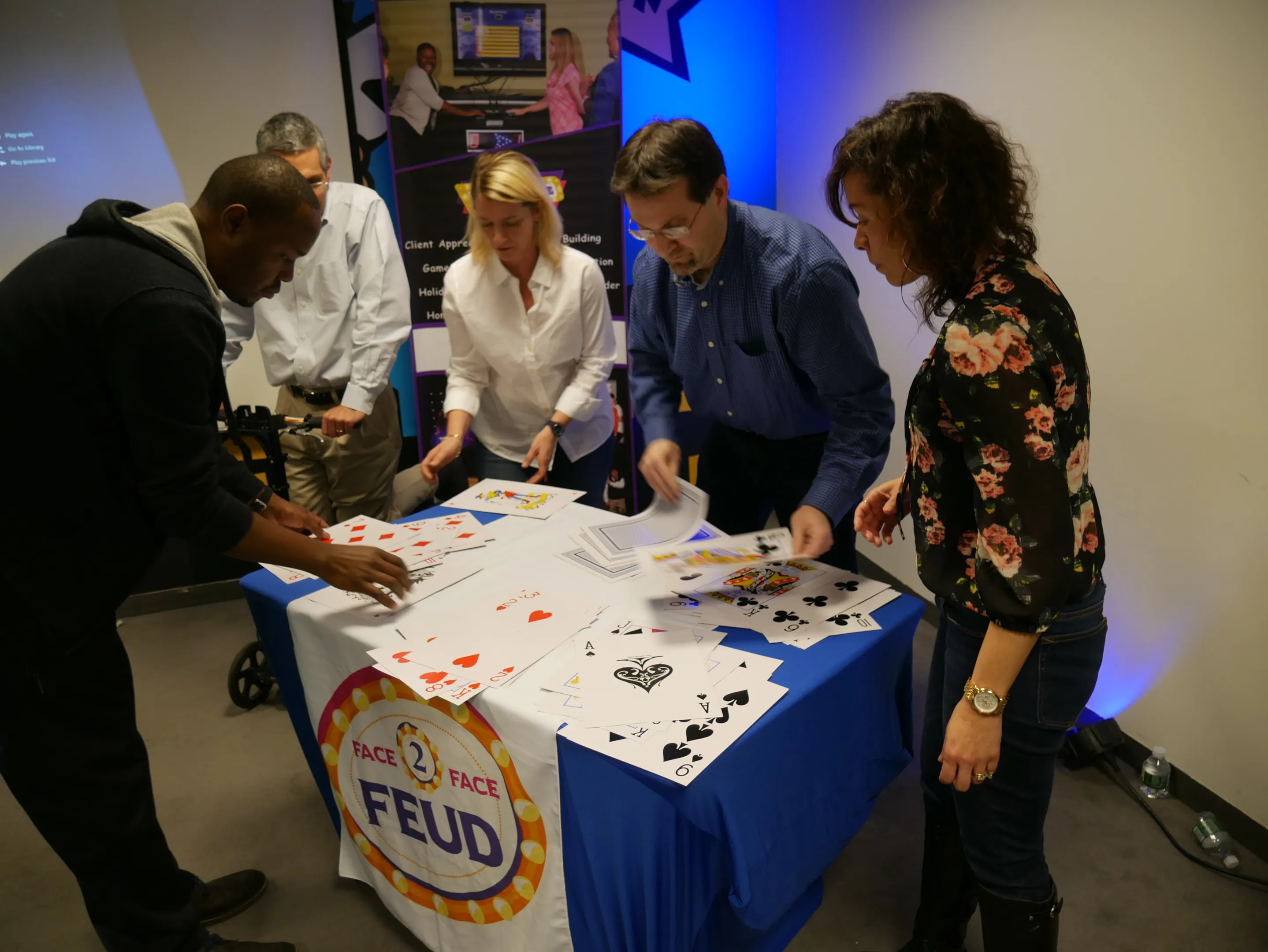
That framework is a live game show. When you wrap team building questions inside a Family Feud survey reveal, a Jeopardy!-style buzzer round, or a Price Is Right bidding war, even the quietest team members lean in. The structure gives people permission to be silly, to shout answers, and to bond over shared laughter. It’s PlayTyme Game Shows has built an entire business around this idea, hosting interactive game show experiences for corporate teams across New Jersey, New York City, and Connecticut.
Why Generic Icebreaker Lists Create Dead Air
Most team building question lists share the same problems. Recognizing these challenges explains why a game show format works better.
No structure means no momentum. Reading questions from a printout creates dead air. There is no scoring, no timer, and no reason for anyone to pay attention after answering their own question.
Introverts check out immediately. Open-floor icebreakers favor loud personalities. Quiet team members sit back and let others dominate, which defeats the purpose entirely.
Questions feel forced without a game mechanic. “What’s your spirit animal?” is tolerable inside a buzzer round with team scoring. Asked cold in a meeting room, it just feels odd.
No shared experience to reference later. A list of questions produces individual answers. A game show round produces a collective memory: the moment accounting swept the lightning round, or the boss guessed wildly wrong on the survey question.
The fix is straightforward. Take great questions and put them inside a game show format with a host, team scoring, sound effects, and a reason to cheer. Below are 50+ questions organized by game show round so you (or a professional host) can run them immediately.
Family Feud Style: “Survey Says” Team Building Questions
Family Feud rounds work because the answers come from surveys, not trivia knowledge. Teams guess what the most popular responses were. This levels the playing field: book smarts do not help here, intuition and humor do.
How to Run It
Split the room into two teams. Read the survey prompt. Each team takes turns guessing the top answers on the board. Award points based on answer ranking (top answer = most points). Three strikes and the other team steals.
The Questions
Name something people pretend to enjoy at work but secretly dread.
Name a snack that disappears fastest from the office kitchen.
Name something coworkers do that makes Monday mornings bearable.
Name a TV show everyone in the office has watched.
Name a reason someone gives for being late to a meeting.
Name something people do during a long video call when their camera is off.
Name a workplace phrase that means the opposite of what it says.
Name something you would find in every boss’s office.
Name the first thing people check when they arrive at work.
Name a song everyone knows the words to at karaoke.
Jeopardy!-Style Buzzer Round: Pop Culture Trivia
Jeopardy! rounds reward quick recall and teamwork. Teams huddle, pick a category, choose a point value, and buzz in with the answer. The category board creates strategy: do you go for the high-value questions early or build confidence with easier ones?
The Questions
Movies (100): This 1994 film features a character who runs across the country multiple times. (Forrest Gump)
Movies (200): The fictional company Dunder Mifflin sells this product. (Paper)
Music (100): This artist’s “Eras Tour” became the highest-grossing concert tour of all time. (Taylor Swift)
Music (200): “Bohemian Rhapsody” was performed by this British rock band. (Queen)
Food (100): This Italian dish literally translates to “pick me up” in English. (Tiramisu)
Food (200): The Scoville scale measures the heat level of these. (Chili peppers)
Sports (100): This soccer star moved from Inter Miami to international fame, known simply by one name. (Messi)
Sports (200): The Super Bowl trophy is named after this legendary coach. (Vince Lombardi)
Tech (100): This company introduced the iPhone in 2007. (Apple)
Tech (200): “GPT” in ChatGPT stands for this three-word phrase. (Generative Pre-trained Transformer)
Price Is Right Format: Workplace Estimation Questions
Price Is Right rounds are pure fun. Teams guess a number (a cost, a statistic, a measurement) and the closest answer without going over wins. This format generates big reactions because wrong guesses are often hilarious.
How to Run It
Display the question on screen. Each team writes their guess on a whiteboard or holds up a card. Reveal the real answer. Closest without going over scores the point.
The Questions
How many emails does the average office worker receive per day? (121)
How many hours per year does the average American spend commuting? (Approximately 240)
How many cups of coffee does the average American drink per year? (Approximately 400)
What percentage of meetings are considered unproductive by attendees? (Approximately 67%)
How many steps does the average office worker take per day? (Approximately 4,000)
What is the average cost of a Super Bowl commercial (30 seconds) in 2025? (Approximately $8 million)
How many hours per week does the average person spend on their phone? (Approximately 4 hours per day, 28 per week)
How many different species of pizza toppings exist worldwide? (Over 200 documented varieties)
“This or That” Lightning Round Questions
Lightning rounds keep the energy high. Teams or individuals choose between two options as fast as possible. There is no wrong answer, which makes this format perfect for learning about coworkers without any pressure. A good host turns each choice into a 10-second debate.
The Questions
Morning person or night owl?
Email or Slack message?
Work from home or work from office?
Coffee or tea?
Window seat or aisle seat?
Zoom backgrounds: real or virtual?
Lunch at your desk or lunch away from your desk?
Reply-all or direct message?
Spreadsheets or slide decks?
Early to the meeting or right on time?
Casual Friday or dress code every day?
Planner or go with the flow?
Audience Poll Round: “Who in This Room” Questions
This round borrows from the “Ask the Audience” mechanic. The host reads a prompt and the entire room votes (by raising hands, standing up, or using audience response pads). Results appear in real time on screen. It is a fast way to surface fun facts about the group and get 100% participation.
The Questions
Who has worked here the longest?
Who is most likely to survive on a desert island?
Who has the most unusual hidden talent?
Who would be the best contestant on a cooking show?
Who is most likely to become a CEO?
Who has traveled to the most countries?
Who would win in a dance-off?
Who sends the most GIFs in the team chat?
Who is most likely to accidentally reply-all to the entire company?
Who would host the best dinner party?
Rapid-Fire Trivia: General Knowledge for Teams
Classic trivia works when it moves fast. These questions span topics so every team member contributes something. The key is speed: 15 seconds per question, buzzer system, no deliberating. First correct answer gets the points.
The Questions
What planet is known as the Red Planet? (Mars)
How many continents are there? (Seven)
What year did the Titanic sink? (1912)
What is the smallest country in the world by land area? (Vatican City)
In what city were the 2024 Summer Olympics held? (Paris)
What element does “O” represent on the periodic table? (Oxygen)
Who painted the Mona Lisa? (Leonardo da Vinci)
What is the currency of Japan? (Yen)
How many strings does a standard guitar have? (Six)
What animal is featured on the Porsche logo? (A horse)
Game Show Format
Best For
Group Size
Energy Level
Prep Needed
Family Feud (Survey Says)
Breaking the ice, new teams
20-300+
High
Survey data
Jeopardy! Buzzer Round
Competitive teams, trivia fans
10-100
Medium-High
Category board
Price Is Right Estimation
Mixed departments, all-hands
20-300+
High
Answer research
This or That Lightning
Quick warmups, large crowds
Any size
Medium
Minimal
Audience Poll
Getting everyone involved
20-300+
Medium
Voting system
Rapid-Fire Trivia
High-energy closers
10-100
Very High
Buzzer system
How to Turn These Questions Into an Actual Event
Having 50+ great questions is only half the equation. The difference between a flat icebreaker session and an event people talk about for months comes down to execution. Here is what matters.
Get a Dedicated Host
A strong host controls pacing, reads the room, riffs on funny answers, and keeps energy high between rounds. Asking a manager to host their own team building event puts them in an awkward position and removes them from participating. Professional hosts from companies like It’s PlayTyme bring wireless buzzers, scoring displays, sound effects, and stage presence that transforms a conference room into a studio set.
Mix Your Formats
Do not run 60 minutes of straight trivia. Alternate between a Family Feud round, a This or That lightning break, a Price Is Right estimation round, and a final Jeopardy! showdown. Variety sustains attention and gives different personality types their moment to shine.
Keep Score Visibly
Projected scoreboards create stakes. When teams see they are two points behind going into the final round, the energy in the room shifts. Scoring turns questions into a shared narrative with a beginning, middle, and climax.
Customize Questions to Your Team
Generic trivia is fine. Questions about your specific company, inside jokes, or industry are better. A professional game show host will work with you beforehand to weave in custom rounds that reference your team’s real experiences.
Why the Game Show Format Outperforms Other Team Building Approaches
Escape rooms work for small groups but exclude anyone with mobility concerns or claustrophobia. Outdoor activities depend on weather and athletic ability. Happy hours leave out non-drinkers. Cooking classes require a specialized venue. Game shows scale from 20 to 300+ people, run indoors in any conference space, require zero athletic ability, and keep every single person involved through team-based play and audience participation rounds.
The format also produces measurable results. Teams that laugh together build the psychological safety that Google’s research identified as the foundation of performance. A 90-minute game show creates dozens of micro-moments where coworkers encourage each other, celebrate together, and learn unexpected things about the people they work with every day. That is not a generic trust fall. That is real connection built through shared experience.
It’s PlayTyme Game Shows specializes in exactly this format. Their professional hosts bring full production setups (LED screens, wireless buzzers, professional sound) to your venue anywhere in the NJ, NYC, and CT area. Every event is customized with company-specific questions mixed into the rounds described above. The result is an event that feels like a TV production, not a corporate obligation.
How to Narrow Game Show Formats Down to One
Start with your group size. Teams under 30 people thrive in buzzer-based formats like Jeopardy! where every person gets turns. Groups over 100 do better with audience poll rounds and Family Feud style play where entire sections of the room compete as a unit. Mixed groups with remote and in-person employees benefit from formats that use digital polling so virtual attendees participate equally.
Next, consider the goal. If your team is newly formed and people barely know each other, lead with This or That and Audience Poll rounds that reveal personal preferences without putting anyone on the spot. If your team has been together for years and wants high-energy competition, go heavy on trivia and estimation rounds where deep knowledge pays off.
Finally, decide whether to DIY or hire a pro. Running your own game show works for small, casual teams if you have the right personality leading it. For groups over 20, company-wide events, or any situation where you want guaranteed engagement, a professional host and production setup is the difference between “that was fine” and “when are we doing that again?” Reach out to It’s PlayTyme to discuss which format fits your team and get a custom question list built around your company’s culture. Check out their office trivia games page for a closer look at how these rounds come together in a live event.
How many team building questions do I need for a one-hour event?
Plan for 40 to 60 questions across multiple rounds. A professional host typically uses 8 to 12 questions per round and runs 4 to 5 rounds in an hour, with scoring breaks and team huddles in between. Having extra questions ready lets the host adjust pacing based on the room’s energy.
Do game show team building activities work for remote or hybrid teams?
Yes. Virtual game shows use digital buzzer apps, screen-shared scoreboards, and video conferencing breakout rooms to replicate the in-person energy. The This or That and Audience Poll formats translate especially well to remote settings because they rely on quick individual responses rather than physical buzzers.
What group size is best for game show style team building?
Game shows scale from 20 to 300+ participants. Small groups (10 to 30) work well with individual buzzer rounds. Larger groups (20 to 300+) use team-based play where tables or sections compete as units. This scalability is one of the biggest advantages over activities like escape rooms or cooking classes that cap at small numbers.
How do I keep team building questions appropriate for the workplace?
Stick to pop culture, general knowledge, workplace humor, and personal preferences. Avoid questions about politics, religion, salary, relationships, or anything that requires sharing personal information someone might not be comfortable disclosing. A professional host screens all questions beforehand and reads the room in real time to skip anything that feels off.
What makes a hosted game show better than running trivia yourself?
A professional host brings three things you cannot replicate with a DIY setup: production equipment (buzzers, LED displays, sound effects), performance skills (comedic timing, crowd management, energy control), and the ability for every team member, including the organizer, to participate as a player rather than a facilitator. The organizer gets to enjoy the event alongside their team instead of running it.
You booked the hotel ballroom for your company event. The venue is set and the catering is ordered. Now the real worry sets in: how do you get 100 people to actually connect in one room?
Too many large events end the same way. People stay stuck in their usual cliques, heads down on their phones, and leave without a single new connection. That wastes the whole investment, and it happens more often than planners admit.
Workplace connection drives real results. A McKinsey report found that strong workplace relationships rank among the top drivers of employee job satisfaction. A separate Gartner analysis found only 13% of employees feel fully satisfied with their overall work experience. The right event moves both numbers, but only when it fits a large indoor crowd.
Before You Read On
Strong workplace relationships rank among the top drivers of employee job satisfaction, per McKinsey
Only 13% of employees feel fully satisfied with their overall work experience, per Gartner
Large indoor events fail when attendees stay in cliques and form no new connections
A structured indoor game show gives 100 people a shared goal that breaks down those cliques
The right event format improves both engagement and satisfaction numbers at the same time
Why Fixed Floor Space Complicates Indoor Group Games
A big indoor group creates problems that outdoor picnics and small gatherings never face. You get a fixed amount of floor space, usually packed with round tables that block movement. Running a high-energy activity looks impossible unless you clear the whole room, and that is rarely an option.
Here are the hurdles you have to plan around:
Limited floor space. Most large-group activities need open room, which a banquet hall set for dinner simply does not have.
Fixed seating. Guests stay at their assigned tables. That creates conversational silos and blocks cross-department mixing.
AV uncertainty. You rarely know if the in-house AV works or is even available. Relying on it invites technical failures that kill momentum.
Passive crowds. In a big room, most people slip into spectator mode. That defeats the entire point of a team event.
You need a format that saves space and pulls in everyone, without a gym-sized floor plan.
Game Show Formats Solve the Space Problem
For planners across New Jersey, NYC, and Connecticut, a fully hosted game show is the answer. The format fits a large indoor audience and skips the usual logistics headaches. It needs only a small area for the host and contestants, while everyone else plays from their seats.
This is exactly what we do at It’s PlayTyme Game Shows. Lisa Lawrence brings more than a decade of experience and more than 3,000 events, and she turns a standard ballroom into a live game show set. We supply the podiums, buzzers, sound system, and custom-branded graphics on the big screen. Your team just shows up. A professional host runs the energy from the first buzzer to the last laugh.
Here is the part planners love: every event is backed by our 100% satisfaction guarantee, and there is no deposit to hold your date. We handle the entertainment, you focus on your guests, and the room ends up talking about the event for weeks.
How It’s PlayTyme Game Shows Compares to Other Team Building Options
Option
Space Needed
Fits 40-100
Host Included
Custom Content
It’s PlayTyme Game Shows
Small front area
Yes
Yes
Yes
DIY Trivia Night
Varies
Hard to manage
No
Manual
Escape Room Outing
Offsite required
No (small teams)
Staff only
Limited
Virtual Team Platform
None (online)
Yes
Sometimes
Limited
Top Indoor Game Ideas for Groups of 40-100
These games are proven in real corporate settings like ballrooms and conference rooms, with little or no room reconfiguration.
1. Hosted Team Trivia (Jeopardy-Style)
A classic that still delivers. Teams sit by table and answer questions across mixed categories. A sharp host sets the pace and adds the comedy that makes it land. We build in company history, inside jokes, and industry questions, so it feels personal. It runs on one screen and one host, nothing more.
2. Survey Showdown (Face-2-Face Feud)
Built on the hit TV format, our Face-2-Face Feud sets two teams against each other to guess the top survey answers. The whole room shouts out guesses and gets loud fast. It creates big collective energy and friendly competition, and nobody leaves their seat.
3. Minute-to-Win-It Challenges (60 Seconds of Fame)
For something physical but still contained, our 60 Seconds of Fame is the pick. A few volunteers come up front for a fast, funny challenge with cups, cotton balls, or ping-pong balls. A few people play while the rest cheer, and that shared moment carries the room. The action stays in one small spot, so your layout never changes.
4. Human Bingo
This is a strong opening activity that gets people moving and talking right away. Each guest gets a card with prompts like “Find someone who speaks more than two languages” or “Find someone here 10+ years.” They mingle, find matches, and collect signatures. It is low-tech and high-impact, and it sparks real introductions before the main program.
5. Two Truths and a Lie
This simple get-to-know-you game scales well with a skilled host. A few executives or new hires take the stage and share three statements. Each table votes on the lie. It surfaces fun facts and humanizes leadership in a structured, entertaining way.
Music & Word Games for High Energy
Some of the best large-group formats run on sound and quick thinking. Both work perfectly for a seated audience.
6. Name That Hit Song
Music connects everyone. Teams hear short clips from different decades and guess the title and artist. It sparks conversation, nostalgia, and a lot of singing along. Our Name That Hit Song show is one of our most requested formats because it lands with the 22-year-old new hire and the 65-year-old executive alike.
7. Word Play Challenges
Put the analytical minds to work with clever puzzles. We project anagrams, riddles, and our custom Word Play challenges on screen, and tables solve them together. It is quieter, focused competition that builds team connection and rewards collaboration, with zero physical activity.
Logistics: Planning for a Confined Space
Even a space-efficient game rewards a little planning. For 40 to 100 guests, a cabaret or banquet layout with round tables works best. It makes team formation easy and pushes collaboration. Theater-style seating works fine too, since the host channels participation.
The single biggest factor is a professional host. A great host does far more than read questions. They manage the room’s energy, handle any technical hiccup, pull in quiet guests, and keep you on schedule. Hire a fully hosted experience and you buy peace of mind plus a guarantee of clean execution.
Which Indoor Game Fits Your Group’s Goals and Culture
The best activity depends on your goals. Run through these questions to narrow it down:
What is the main goal? For pure fun, pick a high-energy game like Face-2-Face Feud or Name That Hit Song. For networking, open with Human Bingo.
What is your culture? Competitive teams love trivia or a survey showdown. Reserved or analytical teams lean toward Word Play.
How much customization do you want? To reinforce company values, mark a milestone, or onboard new hires, custom trivia about your organization works best.
Where does it land on the agenda? After a long day of presentations, go fast and loud to re-energize the room. As a standalone event, you have more room to play.
Work through these factors and you land on a game that entertains and delivers a real outcome, whether that is stronger team connection or a better culture.
Stop worrying about how to fill the time at your next corporate event. A professionally hosted game show is the most reliable way to send everyone home energized and more connected than when they walked in. We bring the equipment, the energy, and the expertise to your venue in NJ, NYC, or CT.
No problem. We bring everything: a professional sound system, microphones, a large screen, and our own game show software and hardware. You provide the space and the people, and we handle the rest.
How much space do we really need for 100 people?
If you can comfortably seat your guests, you have enough space for our game show. Our formats need only a small footprint at the front for the host and setup. We work inside your existing floor plan.
Can the game questions be customized for our company?
Absolutely. We build trivia questions, survey content, and challenges around your culture, industry, event theme, or key employees. That makes the whole experience personal and memorable.
Are these games suitable for a mix of ages and job levels?
Yes. Our games work for a diverse crowd. Team trivia, Face-2-Face Feud, and Name That Hit Song appeal across interests and backgrounds, so interns and executives all play and have a great time.
How long do these game show events typically last?
Our standard shows run 60 to 90 minutes, the sweet spot for keeping a large group energized and focused. We also adjust the length to fit your agenda, from a short burst of fun to a longer main event.
What is the real cost when a large group event fails to create connections?
When attendees stay in their usual cliques and leave without a single new connection, the venue and catering investment is wasted. A Gartner analysis found only 13% of employees feel fully satisfied with their work experience, partly because events miss the connection piece.
The quarterly offsite was supposed to pull the team back together. Instead, half the room drifted toward the snack table while a handful of people did all the work, and by 3 p.m. the energy was gone. If you have booked corporate entertainment that looked great on paper and fell flat in the room, you already know the trouble is rarely the people. It is the format.
Picking the right one matters more than most planners expect. Workplace social events raise employee engagement by roughly 24% on average, and highly engaged teams run about 23% more profitable than disengaged ones. A weak activity does not just waste a budget line. It sets the tone for the months that follow.
Three formats dominate the shortlist for corporate team building: live hosted game shows, escape rooms, and improv troupe workshops. Each one solves a real problem, and each one breaks in a predictable place. The honest challenges are practical: a format that only fits eight people when you invited eighty, a venue across town that eats an afternoon in transit, uneven participation that leaves quiet staff on the sidelines, and no plan B when the activity simply does not land.
What Breaks When Group Size and Venue Don’t Match
Before comparing the three, it helps to name what actually goes wrong. These are the recurring problems planners report after the booking is done.
Group-size mismatch. An activity built for a single team rarely scales to a full department or a company holiday party without splitting people up and diluting the experience.
Venue logistics. Off-site formats add travel, parking, and a hard time window, so the real activity shrinks to 60 minutes of a four-hour block.
Uneven participation. Puzzle-heavy or performance-based formats reward a confident few while introverts watch from the edge.
No safety net. Most providers are paid in full whether the room lights up or stalls, so the financial risk sits entirely with you.
Nothing carries over. If nobody is talking about it on Monday, the engagement bump never materializes.
Quick Comparison: Game Show vs Escape Room Team Building vs Improv
Here is how the three formats score on the dimensions that decide whether a corporate event works for the whole room, not just a lucky few.
A live game show drops a TV-style production into your own space. A professional host runs Family Feud-style face-offs, fast trivia rounds, and Minute to Win It challenges, while teams compete from buzzer podiums in the same room. The format reads instantly, so nobody needs to learn rules or feel exposed.
The format wins on three things the others cannot match together. It scales from a 20-person department to a 300-plus conference crowd without losing energy, because the host pulls the whole room in at once. It comes to you, so a hotel ballroom, a museum, or your own office turns into the set with no travel for staff. And It’s PlayTyme backs every event with a 100% satisfaction guarantee and asks for no deposit to hold your date. Led by founder Lisa Lawrence, the company has hosted thousands of rooms across NJ, NYC, and CT since 2012.
If your priority is full-room participation at scale with no venue headache, this is the format that delivers it. Explore the game show themes to match the show to your crowd.
Corporate Escape Rooms: Where Small Teams Win
Escape rooms lock a small group in a themed space to solve linked puzzles against a 60-minute clock. Operators calibrate the puzzle count for 4 to 8 players, which is exactly where the format shines. For one tight-knit team that loves problem-solving, an escape room creates intense, shoulder-to-shoulder collaboration that few activities can copy.
The constraints are structural, not a knock on the genre. Each room holds a single small team, so a group of 60 means splitting across multiple rooms and comparing escape times afterward, which works but fragments the event. The experience is venue-bound, so your people travel and you lose part of the afternoon to logistics. Quieter staff can also fade into the background when a couple of fast thinkers crack most of the clues. For a single department of eight that wants deep, focused bonding, an escape room is a genuinely strong pick.
Improv Troupes: Where Skill-Building Wins
Improv workshops put a facilitator in front of your team to run applied theater exercises built on listening, adaptability, and saying yes-and. The interactive style works best for 6 to 20 participants, and larger groups get split into parallel breakouts. Many troupes will come on-site, which keeps logistics light.
Where improv genuinely wins is skills that carry into the workday. The exercises rehearse real communication, quick thinking, and trust, so the value transfers directly to how the team operates afterward. The trade-off is comfort and scale: asking people to perform unscripted can intimidate the reserved members of a group, and the format reads more like training than a party. For leadership development or a smaller cohesive team working on communication, an improv troupe is a smart, purposeful choice.
Choosing the Right Format for Your Group and Occasion
Match the format to the room you actually have. For one small team that loves puzzles, an escape room delivers intense focus. For a smaller group working on communication and trust, an improv workshop builds skills that last. Both are real winners inside their lane.
When the brief is a full department, a conference, or a holiday party where everyone should be involved, the live hosted game show wins on the three dimensions that matter most at scale: it grows from 20 to 300+ in one room, it arrives on-site so nobody travels, and it is run start to finish by a professional host and backed by a 100% satisfaction guarantee. That combination is also why this three-way comparison reaches a different conclusion than our straight swap piece on choosing a live game show as an escape room alternative.
Want help matching a format to your group size and goals? Tell us about your event and our team will build the right show for your room. Start with our team building activities in New Jersey and we will take it from there.
Frequently Asked Questions (FAQs)
Is a game show or an escape room better for team building?
It depends on group size. An escape room is excellent for one small team of 4 to 8 who enjoy puzzles. A live game show is the stronger choice when you need a full department or large group involved at once, because a host engages the entire room rather than splitting it across separate spaces.
How many people can each format handle at once?
Escape rooms fit 4 to 8 players per room and scale only by running parallel rooms. Improv workshops work best at 6 to 20 and split larger groups into breakouts. A live hosted game show runs 20 to 300+ people together in a single room without losing energy.
Do these activities come to our office, or do we travel?
Escape rooms are venue-bound, so your team travels to the location. Improv troupes will often come on-site. It’s PlayTyme brings the full game show production to your office, hotel, or conference space anywhere across NJ, NYC, and CT, so there is no travel for staff.
What if the activity falls flat with our group?
Keeping the room up is the host’s job. It’s PlayTyme hosts read the room, adjust the pace, and pull quieter players in through team play, so the energy holds for the whole show. More than 3,000 events since 2012 sit behind that, along with a 100% satisfaction guarantee.
Which format gives the best follow-up value afterward?
Improv builds workplace skills that transfer to daily work, and escape rooms bond a small team through shared problem-solving. A live game show tends to create the widest carryover, since the whole room shares the same moments, photos, and inside references that keep the energy alive for weeks.
The business case for diversity is not abstract. According to McKinsey’s 2023 Diversity Matters report, companies in the top quartile for gender diversity on executive teams are 39% more likely to achieve above-median financial performance than those in the bottom quartile. Meanwhile, a 2025 Gallup survey found that 64% of Americans believe businesses with diverse workforces are more innovative. The data is clear: diversity drives results.
Yet knowing that diversity matters and actually building an inclusive culture are two different things. Many organizations collect diversity and inclusion quotes for newsletters or slide decks, then stop there. The words sit on a poster in the break room while employees still feel unheard, overlooked, or excluded from decisions that shape their daily work.
The real challenge is turning inspiration into practice. Teams struggle to move past surface-level messaging. Managers want to lead inclusively but lack conversation starters. HR departments roll out training that feels disconnected from how people actually collaborate. The quotes below are organized into themes so you can use them where they matter most: in team discussions, leadership workshops, and group activities that build real connection.
The Essentials
Companies in the top quartile for gender diversity are 39% more likely to achieve above-median financial performance.
A 2025 Gallup survey found 64% of Americans believe businesses with diverse workforces are more innovative.
Most organizations collect diversity quotes for newsletters or slide decks and stop there.
Employees still feel unheard while diversity quotes sit on break room posters.
The real challenge is turning inspiration into practice, not just displaying the words.
Why Diversity and Inclusion Quotes Still Matter
Words shape culture. A well-chosen quote does more than fill space on a presentation slide. It gives people a shared reference point, a way to name something they have experienced but struggled to articulate. When a team reads a quote about belonging and then discusses what it means for their own group, that conversation becomes a bridge between abstract values and daily behavior.
Research in organizational psychology consistently shows that language affects how people perceive their environment. When leaders use inclusive language regularly, employees report higher psychological safety and stronger team trust. Diversity and inclusion quotes work best as conversation starters, not endpoints. Pair them with structured discussion or a hands-on team activity, and they become tools for genuine change.
Quotes About Belonging in the Workplace
Belonging is the foundation of inclusion. Without it, diversity is just a headcount metric. These quotes capture what it means to feel genuinely welcome at work.
“Diversity is being invited to the party; inclusion is being asked to dance.” — Verná Myers
“When we listen and celebrate what is both common and different, we become a wiser, more inclusive, and better organization.” Pat Wadors
“Belonging is the innate human desire to be part of something larger than us.” Brené Brown
“You don’t have to fit in. You were born to stand out.” Dr. Seuss
“No one is born hating another person because of the color of his skin, or his background, or his religion.” Nelson Mandela
“An individual has not started living until he can rise above the narrow confines of his individualistic concerns to the broader concerns of all humanity.” Martin Luther King Jr.
How to use these: Open a team meeting by reading one aloud. Ask each person to share a time they felt they truly belonged on a team and what made that possible. This simple exercise surfaces shared values without forcing vulnerability.
Quotes About Equity and Fairness
Equity recognizes that equal treatment does not always produce equal outcomes. These quotes address the structural side of inclusion.
“It is not our differences that divide us. It is our inability to recognize, accept, and celebrate those differences.” Audre Lorde
“Equality is leaving the door open for anyone who has the means to approach it; equity is making sure there is a pathway to that door for those who need it.” Caroline Heldman
“The world is not fair, and often fools, cowards, liars, and the selfish hide in high places.” Bryant H. McGill
“Where justice is denied, where poverty is enforced, where ignorance prevails, and where any one class is made to feel that society is an organized conspiracy to oppress, rob, and degrade them, neither persons nor property will be safe.” Frederick Douglass
“True peace is not merely the absence of tension; it is the presence of justice.” Martin Luther King Jr.
“We need to give each other the space to grow, to be ourselves, to exercise our diversity.” Max de Pree
How to use these: During onboarding or leadership development sessions, pair an equity quote with a scenario exercise. Present a workplace situation and ask the group to distinguish between equal and equitable responses. This grounds abstract concepts in practical decision-making.
Quotes About the Power of Different Perspectives
Diverse teams outperform homogeneous ones because they bring more viewpoints to every problem. These quotes highlight why cognitive diversity is a competitive strength.
“We all should know that diversity makes for a rich tapestry, and we must understand that all the threads of the tapestry are equal in value no matter what their color.” Maya Angelou
“Strength lies in differences, not in similarities.” Stephen R. Covey
“If we cannot now end our differences, at least we can help make the world safe for diversity.” John F. Kennedy
“Diversity: the art of thinking independently together.” Malcolm Forbes
“Innovation comes from people meeting up in the hallways or calling each other at 10:30 at night with a new idea.” Steve Jobs
“The measure of intelligence is the ability to change.” Albert Einstein
“We need diversity of thought in the world to face the new challenges.” Tim Berners-Lee
These are particularly effective for cross-functional teams or departments that have recently merged. Reading them before a brainstorming session reminds the group that disagreement is an asset, not a threat.
Quotes About Inclusive Leadership
Inclusion starts at the top. Leaders set the tone for whether different voices are heard or ignored. These quotes speak directly to anyone managing people.
“A leader takes people where they want to go. A great leader takes people where they don’t necessarily want to go, but ought to be.” Rosalynn Carter
“I always did something I was a little not ready to do. I think that’s how you grow.” Marissa Mayer
“Leadership is not about being in charge. It is about taking care of those in your charge.” Simon Sinek
“The most common way people give up their power is by thinking they don’t have any.” Alice Walker
“A genuine leader is not a searcher for consensus but a molder of consensus.” Martin Luther King Jr.
“In the future, there will be no female leaders. There will just be leaders.” Sheryl Sandberg
How to use these: Start a leadership retreat with one of these quotes projected on screen. Ask each leader to write down one specific behavior they will practice in the next 30 days to make their team more inclusive. Collect and revisit them at the next session for accountability.
Quotes About Action and Courage
Talking about inclusion is easy. Acting on it is harder. These quotes push teams past comfort zones and into commitment.
“In a gentle way, you can shake the world.” Mahatma Gandhi
“Our ability to reach unity in diversity will be the beauty and the test of our civilisation.” Mahatma Gandhi
“Change will not come if we wait for some other person or some other time. We are the ones we’ve been waiting for. We are the change that we seek.” Barack Obama
“Each time a person stands up for an ideal, or acts to improve the lot of others, or strikes out against injustice, he sends forth a tiny ripple of hope.” Robert F. Kennedy
“Never doubt that a small group of thoughtful, committed citizens can change the world; indeed, it’s the only thing that ever has.” Margaret Mead
“Do the best you can until you know better. Then when you know better, do better.” Maya Angelou
These work well as closing statements for training sessions or as discussion prompts during all-hands meetings. They shift the energy from reflection to resolution.
Why Quotes Alone Cannot Change Culture
Collecting quotes is the easy part. The hard part is what happens next. Organizations face several concrete challenges when they try to translate inclusive language into inclusive behavior.
The Poster Problem
Printing a quote on a wall does nothing if daily interactions contradict its message. Employees notice the gap between what a company says and what it tolerates. Quotes without follow-through breed cynicism, not connection.
Discussion Without Structure
Asking a group to “discuss diversity” without a framework often produces awkward silence or surface-level agreement. People need a specific prompt, a time limit, and a facilitator who knows how to guide the conversation past platitudes.
One-Time Events vs. Ongoing Practice
A single DEI workshop does not change culture. Teams need repeated, low-pressure opportunities to practice inclusive behaviors. Game-based team building works because it creates those opportunities naturally: people collaborate, listen, and adapt under shared pressure without it feeling like a lecture.
Leadership Buy-In
If managers treat inclusion as an HR initiative rather than a leadership responsibility, the message stalls. Leaders need to model inclusive behavior in meetings, hiring decisions, and project assignments, not just share quotes on LinkedIn.
How to Use Diversity and Inclusion Quotes in Team Building Activities
The most effective way to use diversity and inclusion quotes is to pair them with interactive experiences that get people talking, collaborating, and seeing each other differently. It’s PlayTyme Game Shows specializes in exactly this: facilitated game show experiences that bring teams together across departments, backgrounds, and seniority levels.
Here are specific ways to integrate quotes into team building:
Quote-Based Trivia Rounds
Build a round of trivia where teams match quotes to their authors or guess the missing word. This turns passive reading into active engagement. It’s PlayTyme’s game show format makes this competitive and fun without requiring anyone to share personal experiences they are not comfortable discussing.
Discussion Stations
Set up stations around a room, each with a different themed quote. Teams rotate through, spending five minutes discussing what the quote means for their specific work. A facilitator captures key takeaways and shares them with the full group at the end.
Pre-Event Reflection
Send one quote to all participants 24 hours before a corporate team building event. Ask them to arrive with one thought about it. This primes the group for deeper engagement during the activity itself.
Method
Best For
Group Size
Time Needed
Engagement Level
Quote trivia round
Large groups, icebreakers
20-300+
15-20 min
High
Discussion stations
Workshops, retreats
10-50
30-45 min
Medium-High
Pre-event reflection
Priming before activities
Any
5 min
Medium
Facilitated game show
DEI events, all-hands
20-300+
60-90 min
Very High
Quote wall + voting
Office culture building
Any
Ongoing
Low-Medium
How to Turn Diversity Quotes Into Real Team Growth
A quote on a slide inspires for a moment. A shared experience changes how people relate to each other for months. The difference between organizations that talk about inclusion and those that practice it comes down to one thing: they create structured opportunities for people to connect across differences.
Start by choosing quotes that match your team’s current reality, not aspirational statements that feel disconnected from daily work. Use the thematic categories above to match quotes to specific goals: belonging for new teams, equity for leadership groups, perspective for cross-functional projects. Then pair those quotes with an activity that requires collaboration.
Game-based team building is one of the most effective formats because it levels the playing field. Job titles disappear when everyone is competing together. Introverts contribute through strategy. Extroverts learn to listen. The result is a team that has practiced inclusive behavior without anyone calling it a “training.”
If your organization is ready to move beyond posters and presentations, explore diversity team games that turn these quotes into action. Contact It’s PlayTyme Game Shows to plan a DEI-focused team building experience for your group in New Jersey, New York City, or Connecticut.
Frequently Asked Questions (FAQs)
How do you use diversity and inclusion quotes in team meetings?
Choose one quote that relates to a current team goal or challenge. Read it aloud at the start of the meeting and ask each person to share a brief reaction. Keep responses to 30 seconds each so the exercise stays focused and does not dominate the agenda. Rotate the person who selects the quote each week to give everyone a voice.
What is the best diversity quote for a corporate event?
Malcolm Forbes’s “Diversity: the art of thinking independently together” works well for corporate audiences because it frames diversity as a business advantage rather than a compliance requirement. Pair it with a collaborative activity like a team trivia game to reinforce the message through experience.
How do diversity and inclusion quotes improve workplace culture?
Quotes give teams shared language for discussing complex topics. When used consistently in meetings, onboarding, and team activities, they normalize conversations about inclusion. Over time, this builds psychological safety because employees see that leadership takes these values seriously enough to revisit them regularly.
What are good diversity activities for large groups?
Facilitated game shows, quote-based trivia competitions, and rotating discussion stations all work for groups of 20 or more. The key is structured facilitation so that every person participates, not just the most outspoken. It’s PlayTyme Game Shows runs events for groups of 20 to 300+ people across the tri-state area.
How often should teams discuss diversity and inclusion?
Monthly touchpoints work best for most organizations. This is frequent enough to maintain momentum without overwhelming the team. Combine a brief quote discussion at monthly meetings with one or two larger interactive events per year, such as a facilitated team building game or workshop, to keep engagement high.
Quick answer: A hosted game show works better for team building because a professional host runs the room and every person plays on a team. DIY trivia apps cost less on paper, but your own staff writes the questions, hosts the show, and fixes the glitches, and the room stays quiet.
Corporate offsites usually land on the desk of an HR director or an office manager who already has a full-time job, and the brief is simple: get people talking to each other. Most activities miss because the room stays passive. Across 3,000 live game shows produced since 2012, the pattern holds: participation has to be built into the format, not hoped for.
The format you choose decides the outcome. Most decision makers weigh two options: run a digital quiz in house, or hire a professional host for a live game show. The subscription price tells you almost nothing. Staff hours, venue Wi-Fi, and a nervous volunteer emcee all carry real cost. The hosted game show vs trivia app question comes down to the kind of interaction your group needs and what you expect back from the budget.
Why Corporate Groups Go Quiet at Live Events
Attendance is not participation. Put fifty or five hundred employees in one room and a few predictable barriers show up.
The passive audience habit: people are trained to sit and watch slides, so breaking that takes a real reason to speak up.
Amateur hosting: a department head with a microphone produces awkward pacing and forced fun, and the volunteer rarely enjoys it either.
Tech that fails under load: hotel Wi-Fi often buckles the moment two hundred phones log on at once.
Split attention: personal screens kill the eye contact and laughter that build camaraderie.
The loudest voices win: loose formats let extroverts dominate while quieter staff disappear.
Hosted Game Show vs DIY Trivia App at a Glance
Option
Who runs the room
Room energy
Group size
Planning load on you
It’s Playtyme Game Shows
Professional host, sound and buzzer setup included
Loud, team-based, face-to-face
20 to 300+
None
Traditional corporate entertainment (comedian, magician, keynote speaker)
Performer driven, varies by act
Show first, audience second
Varies by act
Low to moderate
DIY trivia app or self-run quiz software
A volunteer from your own staff
Quiet, heads down on phones
Capped by software tier
High: writing, testing, hosting, fixing
Cost, Staff Hours, and the Per-Seat Tier Trap
A software subscription looks inexpensive on the invoice. The invoice is not the whole bill. Someone on your team writes the questions, formats the slides, tests the platform, and fixes it live. That work comes out of your management hours, not the vendor’s.
Then the group grows. Self-run quiz software is usually sold in per-seat tiers, so the entry plan that fit a twelve person team stops fitting a company kickoff. Planners find the ceiling late, upgrade under time pressure, and still end up hosting the thing themselves. Read our breakdown of how much corporate team building costs before you compare line items.
Hiring a professional crew changes the math. With shows starting at $2,995, you supply the venue and the people. We bring the host, the equipment, and a format that already works. Your planners sit with their colleagues instead of running the room with a clipboard, and the return on the budget shows up as a group that actually talks to each other afterward.
A Professional Emcee or a Volunteer From Your Own Team?
Running software and hosting a live room are two different jobs. With a DIY quiz, one employee gets volunteered to stand up front. That person reads questions, tries to be funny, and fixes glitches at the same time, usually while dreading the microphone. Public speaking is a genuine fear for a lot of capable people, and handing it to a colleague who wanted to play with their team is an unfair trade.
It’s Playtyme Game Shows sends a professional host who reads the room, adjusts the pacing, and pulls in the quiet participants. We have hosted live game shows for corporate and school groups across New Jersey, New York City, New York State, and Connecticut since 2012. Event planners consistently tell us the host is what separates a room that plays from a room that watches. Our promise is simple: you 100% Satisfaction Guarantee with the work.
Why Live Play Gets Adults to Drop Their Guard
Adults at work need permission to stop being professional for an hour. A quiz app never gives it. Tapping multiple choice answers on a phone feels like another compliance module.
A live host changes the tone the second the microphone goes on. People learn fast that cheering, arguing over answers, and competing are all allowed. The game show is the vehicle; connection is the point. That is the real gap in any hosted game show vs trivia app comparison.
How Many People Actually Play
Many quiz platforms cap participants until you upgrade, and even on the top tier everyone plays alone on a personal device. A live show runs on teams. Our formats work for groups from 20 people to 300 or more, and we structure the show so every table gets into the action.
If the appeal of an app was the technology, that part is covered. PlayPad Mania runs on team keypads and tablets we bring with us, so large groups answer together instead of individually. Face-2-Face Feud and The Challenge do the same job with buzzers and podiums.
Screens Down, Faces Up
Picture a ballroom running a smartphone quiz. Heads down, thumbs moving, almost no sound in the room. Nobody walks out of there feeling closer to their coworkers.
Now picture a live game show. Teammates argue over an answer, a table erupts when they get it right, and the room gets loud. Getting people out of their seats and off their screens is what makes the event stick.
Technical Risk When the Venue Wi-Fi Buckles
Betting your event on a venue’s internet is a gamble. Conference centers and hotel ballrooms in NYC and across North Jersey regularly lose bandwidth once a large group connects at the same time. A digital quiz stops cold the second the network drops, and your volunteer host is left apologizing to the room.
We remove that risk. Our hosts arrive with self-contained sound systems, physical buzzers, audience keypads, and the visual displays the show needs. Nothing depends on venue Wi-Fi. The show starts on time and runs straight through without an IT scramble.
Questions Built Around Your Company
Generic quiz banks feel generic because they are. Questions about pop culture and state capitals say nothing about your company or your people.
We build rounds around your company history, your product lines, and your staff milestones, and we keep every question workplace appropriate. That same tailoring is why these shows work for client appreciation nights. A custom interactive show gives clients a reason to remember the evening long after another plated dinner would fade.
Decide Based on Who You Want Running the Room
Two options, and the deciding factor is not the price tag.
Go with the DIY app when the budget is near zero, the group is small, and someone on staff genuinely wants to build and host it.
Go with the hosted game show when the group is large, the stakes are high, and you need participation you can count on rather than hope for.
If the goal is a room full of people laughing together and remembering each other’s names on Monday, a live host delivers that and software does not.
Ready to take the next corporate event off your desk? Tell us the date, the room size, and the goal, and you get a custom production plan back within two business days. No deposit and no upsell. Contact us to talk through your group size and your dates.
Frequently Asked Questions (FAQs)
What is the best alternative to DIY trivia apps for corporate team building?
A fully hosted live game show is the closest direct replacement. You get a professional emcee, team play instead of solo phone play, and the production handled for you, so nobody on your staff has to write questions or troubleshoot software during the event.
How many people can participate in a live game show?
We run shows for groups from 20 people to 300 or more. Larger groups get a custom setup with audience keypads so every table stays in the game instead of watching from the side.
Do you provide live corporate game show hosts in NJ, NYC, and CT?
Yes. We host corporate team building events across New Jersey, New York City, New York State, and Connecticut. Our team travels to your location with everything the show needs: sound system, physical buzzers, displays, keypads, and game props. You do not supply audio, visual, or in-house hardware, and nothing runs on the venue Wi-Fi.
How long does a typical team building game show last?
Shows run 60 or 90 minutes. Both lengths build real energy without swallowing your whole conference agenda or wearing out your group.
Can we include our own company facts in the game?
Yes. We write rounds around your company history, specific departments, product launches, and staff milestones. Those questions get the biggest reactions of the night.