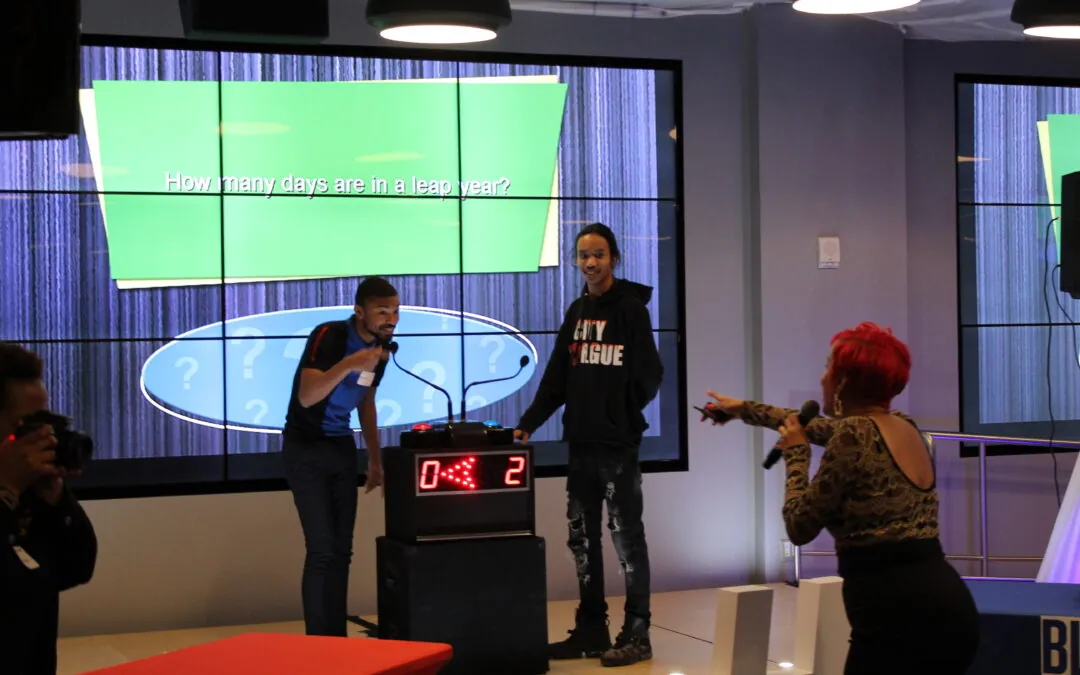
Experiential marketing trends 2026 point in one direction: audiences want to participate, not just watch. Attention is the reason. Gallup reports that only about 20% of employees worldwide are engaged at work, and that same passivity now shows up in audiences who scroll past static ads and ignore one-way booths. Research summarized by Harvard Business Review connects active participation and emotion to far stronger memory, which is precisely why interactive formats are winning event budgets this year.
This guide covers the experiential marketing trends shaping 2026 and then narrows to a specific, defensible play: live game show events as an experiential marketing tool. Game shows put participation, emotion, and shareable moments at the center of a brand activation, and they do it with a structure most other formats lack. Here is where the field is heading, and how a hosted game fits each shift.
Planning an experiential marketing activation? Our hosted game shows draw crowds at events across NJ, NYC and CT.
Audiences in 2026 expect to participate in brand experiences, not passively watch them.
Only 20% of employees globally feel engaged, and that same passivity shows up at events.
Harvard Business Review links active participation and emotion to stronger memory formation.
Live game shows combine participation, emotion, and shareable moments inside a clear, repeatable structure.
Game show formats solve the structure gap that makes most other interactive activations feel forced.
What Experiential Marketing Means in 2026
Experiential marketing creates a live, participatory moment that ties an audience to a brand through doing, not viewing. In 2026 the bar is higher. Audiences expect personalization, real interaction, and a reason to share the moment online. A passive photo wall no longer earns attention; an activity that makes guests the main character does.
The shift rewards formats that are inherently interactive. That is the gap a hosted game show fills naturally, because the audience is the show. Before we connect the two, here are the trends defining the year.
Experiential Marketing Trends 2026
1. Participation over presentation
The biggest shift is from watching to doing. Activations that ask the audience to compete, vote, answer, or build outperform displays that simply broadcast a message. Brands are budgeting for formats where guests are active players, because participation drives the emotion that fixes a brand in memory.
2. Hybrid and remote-inclusive experiences
Hybrid is now standard, not a backup plan. The strongest 2026 activations include remote audiences as real participants through live streams, second-screen interaction, and synchronized play. The format has to treat a person at home as fully present, not as a viewer watching from the outside.
3. Data capture through play
Interactive moments double as data moments. Polls, quizzes, and live voting collect opt-in audience data and real-time sentiment that a static booth never gathers. Brands now measure activations by the responses, sign-ups, and follow-up conversations they produce, not just foot traffic.
4. Shareable, short-form moments
Every activation is also content. The 2026 standard is to engineer naturally shareable moments, a buzzer-beating win, a funny on-stage answer, that guests post without being asked. The experience has to look as good on a phone screen as it feels in the room.
5. Personalization at scale
Audiences expect the experience to reflect them. Custom questions, branded rounds, and references to the specific company or product make an activation feel built for that crowd. Personalization is what separates a memorable brand moment from a generic event.
How Game Show Events Function as Experiential Marketing
A live game show hits every trend above at once, which is what makes it a strong fit rather than a novelty. The audience competes instead of watching. A trained host personalizes rounds around the brand and the crowd. Live voting and buzzers capture responses and sentiment in real time. And the format produces the exact dramatic, funny, shareable moments that travel online.
This is the defensible niche. A game show is not a generic experiential agency offering; it is a structured, repeatable participation engine. It’s PlayTyme Game Shows builds custom, hosted productions where the audience plays the lead role, with branded questions, big-screen scoreboards, and a professional emcee who keeps energy high and the message on point. For brand teams across New Jersey, New York City, and Connecticut, that converts an activation budget into a room full of active, emotionally invested participants.
Want an activation people line up for? We can brand the game show around your products and your audience.
The trends are clear, but executing them is hard. Driving genuine participation is the first hurdle: audiences are guarded, and a weak prompt produces an empty stage. Including remote guests as equals, not afterthoughts, demands real production planning. Capturing useful data without making the experience feel like a survey takes a light, well-designed hand.
There is also a measurement problem. Many activations look busy but cannot prove impact, because they collect attendance instead of engagement. Teams need a format that is interactive by design, inclusive of hybrid audiences, and built to generate both shareable content and measurable response. A loosely planned event rarely delivers all four. A structured, hosted format does, which is the entire argument for the game show approach.
Building a Game Show Activation That Performs
Brand the questions. Tie rounds to your product, your story, and your audience so the play teaches while it entertains.
Plan for hybrid from the start. Treat remote players as full competitors with second-screen buzzing and live scoring.
Capture opt-in data through play. Use registration, polls, and quiz responses to build a usable follow-up list.
Engineer one share-worthy moment. Design a finale that produces the clip people post.
Measure engagement, not attendance. Track participation rate, responses, and follow-ups as the real result.
Bring an Experiential Game Show to Your 2026 Activation
Ready to turn a passive event into a room of active participants? Tell us your audience size, goals, and city, and we will design a branded game show activation built around the 2026 trends above. Reach out through our contact page to start planning, and explore our corporate events options, including conference entertainment for large groups, to see how a live, hosted game becomes your standout brand moment.
Matching Your Experiential Format to Your 2026 Goal
Match the format to your goal, not the other way around. If you need awareness alone, a striking installation has a place. If you need participation, emotion, data, and shareable content from one activation, an interactive format like a hosted game show covers all four in a single experience. Most 2026 objectives sit in that second group.
Decide by answering three questions: Do you want your audience to watch or to play? Do you need remote attendees fully included? Do you need measurable engagement, not just foot traffic? If you want active players, hybrid inclusion, and real data, choose a participation-first format and build the brand into the game itself.
Frequently Asked Questions (FAQs)
What is the biggest experiential marketing trend for 2026?
The clearest trend is the move from presentation to participation. Audiences now expect to play an active role, not watch a display. Formats that make guests the main character, like interactive game shows, outperform passive booths and one-way screens.
How does a game show count as experiential marketing?
A live game show is built on audience participation, the core of experiential marketing. The crowd competes, answers branded questions, and reacts in real time, which creates emotion and memory. It also produces shareable moments and opt-in data in a single event.
Can experiential game shows include remote audiences?
Yes, and hybrid inclusion is a defining 2026 standard. A hosted production streams the game, uses second-screen buzzing, and scores remote players alongside the in-room crowd. Remote guests participate as full competitors, not viewers.
How do I measure the success of an experiential activation?
Measure engagement, not attendance. Track participation rate, poll and quiz responses, opt-in sign-ups, and shares generated, then follow up on the leads collected. A game show format produces these metrics naturally through live play.
Workplace friendships are not a nice-to-have perk. They are a performance driver. According to Gallup’s ongoing workplace research, employees who strongly agree they have a best friend at work are seven times more likely to be fully engaged in their jobs. That single data point explains why some teams outperform others with identical resources.
The connection gap is growing, not shrinking. The U.S. Surgeon General’s 2023 Advisory on Loneliness and Isolation found that roughly one in two American adults experience measurable loneliness, and the workplace is where most adults spend the majority of their waking hours. When offices went hybrid and remote, the casual interactions that once sparked friendships disappeared almost overnight.
Yet knowing friendships matter does not make them easier to form. Packed calendars leave no room for real conversation. Hybrid schedules mean two coworkers on the same project might never overlap in person. New hires join teams where everyone else already shares inside jokes and history. And most “team building” events feel forced: a mandatory happy hour where people cluster with the colleagues they already know, or an icebreaker exercise that produces awkward silence instead of genuine connection. These are the real barriers standing between your team and the friendships that drive engagement, retention, and daily satisfaction.
Want to help coworkers become friends? A hosted game show gets teams laughing and talking, anywhere in NJ, NYC and CT.
Friendship at work is not about socializing on the clock. It is about trust, communication speed, and psychological safety. When employees trust each other personally, they share information faster, flag problems earlier, and collaborate without the friction of politics or self-protection.
Teams with strong interpersonal bonds experience lower turnover. People do not quit jobs where they have real friends. They stay through tough quarters, pick up slack for each other voluntarily, and solve conflicts directly instead of escalating to management. Friendship is the cheapest retention strategy most companies ignore entirely.
The performance effect compounds over time. A team that has worked together for six months with genuine friendships communicates in shorthand, anticipates each other’s needs, and recovers from setbacks faster than a team of strangers with better individual credentials.
What Keeps Workplace Friendships from Taking Hold
Understanding the obstacles is the first step toward removing them. Most workplace friendship failures trace back to a handful of structural problems.
Schedule fragmentation. Hybrid and remote arrangements mean coworkers rarely occupy the same physical space. Spontaneous hallway conversations, shared lunches, and after-meeting chats have been replaced by scheduled Zoom calls with rigid agendas.
Departmental silos. People form weak ties within their own team but never meet colleagues in other departments. Cross-functional friendships, which are the most valuable for information flow and innovation, require deliberate effort to create.
Cultural discomfort with vulnerability. Many workplaces reward professionalism to the point that personal conversation feels risky. Employees worry that showing too much personality will be seen as unprofessional.
Shallow event design. Standard team outings (dinners, bowling nights, escape rooms) put people in proximity without creating the kind of shared challenge or laughter that actually bonds people together.
Turnover and growth. Fast-growing companies constantly introduce new people into established groups. Without structured integration, newcomers remain outsiders for months.
Start With Small, Consistent Interactions
Friendship does not require grand gestures. It requires repeated, low-stakes contact. Research on relationship formation consistently shows that proximity and frequency predict friendship better than shared interests or personality compatibility.
Practical moves that cost nothing:
Walk to a colleague’s desk instead of sending a Slack message for quick questions.
Arrive at meetings two minutes early and use the buffer for personal conversation rather than staring at your phone.
Eat lunch in a common area at a consistent time. Regularity creates the repeated contact that friendship needs.
Ask one genuine follow-up question per day. “How did your daughter’s recital go?” signals that you listened and remembered.
These micro-interactions build the foundation. They turn a coworker from a name on an org chart into a person you actually know.
Use Shared Experiences to Accelerate Connection
Small daily interactions build a foundation, but shared experiences accelerate friendship formation dramatically. When people laugh together, solve a problem together, or experience mild stress together, their brains release oxytocin and encode the memory as socially significant. One powerful shared experience creates more bonding than weeks of polite hallway greetings.
This is the science behind why sports teams, military units, and college roommates form lifelong bonds. The experience does not need to be extreme. It needs to be genuinely engaging, slightly outside the comfort zone, and impossible to complete alone. Those three ingredients turn an event into a friendship catalyst.
How Team Game Shows Build Friendships Faster
This is where structured team events earn their value, if designed correctly. It’s PlayTyme Game Shows runs live, interactive game show events for corporate teams across New Jersey, New York City, and Connecticut. The format works specifically because it hits every friendship-formation trigger at once.
A game show format forces interaction between people who would not normally talk. Teams are mixed across departments and seniority levels. The competitive structure gives everyone a shared goal, and the game mechanics (buzzer rounds, physical challenges, trivia categories) create natural moments of laughter, celebration, and playful rivalry. Nobody stands in a corner checking their phone during a live game show.
Why This Format Outperforms Traditional Team Building
Traditional team building often fails because it is either too passive (a dinner where people talk to the person next to them) or too forced (trust falls, sharing circles). Game shows occupy the sweet spot: they are structured enough to eliminate awkwardness but energetic enough to feel genuinely fun rather than obligatory.
It’s PlayTyme designs each event so that every participant contributes. There is no sitting on the sidelines. Quiet employees discover they are trivia experts. Executives reveal surprising gaps in pop culture knowledge. These moments of surprise and vulnerability are exactly what turns coworkers into friends.
Activity Format
Group Size
Time Needed
Interaction Level
Best For
Team Game Shows (It’s PlayTyme)
20 to 300+
60 to 90 min
High
Breaking barriers fast across departments
Happy Hours
5 to 30
1 to 2 hours
Medium
Casual socializing among existing friends
Volunteer Events
10 to 50
Half day
Medium
Shared purpose and community impact
Lunch Groups
3 to 8
30 to 60 min
Low to Medium
Daily relationship maintenance
Offsite Retreats
10 to 100
1 to 2 days
High
Deep bonding (higher cost and logistics)
Ready to spark new connections at work? Our team rounds mix departments so people meet someone new.
A single great event sparks connection. Rituals sustain it. The teams with the strongest internal friendships have informal traditions that give people regular reasons to interact outside of project work.
Examples of Friendship-Sustaining Rituals
Weekly coffee roulette. Randomly pair two employees each week for a 15-minute coffee chat. No agenda. The randomness ensures cross-departmental mixing.
Monthly team challenges. A trivia quiz, a step-count competition, or a cooking photo contest. Keep it light and voluntary.
Quarterly game show events. Schedule recurring team game shows so that the bonding effect compounds. Each event reinforces connections from the last one and integrates new team members.
Shared playlists or book clubs. Low-effort, ongoing touchpoints that give people something non-work-related to discuss.
The key is consistency. A quarterly game show event plus a weekly coffee roulette creates more friendship than one annual retreat. Frequency beats intensity.
What Leadership Does to Support (or Block) Friendship
Managers set the tone. When a leader eats lunch alone at their desk every day, the implicit message is that socializing is not valued. When a leader shares a personal story in a meeting, it signals that being human at work is safe.
Concrete leadership actions that support friendship formation:
Allocate budget for team events and protect that budget during cost cuts. Friendship infrastructure pays for itself in retention savings.
Mix teams deliberately during events. Do not let people self-select into their usual groups.
Model vulnerability by admitting mistakes openly and asking for help publicly.
Recognize collaborative wins, not just individual achievements. When the incentive structure rewards teamwork, people invest in relationships.
Leaders who block friendship often do so unintentionally: back-to-back meetings with no buffer time, discouraging non-work conversation, or treating team events as optional extras rather than strategic investments.
Choosing the Right Activity for Your Team’s Culture
Not every team needs the same approach. The right friendship-building activity depends on your team’s size, current culture, and the specific barriers you are trying to break down.
For teams that barely know each other
Start with high-energy, structured events like a corporate game show that forces interaction and eliminates the awkwardness of unstructured socializing. The game format gives people a reason to talk, cheer, and laugh together without requiring anyone to initiate conversation on their own.
For teams that get along but stay surface-level
Add depth through recurring rituals: coffee roulette, shared challenges, or quarterly events that create ongoing touchpoints. Surface-level friendships become real friendships through repeated, varied interactions over time.
For remote or hybrid teams
Prioritize in-person events when the team gathers. A single well-designed game show during a quarterly in-person day creates more bonding than months of virtual happy hours. Supplement with virtual coffee chats and async social channels between gatherings.
For large organizations with departmental silos
Cross-functional events are essential. Game shows work exceptionally well here because they naturally mix people from different departments into competing teams, creating connections that would never form through normal workflows.
Building friendships at work is not about forcing people to socialize. It is about removing barriers, creating the right conditions, and giving people structured opportunities to connect as human beings. The organizations that figure this out keep their best people longer, move faster, and build cultures that attract top talent. If your team is ready for a friendship-building event that actually works, reach out to It’s PlayTyme Game Shows to plan a corporate game show that gets your people laughing, competing, and connecting from the first round.
How long does it take to build friendships at work?
Research suggests it takes roughly 50 hours of interaction to move from acquaintance to casual friend, and over 200 hours to develop a close friendship. Structured team events like game shows accelerate this timeline by creating high-quality interactions that pack more bonding into a shorter period than passive coexistence.
What if my workplace culture discourages socializing?
Start small and lead by example. Arrive at meetings early for brief personal conversations, invite a colleague to lunch, or suggest a team event with a clear business case (improved communication, faster onboarding). Frame friendship-building activities as productivity investments rather than distractions.
Do workplace friendships create problems with favoritism or cliques?
Poorly managed friendships create cliques. Well-managed friendship cultures do the opposite. The key is mixing groups during team events, encouraging cross-departmental relationships, and rotating project teams. Game show events naturally prevent clique formation by randomizing team assignments each time.
How do remote employees build friendships with in-office colleagues?
Remote employees benefit most from high-impact in-person events during the times they are on-site. A quarterly game show or team outing creates shared memories that sustain the relationship during remote periods. Between visits, virtual coffee chats and non-work Slack channels keep the connection alive.
Are team building events worth the investment for building workplace friendships?
The data strongly supports it. Gallup’s research shows that teams with strong social bonds have higher engagement, lower turnover, and better customer outcomes. A single well-designed team event costs far less than replacing one disengaged employee, making friendship-building activities one of the highest-ROI investments a company makes.
The problem is that most appreciation events feel the same. Another steak dinner, another round of polite small talk, another evening clients forget by the weekend. To build real loyalty, an event has to create a shared experience that clients actually enjoy and remember. This guide covers ideas that stand out, with a focus on formats that turn a routine thank-you into a relationship that lasts.
Companies planning these events face familiar obstacles. Budgets are tight, so the spend has to earn its keep. Clients are busy, so the event must be worth their evening. A formal dinner can feel stiff, with executives talking shop while everyone watches the clock. And it is hard to know whether the event did anything for the relationship at all. The answer is an experience that breaks the ice and gives clients a genuinely good time.
Planning a client appreciation event? A hosted game show gets clients and your team playing together, anywhere in NJ, NYC and CT.
Keeping a client costs far less than winning a new one.
Gallup finds fully engaged customers deliver a 23% premium in share of wallet and profitability.
Harvard Business Review research shows emotionally connected customers are more than twice as valuable as satisfied ones.
Most appreciation events — dinners and polite small talk — are forgotten within days.
A shared experience clients genuinely enjoy turns a routine thank-you into a lasting relationship.
Why a Standard Dinner Falls Flat
A seated dinner has its place, but it rarely builds connection. Conversation stays surface level, seating limits who clients meet, and the format puts the focus on food rather than relationship. Worse, it blends into every other dinner your clients attend. To stand out, you need an event that gets people talking, laughing, and interacting instead of just eating.
Experience-Based Appreciation Ideas
Shared experiences create the memories that loyalty is built on. The strongest options pull clients into something active and fun.
Hosted game show night: a professional host runs a Family Feud style competition that mixes your team and theirs.
Interactive tasting or class: a guided experience that gives clients a skill to take home.
Private entertainment event: a show or performance that feels like a genuine treat.
Themed celebration: a styled evening that turns a thank-you into an occasion.
Each of these beats a passive dinner because clients participate rather than observe. Participation is what makes an event stick in memory.
Hosted Game Shows as Standout Client Entertainment
A hosted game show is one of the most memorable client appreciation formats available, and it is where It’s PlayTyme Game Shows shines. A professional host runs a high-energy, Family Feud style competition that mixes your staff and your clients into friendly teams. The format breaks the ice instantly, replaces stiff small talk with laughter, and gives clients a story they will retell at the office.
The relationship value is real. When clients compete and celebrate alongside your team, they stop seeing a vendor and start seeing people they like. That emotional connection is exactly what drives loyalty and repeat business. The show scales from an intimate group to a large ballroom, and the host keeps the energy high so nobody checks their phone.
Instant icebreaker: teams form, and the small talk problem disappears.
Memorable story: clients leave with a genuinely fun experience to share.
Stronger bonds: shared laughter builds the connection that retains accounts.
Serving Clients Across NJ, NYC, and Connecticut
Geography matters for an in-person event, and a local partner removes the logistics headache. Teams across New Jersey, New York City, and Connecticut can host a polished game show without flying in talent or managing complex production. A regional host who knows the venues and travels to your space makes the event simple to plan and reliable to run, whether you gather clients in a Newark office, a Manhattan ballroom, or a Stamford conference center.
Want clients to remember your event? We build custom game rounds around your brand and guests.
The experience anchors the event, but thoughtful details make clients feel genuinely valued. Small, personal gestures turn a good evening into a relationship signal.
Personalized welcome: greet each client by name and seat them with people they will enjoy.
Branded keepsake: send guests home with a useful gift, not a throwaway trinket.
Spotlight moments: recognize long-standing clients during the event for their loyalty.
Thoughtful follow-up: a personal note after the event keeps the warmth going.
These touches cost little but signal that you see clients as partners, which is exactly the message an appreciation event should send.
The Challenges of Planning a Client Event
Client events carry pressure because the audience is your revenue. Budget scrutiny means every dollar must show value. Calendar competition means clients will skip an event that sounds dull. Mixed groups can feel awkward when nobody knows each other. And measuring impact is hard when the only output is a nice evening. Plan for each of these and the event becomes a confident investment rather than a gamble.
Choose a format that justifies the spend with memorability. Make the invitation sound genuinely fun so clients clear their calendars. Use an interactive event that breaks the ice for mixed groups. And track follow-up signals, such as renewed contracts or warmer conversations, to prove the event worked. A hosted experience checks every one of these boxes.
Plan a Client Event Your Customers Remember
The best client appreciation events trade a forgettable dinner for a shared experience that builds loyalty. A hosted game show delivers exactly that, with energy and laughter your clients will not forget. To plan one, use the contact page and explore the corporate events options for teams across New Jersey, New York City, and Connecticut. Give your clients a reason to remember why they chose you.
How to Choose the Right Client Appreciation Event
Start with the relationship you want to deepen. For a small group of key accounts, an intimate hosted experience builds genuine rapport. For a large client base, a high-energy event scales the goodwill across many relationships at once. Favor interactive formats over passive ones, pick a local partner to simplify logistics, and choose something clients will retell later. Memorability is the metric that matters, because the event clients remember is the one that keeps them.
Memorable events are interactive, not passive. A shared experience that gets clients laughing and participating beats a seated dinner every time, because participation creates the emotional connection that drives loyalty and repeat business.
Are game shows appropriate for client events?
Yes. A professionally hosted game show breaks the ice between your team and your clients, replaces stiff small talk with genuine fun, and gives clients a story to retell. It scales from small groups to large ballrooms while keeping energy high.
How do client appreciation events build loyalty?
They create emotional connection, which research links to far higher customer value and retention. When clients share laughter and competition with your team, they see trusted people rather than a vendor, and that bond keeps accounts longer.
How far in advance should I plan a client event?
Book six to eight weeks ahead so clients can clear their calendars and you can secure a venue and host. A local partner shortens logistics, but early invitations still drive the strongest attendance.
Can a hosted event work for clients across NJ, NYC, and Connecticut?
Yes. A regional host travels to your venue across New Jersey, New York City, and Connecticut, so you avoid the cost and hassle of flying in talent. Local knowledge of venues also makes the event simpler to plan and reliable to run.
Why do most client appreciation events fail to build lasting loyalty?
Most events default to the same formula — a dinner, polite small talk, and nothing memorable. Without a shared experience clients genuinely enjoy, the evening is forgotten by the weekend.
New Jersey companies spend real money on team building, yet most events feel interchangeable. The problem is rarely the budget. It is the format. According to Gallup’s State of the Global Workplace report, low engagement costs the world economy trillions in lost productivity, and generic events do little to move that number. A separate SHRM analysis of workplace culture shows that employees stay longer when they feel genuinely connected to their teams and their employer. Off-the-shelf trust falls and rope courses rarely build that connection.
Customized team building activities in New Jersey change the equation. When the content reflects your industry, your inside jokes, and your actual people, the event stops feeling like a chore and starts feeling like a celebration of who you are. That is the difference between a forgettable afternoon and a story your team retells for months.
If you manage HR, run an office, or lead a department, you already know the obstacles. You need an activity that includes everyone from the quiet analyst to the loud sales rep. You need it to fit a hotel ballroom or a cramped conference room. You need it to land with a multigenerational, multicultural workforce. And you need proof it was worth the line item when leadership asks. Generic packages ignore all of that. Customization solves it.
Want customized team building in New Jersey? We build game shows around your company, people and brand.
Generic team-building formats fail even when the budget is solid.
Gallup links low engagement to trillions in lost global productivity each year.
SHRM research shows employees stay longer when genuinely connected to their teams and employer.
Off-the-shelf trust falls and rope courses rarely build real connection between colleagues.
Content that reflects your industry and actual people turns a chore into a celebration.
1. Custom Content Reflects Your Actual Company
A generic quiz asks about pop culture. A customized game show asks about your founder, your products, your last big win, and the coworker who always brings donuts on Fridays. It’s PlayTyme Game Shows builds bespoke trivia rounds around your company history, your internal milestones, and your industry, so every question means something. Employees lean in because the material is theirs. That recognition is impossible to fake with an off-the-shelf script.
2. Company Branding Turns an Event Into a Statement
Customized activities carry your logo, your colors, and your tagline across the screen, the host’s script, and the prizes. The event becomes an extension of your brand rather than a rented experience. This matters most when you invite executives, clients, or new hires. A branded game show signals that your company invests in its people with intention, not as an afterthought.
3. Industry-Specific Content Resonates Deeper
A pharmaceutical team in Princeton, a logistics crew in Newark, and a finance group in Jersey City share little in common. Generic content treats them identically. Customized content does not. When questions reference your sector’s regulations, jargon, and daily realities, employees feel seen. The humor lands harder. The competition heats up. The shared knowledge becomes a bonding agent rather than a barrier.
4. Bespoke Theming Fits Any Group Size
Some New Jersey teams number twelve. Others bring three hundred to a holiday party. Off-the-shelf packages cap out or fall flat at the extremes. Customized game shows scale because the format flexes. Small groups play head to head. Large groups split into branded teams with their own buzzers and chants. The structure adapts to the room, the headcount, and the energy you want.
5. Tailored Pacing Keeps Everyone Engaged
Generic events run on a fixed clock that ignores your crowd. A customized program reads the room. The host accelerates when energy spikes and adds a wildcard round when a quiet group needs a spark. This responsiveness keeps introverts comfortable and extroverts satisfied. Nobody checks their phone because the experience is built to hold attention from the first question to the final showdown.
Why Generic Team Building Fails Mixed Groups
Inclusion is where most generic team building fails. Physical challenges sideline employees with mobility limits. Knowledge contests favor veterans over new hires. Customized activities are designed to include every person on day one. It’s PlayTyme balances question difficulty, rotates participation, and seats everyone at the table. The result is a level field where the newest intern and the longest-tenured director compete on equal footing.
How customization removes common barriers
Questions span departments so no single team dominates.
No physical exertion is required, so everyone participates fully.
Bilingual and multigenerational content keeps the whole room engaged.
Rotating roles give quieter employees a moment to shine.
Ready for custom content your team will love? Tell us about your company and we will build the rounds.
People forget the rope course. They remember the night their VP lost a buzzer battle to the mailroom. Customized events create those signature moments because they are rooted in your culture. Those stories travel through the office for weeks and resurface at the next event. Memorable beats generic every time, and memory is what keeps employees attached to a workplace.
8. Custom Events Deliver Measurable Value
When leadership asks what the event achieved, you need an answer. Customized programs let you build in goals: onboarding reinforcement, product knowledge, cross-department mixing, or recognition of a milestone. The game becomes a vehicle for outcomes you can name. That turns a fun afternoon into a defensible investment with a clear purpose and a clear payoff.
9. Local New Jersey Expertise Removes Logistics Stress
A vendor who knows New Jersey venues, traffic, and event spaces saves you headaches. Customized providers based in the region arrive prepared for your ballroom in Atlantic City, your office park in Edison, or your rooftop in Hoboken. They bring their own sound, screens, and buzzers. You provide the people. Local knowledge means fewer surprises and a smoother day.
10. Customization Beats Generic on Cost Per Outcome
Cheap packages look like a bargain until you measure what they deliver. A forgettable event at a low price still costs you the staff time, the venue, and the catering, with nothing to show afterward. A customized game show costs more per head and returns far more in engagement, retention, and goodwill. The math favors the experience people actually remember and value.
Why It’s PlayTyme Game Shows Stands Out in New Jersey
Most New Jersey competitors hand you a binder of pre-built packages and call it a day. It’s PlayTyme builds the show around you. The team writes custom trivia from your company facts, brands every visual element, tailors content to your industry, and brings a professional host who keeps the room electric. The company serves New Jersey, New York City, and Connecticut, so a single trusted partner covers your offices across the tri-state area. That combination of bespoke content and regional reach is rare, and it is exactly why repeat clients keep booking.
Ready to Book a Custom Game Show for Your Team?
Stop settling for the package everyone else uses. Tell It’s PlayTyme about your company, your people, and your goals, and the team will design a game show that fits like it was made for you, because it was. Visit the contact page to start planning, and explore the full menu of corporate event options to see how customized programs come together. Your next team building event in New Jersey should feel unmistakably yours.
Selecting the Right Customized Team Building Partner
Start by asking each vendor how much of the content they actually customize. If the answer is a logo on a slide, keep looking. Ask whether they write questions from your company facts, whether they brand the full experience, and whether they tailor difficulty for mixed groups. Confirm they know New Jersey venues and bring their own equipment. Request references from companies your size in your industry. The right partner treats your event as a custom build, not a template, and proves it before you sign.
What makes team building activities customized rather than generic?
Customized activities are built around your specific company, with trivia drawn from your history, products, and people, plus your branding throughout. Generic packages use the same pre-written content for every client. The difference shows the moment your team recognizes a question about their own workplace.
How many employees can a customized game show include?
Customized game shows scale from small groups of about a dozen to large parties of several hundred. The format flexes by splitting big crowds into branded teams or running head to head play for smaller groups. The structure adapts to your headcount and venue.
Do customized team building events work for remote or hybrid teams?
Yes. Customized game shows run in person at New Jersey venues and adapt for hybrid groups that gather for a special event. The content and pacing adjust to whatever mix of people fills the room. Local hosts handle the logistics so your team simply shows up to play.
How far in advance should I book a customized game show in New Jersey?
Most groups book 4 to 8 weeks ahead, and shorter notice often works when the date is free. That gives the team time to gather your company facts and write custom content, and reaching out early gives you the most flexibility on date, venue, and theming.
Is a customized team building event worth the higher cost?
Yes. A customized event drives stronger engagement, sharper memories, and better retention than a forgettable generic package. Because you can tie the program to real goals like onboarding or recognition, it returns measurable value. The cost per meaningful outcome is lower than cheap alternatives that leave no lasting impression.
According to Gallup, only 33% of U.S. employees report feeling actively engaged at work. At the same time, research published by Harvard Business Review confirms that humor in professional settings strengthens group bonds, increases trust, and makes teams more productive. For corporate event planners in New Jersey, those two facts point in the same direction: the right kind of laughter turns a forgettable company outing into something people actually talk about on Monday morning.
The problem is that most corporate event games fall into one of two traps. They are either so competitive that half the room checks out, or so cheesy that nobody takes them seriously. New Jersey companies booking events across Bergen County boardrooms, Jersey City waterfront venues, and Princeton conference centers keep running into the same frustration: activities that sound fun on paper but fall flat in person.
Teams dread forced participation. Introverts hide near the coffee station. Overly athletic challenges alienate anyone who didn’t stretch beforehand. And the worst offender of all: games that single people out for public embarrassment. When the “fun” activity makes someone the butt of the joke, morale drops instead of rising. Corporate event planners across New Jersey need formats that generate genuine laughter, keep energy high, and make every person in the room feel included rather than targeted.
Want corporate games in New Jersey with real laughs? Our hosted game shows bring the comedy for 20 to 300+ people.
What Makes New Jersey Corporate Game Planning Complicated
New Jersey’s corporate landscape presents specific planning hurdles that generic team building companies overlook. Understanding these challenges before booking saves time, budget, and your reputation as the person who organized the event.
Mixed Group Dynamics
NJ companies range from 15-person startups in Hoboken to 500-employee pharmaceutical teams in Morris County. A game format that works for a tight-knit sales team of 20 bombs with a cross-departmental group of 200 where most people have never spoken to each other. The format needs to scale without losing intimacy.
Venue Variety
Events happen everywhere: hotel ballrooms in Newark, outdoor pavilions at corporate parks in Somerset, restaurant private rooms in Red Bank. The games need to adapt to the space, not the other way around.
The “Too Cool” Problem
New Jersey professionals are a tough crowd. They spot forced fun immediately. The comedy has to feel organic, not scripted. A professional host who reads the room makes the difference between laughter and silence.
Inclusivity Across Roles
When the CEO and the newest intern are on the same team, the dynamic shifts. Games that rely on inside knowledge or physical ability create an uneven playing field. The best formats give everyone an equal shot at contributing.
Why Comedy Beats Pure Competition for Corporate Events
Pure competition divides a room into winners and losers. Comedy unites it. When It’s PlayTyme Game Shows brings game show formats to New Jersey corporate events, the comedy isn’t an afterthought. It is built into the structure of every round. A trained host delivers real-time commentary, playful banter with teams, and perfectly timed reactions that keep the energy up without making anyone uncomfortable.
The comedy works because it follows a simple rule: the humor targets the situation, never the person. When a team gives a hilariously wrong answer on a Family Feud survey round, the host riffs on the answer itself. Nobody gets singled out. The whole room laughs together, and the team that gave the answer laughs loudest because they are in on the joke.
Family Feud Survey Rounds: Where the Laughs Write Themselves
Family Feud is the single most requested corporate event game format in New Jersey, and for good reason. The survey-answer format naturally produces comedy. When the question is “Name something your boss does that annoys you” and someone blurts out “emails at 11 PM,” the room erupts because everyone relates. The host amplifies that moment with a reaction, a callback later in the game, and a running joke that builds throughout the event.
PlayTyme’s Family Feud rounds use customized surveys tailored to the company or industry. HR teams get workplace-themed questions. Sales teams get client-facing scenarios. Holiday parties get pop culture surveys that span generations. Every survey is designed to produce answers that are funny, relatable, and impossible to predict, which keeps the comedy fresh from round one to the final face-off.
Minute to Win It: Physical Comedy Without the Embarrassment
Minute to Win It challenges are inherently physical, which raises the question: how do you keep them funny without making people uncomfortable? The answer is choosing the right challenges. Stacking cookies on your forehead and trying to get them into your mouth is hilarious to watch and hilarious to attempt. It requires zero athletic ability. The comedy comes from the universal awkwardness of the task, not from any individual’s performance.
PlayTyme selects Minute to Win It challenges specifically for their comedy value. Tissue box challenges where players shake ping pong balls out of a box strapped to their waist. Cup stacking races where the cups keep sliding. Chopstick relay races with slippery gummy bears. Every challenge is something a CEO and an intern both struggle with equally, and struggling together is where team bonding actually happens.
Ready for laughs without the cringe? Our hosts read the room and keep every round fun for everyone.
Wheel of Fortune Team Puzzles: Collaborative Comedy
Wheel of Fortune brings a different comedy dynamic to corporate event games in New Jersey. Instead of individual pressure, teams work together to solve puzzles. The comedy emerges when one team member sees the obvious answer while their teammates guess wildly in the wrong direction. The host narrates this tension in real time, building suspense and laughter simultaneously.
The team puzzle format works exceptionally well for larger groups. Tables of 8 to 10 become natural teams. Everyone whispers guesses. Someone always shouts the answer too early. And the host turns every premature guess, every wrong letter, and every dramatic reveal into a moment the audience remembers. For NJ corporate planners booking events with 100 or more attendees, Wheel of Fortune rounds keep every table engaged without requiring anyone to leave their seat.
Name That Tune and The Price Is Right: Rounding Out the Lineup
Two additional formats round out the comedy game show experience. Name That Tune rounds produce instant reactions. The moment a song clip plays, people either know it immediately or hilariously pretend they do. Cross-generational music selections guarantee that every age group gets a moment to shine (and a moment to be baffled by what the other generation listens to). The host plays up these generational divides for laughs that feel personal without being mean.
The Price Is Right pricing games tap into a different kind of comedy: the confidence gap. Watching a senior VP insist that a jar of peanut butter costs $8.99 while the entire room groans is the kind of organic, unscripted moment that no team building exercise replicates. PlayTyme’s pricing rounds use products and prices relevant to the NJ market, keeping the game grounded and the comedy relatable.
Game Format
Best For
Group Size
Comedy Style
Physical Activity
Family Feud Survey Rounds
All-company events, holiday parties
20 to 300+
Crowd-sourced humor from real answers
None
Minute to Win It
Team building, sales kickoffs
15 to 150
Physical comedy from universal awkwardness
Light (standing, hands)
Wheel of Fortune Puzzles
Large seated events, galas
20 to 300+
Collaborative tension and dramatic reveals
None
Name That Tune
Multigenerational groups, mixers
20 to 300+
Generational music gaps
None
The Price Is Right
Casual events, lunch gatherings
20 to 150
Confidence vs. reality pricing gaps
Minimal
How to Decide Between Trivia and Physical Game Formats
Start with three questions. First, how many people are attending? Wheel of Fortune and Family Feud scale to hundreds. Minute to Win It works best under 150 where everyone gets a clear sightline to the action. Second, what is the venue setup? Seated banquet rounds favor puzzle and trivia formats. Open floor plans with staging work for physical challenges. Third, what is the goal? A holiday party prioritizes pure entertainment (Family Feud, Name That Tune). A team building day benefits from the collaborative struggle of Minute to Win It combined with Wheel of Fortune puzzles.
The strongest corporate event games in New Jersey combine two or three formats into a single program. A 90-minute show that opens with Family Feud survey rounds, transitions into Minute to Win It challenges, and closes with a Wheel of Fortune finale gives every personality type a moment to contribute. The comedy builds across formats because the host develops running jokes, callbacks, and team rivalries that carry through the entire event.
It’s PlayTyme Game Shows brings professional hosts, full audiovisual production, and proven game show formats to corporate events throughout New Jersey, New York City, and Connecticut. Whether you are planning a team building day in Parsippany or a holiday party in Princeton, the team customizes every show to your group size, venue, and goals. Contact It’s PlayTyme to discuss your upcoming event, or explore the full range of corporate event options to see which formats fit your team.
How long do corporate game show events typically last in New Jersey?
Most corporate game show events run between 60 and 120 minutes. A 90-minute program is the most popular choice because it allows time for two or three game formats without losing audience energy. PlayTyme adjusts timing based on group size and the number of rounds requested.
Are game show events appropriate for large groups over 100 people?
Absolutely. Formats like Family Feud and Wheel of Fortune are designed for large audiences where tables of 8 to 10 compete as teams. The host engages the full room through audience polling, team challenges, and real-time scoring displayed on screen. Groups of 300 or more participate successfully with this setup.
What happens if some employees refuse to participate in corporate event games?
Game show formats solve this naturally. Unlike ropes courses or athletic challenges, game shows let people participate from their seats. Quieter team members contribute by whispering answers to teammates. The host draws people in through humor rather than pressure, and nobody is forced on stage.
Do corporate game shows work for remote or hybrid teams in New Jersey?
PlayTyme offers hybrid game show formats on request that connect in-person attendees with remote team members through live streaming and interactive response systems. Remote players answer in real time alongside their in-office teammates. The host engages both audiences throughout the event.
How much do corporate event game shows cost in New Jersey?
Pricing depends on group size, event duration, the number of game formats, and venue location within New Jersey. PlayTyme provides detailed quotes after a brief consultation about your event goals and logistics. Most corporate clients book packages that include hosting, equipment, and full AV production.