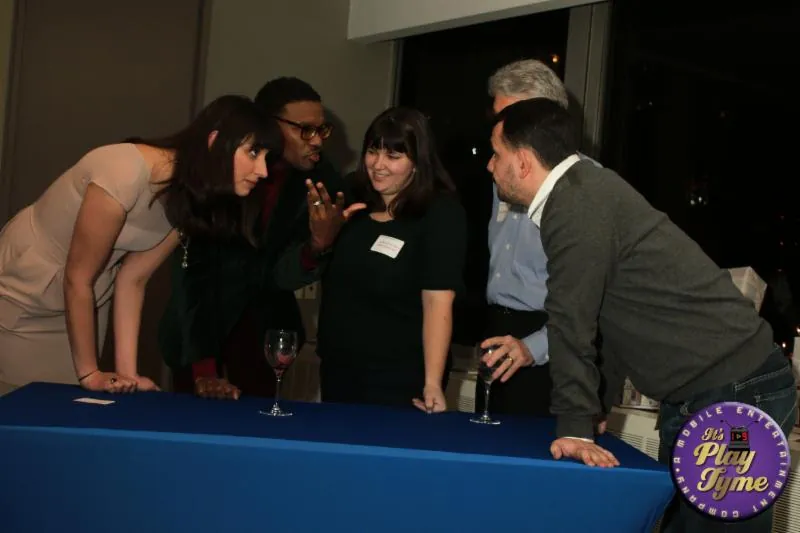
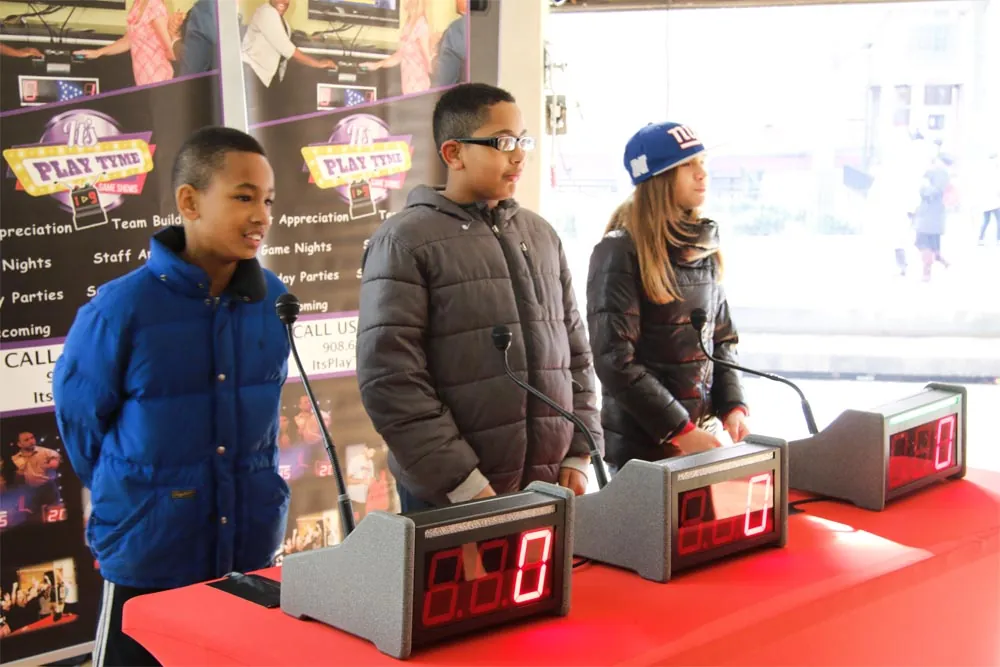
The best Family Feud team building game is not the questions you ask on stage. It is the survey you run before the event, because those ranked answers become the board everyone competes against. That pre-event survey is what separates a forgettable quiz from a game people talk about for weeks. With Gallup reporting that only 20% of employees feel engaged at work, a game built from your own team’s answers is a smart way to pull people in.
Most planners struggle with the same questions. What do you actually ask in the survey? How many people need to answer? How do you turn raw responses into a fair, fun board? And how do you keep the questions light enough for everyone yet specific enough to your company? The methodology and the 40-plus examples below answer all of it.
Want your survey questions on a real Feud board? We host live Family Feud style game shows for teams across NJ, NYC and CT.
The pre-event survey, not stage questions, is what separates a forgettable quiz from a memorable game.
Ranked survey answers become the live game board everyone competes against.
When teammates see their own responses ranked on the board, laughter and buy-in are instant.
Only 20 percent of employees feel engaged; a game built from team answers helps close that gap.
Pew Research found most workers value the social side of work, and this format delivers it.
How the Survey Becomes the Game Board
This is the part most DIY guides skip. The survey is the engine of the entire game. Here is the workflow that produces a board your team will love.
Write the survey. Pick 8 to 12 light, opinion-based questions that fit your culture.
Collect responses. Send the survey to at least 25 to 50 people a week before the event.
Tally the answers. Group similar responses, then count how many people gave each one.
Rank the top answers. The most common answer sits at the top, worth the most points.
Build the board. Show only the top five or six answers per question on game day.
The magic is that the answers are not opinions from a TV studio. They come from the people in the room, so every reveal feels personal. The goal is to guess what your coworkers said, not what is objectively correct.
What Makes a Good Survey Question
Strong survey questions share a few traits. Get these right and the board builds itself.
Open-ended: the question invites many possible answers, not yes or no.
Light and safe: nothing about performance, salary, or anyone by name.
Relatable: every employee has a real answer ready.
Specific to your group: a question about your office lands harder than a generic one.
Survey Questions About Office Life
These produce clear, rankable answers and warm up the room.
Name something everyone keeps on their desk.
Name the first thing people do when they get to work.
Name something that always runs out in the supply closet.
Name a reason people are late to a meeting.
Name something coworkers do to look busy.
Name the most-used app on a work laptop.
Sample ranked answers: Name something everyone keeps on their desk.
Coffee mug (35)
Phone charger (24)
Snacks (18)
Family photo (14)
A plant (9)
Survey Questions About Coworkers
These spark the most laughter because teammates recognize each other instantly.
Name a type of coworker every team has.
Name something a coworker does that drives people crazy.
Name a phrase your boss says all the time.
Name something people only share with their closest work friend.
Name a coworker most likely to organize a party.
Name something people gossip about at work.
Sample ranked answers: Name a type of coworker every team has.
The always-late one (30)
The overachiever (23)
The office comedian (19)
The snack hoarder (16)
The quiet genius (12)
Survey Questions About Food and Breaks
Food is the great equalizer across departments, so these questions rank cleanly.
Name the most popular lunch spot near the office.
Name a food that disappears fastest at a potluck.
Name something people always steal from the office fridge.
Name a snack that lives in every desk drawer.
Name the go-to office coffee order.
Name something people do on a coffee break.
Sample ranked answers: Name a food that disappears fastest at a potluck.
Pizza (33)
Cookies or brownies (26)
Fried chicken (18)
Chips and dip (15)
Fruit, last (8)
Ready to reveal your team’s top answers? Our host brings the board, the buzzers and the energy.
Survey Questions About Work Habits and Remote Days
Hybrid teams answer these fast, and the results bond in-office and remote staff.
Name something that always goes wrong on a video call.
Name a reason people work from home.
Name the first thing you do after a long meeting.
Name something people do when they should be working.
Name a tab everyone has open all day.
Name something that makes a Monday harder.
Sample ranked answers: Name something that always goes wrong on a video call.
Someone is on mute (38)
Frozen screen (25)
A pet or child appears (18)
Background noise (12)
Wrong screen shared (7)
Survey Questions About Company Culture
These tie the game directly to your brand and create the proudest reveals.
Name something our company is known for.
Name the best perk of working here.
Name a tradition unique to our team.
Name something people brag about to friends about this job.
Name the most popular meeting room.
Name a word that describes our team in one breath.
Common Challenges When Building the Survey Yourself
The methodology is clear, but execution trips up most planners. These are the obstacles to plan around.
Low response counts: fewer than 25 replies produce a board with ties and weak rankings.
Messy tallying: grouping “coffee,” “a coffee,” and “my latte” into one answer takes judgment and time.
Questions that flop: some prompts return scattered answers that will not rank into a clean top five.
Timing the survey: sent too early people forget, too late you cannot tally in time.
Hosting the reveal: running buzzers, points, and strikes while reading the room is a real job on game day.
Why Teams Hand the Survey to It’s PlayTyme
Building a great board takes time and a practiced eye. It’s PlayTyme Game Shows designs the custom pre-event survey for you, distributes it, tallies the responses, and builds the ranked board, then sends a professional host with buzzers and broadcast-style screens to venues across New Jersey, New York City, and Connecticut. Your team answers a short survey, then shows up to compete.
Because the questions and answers come from your own people, the reveals hit hard. The host handles scoring, pacing, and fairness, so HR never has to facilitate. The result is a game built for your culture, not pulled off a template.
Start with your goal. If you want cross-department mixing, choose coworker and culture questions that everyone can answer. If you want easy laughs, lean on food and remote-day prompts. Pick 8 to 12 questions, send the survey to at least 25 people, and reserve a couple of spares in case a prompt returns scattered answers. Keep every question light and free of names or performance. Do that, and your board will feel personal, fair, and worth competing for.
Frequently Asked Questions (FAQs)
How many people need to take the survey?
Aim for at least 25 to 50 responses so the rankings are clear and ties are rare. More responses produce a stronger board with cleaner top-five answers. For large companies, 50 or more replies give the most satisfying reveals.
How do I turn survey responses into a game board?
Group similar answers together, count how many people gave each, then rank them from most to least common. The top answer earns the most points. Show only the top five or six answers per question on game day.
What survey questions work best for team building?
Open-ended, light questions about office life, coworkers, food, and company culture rank cleanly and bond the group. Avoid anything about performance, salary, or specific people. Questions tied to your own workplace land harder than generic prompts.
When should I send the survey?
Send it about one week before the event. That gives people time to respond without forgetting, and leaves you a few days to tally answers and build the board. Sending too early lowers response rates as the event slips off the radar.
Can It’s PlayTyme build the survey for us?
Yes. It’s PlayTyme designs the custom survey, distributes it, tallies responses, and builds the ranked board, then provides a host with full equipment. Your team only answers a short survey and shows up to play across NJ, NYC, and CT.
Small groups break the ice differently than big crowds. With five to twenty people in the room, every voice counts, and one awkward silence is felt by everyone. A quick, well-chosen game fixes that fast, which matters because Gallup reports that only 20% of employees feel engaged at work, and small-team connection is where engagement starts.
The format has to fit the moment. Pew Research found that most workers value the social side of their jobs, and a tight, fun icebreaker delivers that without eating a whole meeting. The games below are built for small groups across New Jersey, New York City, and Connecticut: quick to explain, easy to join, and free of props you do not have.
Anyone who leads a small team knows the obstacles. With few people, there is nowhere for a quiet member to hide, a single dominant voice can take over, and a game built for fifty falls apart with eight. You need something short, inclusive, and low-pressure that warms the room in minutes. The small-group games here solve exactly that.
Need an icebreaker for a small group? Our hosted game shows work for teams of 20 and up, anywhere in NJ, NYC and CT.
Small groups need a different design than large crowds. Keep these traits in mind and the warm-up lands every time.
Fast to explain: the rules fit in two sentences so no time is lost.
Everyone participates: with few people, the game must include all of them by design.
Low pressure: nothing forces a shy person to perform alone.
Short runtime: five to ten minutes warms the room without stalling the meeting.
Quick Talking Icebreakers for Small Teams
These need zero props and run in minutes, perfect for the start of a meeting.
One word check-in: each person names one word for their mood, then explains in a single sentence.
Two truths and a lie: each member shares three statements and the group guesses the false one.
Would you rather: the leader poses a fun choice and everyone explains their pick in ten seconds.
Best part of the week: a fast round where each person shares one highlight, work or personal.
Active Games for Small Groups
When the team needs energy, these get people moving and laughing.
Desk scavenger hunt: the leader calls an item (something blue, something round) and the first to hold it up wins.
Common ground: the group races to find five things everyone shares, building fast connection.
The name chain: each person adds a fun fact, and the next must repeat all the facts before adding theirs.
Quick draw: one person sketches a word while the rest guess, a five-minute round that breaks tension.
Mini Game-Show Icebreakers for Small Groups
A scaled-down game show brings competition without needing a crowd. These adapt cleanly to a team of eight to twenty.
Small-Group Feud
Split the team into two mini-teams and run a Family Feud round. Read a light question and reveal ranked answers. Sample: “Name something everyone keeps at their desk” ranks a mug, charger, snacks, photo, and a plant. Even with eight people, the back-and-forth creates real laughs.
Rapid Trivia
A quick five-question trivia round, with the group split into pairs, builds friendly rivalry. Mix company facts with pop culture so everyone has a shot. It runs in under ten minutes.
Want a quick game that warms up the room? Our hosts keep every round short, fun and easy to join.
Remote small teams warm up just as fast with the right prompt.
Show and tell: each person grabs one nearby object and explains why it matters in 20 seconds.
Virtual background vote: everyone picks a fun background and the group votes on a favorite.
Emoji check-in: each person posts one emoji for their mood in chat, then explains it aloud.
One-question poll: the host runs a quick poll, then the group reacts to the results together.
What Goes Wrong With Small Group Icebreakers
Small does not mean simple. These obstacles trip up team leaders most often.
Nowhere to hide: with few people, a quiet member feels exposed, so the game must lower pressure, not raise it.
One voice dominates: a single talkative person can swallow a small round without a structure that shares time.
Wrong scale: games designed for big crowds collapse with eight people and feel flat.
Same game fatigue: small teams meet often, so repeating one icebreaker drains its energy fast.
Time creep: without a firm stop, a five-minute opener stretches and crowds the agenda.
When a Hosted Game Show Fits a Small Group
For a weekly stand-up, a self-run prompt is perfect. For a small-team retreat, a milestone celebration, or a client gathering, a professional host turns the warm-up into the main event. It’s PlayTyme Game Shows scales a full game-show experience to intimate groups across New Jersey, New York City, and Connecticut, with custom questions and broadcast-style production.
A pro host solves the small-group traps at once. The structure gives every person airtime, the format keeps any one voice from taking over, and the energy never depends on the leader. Scoring and pacing are handled, so a team of a dozen gets the same polished show a large crowd would, sized to fit the room.
Planning a small-team event that deserves more than a quick prompt? Contact It’s PlayTyme to check dates, or explore our team building game shows built for groups across NJ, NYC, and CT.
Which Game Fits Your Group and Your Goal
Match the game to your goal and your minutes. For a fast meeting warm-up, pick a talking icebreaker like a one-word check-in that needs no setup. For energy, choose an active game that gets people moving. For a real event, scale up to a mini game show or hire a host. Always keep it short, inclusive, and low-pressure, and rotate your choices so the team never tires of the same round. Pick with the room in mind, and even a group of eight will feel the spark.
Frequently Asked Questions (FAQs)
What are the best icebreaker games for small groups?
Talking games like two truths and a lie, would you rather, and one-word check-ins work best because they include everyone and run in minutes. For energy, try a desk scavenger hunt or a mini Family Feud. The key is keeping every person involved.
How long should a small-group icebreaker last?
Five to ten minutes is ideal for a small team. That is long enough to warm the room and short enough to protect the agenda. Set a firm stop, since small groups can let a single round drift longer than planned.
How do I include quiet members in a small group?
Use structured games where everyone answers in turn, so no one has to fight for airtime or volunteer first. Team-based formats also lower pressure by removing solo performance. A round-robin order makes participation feel natural rather than forced.
Do these games work for virtual small teams?
Yes. Show and tell, emoji check-ins, virtual background votes, and quick polls all translate cleanly to video calls. The small size actually helps online, since everyone fits on one screen and can react in real time.
When should I hire a host for a small group?
Hire a host for small-team retreats, milestone celebrations, and client events where you want a polished centerpiece, not just a quick opener. A pro brings custom questions, equipment, and fair scoring that scale down to a dozen people while keeping the full game-show energy.
Do these icebreaker games require any special props or equipment?
No. The games here are quick to explain, easy to join, and free of props you do not have.
Wellness programs promise healthier, happier teams, yet attendance often tells a different story. Booths sit empty, and the same handful of people show up to every health fair. The engagement problem runs deep. Gallup reports that only 20% of employees feel engaged at work, and a flat wellness event rarely moves that number. The fix is to make the wellness day something people genuinely want to join.
Trivia turns a passive health fair into an active, social experience. Pew Research found that most workers value the social side of their jobs, which means a shared game does more for morale than another flyer about hydration. Wellness trivia folds health messaging into a format that draws a crowd and keeps it engaged.
Wellness coordinators face a familiar struggle. You want strong turnout without mandating attendance, real participation across departments, and health content that sticks instead of getting tossed in the recycling. You want an event that fits a cafeteria, a community room, or an outdoor tent, and you want it to run without you chasing a microphone. The ideas below show how trivia solves each of those.
Planning a corporate wellness event? Our hosted trivia game shows make health topics fun, on site anywhere in NJ, NYC and CT.
Most wellness program booths sit empty because passive formats fail to draw real participation.
Gallup reports only 20 percent of employees feel engaged, and flat wellness events rarely change that.
Trivia turns a passive health fair into an active, social experience that draws a crowd.
A shared game does more for morale than another flyer about hydration.
Wellness trivia folds health messaging into a format people genuinely want to join.
Why Trivia Works for Wellness Events
Trivia fits wellness programming because it teaches without lecturing. A round of health-themed questions delivers facts about nutrition, heart health, sleep, and stress in a format people remember. Competition makes the content stick far better than a poster ever does.
The format also draws people in. A health fair with a hosted trivia game gives employees a reason to stay, mingle, and return next year. It transforms a quiet room of booths into a lively event with a clear centerpiece, which lifts attendance across the board.
Health Topics That Make Great Trivia
Strong wellness trivia blends practical health knowledge with lighter questions that keep the mood fun. Rotate through these themes to cover real ground.
Heart health: Blood pressure basics, the role of movement, and simple habits that protect the heart.
Nutrition: Reading labels, portion sizes, and the truth behind common food myths.
Mental wellness: Stress signals, sleep hygiene, and small daily resets.
Movement: Step goals, desk stretches, and the benefits of short activity breaks.
Preventive care: Screenings, vaccinations, and when to see a provider.
Mixing serious facts with playful rounds keeps the energy high while the health message lands.
Major Problems Wellness Planners Run Into
Wellness days hit predictable obstacles. Naming them early makes the event easier to plan.
Low turnout: Optional events struggle to draw a crowd. A hosted game gives people a reason to show up and stay.
One-and-done attendance: Static booths bore repeat visitors. A fresh trivia show makes the annual fair worth returning to.
Forgettable content: Health flyers get ignored. Competition embeds the facts in memory.
Department silos: People cluster with familiar faces. Mixed teams force fresh introductions.
Coordination strain: A wellness lead should not also run scoring and a microphone. A booked host removes that load.
Want wellness tips your team remembers? We can build trivia rounds around your wellness themes and goals.
It’s PlayTyme Game Shows brings The Challenge, our professional hosted buzzer trivia format with big-screen production, to wellness events across New Jersey, New York City, and Connecticut. The team builds health-themed rounds around your program goals, then runs the entire show so your wellness staff can focus on the day, not the equipment.
The hosted format does the heavy lifting for engagement. Team rounds pull in quiet employees who would otherwise skip a booth. The pace stays brisk, the questions balance health facts with crowd-pleasers, and the host keeps every table involved. Health messaging reaches people who never read the handouts, because they are too busy competing to win.
What sets the hosted format apart
Custom health rounds aligned with your wellness goals.
Strong turnout driven by a fun, social centerpiece.
Zero facilitation burden on your wellness team.
Equipment, scoring, and pacing handled by professionals.
Trivia for Health Fairs and Community Outreach
Wellness trivia reaches beyond the office. It anchors health fairs, community heart-health drives, and outreach events where the goal is education plus connection. A hosted game draws a crowd at a public event the same way it does in a cafeteria.
Corporate health fair: A scheduled trivia show gives the day a peak moment and a reason to linger.
Heart-health campaign: Themed rounds turn awareness messaging into a memorable competition.
Community outreach: A friendly host welcomes mixed groups and keeps the energy warm and inclusive.
Benefits open enrollment: Trivia explains plan basics in a format people actually absorb.
Measuring the Impact of Wellness Trivia
A good wellness event proves its value. Track attendance against past fairs, gather quick post-event feedback, and note which health topics generated the most discussion. Trivia gives you a natural moment to collect that input while energy is high.
The deeper payoff shows up in culture. Employees who laugh together and learn together build the trust that wellness programs are meant to create. That connection carries past the event and into daily work, where supportive teammates encourage healthier habits long after the fair ends. A single strong event also builds momentum, so the next wellness initiative starts with a team that already expects to participate rather than one you have to convince all over again.
Add Trivia to Your Next Wellness Event
Ready to turn your next health fair into an event people remember? Contact It’s PlayTyme to plan a wellness trivia show, or explore our corporate event game shows built for teams across NJ, NYC, and CT. One booking covers the host, the equipment, and custom health-themed rounds.
Start with your goal. If you need strong turnout and health content that sticks, choose a hosted trivia format that builds your messaging into the game. If you only want a passive information booth, a static display fits, though it draws far fewer people. Weigh your venue, your headcount, and how much you want to manage on the day. Wellness teams that want real engagement consistently choose a hosted game show, because it solves attendance, retention, and connection at once. Book early so your preferred date is secured.
Frequently Asked Questions (FAQs)
How does trivia fit a corporate wellness event?
Trivia delivers health facts through competition instead of lectures, so the content sticks. It draws a crowd to health fairs and gives the day a clear centerpiece. A hosted format keeps every department engaged while the wellness message lands.
What health topics work best for wellness trivia?
Heart health, nutrition, mental wellness, movement, and preventive care all make strong rounds. Mixing serious facts with lighter questions keeps the energy high. The host can build the content around your specific program goals.
Will trivia improve turnout at our health fair?
Yes. A scheduled hosted game gives employees a reason to show up and stay, rather than passing booths quickly. The social, competitive draw lifts attendance and makes the annual event worth returning to year after year.
Can wellness trivia work for community outreach events?
Absolutely. A friendly host welcomes mixed public groups and turns awareness messaging into a memorable competition. It works for heart-health campaigns, benefits enrollment sessions, and community health drives alike.
How far in advance should we book wellness trivia?
Most groups book 4 to 8 weeks ahead, and shorter notice often works when the date is free. Early booking also gives the host time to build custom health rounds and leaves room to confirm venue logistics and team counts.
Hoboken packs skyline views, easy transit, and a dense cluster of event spaces into one square mile, which makes it a favorite for corporate planners across the New York metro. Choosing the right room still takes work, especially when Gallup reports that only 20% of employees feel engaged and every gathering needs to earn its place on the calendar.
Most planners scouting Hoboken hit the same hurdles. You need a space that fits your headcount, sits near the PATH or ferry for commuters, allows outside vendors, and offers a backup for weather if the view is the draw. The venues below sort cleanly by event type, so you can shortlist fast and book with confidence.
Planning a corporate event in Hoboken? We bring hosted game shows to your venue for 20 to 300+ guests.
Hoboken packs skyline views, PATH and ferry access, and a dense cluster of venues into one walkable square mile.
The venue sets the ceiling for the experience, so a poor fit limits everything built on top of it.
Harvard Business Review links belonging to higher performance and lower turnover, and the right venue helps build it.
Key checks for any Hoboken venue include headcount, transit proximity, outside vendor policy, and a weather contingency.
Corporate planners across the New York metro choose Hoboken for its accessible, view-forward event options.
Waterfront Venues With Skyline Views
Hoboken’s eastern edge faces the Manhattan skyline, and the waterfront spaces trade on that view. They suit milestone celebrations, client receptions, and summer parties where the backdrop is the point.
Pier 13: A seasonal open-air spot along the river, strong for casual warm-weather gatherings with food and drink. Confirm a weather backup, since it is largely outdoor.
Hoboken waterfront parks: Permitted green spaces work for company picnics and outdoor team days, though they require your own setup and rain contingency.
Rooftop spaces: Several hotels and buildings offer rooftop decks with skyline sightlines for receptions and cocktail-style events.
Waterfront rooms photograph beautifully and energize a crowd. Plan around weather and confirm power access for any entertainment or sound.
Hotel Event Spaces and Ballrooms
Hotels give planners predictability: climate control, in-house catering, parking, and a single point of contact. They handle formal dinners, conferences, and larger headcounts with ease.
W Hoboken: A waterfront hotel with modern meeting and event space plus skyline views, suited to upscale receptions and corporate functions.
Nearby branded hotels: Properties in and around Hoboken offer flexible ballrooms and breakout rooms for conferences and multi-session days.
Hotels cost more, but they remove logistical risk. The tradeoff is worth it for high-stakes events where reliability beats personality.
Unique and Flexible Loft Spaces
For teams that want character over a standard ballroom, Hoboken offers industrial and loft-style venues with open floor plans.
Mission 50: A coworking and event space with flexible rooms for meetings, workshops, and mid-size gatherings, central to downtown Hoboken.
Converted industrial lofts: Open-plan spaces with exposed brick and high ceilings flex easily between seated dinners and standing socials.
Flexible spaces give you a blank canvas, which is ideal when you want to control the layout and bring in your own entertainment.
Restaurants and Private Dining Rooms
For smaller teams, a private dining room delivers food, drink, and atmosphere in one booking with minimal planning.
Washington Street restaurants: Hoboken’s main strip holds many restaurants with private or semi-private rooms for team dinners of 10 to 50.
Brewery and taproom spaces: Casual private areas suit relaxed celebrations and after-work gatherings.
Restaurant rooms keep logistics simple. Confirm whether the space allows outside entertainment if you plan more than a meal.
What to Plan for Before Booking in Hoboken
Hoboken’s density creates real constraints. Knowing them early saves your timeline and budget.
Parking and access: Street parking is scarce. Prioritize venues near the PATH, ferry, or a partnered garage so guests arrive easily.
Capacity mismatch: Many charming spaces are small. Confirm the real seated and standing capacity, not the optimistic listing.
Vendor restrictions: Some venues require in-house catering or limit outside entertainment. Ask before you fall in love with a room.
Weather exposure: Waterfront and rooftop spaces need a credible rain plan, especially spring and fall.
Power and sound: Lofts and outdoor sites may lack easy power for AV. Confirm access points if you plan a hosted activity.
Booked your Hoboken venue? Tell us the date and group size, and we will build the show around your room.
Start from the event type, then shortlist venues in that style. This keeps your search focused and your budget honest.
Entertainment That Travels to Any Hoboken Venue
The biggest planning relief is entertainment that adapts to whatever room you book. A hosted game show is fully portable, so it works in a hotel ballroom, a waterfront tent, a loft, or a restaurant back room. It’s PlayTyme Game Shows brings the host, the broadcast-style equipment, and the format to any of these Hoboken spaces, which means your venue choice never limits your entertainment.
That portability solves a common headache. You pick the room for its view, location, or price, and the activity comes to you with its own gear and a professional emcee who handles setup, scoring, and pacing. One vendor covers engagement no matter where the event lands.
Begin with your headcount and event type, then filter by transit access and vendor rules. Confirm true capacity, a weather backup for any outdoor space, and power access if you plan a hosted activity. Visit your top two choices in person, since photos flatter every room. Lock the date early, because Hoboken’s best spaces book months ahead, especially in spring and the holiday season. With the venue settled, portable entertainment lets you build the experience around the space instead of against it.
Frequently Asked Questions (FAQs)
What are the best corporate event venues in Hoboken NJ?
The strongest options span waterfront spaces like Pier 13, hotels such as the W Hoboken, flexible lofts like Mission 50, and private restaurant rooms along Washington Street. The right pick depends on your headcount and event type. Waterfront spaces suit receptions, while hotels handle formal dinners and conferences.
Do Hoboken venues allow outside entertainment vendors?
Many do, though some hotels and restaurants require in-house catering or limit outside vendors. Always confirm the rules before booking. Portable entertainment like a hosted game show adapts to nearly any space and brings its own equipment.
How early should I book a Hoboken corporate venue?
Book two to four months ahead for most events, and earlier for spring and holiday dates when demand peaks. Popular waterfront and hotel spaces fill fastest. Early booking also gives you time to confirm logistics like parking and AV.
What should I check about parking and transit?
Hoboken street parking is limited, so prioritize venues near the PATH station, the NY Waterway ferry, or a partnered garage. Easy access raises attendance and reduces guest stress. Confirm any parking partnerships when you book.
Can a game show work in any Hoboken venue?
Yes. A hosted game show is fully portable and works in ballrooms, lofts, restaurant rooms, and tented waterfront spaces. The team brings the host and broadcast-style equipment, so your venue choice never limits the entertainment. Just confirm power access for the sound setup.
Why do corporate planners from across the New York metro choose Hoboken for events?
Hoboken packs skyline views, easy transit, and a dense cluster of event spaces into one square mile. That combination is why it remains a favorite for corporate planners across the New York metro.
Plenty of team events promise fun, but fun alone does not build a team that works together. Real collaboration, where people share information and solve problems as one unit, is the skill that moves results. That matters because Gallup reports that only 20% of employees feel engaged, and disengaged groups default to working in isolation rather than cooperating.
Collaboration is learnable, and shared experiences teach it fastest. Harvard Business Review found that psychological safety underpins high-performing teams, and that safety grows when people cooperate toward a shared goal in a low-stakes setting. The collaborative activities below, all available across New Jersey, are built around cooperation rather than individual performance, so your team practices the exact behavior you want at work.
If you lead a group that works in silos, you know the worry. Departments rarely talk, new hires stay on the edges, and meetings turn into a few voices while the rest go quiet. You want experiences that force people to depend on each other, not just sit in the same room. Each idea here ties to a clear collaboration outcome, so you choose by the cooperation it builds.
Looking for collaborative team building in New Jersey? Our hosted game shows get 20 to 300+ people working together.
Only 20% of employees feel engaged, so most teams default to isolation instead of cooperation.
Collaboration is a learnable skill, and shared experiences teach it faster than any other method.
Harvard Business Review links psychological safety to high team performance; low-stakes events build that safety.
New Jersey collaborative activities are structured around group cooperation, not individual performance.
Teams stuck in silos benefit most because shared goals built at these events carry back to the workplace.
What Makes an Activity Truly Collaborative
Collaborative is not the same as group. A group activity puts people side by side. A collaborative activity makes them depend on each other to succeed. The difference shows in three features.
Shared goal: One outcome the whole team wins or loses together, so individual glory does not matter.
Interdependence: No one can succeed alone, which forces information sharing.
Pooled strengths: The activity rewards combining different skills and perspectives.
Hold any idea up to these three features. If it passes, it builds real cooperation. If it fails, it is just a fun outing.
Game Shows: Collaboration Built Into Every Round
A hosted game show is collaboration-first by design, because teams cannot win without talking, strategizing, and sharing the decision. It’s PlayTyme Game Shows runs these formats across New Jersey, New York City, and Connecticut with a professional host and broadcast-style equipment.
The cooperation outcomes are concrete:
Forced strategy talk: Teams must decide answers and wagers together, so quiet members get pulled into the discussion.
Shared wins: The whole team scores together, which rewards cooperation over individual showing off.
Pooled knowledge: Categories range wide, so the marketer, the engineer, and the new hire each contribute, proving every voice has value.
Live negotiation: Final wagers require fast group agreement, the same skill teams need on real deadlines.
Players leave having practiced cooperation dozens of times in an hour, all while thinking they were just playing a game.
Activities Where No One Succeeds Working Alone
These structured activities make interdependence the whole point.
Escape rooms: Teams must pool scattered clues to escape in time. The outcome is open information sharing instead of clue hoarding.
Build-a-bridge challenges: Teams construct a working structure from limited materials. The outcome is shared planning and role division.
Group puzzle relays: Each member holds one piece of the solution. The outcome is recognizing that no one wins alone.
Each format breaks down the moment one person tries to go solo, which makes the lesson land without a lecture.
Creative Collaboration Activities
Some teams cooperate best when they build something together.
Group cooking challenges
Teams plan and cook a shared dish under time pressure. The outcome is coordination and division of labor toward one result everyone tastes.
Team art or build projects
A large mural or model that only works if sections connect. The outcome is alignment, since each team must match the pieces beside them.
Want every team member contributing? Our game rounds reward working together, not going solo.
Common Challenges in Building a Collaborative Team
Knowing the obstacles helps you choose the activity that fixes them.
Entrenched silos: Departments rarely interact. Mixed-team formats force cross-group cooperation toward a shared win.
Solo-star culture: A few people grab credit while others coast. Team scoring spreads the reward, so cooperation pays.
Left-out newcomers: New hires hesitate to contribute. Wide-ranging game show categories give everyone a moment to add value.
Surface-level fun: Outings that entertain but do not bond. Choose activities with true interdependence, not just shared space.
Uneven participation: Loud voices dominate. Formats that require group agreement pull quiet members into the decision.
Comparing Collaborative Formats
Activity
Collaboration driver
Best for
Hosted game show
Shared scoring and strategy
Any size, mixed groups
Escape room
Pooled clues
Small teams
Build-a-bridge
Role division
Mid-size groups
Group cooking
Coordinated tasks
Smaller teams
The comparison shows the game show as the one format that scales across sizes while keeping cooperation at its core. The others shine for smaller groups.
Making Collaboration Stick After the Event
One collaborative event sparks cooperation, but a few follow-up habits keep it alive. Reference the shared win in your next team meeting, mix project teams the way the activity mixed them, and call out moments where people pooled strengths. Those small reinforcements turn a single afternoon into a lasting cooperative habit.
Ready to give your team a cooperation workout they will enjoy? Contact It’s PlayTyme to check dates, or explore our team building game shows built for groups across New Jersey, NYC, and CT.
Start with the cooperation problem you most want to solve, whether that is breaking silos, including newcomers, or curbing a solo-star culture. Test each option against the three collaboration features: a shared goal, true interdependence, and pooled strengths. Weigh your group size, since escape rooms and cooking suit small teams while a hosted game show scales to any crowd. For mixed or larger groups that need everyone involved, the game show format delivers the most cooperation per hour because no one can win alone. Book early so the date and format you want stay open.
Frequently Asked Questions (FAQs)
What makes a team building activity collaborative?
A truly collaborative activity has a shared goal, real interdependence, and a reward for pooling different strengths. People must depend on each other to succeed, not just sit in the same room. Formats like hosted game shows and escape rooms pass this test because no one can win alone.
Which collaborative activities work for large New Jersey groups?
Hosted game shows scale best, holding cooperation at the center for groups from 20 to 300+. Team scoring and wide categories keep everyone contributing. Escape rooms and cooking challenges work well too, but they suit smaller teams because of capacity limits.
How do game shows build collaboration specifically?
Game show rounds force teams to discuss answers, agree on wagers, and pool knowledge across categories. The whole team wins or loses together, which rewards cooperation over individual performance. Players practice shared decision making dozens of times in a single session.
How do collaborative activities help with department silos?
Mixed-team formats place people from different departments on the same side, forcing them to cooperate toward a shared win. That cross-group contact builds new working relationships that carry back to the office. Assigning teams rather than letting people self-select makes the mixing happen naturally.
How do I keep cooperation going after the event?
Reference the shared win in your next meeting, mix project teams the way the activity mixed them, and praise moments where people pooled strengths. These small reinforcements turn one event into a lasting habit. Consistency matters more than how often you run events.
Why does psychological safety matter for collaborative team activities?
Harvard Business Review found that psychological safety underpins high-performing teams, and it grows when people cooperate toward a shared goal in a low-stakes setting. Collaborative activities create exactly that environment, giving your team a practical way to build the safety that drives better results at work.