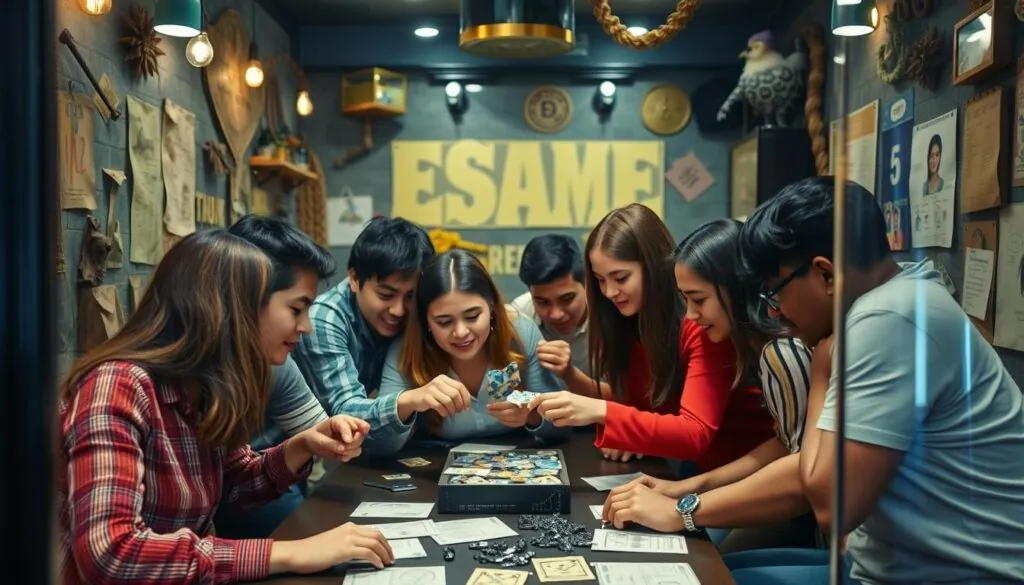
The room went quiet. Your offsite ended with polite smiles, a few checked phones, and a team that left as disconnected as it arrived. You wanted real conversations and genuine laughs. You got another forgettable afternoon.
You are not imagining the problem. Gallup reports that just 31% of U.S. employees are engaged at work. The right interactive experience turns a flat agenda into the part of the day people actually talk about afterward. Here are seven companies serving New Jersey and New York City, starting with the one we know best.
A good corporate game show does more than fill time. It gets people communicating, competing, and working together without anyone calling it a workshop. The trick is finding a host who delivers that result and runs the whole thing for you. As you compare providers, look at who offers fully hosted events sized to your group.
Comparing corporate game show companies in NJ and NYC? Tell us your date, group size and venue, and we will send a clear quote.
Since 2012, It’s PlayTyme has run fully hosted live game shows for corporate teams. Founder Lisa Lawrence and her hosts handle everything, from setup to the final round, for groups of 20 to 300+. We cover New Jersey, New York City, and the tri-state area, and we travel nationally on request.
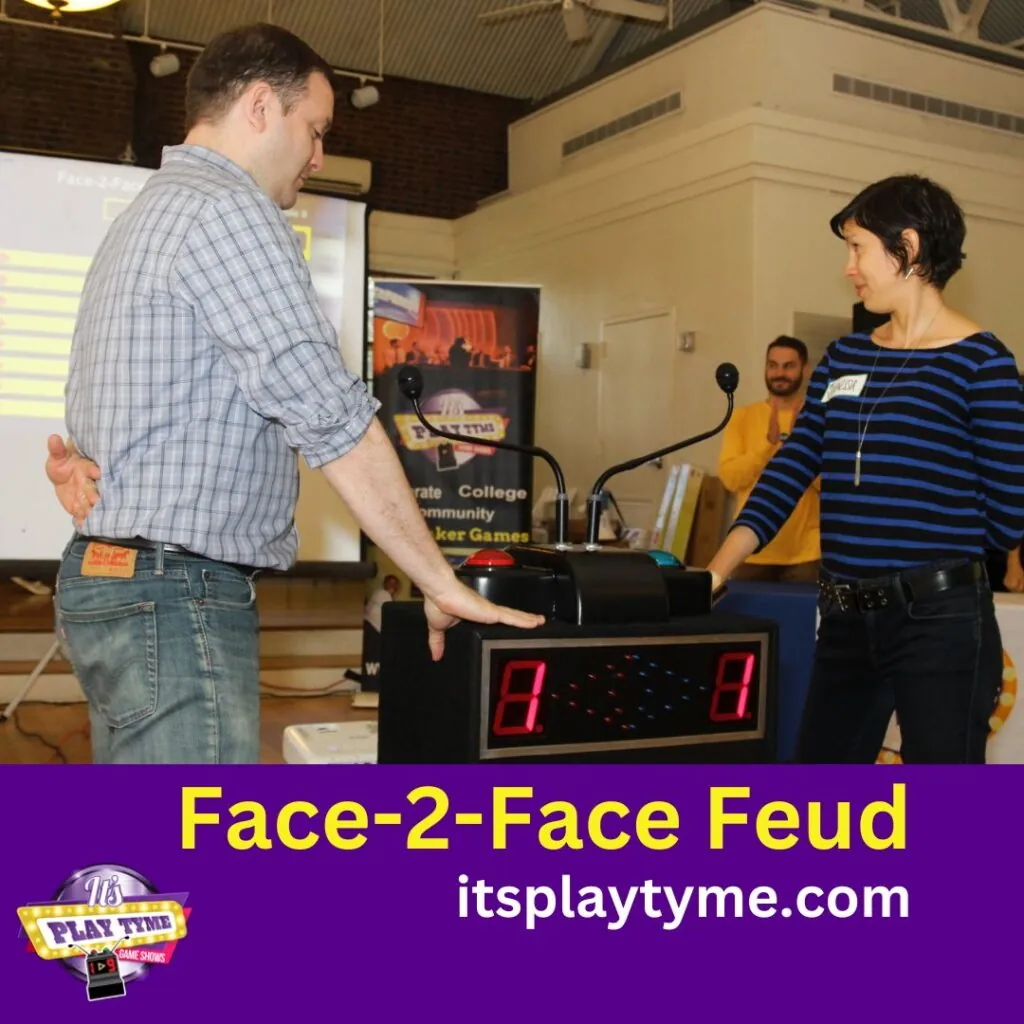
This is not a DIY kit or a generic team-building seminar. A professional host runs the entire event and keeps every person in the game. Signature formats include Face-2-Face Feud, head-to-head trivia showdowns, and custom shows built around your company culture. Every event is backed by a 100% satisfaction guarantee, there is no deposit to hold your date, and the host running your event is named in your agreement.
Customized team-building programs incl. game shows
Varies by event
Yes
The Game Show Night
Live hosted game shows
Varies by event
Yes
GenoPalooza
Trivia, bingo & game shows
Varies by event
Yes
Bar None Games
Virtual & hybrid hosted trivia/game shows
Varies by event
Yes
TrivWorks
Corporate trivia events
Varies by event
Yes
The Game Show Connection
Studio-style game shows
Varies by event
Yes
2. Team Building Unlimited
Team Building Unlimited is a New Jersey-based team-building and events company that designs customized programs, including game-show-style formats, for corporate groups. Their lineup includes a Game Show format alongside themed challenges like the Tailgate Challenge and Cake Wars. See Team Building Unlimited for their current programs.
3. The Game Show Night
The Game Show Night, run by host Bob Scott, produces live, high-energy game show events for corporate teams, fundraisers, and community groups across New Jersey, New York, Connecticut, and the surrounding region. The company says it runs more than 100 shows a year across over 50 locations, each with a live host and full production. See The Game Show Night for details.
4. GenoPalooza
GenoPalooza Productions, based in Ocean, New Jersey, runs live trivia, bingo, and game-show nights for corporate groups, bars, and restaurants across New Jersey and the surrounding region. Learn more at GenoPalooza.
Want a game show company that comes to you? We host at offices and venues across NJ, NYC and CT.
Bar None Games is a woman-owned company offering live-hosted trivia and game-show events for corporate teams, with a strong focus on virtual and hybrid formats and a dedicated NYC team-building offering. The company says it has worked with more than 3,000 teams. See Bar None Games for current formats.
6. TrivWorks
TrivWorks runs corporate trivia and game-show events nationwide, including the New York City area, led by founder David Jacobson, who has produced thousands of trivia events over a 25-year career. Formats include team trivia, roving trivia, and head-to-head competitions with a professional emcee. See TrivWorks for options.
7. The Game Show Connection
The Game Show Connection produces studio-style game shows for corporate events nationwide, including the New York City area, with digital scoring, lighting, sound effects, and a professional host. Formats are built for picnics, banquets, holiday parties, and training sessions. See The Game Show Connection for more.
Book Exciting Game Shows for Corporate Events
The format you pick shapes the whole event. Quick-fire trivia tests general knowledge and moves fast. Custom-themed productions pull in your industry and inside jokes. Match the format to your team and your goals, and the room follows. It’s PlayTyme builds shows that pull everyone in, not just the loud few.
Interactive Game Shows For Team Building
A strong corporate event does more than entertain. It builds real team connection. Game shows do this naturally, pushing people to communicate, strategize, and compete in good fun. The best ones, like the shows from It’s PlayTyme, give colleagues a reason to interact outside their usual roles. People leave with stronger working relationships and a few stories to retell.
How to Select the Right Game Show Company
Start with your group size and mix of people, then confirm the provider can host them all well. Next, name your goal: pure fun, better communication, or both. Decide whether a fully hosted event saves you planning time or a self-run option fits your resources. Finally, check booking terms and track records, and pick a provider that stands behind the result.
Ready to make your next corporate event the one people quote on Monday? Connect with us today to talk through your group, your goals, and a custom game show that brings your team together.
Frequently Asked Questions (FAQs)
What is a corporate game show company?
A corporate game show company designs and hosts interactive game shows for businesses. The events entertain employees, sharpen communication, and build team connection. Most offer several formats, from trivia to custom-themed shows, built for a corporate crowd.
How do corporate game shows improve team dynamics?
They put people in a relaxed, competitive setting where they collaborate, talk, and think on their feet. That interaction away from daily tasks builds rapport and surfaces individual strengths. The result is a tighter, more productive team.
What group sizes can corporate game show companies accommodate?
Most handle a wide range, from small teams of 10 to 20 up to large groups of 500 or more. Confirm the provider’s capacity and make sure the format scales, so everyone gets in on the action.
Are game show experiences customizable for different corporate cultures?
Yes. Many top providers, including It’s PlayTyme, tailor the content, themes, and formats to your culture, industry, or event goals. That customization makes the show land with your specific team.
What should I look for in a corporate game show provider?
Prioritize experience, a proven track record, and a fully hosted setup. Look for strong client testimonials, flexible formats, and a clear grasp of corporate goals. A 100% satisfaction guarantee is a strong sign of confidence.
Why does employee engagement data matter when choosing a corporate game show company?
Gallup reports that just 31% of U.S. employees are engaged at work, meaning most teams arrive at events already disengaged. A well-run interactive game show directly addresses that gap by getting people communicating and competing in a way a standard workshop cannot.
What does a fully hosted corporate game show event mean?
A fully hosted event means the provider supplies a professional host who runs the entire experience for your group. Your team shows up and participates while the host manages all logistics, pacing, and energy from start to finish.
Did you know that a happy workforce is a productive one? Approximately 13% of employees assert they are more productive when happy, highlighting the importance of creating a positive team environment. Effective collaboration is the backbone of any successful organization, and it all starts with building strong relationships among colleagues.
When colleagues feel connected, they are more likely to work together seamlessly, driving productivity and workplace satisfaction. This is where team building comes into play. By incorporating engaging activities into your work routine, you can foster a more cohesive and collaborative work environment.
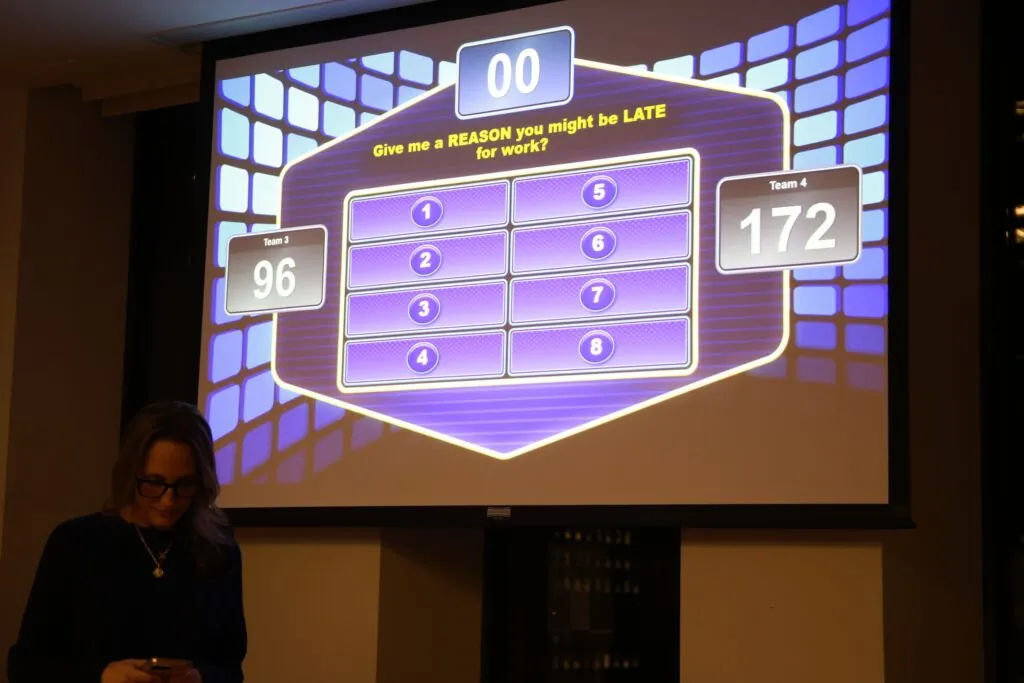
Feud work question, sudden death round
Planning a team bonding event? Our hosted game shows bring your group together, on site anywhere in NJ, NYC and CT.
Team-building activities improve morale and strengthen relationships among colleagues.
Effective exercises help identify leadership strengths and demonstrate the value of cooperation.
Selecting the right activities is crucial to boost engagement and genuine participation.
A variety of activities can be implemented in different settings, from office exercises to outdoor adventures.
Each activity addresses specific aspects of team development, including communication and problem-solving.
Why Team Bonding Activities Are Essential for Workplace Success
Team bonding activities play a crucial role in fostering a positive and productive work environment. These activities are designed to build camaraderie between workers and develop personal relationships between team members, ultimately benefiting both employees and the organization as a whole.
Team-building events are a continuous process necessary for forming stronger ties between workers and the company. When team building becomes a workplace staple, several common benefits emerge, including streamlined onboarding, improved communication, boosted morale, increased trust, and encouraged creativity.
The 7 C’s of Effective Team Building
The seven C’s of team building are essential elements that contribute to the development of strong, effective teams. These are:
Communication
Collaboration
Commitment
Competence
Confidence
Creativity
Cohesion
These elements provide a framework for developing high-performing teams by fostering an environment where team members can work together seamlessly, share ideas, and support one another.
By investing in team-building activities, organizations can expect to see tangible improvements in these areas, ultimately contributing to a more efficient and effective work environment. For a hosted in-person event in NJ, NYC, or CT, see our corporate team building programs.
Team Bonding Games – Company Culture Ideas
How Team Bonding Improves Company Culture
Team bonding activities help break down silos between departments, creating a more unified organization where information flows freely and efficiently. A strong company culture built through team bonding leads to better talent attraction and retention, as employees are more likely to stay with organizations where they feel connected to their colleagues.
By encouraging out-of-the-box thinking, team-building exercises inspire creativity and innovation, allowing workers to break away from routine tasks and find new approaches to problem-solving. This, in turn, contributes to a more dynamic and adaptive company culture.
Quick Team Bonding Activities for Busy People
Quick team bonding activities are essential for busy teams looking to build connections without dedicating entire days to team-building events. These activities are designed to be short, engaging, and effective, typically requiring only 20-30 minutes to complete. They can be easily incorporated into regular team meetings, lunch breaks, or as energizers during longer work sessions.
This activity is an effective icebreaker that builds familiarity between colleagues by encouraging them to share personal information in a fun, game-like format. It’s suitable for groups of 5-8 people and requires about 30 minutes. Participants share two honest events and one lie, and their colleagues have to guess which one is false.
2 – One-Word Icebreaker Game
The One-Word Icebreaker Game provides an informal way to understand employees’ thoughts on aspects of work. It’s ideal for groups of 4-5 people and takes about 20 minutes. Each member gives a one-word descriptor of a work event, followed by a group discussion.
3 – Office Trivia Challenge
Office Trivia Challenge creates a fun, competitive atmosphere where teams answer questions about the workplace, company culture, and colleagues. It’s suitable for groups of 5-20 people and can take between 30-45 minutes.
4 – Human Knot
The Human Knot exercise is ideal for large teams and physically demonstrates the importance of communication and collaboration. Team members stand in a circle, join hands with someone opposite them, and then work together to untangle themselves without releasing their hands.
Activity
Group Size
Time Commitment
Purpose
Two Truths and a Lie
5-8
30 minutes
Build familiarity
One-Word Icebreaker
4-5
20 minutes
Understand work feelings
Office Trivia
5-20
30-45 minutes
Teamwork and knowledge
Human Knot
Large teams
Varies
Communication and collaboration
Team Bonding Activities That Break the Ice
The right icebreaker activity can significantly enhance team dynamics by encouraging open communication and trust among team members. Icebreaker activities are particularly valuable for new teams or when integrating new members, as they help establish initial connections and reduce social anxiety in the workplace.
A Penny for Your Thoughts
“A Penny for Your Thoughts” is an engaging icebreaker activity suitable for groups of 5-7 people. This activity requires pennies or coins with listed years and a container to place them in. Participants reach into the container, identify the year inscribed on the coin they pick, and then share a personal event from that time. This activity encourages storytelling and helps build personal relationships between workers, fostering a deeper connection among team members.
What Do We Have in Common?
“What Do We Have in Common?” is an excellent activity for large groups, ranging from 20 to 50 people. The objective is for participants to discover between 5 to 10 things they share in common within their group. This activity encourages interactions among large organizations and helps participants find common ground, whether it’s shared interests, experiences, or preferences.
Whodunit
The “Whodunit” activity is designed for groups of 5-10 people and aims to improve colleagues’ knowledge of each other. Participants share interesting facts about their lives outside of work, and their colleagues have to match these facts with the right person. This activity reveals surprising accomplishments or experiences, challenging team members to guess who they belong to.
Lost on a Desert Island
“Lost on a Desert Island” is an activity that can be conducted with groups ranging from 5 to 20 people. Participants are asked to imagine they are stranded on a deserted island and must decide on one item they would bring along with them and explain why it matters to them. This activity encourages creative thinking while revealing personal values and preferences.
These icebreaker activities not only help in creating a psychologically safe environment where team members feel comfortable sharing personal information but also significantly reduce the time it takes for a team to reach the “performing” stage of team development. By facilitating open communication and empathy, these activities accelerate productivity and collaboration within the team.
Creative Team Building Exercises
Creative team building exercises are essential for fostering innovation and collaboration within teams. These activities tap into different parts of the brain than analytical work tasks, helping team members develop innovative thinking that can be applied to workplace challenges.
Classify This
Classify This is an activity designed for 8-16 people, aiming to build collaboration between team members. It requires 20-30 minutes. In this exercise, different objects are grouped together, and team members are divided into groups of two or four to classify these objects into a common group. This activity encourages lateral thinking and the ability to see patterns that might not be immediately obvious.
Sales Pitch
Sales Pitch is another creative exercise suitable for 8 people, requiring 45 minutes. Team members select an item from the office and craft a sales pitch promoting it within 15 minutes. This activity transforms ordinary office items into products worthy of promotion, requiring team members to think creatively about features, benefits, and persuasive communication.
Life Map
Life Map allows team members to draw or create a collage of their life story, which they then share with the team. This activity fosters deeper understanding between team members while exercising creative storytelling.
Team Beats
Team Beats is an energizing and rhythmic activity designed for large groups. Participants collaborate to create music using a variety of percussion instruments. This activity brings rhythm and music into the workplace, requiring synchronization, listening, and creative expression.
These creative exercises are particularly valuable for teams that need to innovate or find fresh approaches to persistent problems in their work. By temporarily stepping away from logical, linear thinking, team members often return to work challenges with new perspectives and unexpected solutions.
Creative team building helps break down mental barriers and assumptions that can limit problem-solving in the workplace, encouraging “what if” thinking instead of “what is” thinking. These activities often reveal creative talents within team members that might be underutilized in their current roles, potentially opening up new project opportunities or role expansions.
The playful nature of creative exercises helps reduce stress and creates positive associations with collaboration, making future teamwork more appealing and productive.
Outdoor Team Bonding Activities
By taking team-building activities outdoors, organizations can create memorable experiences that foster a sense of unity and cooperation among team members. Outdoor team bonding activities take advantage of natural environments to create shared experiences that strengthen relationships beyond the confines of office walls.
Scavenger Hunt
A scavenger hunt is an engaging outdoor activity that combines physical activity with problem-solving as teams navigate outdoor spaces to find objects or complete challenges. This activity encourages strategic thinking and collaboration among team members. Suitable for 8-16 people, it requires a time commitment of 20-30 minutes.
Camping Experience
Engaging in outdoor team-building activities centered around connecting with nature provides significant advantages to team members. By forgetting about the hassle of modern life, large groups can tackle fun physical and mental problems by engaging in a camping experience together. This experience removes teams from technology and workplace distractions, creating opportunities for authentic connections around campfires and during shared outdoor activities.
Sandcastle Wars
Sandcastle Wars is a competitive and creative activity designed for large group activities, where teams go head-to-head in building the most impressive sandcastles. This activity channels competitive energy into creative expression as teams design and build elaborate sand structures, revealing how team members approach both artistic and structural challenges.
Sports Tournament
Organizing a mini-sport tournament is a great way to divide large groups of people into different groups. Teams can select their team’s name and anthem, fostering group cohesion. Different sports like football, soccer, and basketball can be played together, allowing physical activity and healthy competition while building team identity.
Outdoor activities often level the playing field among team members, as workplace hierarchies become less relevant when facing physical challenges or creative outdoor tasks. The change of environment from office to outdoors can spark new conversations and relationships between colleagues who might not normally interact during regular work hours.
Physical activity in outdoor settings releases endorphins that create positive associations with teammates and the shared experience, strengthening bonds that transfer back to the workplace. Weather and environmental factors in outdoor activities introduce unpredictable elements that test a team’s adaptability and resilience, valuable skills in today’s rapidly changing business environment.
Outdoor team bonding creates shared stories and references that become part of team culture, with phrases like “remember when we built that amazing sandcastle” becoming shorthand for teamwork and creativity.
Team Building Activities That Build Trust
Trust is the foundation of any successful team, and building it requires intentional effort and activities. In a team environment, trust means that members rely on each other to follow through on commitments and support one another. Trust-building activities address this fundamental aspect of effective teamwork, creating a culture where team members feel confident in their colleagues’ abilities and intentions.
Frostbite
Frostbite is a team-building activity that encourages cooperation among team members. In this exercise, groups of five or six people are tasked with building a shelter in a simulated Arctic environment. Team members elect a leader to guide them through the activity while the rest are blindfolded, relying solely on the leader’s verbal instructions to construct the shelter. This activity promotes trust by creating a scenario where team members must depend on their leader during uncertainty.
Minefield
Minefield is another activity designed to improve trust and partnership between colleagues. In pairs, one blindfolded participant is led by a seeing partner through an obstacle course. The blindfolded participant must rely entirely on their partner’s verbal guidance to navigate the course. This activity builds trust through vulnerability and clear communication, essential components of effective teamwork.
Compliment Circle
The Compliment Circle is a structured activity that fosters positive recognition among team members. Gathered in a circle, team members acknowledge the efforts and qualities of their colleagues. This activity reinforces appreciation and psychological safety, creating a positive team culture where members feel valued and supported.
9 Dimensions Team Building Activity
The 9 Dimensions Team Building Activity allows team members to assess themselves across various professional attributes. Participants use colored dots to indicate their self-assessment on different dimensions, creating transparency about their strengths and areas for growth. This activity builds authentic trust by promoting honest self-reflection and open discussion among team members.
Trust-building activities like these are particularly valuable after team conflicts, reorganizations, or when integrating new leadership. They help rebuild damaged relationships and establish new foundations for teamwork. By incorporating elements of vulnerability and clear communication, these activities create deeper bonds among team members than typical work interactions. The trust developed through these structured activities transfers to workplace scenarios, making difficult conversations more productive and increasing willingness to take interpersonal risks.
Physical Team Bonding Activities
Physical team bonding activities are an excellent way to break the monotony of office routines and foster a more cohesive team environment. These activities engage the body as well as the mind, creating energetic experiences that can significantly enhance collaboration and communication among team members.
Gutterball
Gutterball is a collaborative activity that challenges teams to transport a ball across a room using makeshift gutters or tubes. This game requires coordination, communication, and strategic thinking about physical space. Suitable for 8-20 people, it demands a time commitment of 30-60 minutes.
Egg Drop Challenge
The Egg Drop Challenge combines engineering principles with teamwork as groups design protective structures for raw eggs that will be dropped from increasing heights. This activity promotes teamwork between team members and is ideal for groups of 5-8 people, requiring 20-30 minutes.
Racing Games
Racing games introduce friendly competition through physical activities like relay races, go-kart racing, or obstacle courses that get team members moving and cheering for each other. These games are suitable for small, medium, and large groups and can be enjoyed by teams of various sizes.
Playing board games or puzzles offers a less physically demanding but still hands-on experience that brings teams together around tables to solve problems collaboratively. Office-friendly board games and jigsaw puzzles are a fun spin on collaboration and are suitable for 8-20 people, requiring 20-30 minutes.
Physical team bonding activities release endorphins that create positive associations with the team experience, contributing to improved mood and energy when the team returns to work tasks. These activities often reveal different leadership styles and team dynamics than those observed in typical work settings, as physical challenges require different skills than intellectual ones.
Inclusive physical activities should offer modifications or alternatives to ensure all team members can participate regardless of physical ability or comfort level. The shared physical experience of overcoming challenges together creates a unique bond between team members that’s difficult to replicate through purely cognitive or discussion-based activities.
Team Bonding Activities to Improve Communication
Communication is the backbone of any successful team, and there are various team building activities designed to strengthen this skill. Effective communication is crucial for team collaboration, problem-solving, and overall productivity. By engaging in activities that target verbal, non-verbal, and listening skills, teams can significantly improve their communication dynamics.
3 Question Mingle
The 3 Question Mingle activity encourages team members to engage in meaningful conversations by writing down questions they genuinely want answers to on sticky notes. They then have a one-minute meeting with another person, ask one question, and trade the post-its. This activity promotes interaction among team members who might not normally communicate, fostering a more connected team environment.
Perfect Square
In the Perfect Square activity, team members are divided into groups of six and stand in a circle around a rope. Blindfolded, they must work together to form a perfect square with the rope. This exercise requires clear verbal communication, leadership, and the ability to translate instructions into action, highlighting the importance of effective communication in achieving a common goal.
Birthday Lineup
The Birthday Lineup activity involves team members standing side-by-side and then rearranging themselves in order of their birthdates without speaking. This non-verbal communication exercise challenges teams to develop alternative methods of communication, which can be valuable in various work situations where verbal communication is not possible or effective.
Sync Claps
Sync Claps is a simple yet effective circle exercise that builds rhythm and synchronization among team members. Participants stand in a circle and pass a clap around, with each clap involving two members clapping simultaneously. This activity teaches the importance of timing, attention, and coordination in group efforts, all of which rely on effective communication.
These activities not only improve communication but also highlight common workplace challenges such as unclear instructions and misinterpretations. By experiencing these challenges in a low-stakes environment, teams can develop strategies to improve their information sharing in high-pressure work situations.
Activity
Group Size
Time Commitment
Purpose
3 Question Mingle
Varies
Variable
Encourage meaningful conversations
Perfect Square
6
20-30 minutes
Improve verbal communication and teamwork
Birthday Lineup
8-15
20-30 minutes
Enhance non-verbal communication
Sync Claps
Varies
10-15 minutes
Build rhythm and synchronization
By incorporating these team-building activities into their development plans, organizations can significantly enhance their teams’ communication skills, leading to more efficient collaboration and problem-solving.
Want bonding that works for every personality? Our team game rounds give quiet and outgoing teammates a role to play.
Problem-solving team bonding activities are designed to push teams out of their comfort zones and into a realm of collaborative innovation. These activities simulate real-world challenges, allowing teams to develop effective strategies for overcoming obstacles in a controlled environment.
The Marshmallow Challenge
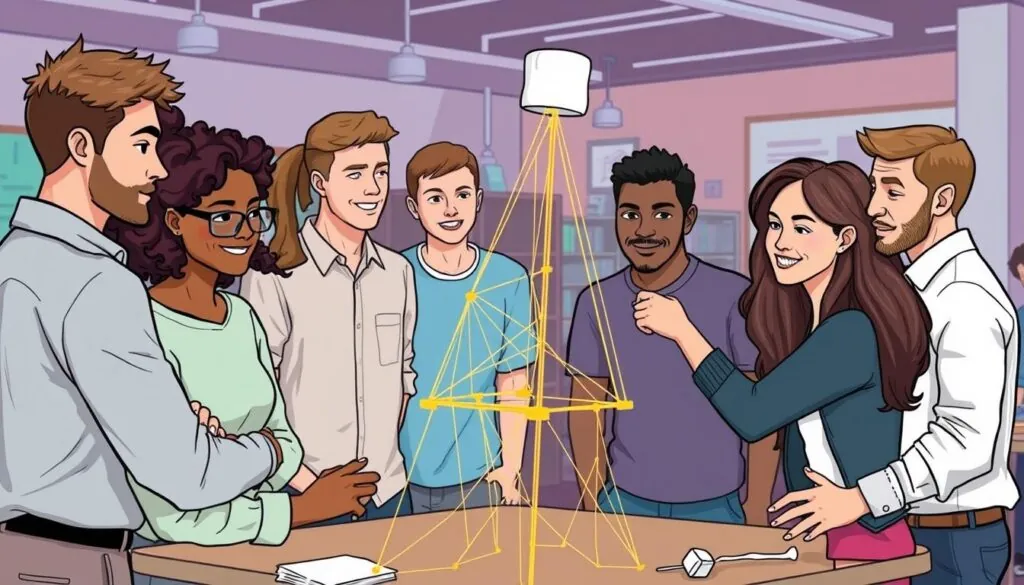
The Marshmallow Challenge is a popular team-building activity that requires groups of 4 members to build the tallest freestanding structure possible using 20 sticks of spaghetti, one marshmallow, one yard of string, and tape within 20-30 minutes. This activity tests how creatively teams work together, revealing team dynamics, leadership patterns, and approaches to constraints.
Escape Room Adventures have become increasingly popular for team building as they require diverse thinking styles, clear communication, and effective delegation under time pressure. These activities improve problem-solving and social skills, making them ideal for small and medium-sized groups. For more ideas on face-to-face team building activities, visit top face-to-face team building activities.
Bridge Build is a strategic and collaborative activity designed for large groups, where participants work together to construct a bridge using limited materials. This activity focuses on teamwork, creativity, and problem-solving, emphasizing resource management and structural thinking.
Tower of Strength
Tower of Strength is an engaging and competitive activity where large groups are challenged to build the tallest freestanding tower using limited materials. This activity promotes teamwork, creativity, and effective communication, highlighting how teams handle competition and structural challenges.
These problem-solving team bonding activities not only reveal natural problem-solving approaches within the team but also build confidence in a team’s collective ability to overcome obstacles. By debriefing these activities, teams can identify effective problem-solving strategies and apply them to workplace challenges.
Team Building Activities for Large Groups
When it comes to team building, large groups present a unique set of challenges and opportunities. Managing team building for large groups requires careful planning to create powerful alignment and shared purpose across an entire organization.
Large Team City Hunt
Large Team City Hunt transforms urban environments into giant game boards where teams navigate city streets to complete challenges, combining exploration, problem-solving, and teamwork. This activity is ideal for large groups, as it can be enjoyed by anywhere between 4 to over 200 people.
Carnival Games create a festive atmosphere where large groups can rotate through multiple game stations, allowing for both structured interaction and spontaneous fun between colleagues. From ring toss to balloon darts, these activities are designed to bring out the competitive spirit in a fun and relaxed environment.
Charity Bike Build
Charity Bike Build adds meaningful purpose to team building as participants assemble bicycles for underprivileged children, connecting team efforts to positive community impact. Helping children to achieve their dreams of having a bike is one of the most fulfilling things that large groups can do.
Random Acts of Kindness takes teams into the community to perform good deeds, creating emotional connections between team members while generating positive public relations for the organization. The activity consists of doing as many good deeds as possible in a short period of time.
Large group activities often require more structured facilitation and clear instructions to ensure all participants understand their roles and the objectives of each exercise. Breaking large groups into smaller teams for activities creates manageable units while still maintaining the energy and excitement of the full group during introductions and conclusions.
These activities can effectively bridge departments that rarely interact, creating cross-functional relationships that improve organizational communication and collaboration. For multinational or geographically dispersed organizations, large group activities during annual meetings or conferences create shared experiences that sustain relationships during periods of remote work.
The logistics of large group activities require careful planning, including considerations for space, materials, timing, and accessibility to ensure all team members can fully participate.
Virtual Team Bonding Activities for Remote Teams
As remote work continues to reshape the modern workplace, virtual team bonding activities have become essential for maintaining a connected and productive team.
Virtual team bonding activities help bridge the distance between remote team members, fostering a sense of unity and collaboration. These activities are designed to promote teamwork, improve communication, and build trust among team members.
Virtual Escape Rooms are an exciting way to improve problem-solving and social skills among team members. By working together to find clues and solve puzzles, remote teams can enhance their collaboration and communication.
Virtual Escape Rooms can be tailored to fit specific themes or holidays, adding a unique touch to the activity. This game is suitable for group sizes ranging from 50 to 100 players.
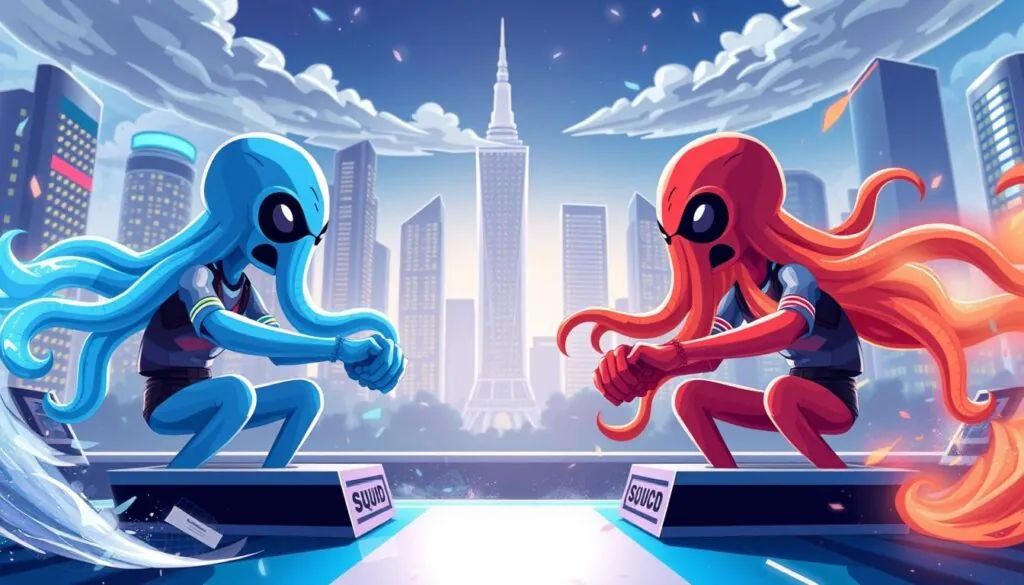
Inspired by the popular Netflix series, Virtual Squid Game is a friendly competition where teams work together to overcome challenges. This activity can be played both in-person and remotely, supporting up to 200 participants.
Virtual Squid Game promotes teamwork and problem-solving skills, making it an ideal activity for large groups.
Virtual Happy Hours
Virtual Happy Hours provide a relaxed atmosphere for team members to connect on a personal level. By preparing cocktails together and sharing professional achievements, teams can build stronger relationships.
This activity encourages informal socialization, helping to reduce the feeling of isolation that remote workers often experience.
Online Trivia Games
Online Team Trivia brings competitive fun to virtual teams, with customizable questions that can include company history, industry knowledge, or general trivia.
This activity promotes teamwork and communication while also providing an entertaining way to engage team members.
Effective virtual team building requires intentional facilitation, clear instructions, and technology checks to ensure all participants can fully engage. By leveraging digital platforms, teams can create shared experiences that strengthen their identity despite geographical separation.
Virtual team bonding activities are particularly valuable for onboarding new remote team members, helping them build relationships and understand team culture more quickly.
Food-Based Team Building Activities
In the world of team building, culinary experiences have emerged as a powerful tool to foster collaboration and camaraderie. Food-based team building activities leverage the universal appeal of culinary experiences to bring teams together in a relaxed, enjoyable environment that encourages natural conversation.
Cooking Together
Group Cooking Classes transform team members into collaborative chefs, requiring coordination, time management, and clear communication to create a successful dish together. For large groups, it’s effective to divide team members into smaller groups of 5 before starting the cooking activity.
Taste Testing
Taste Testing Challenges engage the senses as team members blindly sample and identify foods or beverages, often revealing surprising preferences and creating memorable shared experiences. This activity encourages teamwork and can be a fun way to discover new flavors.
Potluck with a Twist
Office Potlucks with a Twist elevate the standard shared meal by adding themes, competitions, or storytelling elements that connect the food to personal histories or cultural backgrounds. This activity fosters a sense of community and can help break down hierarchical barriers.
Food Truck Experience
Food Truck Rallies take teams outside the office to explore local cuisine together, creating a mobile feast that encourages mingling and conversation in a casual setting. This activity is particularly effective for multicultural teams, as it allows participants to share and enjoy different culinary traditions.
Food-based activities naturally break down hierarchical barriers as everyone participates equally in the universal experiences of cooking and eating. The act of breaking bread together has deep cultural significance across most societies, making food-based team building some of the most universally appealing activities.
When organizing food-based team-building activities, it’s crucial to consider dietary restrictions and preferences to ensure all team members can fully participate without discomfort or exclusion. The sensory nature of food experiences creates stronger memory imprints than many other team-building activities, making these events particularly memorable and reference-worthy in future team interactions.
Strategic Team Building Activities
Strategic team building is about more than just fun activities; it’s about driving business results. By aligning team members with organizational goals and developing a shared understanding of business objectives and values, strategic team building activities can have a significant impact on a company’s success.
These activities are designed to bridge the gap between fun team building and practical business outcomes, making the purpose of team development more apparent to skeptical participants. They are particularly valuable during organizational change, helping teams understand new directions and their role in achieving updated company objectives.
Company Concentration
Company Concentration is a memory-matching game that reinforces knowledge of company information. In groups of 3-6 people, participants match cards containing names and images of colleagues, as well as company facts like the logo, mission statement, and core values. This activity takes 20-30 minutes and is an engaging way to get teammates excited about upcoming goals.
All the News
All the News encourages forward thinking as team members create newspaper headlines announcing future achievements. In groups of 8-20 people, divided into smaller teams of 3-6, participants share headlines of potential feats and review the measures required to reach them. This activity takes 45-50 minutes and helps teams get excited about projected goals.
Slideshow
Slideshow activities develop presentation skills and collaborative analysis as teams select topics, research them together, and create compelling visual presentations to share with colleagues. This activity takes 45-50 minutes and is suitable for groups of 8-20 people.
Salt and Pepper
Salt and Pepper is a game played in pairs, where participants have to discover their partner’s identity by asking yes or no questions. With a time commitment of 20-30 minutes, this activity builds collaboration between team members and is an engaging way to foster teamwork.
Activity
Group Size
Time Commitment
Purpose
Company Concentration
3-6 people
20-30 minutes
Get teammates excited for upcoming goals
All the News
8-20 people
45-50 minutes
Get teammates excited for upcoming goals
Slideshow
8-20 people
45-50 minutes
Apply team effort when exploring an idea
Salt and Pepper
Pairs of 2
20-30 minutes
Build collaboration between team members
By incorporating company-specific information into engaging activities, strategic team building exercises reinforce important organizational knowledge in a more memorable way than traditional communication methods. They can also reveal misunderstandings or knowledge gaps about company strategy that might otherwise go unaddressed in regular work interactions.
Unique Team Bonding Activities to Try This Year
Unique team bonding activities offer a refreshing change from the standard exercises, engaging even the most skeptical team members. These activities not only provide a break from the monotony of traditional team building but also foster creativity, improve communication, and enhance teamwork.
Origami Class
Learning about the Art of Origami is always interesting and entertaining, even for large groups inside companies. It has been proven that Origami builds patience, precision, and improves decision-making processes. By going to an Origami Class, team members will face interesting mental challenges as they learn how to craft little paper figures with their own hands.
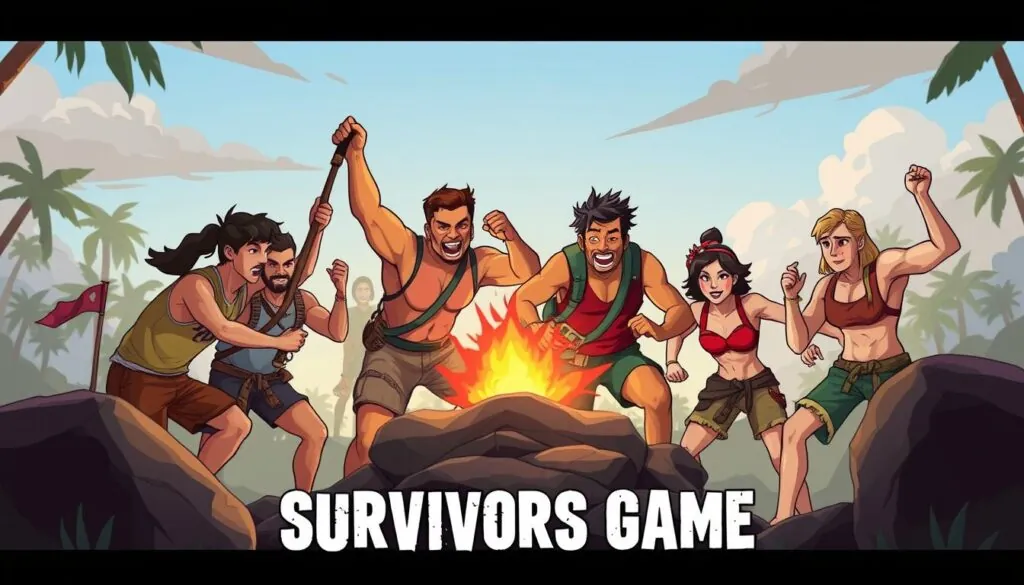
Are you ready to experience an activity where surviving is the main goal? With Survivors, large groups can work together to overcome different competition challenges inspired by the famous Survivor TV show. The challenges are both physical and mental, and the drama and adrenaline that Survivor participants experience can’t be compared to other activities.
For this team building method, ask each participant to prepare a presentation including three things that have shaped who they are as a person. Encourage creative thinking by asking teams to use simple drawings and words to visualize their presentation too.
Passions Tic Tac Toe
In this activity, your entire team fills in a 3×3 grid with a passion or core value in each of the boxes. Then, ask your group to mingle and compare passions. When someone finds a match, they each sign for the other person in that square of the grid. Declare your first winner as the person who gets three passions in a row.
These unique team bonding activities break through the monotony of standard team building exercises, offering fresh experiences that engage even the most team-building-resistant employees. They introduce new ways of interacting, improve communication, and foster a more cohesive team environment.
How to Choose the Right Team Bonding Activities for Your Group
Effective team bonding activities are key to creating a positive and inclusive team culture. Choosing the right activities requires careful consideration of several factors to ensure that the experience is enjoyable and beneficial for all participants.
Consider Your Team Size
Team size is a critical factor in selecting team bonding activities. Large groups, typically ranging from 50 to 500 team members, require more complex and inclusive activities. For instance, scavenger hunts or large-scale game shows can be ideal for big teams. On the other hand, smaller teams can engage in more intimate and straightforward activities like board games or quick quizzes.
Team Size
Activity Type
Examples
Small (less than 20)
Intimate, straightforward
Board games, quick quizzes
Medium (20-50)
Moderately complex
Escape rooms, team sports
Large (50-500+)
Complex, inclusive
Scavenger hunts, large-scale game shows
Match Activities to Your Team’s Personality
Understanding your team’s personality is vital in selecting activities that will resonate with them. Introverted teams may prefer more subdued and thoughtful activities, while extroverted teams might enjoy more energetic and competitive events.
Set Clear Objectives for Your Team Building Event
Defining clear objectives helps in choosing activities that are aligned with your goals. Whether the aim is to improve communication, build trust, or simply have fun, the activities should be selected with these objectives in mind.
Plan with Enough Time
Planning ahead is essential, especially for large or complex activities. This ensures that all logistical aspects are taken care of, and the event runs smoothly.
By considering these factors and planning carefully, you can choose team bonding activities that will be enjoyable and beneficial for your team.
Conclusion: Creating a Positive Culture of Connection Through Team Bonding
Team bonding is more than just a series of events; it’s a foundational process that helps build a sustainable culture of connection within organizations. This culture is not created overnight but is developed through consistent and varied team exercises over time.
As teams mature, team-building activities should evolve to address specific development needs identified through team performance. This evolution ensures that the team continues to grow and strengthen. Creating psychological safety through team bonding allows for more honest communication, innovative thinking, and a willingness to take calculated risks that drive organizational growth.
In today’s work environments, especially in remote and hybrid settings, intentional team bonding is crucial. It requires thoughtful adaptation of connection activities to bridge physical distance. Leaders play a critical role in modeling the vulnerability and participation that make team bonding effective.
Measuring the impact of team bonding through both qualitative feedback and quantitative metrics helps refine the approach and demonstrate ROI to stakeholders. A culture of connection built through team bonding creates resilience that helps organizations weather challenges and maintain cohesion during difficult periods.
Ultimately, the goal of team bonding extends beyond immediate productivity gains to creating a workplace where people feel valued, understood, and motivated to contribute their best work as part of a community they care about. By integrating team bonding into regular operations, organizations can make connection a part of their DNA, leading to a more cohesive and productive work environment.
Frequently Asked Questions – Best Team Bonding Activities
What are some effective ways to improve communication among group members?
Activities like the Human Knot, Perfect Square, and Birthday Lineup help participants build essential communication skills through collaboration and non-verbal interaction.
How can I facilitate a fun and engaging experience for remote teams?
Use virtual team bonding activities like Virtual Escape Rooms, Virtual Happy Hours, and Online Team Trivia to boost connection and teamwork across distances.
What are some creative ways to build trust among team members?
Trust-building games like Frostbite, Minefield, and Compliment Circle foster vulnerability and strengthen team relationships.
How can I choose the right activity for my group’s size and personality?
Consider your team size and personality—choose large, inclusive games like scavenger hunts for big groups and intimate activities like board games for smaller teams.
What are some unique and engaging team bonding activities to try this year?
Try Origami Classes, Survivor’s Game, or Passions Tic Tac Toe to break monotony and ignite creativity.
How long should a typical team bonding activity last?
Most activities take between 30 to 60 minutes, perfect for meetings, workshops, or retreats.
Can team bonding activities be adapted for large groups?
Absolutely—activities like Large Team City Hunt, Carnival Games, and Charity Bike Build are designed to engage large groups effectively.
Recognition drives retention, yet most companies treat their annual awards dinner as a podium-and-plated-chicken affair. According to Gallup, employees who do not feel adequately recognized are twice as likely to say they will quit within the next year. At the same time, Gallup research on workplace relationships shows that only two in ten U.S. employees have a best friend at work, a gap that well-designed group activities close faster than any team memo.
An awards dinner is one of the few nights a year when an entire organization gathers in the same room. Wasting that opportunity on a static ceremony means losing your best chance to strengthen the connections that keep people engaged long after the trophies are handed out.
Planning annual awards dinner activities that work for every attendee is harder than it sounds. Event committees juggle tight timelines, mixed age groups, varying comfort levels with participation, and the constant risk that entertainment falls flat with half the room. Budget constraints add pressure, and so does the expectation that the evening feels polished rather than thrown together at the last minute. Without a structured plan, the ceremony drags, guests check their phones between awards, and the energy never recovers.
Planning activities for your annual awards dinner? Add a hosted game show that keeps every guest engaged, anywhere in NJ, NYC and CT.
Where Awards Dinner Engagement Usually Falls Apart
Most awards dinners follow a predictable pattern: cocktail hour, dinner, speeches, awards, dessert, exit. The problem is that predictability breeds disengagement. Here are the specific challenges planners face.
Dead time between courses and awards: Gaps of ten to fifteen minutes with nothing happening send guests to their phones or side conversations that pull attention from the stage.
One-directional entertainment: A DJ or background music fills silence but does not create participation. Guests become spectators rather than active participants.
Mixed demographics: A room with entry-level hires, senior leaders, and support staff needs activities that do not alienate anyone by skill level, physical ability, or personality type.
Post-awards energy crash: Once the final trophy is awarded, the evening often loses momentum. Guests leave early if nothing anchors them to the room.
Budget allocation: Companies spend heavily on the venue and catering, leaving little for programming that actually makes the night memorable.
Pre-Dinner Activities That Set the Tone
The cocktail hour is not just a waiting period. It is the first impression of the entire evening. Smart planners use this window to warm up the room and break down departmental silos before anyone sits down.
Photo Stations and Memory Walls
Set up a branded photo booth with props tied to the company’s year (project names, product launches, inside jokes). Pair it with a “memory wall” where employees pin photos or notes from the past year. This gives guests something to do with their hands and a reason to talk to people outside their usual circle.
Trivia Warm-Ups
Distribute trivia cards at check-in with questions about the company, the industry, or the award nominees. Guests trade answers as conversation starters. Announce the top scorers during dinner for a low-stakes competitive kick.
Interactive Polling
Use a live polling platform projected on a screen. Ask lighthearted questions (“Which department has the best snack drawer?”) to get people laughing and paying attention to the screens before the formal program begins.
During-Dinner Entertainment That Holds Attention
The biggest engagement risk sits between the salad course and the final award. This is where annual awards dinner activities succeed or fail. The goal is to fill dead time without overshadowing the ceremony itself.
Table-Based Challenges
Give each table a mini challenge between award categories: a puzzle, a creative task (build the tallest structure from table items), or a rapid-fire quiz. Tables compete against each other, creating energy that carries into the next set of awards.
Live Game Show Rounds
A professional game show format transforms the gaps between awards into the most memorable parts of the night. It’s PlayTyme Game Shows runs interactive game show experiences designed for exactly this scenario: large groups, mixed demographics, and tight timelines. Their hosts manage the pacing so every table participates without anyone feeling put on the spot. Game show rounds slot between award presentations, keeping energy high while giving award recipients a moment to celebrate before the next segment.
Audience Voting
For select awards, let the audience vote in real time using their phones. The anticipation of watching votes come in on screen turns a standard announcement into a shared experience. Pair this with a brief nominee highlight reel for maximum impact.
Post-Dinner Activities That Keep the Energy Alive
The ceremony ends. Now what? The best annual awards dinner activities include a post-ceremony plan that gives guests a reason to stay, mingle, and leave on a high note.
After-Party Game Stations
Set up three or four game stations around the room: a quick-draw trivia kiosk, a team relay challenge, a music or pop-culture quiz. Guests rotate at their own pace. This structure works for both the crowd that wants to keep competing and the group that prefers to watch and cheer.
Recognition Lounge
Create a casual space where award winners display their trophies and colleagues stop by to congratulate them. Add a short-form video booth where winners record a 30-second “acceptance speech” for the company intranet. This extends the recognition beyond the stage moment.
Networking Bingo
Hand out bingo cards with prompts like “Find someone who started this year” or “Talk to someone from a different floor.” Completed cards earn a small prize. This works especially well for organizations with multiple offices or remote employees meeting in person for the first time.
Why Interactive Game Shows Work as the Entertainment Anchor
A live game show format solves the three hardest problems of awards dinner entertainment at once: it fills time without feeling like filler, it includes every guest regardless of age or role, and it maintains a professional tone while being genuinely fun.
It’s PlayTyme Game Shows specializes in corporate event entertainment that fits around an existing program rather than replacing it. Their format scales from 20 to 300+ guests, uses wireless buzzers and scoring systems so every table competes simultaneously, and their professional hosts read the room to adjust pacing and difficulty on the fly. The result is an evening where the entertainment supports the awards rather than competing with them.
Unlike a comedian or band (which guests passively watch), a game show turns every attendee into a participant. That shift from spectator to player is what makes the night stick in people’s memories weeks later.
Want energy between courses and awards? Our hosts run game rounds that fit around your program.
Building a Timeline for Your Awards Dinner Activities
A strong timeline prevents dead air and keeps the evening moving without feeling rushed. Here is a sample flow for a three-hour awards dinner with integrated activities.
6:00 to 6:45 PM: Arrival and Cocktails
Photo station opens. Trivia warm-up cards distributed at check-in. Interactive polling runs on the main screen. Guests mingle, answer trivia, and settle in.
6:45 to 7:00 PM: Welcome and Opening Remarks
Brief welcome from leadership. Announce the trivia warm-up winners. Set expectations for the evening’s interactive elements so guests know participation is part of the plan.
7:00 to 8:15 PM: Dinner, Awards, and Game Show Rounds
Alternate between award presentations and game show rounds. Two to three game show segments of eight to ten minutes each fill the gaps between award categories. Table challenges run during course transitions. Audience voting activates for select awards.
8:15 to 8:30 PM: Final Awards and Closing Remarks
Present the top awards. Announce the overall game show winning table. Brief closing from leadership.
8:30 to 9:00 PM: After-Party Activities
Game stations open. Recognition lounge activates. Networking bingo cards distributed. Guests stay because there is still something happening.
Tips for Making Activities Land With Every Audience
Even the best activity list fails without thoughtful execution. These principles keep your annual awards dinner activities working for the full range of personalities in the room.
Make participation optional but irresistible. Structure activities so that joining feels natural, not forced. Table-based formats work because the group dynamic pulls individuals in without singling anyone out.
Balance competition with celebration. The night is about recognizing people, not creating new rivalries. Keep game stakes lighthearted (bragging rights, a small trophy for the winning table) rather than high-pressure.
Brief your emcee or host thoroughly. A professional game show host from a company like It’s PlayTyme knows how to read a corporate room. If you are running activities in-house, give the emcee a detailed run sheet with timing, transitions, and fallback options.
Test your tech in advance. Wireless buzzers, polling platforms, and projection systems need a sound check before guests arrive. Technical glitches during the ceremony undermine every good activity you planned.
Collect feedback the next day. Send a short survey asking which activities guests enjoyed most. This data shapes next year’s planning and proves the investment was worthwhile to leadership.
What to Ask Before You Book Awards Dinner Entertainment
Start with three questions: How large is your group? What is the ratio of ceremony time to social time? And what do you want guests saying about the evening the next morning?
If your group is under 50, table-based challenges and trivia carry the night without external entertainment. For groups of 50 to 500, a professional game show format delivers the highest engagement per dollar because it scales without losing the personal touch. If your budget allows only one upgrade beyond the standard DJ, make it interactive entertainment that puts guests in the action rather than background music they tune out.
The organizations that get the most from their awards dinners treat the ceremony as the backbone and the activities as the connective tissue. Awards give people a reason to clap. Activities give them a reason to stay.
Ready to turn your next awards dinner into the event your team talks about all year? Get in touch with It’s PlayTyme Game Shows to build a custom game show experience around your ceremony. Explore their full lineup of corporate event entertainment to find the right format for your group size and schedule.
What are the best activities for an annual awards dinner?
The strongest annual awards dinner activities combine pre-dinner icebreakers (photo booths, trivia cards), during-dinner entertainment (live game show rounds between awards), and post-dinner social activities (game stations, networking bingo). Interactive formats consistently outperform passive entertainment because they turn guests into participants.
How do you keep guests engaged during a long awards ceremony?
Break the ceremony into segments with game show rounds or table challenges between award categories. Each interactive segment should run eight to ten minutes, enough to reset attention spans without disrupting the program’s flow. Audience voting for select awards also keeps guests actively involved.
How much does entertainment for an awards dinner cost?
Costs vary by format and group size. Low-budget options like trivia cards and photo props cost under $200. Professional game show entertainment for groups of 20 to 300+ typically falls in the mid-range of event budgets and delivers higher engagement per dollar than a DJ or band. Contact providers directly for exact pricing based on your event details.
What activities work for large corporate awards dinners with 200 or more guests?
Table-based competition formats scale best for large groups because every table plays simultaneously. Professional game shows with wireless buzzer systems handle 200 to 300+ guests without losing energy. Combine these with audience live-polling on the main screen so the entire room stays connected to the action at once.
How far in advance should you book entertainment for an awards dinner?
Book professional entertainment at least six to eight weeks before your event date. Popular providers fill their calendars quickly during peak awards season (November through February and June). Early booking also gives you time for a planning call to customize the game show content around your specific award categories and company culture.
How does an annual awards dinner directly affect employee retention?
Gallup research shows that employees who do not feel adequately recognized are twice as likely to say they will quit within the next year, making a well-designed awards dinner a concrete retention tool, not just a social event.
Only 20% of employees worldwide reported feeling engaged at work in 2024, according to Gallup’s State of the Global Workplace report. That number represents a continued slide from the 2022 peak and a direct hit to team productivity. Meanwhile, SHRM research shows that replacing a single employee costs at least 50% of their annual salary, making retention a financial priority, not just an HR talking point.
For companies across Bergen County, those numbers translate into real urgency. Team building activities in Paramus NJ offer a practical way to reconnect departments, rebuild trust after restructuring, and give hybrid teams a reason to show up in person. Paramus sits at the intersection of Routes 17 and 4, making it one of the most accessible locations in northern New Jersey for groups traveling from multiple office locations.
But planning a team building event for a large group is rarely straightforward. Coordinators face venue capacity limits, dietary restrictions for catered events, budget scrutiny from finance, and the constant worry that half the team will disengage five minutes in. Finding an activity that works for 20 people is one thing. Finding one that holds the attention of 200 or 500 people, across age groups and personality types, is a different problem entirely.
Planning team building in Paramus? We bring hosted game shows to your office or venue for 20 to 300+ people across Bergen County.
Why Paramus Is Bergen County’s Premier Spot for Corporate Events
Paramus is not just a retail destination. The borough serves as a commercial center for Bergen County, with corporate offices, medical campuses, and regional headquarters lining Routes 17 and 4. The Paramus Regional Chamber of Commerce counts over 300 member businesses, and the local economy spans finance, healthcare, logistics, and professional services.
For event planners, the location offers practical advantages that matter when coordinating large groups:
Highway access: Routes 17 and 4 connect directly to the Garden State Parkway and I-80, putting Paramus within a 30-minute drive for most of Bergen, Passaic, and Essex counties.
Hotel conference space: Properties along Route 17 (including the Crowne Plaza Paramus and nearby hotels in Saddle Brook and Rochelle Park) provide ballrooms and meeting rooms that accommodate groups of 100 to 500.
Paramus Park proximity: The area around Paramus Park Mall offers restaurants for post-event dining, making it easy to extend the experience into an evening social.
NYC access: Manhattan is roughly 15 miles east, so teams based in New York City reach Paramus without a long commute.
Biggest Obstacles When Scaling Team Building Events
Coordinating team building activities in Paramus NJ for 50, 100, or 500 people introduces complications that smaller outings never encounter. Understanding these obstacles upfront saves time and budget.
Venue Capacity and Layout
Most activity venues cap out around 30 to 50 participants. Conference rooms at hotels work for larger groups, but the activity itself needs to function in that space. An event that requires participants to move between stations needs a different floor plan than one that keeps everyone seated.
Engagement Across Personality Types
A group of 200 includes introverts, extroverts, competitive types, and people who would rather observe. Activities that rely solely on physical competition or public speaking alienate a significant portion of the group. The best formats offer multiple ways to participate.
Budget Justification
Finance departments want measurable outcomes. “Fun” is not a line item that survives budget review. Planners need activities that connect directly to collaboration, communication, or morale improvement so the investment stands up to scrutiny.
Scheduling Conflicts
Large groups mean more calendars to coordinate. Activities that require a full day eliminate some participants entirely. The most practical options fit into a two-to-three-hour window during a workday or pair with an existing offsite meeting.
1. Interactive Game Shows (The Standout Choice for Large Groups)
It’s PlayTyme Game Shows runs live, hosted game show events designed specifically for corporate groups ranging from 20 to 300+ participants. The format works in hotel ballrooms, corporate conference centers, school auditoriums, and outdoor tented spaces throughout Paramus and Bergen County.
What sets this option apart from typical team building activities in Paramus NJ is the structure. A professional host runs the event with studio-quality sound, lighting, and scoring systems. Teams compete in rounds of trivia, survey-style games, and physical challenges that rotate fast enough to keep energy high. Every participant has a role because the game mechanics require full-team input, not just the loudest voice at the table.
Key reasons this format works for large corporate groups:
Scales from 20 to 300+ people without losing engagement or requiring extra facilitators for every table.
Runs 60 to 120 minutes, fitting cleanly into a half-day offsite or an after-lunch block.
Requires zero preparation from participants (no costumes, no pre-reading, no athletic ability).
The host manages all logistics, setup, and teardown, so the event coordinator’s job ends at booking.
Works in any venue with power outlets and enough space for tables and chairs.
Bergen County parks and nearby outdoor facilities offer obstacle courses, scavenger hunts, and relay-style competitions that get teams moving. Venues like Campgaw Mountain Reservation in Mahwah (about 20 minutes from Paramus) provide space for groups up to 100.
Outdoor activities work best for groups that skew younger or more athletic. They do require weather contingency plans, which adds a layer of logistical complexity. For groups over 100, splitting into waves becomes necessary, and that stretches the timeline considerably.
Best suited for: groups of 20 to 80 during spring and fall months when weather cooperates.
3. Culinary Team Competitions
Cooking challenges divide teams into small groups that must collaborate on a dish within a time limit. Several catering companies and culinary studios in northern New Jersey offer corporate cooking events, though most cap group size at 40 to 60 people.
The format encourages communication and delegation. It also introduces dietary and allergy considerations that the organizer needs to manage. For groups over 60, the logistics of kitchen space, ingredient prep, and judging become significantly harder to coordinate.
Best suited for: groups of 15 to 60 who enjoy hands-on, creative activities.
4. Trivia and Quiz Events
Trivia nights have become a staple of corporate team building. Several event companies in the Bergen County area offer hosted trivia with customizable question categories. The format keeps things low-key and works for groups up to 150 in a restaurant or event space.
The limitation is engagement depth. Standard trivia relies on individual knowledge, so quieter team members often sit back while one or two people answer every question. Without a skilled host or varied round formats, energy tends to drop after 45 minutes.
Best suited for: groups of 20 to 150 who want a relaxed, low-physical-activity option.
Want an event that works at any group size? Our hosts scale every round for small teams and full companies.
Escape rooms test communication, logic, and teamwork under time pressure. Locations in Hackensack, Paramus, and surrounding Bergen County towns offer corporate packages. The typical room holds 6 to 10 people, so large groups rotate through multiple rooms simultaneously.
For a group of 100, that means booking 10 to 15 rooms and staggering start times. The per-person cost adds up quickly, and the experience varies by room quality. Some team members finish early and wait. Others feel rushed. Coordination across that many rooms requires a dedicated on-site manager.
Best suited for: groups of 10 to 40 who want an intellectually challenging, immersive experience.
Activity
Group Size
Duration
Venue Flexibility
Best For
It’s PlayTyme Game Shows
20-300+
60-120 min
Any indoor/outdoor venue
All-company events, mixed groups
Outdoor Adventure Challenges
20-80
2-4 hours
Parks, outdoor facilities
Athletic, younger teams
Culinary Competitions
15-60
2-3 hours
Culinary studios, catered venues
Creative, hands-on teams
Trivia & Quiz Events
20-150
60-90 min
Restaurants, event spaces
Relaxed, knowledge-based fun
Escape Room Challenges
10-40
60-90 min
Dedicated escape room venues
Small teams, problem solvers
Booking Logistics: Venues, Timing, and Group Size in Paramus
Securing the right venue is the first practical step for any team building event in Paramus. Here is what to account for when planning.
Venue Options by Group Size
20 to 50 people: Most restaurants with private dining rooms, smaller hotel meeting rooms, or corporate office common areas work. Escape rooms and culinary studios fit this range.
50 to 150 people: Hotel ballrooms along Route 17, community centers, and larger restaurant event spaces. Game show events and trivia nights fit comfortably at this scale.
150 to 500 people: Full hotel ballrooms (Crowne Plaza, nearby Hilton properties), school auditoriums, or outdoor tented spaces. Interactive game shows are one of the few formats that maintain engagement at this size without fragmenting the group.
Timing Considerations
Weekday events between 10 a.m. and 3 p.m. get the highest attendance for corporate groups. Avoid scheduling on Mondays (too many standing meetings) and Fridays (early departures). Tuesday through Thursday gives the best turnout. Book venues at least four to six weeks in advance, especially during Q4 when holiday parties compete for the same spaces.
Budget Planning
Costs vary widely by format. Escape rooms run $25 to $45 per person. Culinary events range from $75 to $150 per person including ingredients. Game show events typically price per event rather than per head, which makes them more cost-effective as group size increases. Always confirm whether the venue charges a separate room rental fee or if it is bundled with catering minimums.
Which Team Building Format Fits Your Group Size
The right choice depends on three factors: group size, the outcome you want, and the physical space available.
If your group exceeds 100 people, start by eliminating options that fragment the experience. Escape rooms and cooking challenges require splitting into small pods, which defeats the purpose of a shared team experience. Game shows and large-format trivia keep everyone in the same room, competing together.
If your goal is interdepartmental bonding (breaking silos between teams that rarely interact), choose an activity that randomizes team assignments rather than letting people sit with their usual colleagues. A professional host handles this naturally during game show events by assigning mixed tables.
If you are working with a hotel conference room in Paramus, confirm the room layout supports your chosen activity. Theater-style seating works for presentations but kills interaction. Round tables with 8 to 10 seats per table give game shows and trivia the best energy.
For groups that include remote employees flying in, pair the team building activity with a meal. The combination of structured competition and informal dining covers both the bonding and the social elements in a single afternoon.
Ready to plan your next corporate team building event in Paramus? Get in touch with It’s PlayTyme Game Shows to discuss your group size, venue, and preferred format. Browse the full list of corporate event options to see what fits your team best.
What are the best team building activities in Paramus NJ for large groups?
Interactive game shows are the strongest option for large groups because they scale from 20 to 300+ people without losing engagement. A professional host keeps energy high and ensures every participant stays involved. Hotel ballrooms along Route 17 provide ideal venues for these events.
How far in advance should I book a team building event in Paramus?
Book at least four to six weeks ahead for groups over 50 people. During October through December, venue availability tightens because of holiday parties and year-end celebrations. Smaller groups of 20 to 30 have more flexibility with shorter lead times.
How much do corporate team building activities cost per person in Bergen County?
Costs range from $25 per person for escape rooms to $150 per person for culinary competitions. Game show events typically charge a flat event fee, which brings the per-person cost down significantly for groups over 50. Always ask whether venue rental is included or billed separately.
Where are the best venues for team building near Paramus NJ?
Hotel conference centers along Routes 17 and 4 offer ballrooms that seat 100 to 500 people. The Crowne Plaza Paramus and nearby properties in Saddle Brook and Rochelle Park are popular choices. For outdoor events, Bergen County parks like Campgaw Mountain Reservation provide open space for adventure-style activities.
Do team building game shows work for mixed groups with different age ranges?
Yes. Game show formats use rotating rounds that include trivia, surveys, and physical challenges, so no single skill set dominates. Participants aged 22 to 65 all find rounds that match their strengths. The format is designed to be inclusive without requiring athletic ability or specialized knowledge.
Why is team building a financial priority rather than just an HR initiative?
SHRM research shows that replacing a single employee costs at least 50% of their annual salary. That makes the engagement gap team building addresses a direct budget concern, not only a culture one.
What makes Paramus a convenient location for corporate team building events?
Paramus sits at the intersection of Routes 17 and 4, making it one of the most accessible locations in northern New Jersey for groups traveling from multiple office locations.
Project Graduation exists for one reason: to give seniors a safe, sober, supervised place to celebrate on one of the riskiest nights of the year. The stakes are real. The National Highway Traffic Safety Administration reports that teen drivers face their highest crash risk during the spring and summer months that bracket graduation. The Centers for Disease Control and Prevention adds that motor vehicle crashes remain a leading cause of death for teenagers in the United States.
A great celebration costs money, and parent committees rarely start with a budget. That is where smart fundraising comes in. The right mix of events covers the venue, the food, the prizes, and the entertainment that keeps students engaged until sunrise. This guide ranks ideas by realistic return, starting with the highest-ROI option for committees in New Jersey, New York City, and Connecticut.
If you sit on a Project Graduation committee, you already feel the squeeze. Volunteer hours are limited, families are tapped out by spring, and you compete with a dozen other school fundraisers for the same dollars. You do not need another generic bake-sale list. You need fundraisers that bring in real money without burning out your team.
Raising money for project graduation? A hosted game show night can bring families together and fill your fund, anywhere in NJ, NYC and CT.
Start With the Highest-ROI Fundraiser: A Game Show Ticket Night
The single best fundraiser doubles as a community event: a ticketed game show night. Sell tickets to families, alumni, and local businesses, fill a gym or banquet hall, and let a professional host run an evening of trivia and friendly competition. The format draws a crowd because it entertains every age at once, from freshmen to grandparents.
A hosted game show night from It’s PlayTyme Game Shows turns a fundraiser into the highlight of the spring calendar. You sell tickets, run a concession stand, add a 50/50 raffle at intermission, and stack several revenue streams into one night. A mid-sized event of 150 to 300 guests routinely raises 3,000 to 8,000 dollars after costs, far more than a typical car wash or bake sale.
The math works because every guest spends in more than one way. A family of four buys four tickets, snacks at the concession table, and raffle entries at intermission. Add a sponsor banner along the wall and a silent auction in the lobby, and a single evening pulls in revenue that smaller fundraisers take months to match. The event also builds the community goodwill that makes next year’s outreach easier.
Layer in Supporting Fundraisers
One event rarely funds an entire celebration. The strongest committees stack three or four fundraisers across the school year, each with a clear target. Below are the most reliable supporting ideas with realistic dollar ranges.
Raffles and 50/50 Drawings
Raffles deliver high margins because donated prizes cost you nothing. Sell tickets for a vacation package, a smart TV, or a basket of local goods. A well-run raffle brings in 1,000 to 4,000 dollars, and a 50/50 drawing at any large event adds several hundred more.
Local Business Sponsorships
Sponsorships are the most overlooked source of fast money. Offer tiered packages with logo placement on banners, programs, and social posts. Most committees raise 2,000 to 6,000 dollars from a focused outreach push to 20 or 30 local businesses.
Product and Spirit Sales
Branded apparel, yard signs, and senior banners sell well because families want keepsakes. Pre-sell to control inventory and protect margins. Expect 800 to 2,500 dollars depending on participation and pricing.
Restaurant and Dine-Out Nights
Partner with a local restaurant that donates a percentage of sales on a set night. These nights require almost no upfront cost and typically return 300 to 1,000 dollars while building goodwill with a community partner.
Want a fundraiser parents and students both show up for? Tell us your goal and we will help you plan a game show night around it.
The Problems Every Graduation Fundraiser Has to Solve
Even strong committees hit predictable obstacles. Naming them early helps you plan around them:
Volunteer burnout: the same handful of parents carry every event, so simple fundraisers win.
Donor fatigue: families face requests from sports, band, and clubs all year long.
Weather and timing: outdoor events fail when spring storms hit, so indoor formats protect your return.
Cash-flow gaps: deposits for venues and entertainment come due before ticket money arrives.
A single high-ROI indoor event solves several of these problems at once. It concentrates volunteer effort into one night, draws a wide crowd rather than tapping the same families repeatedly, and runs rain or shine inside a school gym or hall.
How to Build Your Fundraising Calendar
Spread your fundraisers across the school year so no single month carries the load. Launch sponsorship outreach in the fall when business budgets reset. Run product sales around the holidays. Hold the game show ticket night in late winter or early spring while excitement builds. Save the raffle drawing for the celebration itself, when the crowd is largest.
Ready to anchor your campaign with a high-energy event? Reach out through our contact page, or learn more on our school programs and events pages to see how a hosted game show night fits your school. One well-run evening funds a large share of your celebration while bringing the whole community together.
Building a Fundraising Mix Around Your Budget
Start with your total budget, then work backward. If you need 10,000 dollars, anchor the plan with one large event that delivers the biggest share, then fill the gap with two or three low-effort fundraisers. Weigh each idea by dollars raised per volunteer hour, not just total revenue. The best mix raises the most money while protecting the small team that makes it all happen.
A ticketed game show night delivers the highest return because it stacks ticket sales, concessions, and a raffle into one event. It also draws a wide community crowd rather than tapping the same families twice. A mid-sized night routinely raises several thousand dollars after costs.
How much does a Project Graduation celebration cost?
Costs vary by school size, but most committees budget between 8,000 and 20,000 dollars to cover venue, food, prizes, and entertainment. Planning three or four fundraisers across the year reliably reaches that range without overloading volunteers.
How early should we start fundraising?
Begin in the fall of senior year. Early sponsorship outreach captures business budgets before they are spent, and a longer runway lets you spread events so no single month carries the load. Starting early also eases the cash-flow gaps that catch many committees.
Do we need a large committee to run a game show night?
No. A professional host runs the entire event, so your volunteers focus on tickets, concessions, and the raffle. That division of labor lets a small committee pull off a large, high-revenue night without burning out.
What raises money with the least volunteer effort?
Raffles and restaurant dine-out nights deliver the best return per volunteer hour. Donated prizes and partner-run sales mean almost no upfront cost. Pair one of these with a larger anchor event for an efficient, balanced campaign.