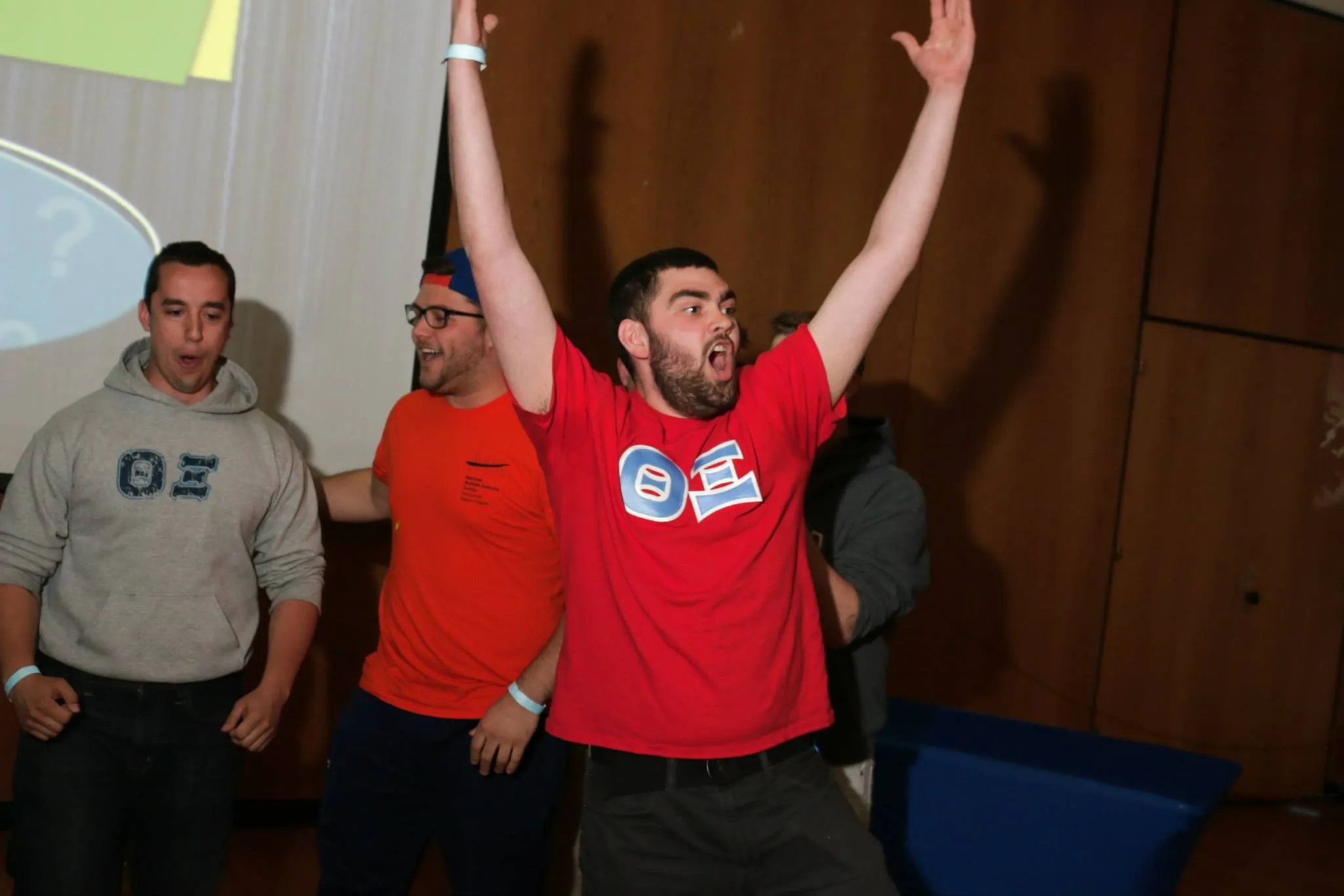
Greek Week chairs juggle real obstacles when they plan this night. The budget gets stretched thin across a whole week of programming. Multiple chapters with rival energy have to share one room without it turning chaotic. A student volunteer with a microphone rarely holds a packed crowd. And the night has to feel bigger than last year, or nobody talks about it. The right format solves every one of those at once.
Planning a Greek Week game night? Our hosted game shows get every chapter competing, on campus anywhere in NJ, NYC and CT.
Greek Week game night is the social heart of the week, where chapters compete and form lasting bonds.
Gallup research shows that strong social bonds inside a group drive both engagement and long-term retention.
Only about one in three people feel truly engaged day to day, making a high-energy structured event critical.
A polished hosted game night turns a crowded multi-chapter room into one electric, unified audience.
Why a Hosted Game Night Anchors Greek Week
A game night gives Greek Week a centerpiece that every chapter shows up for. It mixes fraternities and sororities into teams, replaces awkward standing around with friendly rivalry, and gives councils a points event that feeds the overall standings. Unlike a party, it has structure, momentum, and a clear winner. That structure is what keeps hundreds of students locked in for two straight hours.
The format also scales. A small council night runs the same way a 400 person showcase does, because a professional host controls the pace, the volume, and the energy. Students stop checking their phones and start chanting for their chapter. That is the moment Greek Week is built for.
Greek Feud: The Headline Format
Greek Feud is the signature game show round, modeled on the Family Feud format that students already know. Two chapters face off at the buzzer to guess the top survey answers, while the host keeps the banter sharp and the crowd loud. The questions get tailored to campus life, Greek traditions, and inside jokes, so every answer lands with the room.
Instant buy in: students know the rules in seconds, so play starts fast.
Team energy: chapters rally behind their players and roar at every steal.
Points ready: the bracket feeds straight into your Greek Week scoreboard.
Greek Feud works as the anchor because it is loud, fast, and impossible to watch passively.
Trivia Showdown for Chapter Bragging Rights
A trivia showdown rewards the chapters that think they know it all. Teams race through rounds on pop culture, campus history, and Greek life, with a live leaderboard that swings the room with every answer. The format favors quick teamwork over individual stars, so the whole chapter feels involved.
Trivia also balances the night. After the high volume of Greek Feud, a focused trivia round keeps the competition tight and gives quieter chapters a real shot at the title. The leaderboard reveal at the end is the kind of moment students film and post.
Lip Sync Battles and Performance Rounds
Lip sync battles turn the spotlight on the chapters themselves. Each group prepares a short, choreographed number, and the host runs it like a televised showdown with crowd scoring. The performances become the most shared content of the entire week, because students love watching their friends commit to a bit.
Creative outlet: chapters express personality beyond trivia and buzzers.
Crowd judging: the audience scores it, so every seat stays engaged.
Highlight reel: the performances power your recap posts and reels.
Pairing a performance round with the game show formats gives the night variety, so it never feels like one long quiz.
Want chapters cheering for points all night? We bring the host, the buzzers and the prizes.
Proven on New Jersey Campuses Like Montclair State
Local experience matters when hundreds of students fill a campus venue. It’s PlayTyme Game Shows has run Greek Week game nights on New Jersey campuses, including Montclair State, with formats built for student crowds. A host who knows campus venues, sound setups, and council scheduling shows up ready, so chairs spend their energy on turnout rather than production.
The team brings the full kit: a professional host, sound, scoring, and the on screen graphics that make the night feel like real television. Chapters get a polished show, and the council gets a points event that runs on time. That reliability is what separates a hosted night from a volunteer scramble.
The Challenges of Planning a Greek Week Game Night
Every Greek Week night carries pressure because the whole community is watching. Budgets stretch across days of events, so each dollar has to earn attention. Rival chapters need a format that channels competition into fun instead of friction. A packed venue demands real sound and a host who commands the room. And the night must top last year to keep the tradition growing. Plan for each, and the night becomes the highlight of the week.
The fix is a professionally hosted show that bundles structure, sound, scoring, and energy into one booking. It keeps mixed chapters engaged, holds a loud room, and gives the council a repeatable centerpiece. One vendor handles the production, so student leaders run the week instead of running cables.
How to Build Your Greek Week Game Night Lineup
Start with the anchor and build outward. Open with Greek Feud to set a loud tone, drop in a trivia showdown to tighten the standings, then close with lip sync battles for the highlight moment. Stagger the formats so energy rises and resets across the night. To lock your date, use the contact page and review the hosted event options on the events page. Book early so your date and full production setup are locked in.
How to Choose the Right Game Night for Your Chapter
Match the lineup to your crowd and your calendar. For a tight council event, a single Greek Feud bracket delivers a fast, loud win. For a marquee all chapter showcase, stack Greek Feud, trivia, and lip sync into a full production. Favor a hosted show over a volunteer run night when turnout is high, since a professional holds the room and keeps the points clean. Pick the format students will retell, because the night they remember is the tradition that lasts.
Frequently Asked Questions (FAQs)
What is the best game night format for Greek Week?
Greek Feud is the strongest anchor because students know the rules instantly and the buzzer play stays loud. Pair it with a trivia showdown and lip sync battles for variety, and the night holds a packed crowd from start to finish.
How many chapters can join one game night?
A hosted show scales from a small council event to a 400 person showcase. A professional host controls pace, sound, and scoring, so the format works whether two chapters compete or the whole community fills the venue.
Can the games feed into our Greek Week points?
Yes. The bracket and leaderboard produce clear winners that drop straight into your overall standings. The council gets a structured points event that runs on time and keeps the week competitive.
Do you run game nights on New Jersey campuses?
Yes. Hosted Greek Week game nights run on New Jersey campuses, including Montclair State, with formats built for student crowds. A local host arrives with the full production kit and knows campus venues and scheduling.
How far in advance should we book?
Most groups book 4 to 8 weeks ahead, and shorter notice often works when the date is free. Locking in your host early secures both the date and the full production setup.
Why does a game night build stronger chapter bonds than other Greek Week events?
Gallup research shows that people with a close social bond in their group are far more engaged and far more likely to remain involved. A hosted game night creates exactly that bond by turning a crowded multi-chapter room into one shared audience that competes, laughs, and remembers the night together.
College students want connection, yet many spend their evenings alone in a dorm. Gallup research shows that a small minority of people feel genuinely engaged in their daily environment, and that disengagement follows students from the lecture hall into campus life. Student programming boards need events that pull a crowd, spark laughter, and build belonging in a single night.
The appetite for social gatherings keeps growing. Pew Research Center documents how younger adults still place a high value on in-person community even as screen time climbs. A well-run game night answers that need directly. It turns a quiet Thursday into the most talked-about event of the semester.
Planning a campus game night is harder than it looks. Budgets stay tight, attention spans run short, and a room of 200 students will not sit still for a slow activity. Programming boards juggle venue rules, audio-visual limits, and the pressure to top last semester’s turnout. The right format solves all of these problems at once, so choosing it matters more than any single decoration or snack.
Planning a college game night? Our hosted game shows pack the room, on campus anywhere in NJ, NYC and CT.
College students crave in-person connection, yet Gallup data shows most feel disengaged in their daily campus environment.
Pew Research confirms younger adults still prioritize in-person community even as screen time continues to rise.
A well-run game night can turn a quiet Thursday into the most talked-about event of the semester.
Tight budgets and short attention spans make activity pacing and venue setup the two hardest planning variables.
A room of 200 students will not stay engaged through a slow or poorly structured activity.
Why Game Nights Work So Well on College Campuses
Game nights succeed because they reward participation, not spectating. Students laugh together, compete in friendly teams, and meet people outside their usual circle. The format scales from a 30-person floor event to a 500-seat student union show. It also fits almost any theme, from welcome week to finals stress relief. Few other programs deliver that much energy for the cost.
A strong game night also produces content. Students film clips, post photos, and tag friends, which markets your next event for free. That social momentum is exactly what a programming board needs to prove its budget was well spent.
Game Night Ideas for Colleges That Fill the Room
Variety keeps your calendar fresh. These formats consistently draw crowds and play well in a large space.
Live trivia tournaments. Run themed rounds on pop culture, sports, and campus history. Teams of four keep everyone involved.
Family-style face-off shows. Two teams guess the top survey answers in a fast, loud, audience-driven format.
Quiz-board showdowns. A category grid with rising point values rewards both knowledge and strategy.
Minute challenges. Quick physical tasks using cups, ping-pong balls, and balloons turn nervous freshmen into instant fans.
Music bingo. Players mark songs as a host plays clips, blending a concert feel with a game.
Team escape puzzles. Timed riddles push small groups to cooperate under pressure.
Mix two or three of these into one night for variety. Open with a high-energy face-off, drop into a trivia round, then close with a minute challenge final. That arc keeps the crowd loud from start to finish.
Common Challenges of Running a College Game Night
Most setbacks trace back to a handful of issues. Name them early and you avoid a flat event.
Low turnout. Weak promotion or a dull theme leaves seats empty. Build a two-week promo plan across social channels and resident assistants.
Dead air. An unprepared host kills momentum fast. A confident emcee keeps the pace tight between rounds.
Audio-visual failures. A frozen scoreboard or a dropped mic stalls the whole show. Test every cable an hour before doors open.
Uneven participation. A few loud students dominate while the rest watch. Team formats and rotating volunteers fix that imbalance.
Budget overruns. Prizes and rentals add up. Set a per-head cost and stick to it.
A professional host removes most of these risks in one move, because pacing, equipment, and crowd control are their job, not yours.
Want students to stay all night? We bring the host, the buzzers and the prizes that keep every seat filled.
A do-it-yourself game night asks volunteers to write questions, run the tech, and entertain a restless crowd at the same time. That is a heavy lift for a student committee. A professional production removes that burden. It’s PlayTyme Game Shows brings a polished emcee, broadcast-style scoring screens, sound, and ready-to-run formats built for big rooms. The team has run hundreds of events across New Jersey, New York City, and Connecticut, so they know how to read a college crowd and adjust on the fly.
The difference shows in the energy. A trained host keeps every round moving, pulls quiet students into the action, and lands the jokes that make the night memorable. Your committee gets to enjoy the event instead of troubleshooting a laptop.
Planning Timeline and Budget Tips
Strong events start four to six weeks out. Use this simple schedule.
Weeks five and six: book the date, reserve the venue, and confirm your host or production partner.
Weeks three and four: design the theme, order prizes, and launch the promo campaign.
Weeks one and two: push reminders, recruit team captains, and confirm audio-visual needs.
Event day: arrive early, run a full tech check, and brief any student volunteers.
On budget, spend where students notice. A great host and a clear scoreboard matter more than expensive decor. Modest prizes such as gift cards and branded merch motivate teams without draining funds.
Bringing a Pro Game Show to Your Campus
The fastest way to guarantee a packed, high-energy night is to hire a team that does this every week. Tell us your venue size, date, and theme, and we will match a format to your crowd. Reach out through our contact page to check availability, or explore our college campus games options to see what fits your programming calendar. Booking early locks in your preferred date during busy semesters.
How to Choose the Right Game Night Format for Your Campus
Start with your room and your goal. For a large student union crowd, pick a loud, fast face-off or trivia tournament that rewards big participation. For a smaller floor or club event, lean into escape puzzles and minute challenges that build close teamwork. Match the theme to the moment, whether that is welcome week excitement or finals week stress relief. Finally, weigh your committee’s bandwidth honestly. If volunteers are stretched thin, a hosted production protects your turnout and your reputation. Decide on those three factors, the room, the goal, and your team’s capacity, and the right format becomes obvious.
What are the best game night ideas for colleges on a tight budget?
Trivia tournaments and family-style face-off shows deliver the most energy per dollar. They need little equipment, scale to any crowd, and rely on a strong host rather than costly props. Add modest prizes like gift cards to drive sign-ups without overspending.
How many students should we expect at a campus game night?
Turnout depends on promotion and venue, but well-marketed events draw anywhere from 50 to several hundred students. A two-week social campaign and resident assistant outreach make the biggest difference. A high-energy format keeps that crowd in their seats once they arrive.
Should we run the game night ourselves or hire a host?
A hired host handles pacing, scoring, and equipment, which removes the biggest risks of a flat event. A do-it-yourself setup works for small floor gatherings, but large shows benefit from a professional emcee. The choice comes down to crowd size and your committee’s available time.
How far in advance should we book a college game show?
Most groups book 4 to 8 weeks ahead, and shorter notice often works when the date is free. Early booking also gives you time to promote the event and recruit team captains.
What kinds of prizes work best for college game nights?
Gift cards, campus dining credit, and branded merchandise motivate students without straining the budget. Bragging rights matter too, so a simple trophy or leaderboard adds friendly competition. Keep prizes fun and frequent rather than large and rare.
Schools shape more than test scores. They shape how young people treat one another, handle setbacks, and tell the truth when it costs them something. The habits formed in a gym full of students follow them into every job they will ever hold. Gallup reports that only 20% of employees feel engaged at work, and that gap often traces back to social skills that were never practiced early. Character building starts long before a first paycheck.
Trivia turns those lessons into something students enjoy. A well-run game rewards listening, fair play, and teamwork instead of dry lectures. Pew Research found that most workers value the social side of their jobs, which confirms what every teacher already senses: people thrive when they feel connected. Character building trivia games give students a low-pressure way to practice connection while having fun.
Coordinators face real obstacles when planning this kind of programming. You need an activity that holds the attention of a restless K-12 crowd, fits a 45-minute assembly block, and works for hundreds of students at once. You want clear character lessons without a preachy tone that makes teenagers tune out. You also need a format that includes quiet students, not just the loud ones who always raise a hand. The sections below show how to meet each of these goals.
Want character building trivia for your assembly? We host interactive game show assemblies for K-12 students in NJ, NYC and CT.
What Character Building Trivia Games Actually Teach
Character building trivia games wrap social and emotional lessons inside a fast, competitive format. Students answer questions about real situations, famous role models, and everyday choices. Each round opens a short conversation about why a decision matters. The competition keeps energy high while the content does the teaching.
The format works because students learn by doing, not just by hearing. When a team debates the fair answer to a scenario question, they practice the exact skill the lesson targets. They negotiate, listen, and reach a shared decision in under a minute. That repetition builds habits no single speech can match.
Core Character Traits You Can Build Through Trivia
A strong program targets specific traits and ties each one to clear questions. Pick the three or four that fit your school’s current goals.
Respect and Empathy
Questions about understanding different viewpoints and backgrounds.
Scenarios where students choose how to respond to a classmate in need.
Role-model rounds featuring leaders known for kindness.
Integrity and Honesty
Dilemmas that reward telling the truth even when it is hard.
Questions about fairness, cheating, and owning a mistake.
Stories of people who did the right thing under pressure.
Teamwork and Responsibility
Team rounds that only score when everyone contributes.
Questions about reliability, follow-through, and shared goals.
Challenges that reward helping a teammate over showing off.
How to Run a Character Building Trivia Assembly
The best assemblies follow a simple structure. Start with a quick energizer to wake the room. Move into themed rounds that mix easy wins with thoughtful scenarios. End with a final round that brings the whole grade together. A skilled host paces the show so no segment drags.
Grouping matters as much as the questions. Assign teams across friend groups so students meet new classmates. Use buzzers or response cards so every student answers, not just volunteers. Keep scores visible to fuel friendly rivalry. Close each round with a 30-second takeaway that names the trait the questions tested.
What Stalls Character Education at School Assemblies
Even motivated coordinators run into predictable obstacles. Naming them early makes them simple to solve.
Holding attention: Long talks lose a young crowd fast. A game format keeps students locked in because they want their team to win.
Avoiding a preachy tone: Teenagers resist lectures. Trivia delivers the lesson through a question, so the message lands without a sermon.
Including everyone: Solo formats favor confident students. Team play and response cards pull in the quiet majority.
Large group size: Hundreds of students need real sound and stage presence. Professional production handles the room a single teacher cannot.
Tight schedules: Assemblies run on strict bells. A hosted show starts and ends on time, every time.
Ready for an assembly students learn from? We tie every trivia round to your character education goals.
Why It’s PlayTyme Game Shows Stands Out for Schools
It’s PlayTyme Game Shows brings broadcast-style game show production to schools across New Jersey, New York City, and Connecticut. A professional host runs the entire assembly with buzzers, big screens, and a script built around your character goals. Teachers watch from the side while the show carries the energy and the message.
The team designs each set of questions around the traits your school wants to reinforce. Rounds reward respect, honesty, and teamwork through real scenarios students recognize. The pace keeps a packed gym engaged from the first buzzer to the final tie-breaker. Shy students join in because team play removes the fear of standing alone. The result is a memorable hour that doubles as a character lesson.
Sample Categories and Question Ideas
A balanced show mixes knowledge rounds with character scenarios. Knowledge rounds give quick confidence, while scenario rounds spark the real conversations.
Role Model Round: Identify leaders, athletes, and historical figures known for courage or kindness.
What Would You Do: Teams pick the fair response to a friendship or fairness dilemma.
Teamwork Trivia: Questions that only score when the whole team agrees.
Honesty Challenge: Scenarios that reward telling the truth and owning a mistake.
School Spirit: Local and school-themed questions that build belonging.
Rotating these categories keeps each assembly fresh, so a school can book a program for multiple grades or repeat events across a year without repeating content.
Ready to turn your next assembly into a character lesson students remember? Contact It’s PlayTyme to check dates, or explore our school assembly game shows built for K-12 students across NJ, NYC, and CT.
Start with the trait you most want to strengthen this year. If your school is focused on respect and inclusion, choose a program heavy on empathy scenarios. If integrity is the goal, weight the questions toward honesty and fair play. Match the format to your grade level, since younger students need shorter rounds and more movement. Confirm the provider supplies a host, sound, and scoring so your staff can simply watch. Schools that want clear lessons with real energy consistently choose a hosted game show, because it solves attention, inclusion, and timing in one booking.
Frequently Asked Questions (FAQs)
What grade levels work best for character trivia assemblies?
The format adapts to every level from elementary through high school. Younger grades get shorter rounds with simpler scenarios, while older students handle deeper dilemmas. A skilled host adjusts the pace and content to match the audience in the room.
How long does a character building trivia assembly last?
Most programs run 45 to 60 minutes, which fits a standard assembly block. The structure includes an energizer, themed rounds, and a final group challenge. A hosted show starts and ends on schedule so classes return on time.
How do these games include shy or quiet students?
Team play and response cards give every student a way to participate without standing alone. Questions reward group decisions, so quiet students contribute inside the safety of a team. The host keeps the tone friendly and pressure-free.
Can the questions be customized to our school values?
Yes. The program is built around the specific traits your school wants to reinforce, such as integrity, empathy, or responsibility. You can also add school-themed and local questions to build belonging. This keeps the message aligned with your existing character curriculum.
You know the signs. The heavy silence in a meeting. The flat response to a big company win. Morale is sagging, and most leaders feel stuck on what to do about it. Another awkward happy hour or a trust fall exercise feels like a risk, not a fix. The problem is everywhere. Gallup finds that only 20% of employees worldwide are engaged at work, so the vast majority are just going through the motions. The root cause is usually a missing connection to the team and the company’s purpose. Gartner research found that only 1 in 4 employees feel connected to their organization’s culture, and no amount of free pizza closes that gap.
The fix moves past forced fun. It centers on real, positive shared experiences. Strong team building activities to boost morale are not just a break from work. They are investments in your culture, your communication, and your bottom line. The trick is picking an activity that matches your goals and energizes people, instead of leaving them watching the clock.
What Is the Real Link Between Team Building and Morale?
Morale is the shared attitude, satisfaction, and confidence of a group. High morale makes teams productive, creative, and resilient. Low morale stalls productivity, breeds cynicism, and pushes your best people toward the door. Team building hits the core drivers of morale. It builds psychological safety, sharpens communication, and creates positive shared memories.
A good event breaks the formal hierarchy and routine of the workday. It lets employees interact as people, not job titles. That shared experience builds trust and team connection. When a team laughs together during a fast-paced game show or solves a puzzle as a unit, those good feelings follow them back to the office. The goodwill helps them handle the normal stresses and conflicts of work with more ease.
Why Morale Programs Fail in the Hybrid Workplace
Improving culture can feel like walking a tightrope. The biggest obstacle is cynicism. Plenty of workers have sat through “mandatory fun” that felt hollow, so they distrust anything new. Hybrid and remote work makes it harder, since you now have to connect people across locations and time zones.
The one-size-fits-all approach is another trap. An activity the sales team loves can feel like a nightmare to the engineers. Real inclusion goes past personality types. An event has to work for people with different physical abilities, social anxieties, and neurodivergent traits, so no one is forced to perform or left sitting on the sidelines. This is where a professionally hosted event beats a DIY attempt. An experienced host reads the room, offers ways to take part that fit different comfort levels, and adjusts the energy to pull everyone in.
Budget and proof are the next hurdle. Decision-makers have to defend the spend and show a return, which is hard when morale feels intangible. The internal cost is real too: someone on staff has to research options, schedule, and run the logistics, often on top of a full workload. A fully hosted experience answers both. It moves the planning and execution off your team, and a clear before-and-after in team connection gives you something concrete to report back.
The last challenge is momentum. A great event can lift the room for a week, then fade as the inbox takes over. The boost lasts when the experience connects to daily work: shared references people keep using, new cross-team relationships that outlive the event, and a rhythm of follow-up activities that keeps the connection alive.
Types of Team Building Activities and Their Morale Impact
Not all team building works the same way. The format you pick shapes the outcome and how much it lifts morale. Knowing the strengths of each type helps you match the activity to your team and your goals.
Hosted Game Shows: High-Energy Corporate Entertainment
A professionally hosted game show, like the experiences from It’s PlayTyme Game Shows, is one of the most effective team building activities to boost morale. The format is energetic, friendly-competitive, and built for full participation. A skilled host takes the work off the organizer and removes the awkwardness that sinks DIY events. They create an atmosphere of fun that pulls in even the most reserved people. Games like Face-2-Face Feud or Jeopardy-style trivia spark communication and teamwork in a low-stakes, high-energy setting. The result is real fun and a shared memory people talk about by Monday.
Collaborative Problem-Solving (Escape Rooms)
Escape rooms put a small group under pressure to solve a problem together. The format highlights individual strengths, sharpens communication, and builds a sense of shared achievement. The intense focus forges a strong team connection fast. The catch: small-group rooms are hard to scale for big departments, and the pressure is not fun for every personality type.
Community-Focused Activities (Volunteering)
Volunteering as a team connects employees to a bigger purpose and reinforces shared values. Supporting a community cause together builds deep team connection and real pride. It lifts morale by tying the team’s effort to a meaningful mission. The trade-offs are logistical. Finding the right non-profit partner and organizing the day takes time, and it works best when employees care about the cause.
Want a morale boost the whole company feels? Our hosts bring the energy, the rounds and the prizes.
How to Measure the Impact of Team Building on Morale
To justify the spend, measure the impact. Morale feels intangible, but you can track its signals. The most direct method is a pre- and post-event survey. Ask simple questions about team connection, satisfaction, and clear communication. Then compare the results to see if the needle moved.
Watch behavior, too. Is there more cross-department conversation in the days after the event? Do meetings feel more energetic? Are people still quoting jokes from the activity? Those signs point to a real morale boost. Over time, strong morale backed by regular team building raises retention and shows up in better performance.
How Often Should You Plan Team Building Activities?
There is no perfect frequency, but consistency beats scale. One expensive offsite a year does less than a steady rhythm of smaller events. A solid model: book one large, high-impact event each year or twice a year, like a hosted game show to launch the year or mark a big milestone.
Fill the gaps with quarterly or monthly low-lift activities. A team lunch, a short virtual game, a departmental challenge. That rhythm keeps the momentum going and signals that team connection is an ongoing priority, not a one-time fix. It shows people that their cohesion is part of how the company runs.
Choosing the Right Activity for Your Team Morale Goal
The right event comes down to two things: your goals and your people. Before you book, define what success looks like. Do you want to integrate new hires, celebrate a win, fix communication between two departments, or just re-energize a tired team? The goal sets the format.
Next, look at your audience. What is the group size, age range, and general mood? An event for 20 competitive salespeople looks nothing like one for 200 reserved accountants. Then weigh your resources. Do you have the time and skill to plan and run the event, or would a fully hosted solution deliver a better result?
A partner who handles every detail lets you and your team simply show up and enjoy it. A 100% satisfaction guarantee means you can focus on the outcome for your team.
For an event that delivers laughter, participation, and a real lift in spirits, a professionally hosted game show is a premier choice. It is a proven format that works for diverse groups of 20 to 300+ and delivers a genuinely memorable day.
What are some fun team building ideas that aren’t awkward?
Skip anything that singles people out or forces a confession. The least awkward formats are hosted and high-energy: game shows like Face-2-Face Feud or Jeopardy-style trivia, where a professional host carries the room and everyone competes in small teams. Because the host sets the pace and the laughs, even reserved people join in without feeling put on the spot.
How can you boost morale for a remote team?
Boosting morale for remote teams takes intention. Virtual game shows, online problem-solving challenges, and collaborative digital whiteboard sessions all work well. Pick activities built for a virtual format and run by a host who keeps people involved through their screens.
How do you measure the ROI of team building?
Start with a pre- and post-event survey on team connection, satisfaction, and clear communication, then compare the scores. Track behavior too: more cross-department conversation, more energy in meetings, jokes from the activity still circulating. Over time, tie those signals to retention and performance numbers, since lower turnover and stronger output are where the return shows up.
How do you get employees excited about team building?
To beat cynicism, build anticipation and lead with the why. Frame the event as a well-earned break and a reward, not a mandatory task. A genuinely fun activity, like a game show, sells itself. Once people hear it is something exciting and not another lecture, their interest follows.
Workplace stress costs more than morale. The World Health Organization reports that depression and anxiety drain an estimated $1 trillion from the global economy each year in lost productivity alone. Meanwhile, the American Psychological Association’s 2023 Work in America Survey found that 57% of workers experienced negative impacts from work-related stress, including reduced motivation, energy loss, and emotional exhaustion.
These numbers point to a workplace reality that traditional wellness programs alone do not fix. Many companies invest in meditation apps, EAP hotlines, and webinars, yet employees still report feeling isolated and burned out. The missing ingredient is often the simplest one: genuine human connection through shared, enjoyable experiences.
HR leaders and team managers face specific obstacles when implementing employee mental health strategies. Budgets are tight. Remote and hybrid schedules fragment teams. Participation in wellness initiatives stays low because programs feel clinical or forced. And the employees who need support most are often the ones least likely to raise their hand. These challenges demand a different approach: one that meets people where they are and makes mental health support feel like something worth showing up for.
Want to give your team a positive break together? A hosted game show brings laughter and connection, anywhere in NJ, NYC and CT.
Standard corporate wellness programs face a participation problem. Lunch-and-learn sessions about stress management draw the same small group of attendees. Meditation rooms sit empty. EAP utilization rates hover between 3% and 8% at most organizations, meaning the vast majority of employees never touch the resources available to them.
The core issue is stigma combined with accessibility. Employees worry that using mental health resources signals weakness or puts them on a manager’s radar. Programs that require self-identification as “struggling” create a barrier before they deliver any benefit. Remote workers feel even more disconnected from these initiatives, turning wellness into something that happens to other people in the office.
Effective employee mental health strategies need to sidestep these barriers entirely. The best interventions are the ones employees do not realize are interventions at all.
Why Laughter Is a Frontline Mental Health Tool
Positive psychology research consistently shows that laughter triggers measurable physiological changes. It reduces cortisol (the primary stress hormone), increases endorphin production, and activates the parasympathetic nervous system. This shifts the body from a stress response to a relaxation state. A single session of sustained laughter produces effects comparable to moderate aerobic exercise.
In a workplace context, shared laughter does something even more valuable: it builds trust. When colleagues laugh together, social barriers drop. Hierarchies flatten temporarily. People who rarely interact discover common ground. This is not abstract theory. It is the mechanism behind why team outings, game nights, and group activities consistently rank among the most effective team-building interventions in organizational psychology research.
How Shared Play Builds Psychological Safety
Psychological safety (the belief that you will not be punished or humiliated for speaking up) is the foundation of healthy teams. Google’s Project Aristotle identified it as the single most important factor in high-performing teams. Building psychological safety requires repeated low-stakes interactions where people feel seen, heard, and accepted.
Structured play provides exactly this. Game-based team activities create an environment where mistakes are expected, creativity is rewarded, and vulnerability is natural. When someone fumbles a trivia answer or acts out a ridiculous charade, the group laughs together, not at each other. These micro-moments of shared vulnerability accumulate into genuine trust over time.
It’s PlayTyme Game Shows designs corporate events around this principle. Their game show format brings teams together through interactive challenges that encourage participation from everyone, not just the extroverts. The structured, host-led format removes the awkwardness of unstructured socializing and gives every participant a defined role in the experience.
Five Employee Mental Health Strategies Rooted in Team Play
1. Regularly Scheduled Team Game Events
Quarterly or monthly game show events give employees something to look forward to. Anticipation of a positive event is itself a mood booster. These events break the routine, provide a reset from daily pressures, and create shared memories that strengthen team bonds long after the event ends.
2. Cross-Department Mixers Through Competition
Friendly competition across departments dissolves silos and builds relationships that make daily collaboration easier. When the accounting team squares off against marketing in a trivia challenge, they build rapport that translates into smoother communication on Monday morning.
3. Celebration-Based Recognition Events
Replacing generic award ceremonies with interactive game show events turns recognition into an experience. Employees feel valued and energized rather than sitting through another slide deck. The celebration format reinforces that leadership cares about the whole person, not just their output.
4. Onboarding Through Play
New hires who participate in a team game event during their first month report feeling connected to colleagues faster. Play accelerates the relationship-building process that organic workplace interaction takes months to achieve. First impressions of company culture form quickly, and a playful onboarding experience sets a positive tone from day one.
5. Stress-Relief “Reset” Events During High-Pressure Periods
Scheduling a game show event during peak project season, year-end close, or post-launch crunch gives teams a structured break that actually recharges energy. Unlike a pizza lunch that people eat at their desks, an interactive event requires full presence and delivers genuine mental restoration.
Looking for an event that feels easy and inclusive? Our game shows never put anyone on the spot.
Interactive game shows stand out because they combine high participation with strong outcomes across every category. The format is inherently inclusive: no athletic ability required, no vulnerability demanded, and no prior experience needed. Everyone starts on equal footing.
Building a Sustainable Mental Health Culture Through Events
One-off wellness initiatives rarely stick. The organizations that see lasting improvements in employee mental health treat play and connection as ongoing investments, not annual checkboxes. This means building team events into the regular calendar, not waiting for a crisis or an annual retreat.
A practical cadence looks like this: one large interactive event per quarter (a full game show experience), supplemented by smaller monthly touchpoints (team trivia during a meeting, a quick icebreaker challenge). This rhythm keeps the connective tissue of the team strong without requiring massive budgets or logistical complexity.
The return shows up in retention, sick days, and the intangible quality of how people talk about their workplace. Teams that laugh together stay together. That is not a slogan. It is a pattern backed by decades of organizational behavior research.
Matching Mental Health Activities to Your Team’s Needs
Start with your team’s actual needs, not a catalog of options. Ask: Are people stressed, disconnected, or both? Is the issue across the organization or concentrated in specific departments? Are remote workers included or left out of current initiatives?
Match the format to the problem. Disconnected teams need shared experiences that build relationships. Stressed teams need activities that provide genuine mental breaks. Most teams need both, which is why interactive game shows work so well: they deliver connection and stress relief simultaneously.
Consider logistics honestly. The best employee mental health strategies are the ones that actually happen. An elaborate retreat that gets postponed three times does less good than a game show event that fits into a single afternoon. Choose providers who handle the setup, hosting, and execution so your team shows up and plays rather than plans and worries.
It’s PlayTyme Game Shows brings interactive corporate game show experiences to teams across New Jersey, New York City, and Connecticut. Their professionally hosted events turn any group into a connected, energized team, with all setup and materials included. Reach out today to book an event that supports your team’s mental health and morale.
How do team game shows support employee mental health?
Team game shows reduce stress through laughter and play while building social bonds that combat workplace isolation. The shared experience triggers endorphin release and creates positive memories that improve overall job satisfaction. These benefits persist well beyond the event itself.
What size groups work best for game show team events?
It’s PlayTyme Game Shows accommodates groups from 20 to 300+ participants. The format scales naturally because teams compete in smaller groups within the larger event, keeping everyone actively engaged regardless of total attendance.
How often should companies schedule team-building events for mental health benefits?
Research supports quarterly large events supplemented by monthly smaller touchpoints. Consistency matters more than scale. Regular, enjoyable interactions build the trust and connection that serve as ongoing mental health support.
Are game show events effective for remote or hybrid teams?
Yes. Virtual game show formats bring remote and hybrid teams together in real time with the same interactive energy as in-person events. The structured format works better than casual video calls for building genuine connection across locations.
What makes interactive events more effective than traditional wellness programs?
Traditional wellness programs require employees to self-identify as needing help, which creates stigma barriers. Interactive events remove that barrier entirely by making mental health support feel like fun rather than treatment. Participation rates are significantly higher as a result.
What does research reveal about the financial cost of workplace stress?
The World Health Organization estimates that depression and anxiety cost the global economy approximately $1 trillion each year in lost productivity, making employee mental health a significant financial concern for organizations of any size.
Why do traditional wellness programs like meditation apps and EAP hotlines often fall short?
Many employees continue to feel isolated and burned out despite access to these tools because they lack genuine human connection. Shared, enjoyable experiences tend to address the social and emotional gaps that self-directed wellness resources cannot fill.