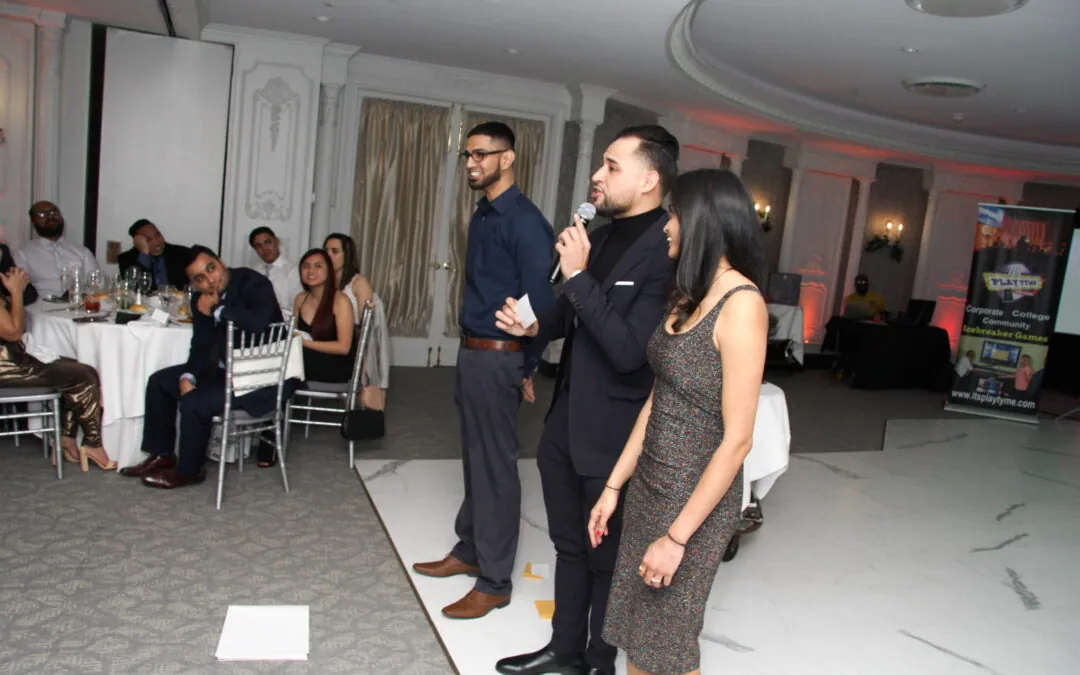
The holiday season is the one time of year most companies invest in bringing their people together outside the daily grind. Yet a surprising number of these events fall flat. According to Gallup’s Q12 meta-analysis, business units in the top quartile of employee engagement outperform the bottom quartile by 23% in profitability. Social events that actually engage people are not just a perk: they are a business investment.
Gallup research also shows that only 2 in 10 U.S. employees strongly agree they have a best friend at work, and improving that ratio correlates with 12% higher profit. A game show Christmas party is built to do exactly that: break down silos, spark real conversations, and give every attendee a reason to participate rather than watch from the sidelines.
Planning a corporate holiday event comes with real friction. Organizers juggle venue logistics, headcount fluctuations, and the pressure to choose entertainment that works for the entire team, not just the extroverts. A sit-down dinner with a DJ gets polite attendance. A generic trivia night loses half the room after round two. The challenge is finding a format that keeps energy high from the first minute to the last without requiring anyone to perform or feel awkward.
What This Comes Down To
Top-quartile engaged business units outperform the bottom quartile by 23% in profitability, per Gallup.
Gallup links having a best friend at work to 12% higher profit, yet only 2 in 10 employees qualify.
Corporate holiday events that genuinely engage people function as a business investment, not just a perk.
A game show Christmas party breaks down silos and gives every attendee a reason to participate.
Holiday event organizers face real friction: venue logistics, shifting headcounts, and attendance uncertainty.
Why a Game Show Christmas Party Beats Traditional Holiday Entertainment
Most corporate holiday parties follow a predictable script: cocktail hour, dinner, maybe a raffle or a playlist no one asked for. The result is clusters of coworkers who already know each other, a dance floor that stays empty until 9 PM, and a bill that does not reflect the experience.
A game show format flips the dynamic. Everyone participates at the same time. Rounds are short enough to hold attention and varied enough to give different personality types a chance to shine. The competitive structure creates instant energy, and the shared experience gives people something to talk about on Monday morning beyond “the food was fine.”
Three reasons the format works so well for holiday parties:
Instant inclusion. No one sits on the sideline. Teams form naturally, and the host keeps every group involved regardless of size.
Built-in structure. The event has a beginning, middle, and end. There is no awkward “what do we do now?” gap between courses.
Scalable energy. Whether you have 20 people or 200, the format adapts without losing intensity.
The Problems Holiday Party Entertainment Has to Solve
Booking holiday entertainment sounds simple until you face the realities of a diverse workforce. Here are the specific hurdles event planners deal with every December:
Mixed comfort levels. Some employees thrive in social settings. Others dread being called on stage or forced into karaoke. You need entertainment that invites participation without putting anyone on the spot.
Wide age and interest gaps. A team of 50 people spans generations, hobbies, and energy levels. Activities that skew too young, too physical, or too niche lose large portions of the group.
Budget pressure with high expectations. Leadership wants a “memorable” event, but the budget has not grown since 2019. The entertainment needs to deliver impact without requiring an elaborate production.
Venue constraints. Not every venue supports a band, a photo booth, and a dance floor. A game show fits into a conference room, a restaurant back room, or a rented event space with minimal setup.
Remote and hybrid teams. Employees who rarely see each other in person need an activity that builds connection fast, not an event where they stand around making small talk with strangers.
What a Game Show Christmas Party Actually Looks Like
Picture your team seated at round tables. A professional host takes the stage with a wireless mic, a sound system, and a screen displaying questions, puzzles, and holiday-themed challenges. The room divides into teams. Each round brings a different format: general knowledge trivia, music identification, visual puzzles, physical relay challenges, or fill-in-the-blank word games.
The host controls the pace, reads the room, and adjusts difficulty on the fly. Between rounds, there is time for food, drinks, and conversation, but the energy never drops because everyone knows the next round is coming. Winners get bragging rights (and sometimes prizes). The whole experience runs 60 to 90 minutes, fitting neatly into a dinner event or standalone party.
For corporate Christmas party entertainment, It’s PlayTyme Game Shows brings all the equipment, handles the setup, and runs the entire show. Your planning team does not need to build a single slide or write a single question.
Game Show Formats That Fit Every Group Size
Format
Best For
Group Size
Energy Level
Holiday Friendly
Classic Trivia Challenge
Knowledge-based teams
20 to 300+
Medium
Yes (holiday trivia rounds)
Name That Tune
Music lovers, mixed ages
15 to 150
High
Yes (holiday music edition)
Minute to Win It
High-energy groups
20 to 100
Very High
Yes (ornament stacking, candy cane relays)
Face 2 Face Feud Style
Team rivalry, laughs
20 to 300+
High
Yes (holiday survey questions)
Word Play Style
Word game fans
15 to 100
Medium-High
Yes (holiday phrases and puzzles)
The right format depends on your team’s personality. A finance department that thrives on precision will gravitate toward trivia. A sales team that feeds on energy will light up during Minute to Win It. A mixed group benefits from a multi-round show that blends two or three formats in one event.
How to Add Holiday Flair to Your Game Show
The game show format is a strong foundation on its own, but holiday customization turns it into a true Christmas party experience. Here is what that looks like in practice:
Themed Rounds
Swap standard trivia categories for holiday editions: Christmas movie quotes, holiday song lyrics, “name that carol,” and seasonal pop culture questions. A professional host weaves in references to your company’s inside jokes and traditions.
Festive Challenges
Physical rounds get a seasonal twist. Teams race to wrap a gift blindfolded, stack ornaments into a tower, or pass a candy cane down the line using only a pencil. These moments generate the photos and stories that become part of your company’s culture.
Prize Integration
Tie prizes to the holiday spirit: gift cards, extra PTO hours, or donations to a charity of the winning team’s choice. The stakes stay light, but the motivation stays real.
Décor and Music
The game show setup pairs naturally with holiday decorations you already have. Add a holiday playlist during breaks, and the room feels festive without a separate entertainment budget.
Why It’s PlayTyme Game Shows Stands Out for Holiday Events
It’s PlayTyme Game Shows has run corporate events, holiday parties, and team-building programs across New Jersey, New York City, and Connecticut for years. Here is what sets them apart for your game show Christmas party:
Professional hosts who read the room. The host is not reading from a script. They adjust pacing, humor, and difficulty based on your group’s energy in real time.
All equipment included. Sound system, screens, buzzers, scoring displays: everything arrives, gets set up, and gets broken down by the It’s PlayTyme team. Your venue does not need any AV beyond a power outlet.
Customized content. Questions, challenges, and rounds are tailored to your industry, your team’s interests, and the holiday theme. No two shows are identical.
Proven with groups of every size. From a 15-person department dinner to a 300-person company-wide celebration, the format scales without losing the personal feel.
Turnkey for planners. Event organizers get a single point of contact, a clear timeline, and zero day-of stress. The game show runs itself once it starts.
When to Book and What to Expect
December fills up fast for professional entertainment companies. If you are considering a game show Christmas party, here is a practical timeline:
8 to 10 weeks before the event: Reach out to lock in your preferred date. Popular Fridays and Saturdays in December book months in advance.
4 to 6 weeks before: Finalize your headcount, venue details, and any customization requests (themed rounds, specific game formats, prize coordination).
2 weeks before: Confirm logistics with the host team. Share any company-specific trivia or inside references you want included.
Day of: The team arrives 30 to 60 minutes early for setup. You focus on greeting your guests. The show handles the rest.
Most game show events run 60 to 90 minutes and fit into a larger party schedule (cocktails, dinner, show, awards). Shorter formats (45 minutes) work for lunch events or tighter schedules.
Selecting the Right Game Show Format for Your Party
Start with three questions: How large is the group? What is the energy level you want? And does your team prefer brain-based or action-based competition?
For groups under 30, a single-format show (trivia or Face 2 Face Feud style) keeps everyone involved without spreading attention too thin. For groups over 50, a multi-round format with varied challenges gives different personalities a chance to contribute. For groups over 100, the host becomes the anchor: a strong emcee who keeps energy consistent across a large room is more important than any single game format.
If your team is meeting in person for the first time in months, prioritize formats with physical elements (Minute to Win It, relay challenges) that get people out of their seats. If your team sees each other daily and needs a mental break, lean into trivia and word games that reward knowledge over athleticism.
The best game show Christmas party is the one tailored to the people in the room. A professional provider will ask the right questions during the planning process and recommend the format that fits, not the one that is easiest to run.
Can a game show work for a Christmas party where half the guests barely know each other?
Yes. Teams are usually mixed across departments, so people who rarely work together end up sharing answers at the same table. The format gives quieter guests a clear role without asking anyone to perform alone.
How do we keep the holiday questions from feeling generic?
Mix classic holiday trivia with rounds about your own company, such as the year in review, milestones and department moments. The answers are about people in the room, which is what gets the loudest reactions.
Should the game show happen before or after dinner?
Most planners schedule it after the main course, when guests are settled and the energy would otherwise dip. Running it before dinner can work too, but a hungry room is harder to hold.
Does a big holiday crowd slow the game down?
Not with the right format. For large groups, It’s PlayTyme runs the show from the tables on wireless PlayPad keypads, so every team answers every question at the same time, while smaller groups compete at buzzer podiums.
Frequently Asked Questions (FAQs)
How long does a game show Christmas party last?
Most game show events run between 60 and 90 minutes, which fits comfortably into a dinner party or standalone event. Shorter 45-minute formats are available for lunch events. The host paces the show so energy stays high from start to finish.
What does a game show Christmas party cost?
Pricing depends on group size, event duration, and customization level. It’s PlayTyme provides a clear quote after a short consultation. The cost typically compares favorably to hiring a DJ, a band, or a photo booth, and the engagement level is significantly higher.
What venues work for a game show Christmas party?
Any space where your group fits comfortably works. Conference rooms, hotel ballrooms, restaurant event spaces, and even office lobbies have all hosted successful game shows. It’s PlayTyme brings all the AV equipment, so your venue only needs power outlets and enough seating for your group.
Every gala planner shares the same fear. You book an act, the room goes flat, and 200 guests check their phones between categories. The awards are only half the night. The other half is whatever you put around them.
Recognition is the point of the evening, and most people get very little of it. Gallup reports that only one in three U.S. workers strongly agree they received recognition or praise for good work in the past seven days. Gallup’s latest global report puts engagement at 20% of employees worldwide in 2025, a gap it prices at $10 trillion in lost productivity.
That sets the brief for awards night entertainment ideas. You need something that pulls 100 to 300 people into the celebration instead of seating them in front of it.
Why Awards Nights Lose the Room Right After Dinner
The trouble starts when dessert is cleared. Guests have eaten, the lights drop, and the biggest awards land at the lowest energy point of the evening. Polite clapping replaces real cheering.
Planners running a 100 to 300 person banquet hit the same obstacles every time:
The post-dinner slump arrives exactly when the top honors are announced.
Stage-only acts isolate tables, because guests face the podium instead of each other.
Only the honorees feel recognized. Everyone else watches someone else’s moment.
Speech blocks run 40 minutes or longer with no interactive break.
Remote and hybrid attendees watch the ceremony on a screen with nothing to do between categories.
Alcohol-free and dry-venue events lose the open bar as the thing that loosens up the room, so the program has to carry the energy on its own.
Large ballrooms across New Jersey, New York City and Connecticut create sightline and audio problems, and house labor and A/V charges often surface after the contract is signed.
The guest list is mixed: executives, staff, honorees, spouses and board members, all with different tastes.
Nothing measurable comes out of the evening, so finance questions the line item next year.
Traditional corporate awards ceremony entertainment, like background musicians and roving acts, rarely solves this. It gives people something to watch, not something to do. Guests disconnect from the shared purpose of the night the moment they become spectators.
Awards Night Entertainment Compared by Format, Interaction and Group Size
Founded in 2012 in Teaneck, New Jersey, It’s PlayTyme Game Shows has produced more than 3,000 live events across New Jersey, New York City and Connecticut. Founder Lisa Lawrence built the company on one line: great events are not measured by how many attend, they are measured by how many participate.
The game show is the vehicle, not the product. A professional host runs the room, every table plays as a team, and the whole group is laughing together before the first award is announced.
Best for: corporate galas, school staff appreciation dinners and awards banquets of 100 to 300 guests.
Pricing: fully hosted 90-minute shows start at $2,995 for groups of 20 or more. Use our pricing estimator to see the range for your group size. Setup and breakdown, customization and gratuity are quoted separately, and travel outside NJ, NYC and CT may add a fee. Every other price band is listed on the pricing page.
Standout features: eight live game show formats including Face 2 Face Feud, The Challenge, Word Play and PlayPad Mania. Audience keypads and cellphone-based live polling bring the entire room in at large headcounts. Every event is backed by a 100% satisfaction guarantee.
Pros:
Every guest plays, not just the honorees at the podium.
Fills the dead space between dinner service and the ceremony.
Turnkey delivery: host, game-show set, audio, lighting and prizes arrive with the crew.
Send the date, room size and goal, and we will set up a quick discovery call. No deposit required.
2. Hank Lane Music
Hank Lane Music books bands, DJs and live acts for events across the New York tri-state area. A live band gives a formal evening its classic backdrop, fills the room during meal service, and opens the dance floor once the presentations end.
Best for: traditional galas that want ambiance during dinner and dancing afterward.
Pricing: available on request.
Standout features: a deep roster of musicians, scalable band sizes and professional sound production.
Pros:
Sets an upscale tone from the moment doors open.
Setlists adjust to the age mix in the room.
Fills a large banquet hall with consistent sound.
Cons:
Passive entertainment until the dance floor opens.
Volume competes with table conversation.
3. Clean Comedians
Clean Comedians books stand-up comics, speakers and entertainers who work clean for corporate audiences. A comedian gives the room one focal point and breaks up a long run of executive speeches with a short set.
Best for: seated dinners where guests stay at their tables.
Pricing: available on request.
Standout features: performers screened for corporate-appropriate material, which shortens the human resources approval conversation.
Pros:
Easy to slot into a tight run of show.
Needs minimal stage setup or props.
Gives the room a shared listening moment.
Cons:
Generates no peer-to-peer interaction.
Humor is subjective, and a mixed room rarely agrees on it.
4. Screaming Queens Entertainment
Screaming Queens Entertainment supplies costumed performers and character acts for parties and events. These entertainers work the room instead of the stage, which adds visual flair to a plain ballroom.
Best for: the cocktail hour before guests take their seats.
Pricing: available on request.
Standout features: elaborate costuming and strong photo moments for arriving guests.
Pros:
Creates visual impact at the door.
Gives arriving attendees something to talk about.
Needs no dedicated stage space.
Cons:
Does not unify the room around one shared activity.
Distracting if it runs during dinner or speeches.
5. Casino Parties LLC
Casino Parties LLC delivers blackjack, roulette and craps tables with professional dealers for corporate events and fundraisers across New York, New Jersey and Connecticut. Guests play with provided chips and mingle away from their assigned seats.
Best for: post-award entertainment, when guests want to move around the venue.
Pricing: available on request.
Standout features: real gaming tables, trained dealers and a relaxed social setting.
Pros:
Encourages natural movement around the room.
Gives non-dancers something to do after the ceremony.
Pairs well with themed decor or a charity fundraiser.
Cons:
Splits a large group into small, isolated pockets.
Requires significant open floor space.
How to Sequence an Awards Night So the Energy Holds
Pacing decides the night. A continuous block of speeches tires a crowd fast, and short bursts of activity pull focus back.
Open the interactive segment as dessert is cleared. Present two or three awards, run a fast round between categories, then close with your top honors. The room reaches the biggest moment loud instead of drained.
Interactive event entertainment should support the awards ceremony, not compete with it. When a professional host announces a lighthearted category, the recognition lands as inclusive rather than stiff, and the audience stays in it because they are part of the show.
Where the Same Approach Works Beyond the Corporate Gala
The room is the same whether the banner reads annual awards, staff appreciation or athletic banquet. Schools running staff morale nights, Project Graduation events and end-of-year celebrations face one problem: a big space, a long program, and an audience parked at round tables.
Conference organizers hit it too. A ballroom full of attendees who never speak to each other rates the whole event on the keynote alone, which is why corporate entertainment ideas by group size matter as much as the headline act. Sports banquets handing out team honors get more from the evening when the audience competes together before the trophies come out.
The rule holds across all of them. Make the guests the stars, and the connections outlast the event date.
How to Choose Awards Night Entertainment for 100 to 300 Guests
Start with the outcome you owe your leadership. If the goal is atmosphere, book a band. If the goal is connection across departments and tables, book an activity that requires every guest to participate.
Then check three things: how many people the format actually involves, whether it fits the run of show without pushing the ceremony past 10 p.m., and what the venue charges for the space and labor it needs. A hosted game show holds up on all three, because one host, one set and 90 minutes cover the entire room.
Ready to book an opening activity that gets your whole room participating? Get a quote and send us the date, headcount and venue. We will set up a quick discovery call before preparing your proposal.
Frequently Asked Questions (FAQs)
How long should entertainment last at an awards dinner?
Plan on 60 to 90 minutes of interactive programming. That is long enough to build energy and short enough to keep the ceremony as the main event. Run it as one block or split it across award categories.
How do you keep guests engaged during a long awards banquet?
Break the program into segments instead of running one long block of speeches. Start the interactive portion as dessert is cleared, present two or three awards, then run another fast round before the top honors. A hosted format quiets the side conversations and points the room back at the stage without anyone tapping a microphone.
Can we customize the questions for our company?
Yes. A professional host builds your organization, its people and its inside jokes into the game. Customization is quoted separately from the package price, and it is what makes the night feel specific to your team.
How much does a corporate game show cost for an awards night?
Price follows group size. It’s PlayTyme Game Shows offers a fully hosted 90-minute show starting at $2,995 for groups of 20 or more, and our pricing estimator shows the range for your group size. The formats scale to the full room with keypads or cellphones, so a 300-person banquet plays along from the tables.
You already know how most company picnics go. People hold paper plates, stand with the same three coworkers they talk to every day, and quietly hope nobody hands them a beanbag. The food is fine. The connection never happens.
An outdoor corporate event or summer picnic is one of the few days on the calendar built to close that gap for hybrid and on-site teams. So spend the budget on participation, not on background noise. Whether you are feeding 25 people under a pavilion or buying out a park for 300, the outdoor team building activities below are ranked by one measure: how many people actually play.
What Makes Company Picnics and Summer Outings Hard to Run
Outdoor events fail for reasons that have nothing to do with the catering. Plan around these before you book a single activity.
The open field works against you. A park or pavilion has no focal point, so a group of 100 splits into a dozen clusters of four within 20 minutes and stays that way all afternoon.
People arrive expecting to watch. Most professionals show up assuming someone else will perform. Breaking that habit takes a structured opening, not an announcement over a speaker.
Headcount changes everything. An activity that lands with a 25-person department collapses at 300, usually because two thirds of the group ends up in line waiting for a turn.
Adults will not risk looking foolish. Camp games and trust falls read as childish, and the moment one senior person opts out, the rest of the table follows.
Physical ability varies more than the run of show assumes. A field relay or an inflatable obstacle course quietly excludes anyone with a knee injury, a mobility limitation or a medical reason to stay out of the sun, and those employees spend the afternoon on a bench watching.
Remote and hybrid staff are meeting for the first time. On a distributed team, the picnic is often the first time people who have shared a screen for two years stand in the same field, and unstructured time sends them straight back to the two colleagues they already know.
Food service and entertainment collide. If the grill hits its peak at the same moment the main activity starts, you lose half the crowd to the buffet line, so the run of show and the catering timeline have to be locked together before either one is confirmed.
Weather has a vote. One forecast change and an outdoor-only plan turns into a cancelled afternoon, which is why the rain contingency has to be booked at the same time as the entertainment.
Venue rules across New Jersey, New York City and Connecticut add cost late. Park permits, noise ordinances, generator or power-drop access and certificate-of-insurance requirements often surface after the deposit is paid.
Families change the math. Once spouses and kids attend, an activity built for employees alone leaves half the crowd standing around.
Nobody measures it. Without a clear outcome, finance treats the picnic as a discretionary line item and cuts it the following year.
1. Live Game Show Experiences, the Centerpiece
Anchor the picnic with a professionally hosted live game show. It’s PlayTyme Game Shows turns an outdoor crowd into one connected room. A real host takes the microphone, and the drifting stops.
Great events aren’t measured by how many people attend. They’re measured by how many people participate. Formats like Face 2 Face Feud, The Challenge, Word Play, 60 Seconds of Fame and PlayPad Mania put every attendee on a team, so nobody spectates. It’s the strongest opening activity on this list because it sets the tone in the first five minutes.
We bring the podiums, buzzers, audio and the sound engineer to your venue across New Jersey, New York City, New York State and Connecticut. More than 3,000 live events since 2012 sit behind that setup, along with a 100% satisfaction guarantee.
Best for: groups of 25 to 300 that want one high-energy centerpiece with zero committee workload.
Pricing: Hosted game shows start around $2,995 for groups of 20 or more. Use our pricing estimator to see the range for your group size. A 60-minute show is also available, and half-day and full-day team building programs are custom-priced through a rep. Setup, breakdown, and prizes are included. Extensive customization and travel outside NJ, NYC and CT may be quoted separately.
Pros:
Every attendee plays as part of a team, not just the volunteers.
Your planning committee runs nothing on the day.
A professional host handles the social barriers so your staff doesn’t have to.
2. GPS Scavenger Hunts
Getting people outside is half the reason you booked a park. Strayboots runs smartphone scavenger hunts that split a large group into squads. Teams solve riddles, take photos and find landmarks around the venue or the surrounding neighborhood.
Best for: active groups of 50 to 200 that want mobile puzzle solving.
Pricing: quoted on request, typically per person.
Pros:
Gets attendees moving and out of the folding chairs.
Runs off phones, so there is almost no equipment load-in.
Cons:
Splits the company into isolated pockets instead of uniting it.
Depends on clear weather, cell signal, charged batteries and a level of walking not everyone can manage.
3. Philanthropic Build-a-Thons
A charitable build gives the day a purpose beyond lunch. Outback Team Building runs philanthropic events where teams assemble bicycles, wheelchairs or care packages, then donate the finished items to a local charity.
Best for: mission-driven organizations with 50 to 300 attendees.
Pricing: quoted on request.
Pros:
Sends people home with something tangible they built.
Gives quieter employees a hands-on task instead of a spotlight.
Cons:
Eats a large share of your covered pavilion space.
Attention goes to the assembly task, not to the group.
4. Interactive Culinary Challenges
Food already sits at the center of a picnic, so make it the activity. TeamBonding runs culinary challenges where employees work the prep stations and compete on a clock, food-truck style.
Best for: groups of 50 to 150 that like to cook and taste.
Pricing: quoted on request.
Pros:
Replaces the buffet line with something people remember.
Conversation starts on its own over shared ingredients.
Cons:
Outdoor food safety and allergy protocols get strict fast.
The activity and the meal service compete for the same hour.
5. Giant Inflatables and Lawn Games
Some companies want a fair, not a program. Interactive Entertainment Group rents large-scale outdoor games, inflatable obstacle courses and portable mini-golf. Attendees roam the grounds and pick what they feel like doing.
Best for: large groups of 100 to 300 that want a casual festival feel.
Pricing: quoted on request.
Pros:
Everyone chooses their own level of physical effort.
Works well when spouses and children attend.
Cons:
Never brings the full company together at one moment.
People stay inside the cliques they arrived with, which is the opposite of what a hybrid team needs.
How to Choose Company Picnic Entertainment for Your Group Size
Start with headcount, then work backward. Under 50 people, almost any structured activity holds the group together. Above 100, only a facilitated format keeps everyone in the same experience at the same time, and drop-in rentals become a supporting act rather than the plan.
Then decide what you want people to leave with. If the answer is stronger working relationships, the kind that show up months later in how readily people ask each other for help, book the participation format first and let the lawn games fill the open hours around it. Matching corporate entertainment ideas to your group size is the single decision that determines whether the afternoon lands, and our published pricing by group size makes that comparison straightforward.
Ready to build the summer outing your team actually talks about on Monday? Book your event with It’s PlayTyme Game Shows. Tell us the date, the headcount and the goal, and we bring the full live game show to your venue across New Jersey, New York City, New York State and Connecticut.
Frequently Asked Questions (FAQs)
What are the best interactive company picnic entertainment ideas to kick off an event?
A live hosted game show is the strongest opener. It gives the crowd one focal point in the first five minutes, before people scatter into small groups. Scavenger hunts, charity builds and culinary challenges all work well once the group is warmed up, but they start slower. Once the crowd has laughed together once, the rest of the afternoon runs itself.
How do you entertain a crowd of 300 employees outdoors?
Use a facilitated format that scales to the full headcount. In a live game show, teams compete up front while the rest of the audience plays along from their seats using keypads or their phones, so nobody waits in line for a turn.
What does company picnic entertainment cost?
Cost tracks group size. Hosted game shows start around $2,995 for groups of 20 or more. Use our pricing estimator to see the range for your group size. A 60-minute show is also available, and half-day and full-day team building programs are custom-priced through a rep. Setup, breakdown, and prizes are included. Extensive customization and travel outside NJ, NYC and CT may be quoted separately.
How do you plan a corporate summer outing that avoids feeling like forced team building?
Bring in an outside host instead of asking a manager to run it. A professional facilitator reads the room, keeps the competition friendly and never puts an individual on the spot, and familiar game formats remove the learning curve that embarrasses people. Book the covered pavilion or indoor backup room at the same time you book the entertainment, because our production runs equally well indoors and a forecast change should move the room, not cancel the day.
Holiday celebrations at work do more than fill a conference room with festive cheer. According to Challenger, Gray & Christmas, 64.4% of companies now hold in-person holiday parties, the highest rate since pre-pandemic years. And the investment pays off: SHRM reports that structured employee recognition programs reduce voluntary turnover by up to 31%, and a well-planned holiday party is one of the most visible forms of company-wide recognition.
Quick answer: Office Christmas party planning comes down to a few key steps: set the budget, secure the venue, book one main activity everyone can join, plan the catering, then send invitations and build a day-of run sheet. A hosted survey-style team game or trivia board covers the activity step for groups of 20 to 300 or more.
A great office Christmas party brings teams together, rewards a year of hard work, and sets a positive tone heading into the new year. But getting from “we should throw a party” to an event people actually enjoy takes real planning.
The reality is that most event planners face the same frustrations: a vague budget, a packed holiday calendar that makes venues scarce, entertainment that falls flat, and the pressure to make every employee feel included. Office Christmas party planning becomes stressful fast when you lack a clear process. This guide breaks down every step so you finish with a celebration your team talks about well into January.
Common Challenges With Office Christmas Party Planning
Before diving into the steps, it helps to understand what trips up even experienced planners:
Budget ambiguity. Leadership approves “a party” without specifying a dollar amount. Without clear numbers, every vendor conversation is a guessing game.
Late start on bookings. Popular venues and entertainers book out months in advance during the holiday season. Waiting until November leaves you with limited options.
Low attendance. Generic parties with no interactive element often see RSVPs drop. Remote and hybrid employees feel excluded from in-person-only events.
Dietary and accessibility gaps. A single catering menu or an inaccessible venue alienates part of the team before the party even starts.
Day-of chaos. Without a run-of-show timeline, transitions between dinner, speeches, and activities feel awkward and disorganized.
Each step below addresses these challenges directly.
Step 1: Set a Realistic Budget
Every decision flows from the budget. Lock this down first.
Break It Into Categories
Divide your total budget across five buckets: venue (30-40%), catering (25-35%), entertainment (15-20%), decorations (5-10%), and a contingency buffer (5-10%). A per-person budget between $75 and $150 covers a solid experience for most mid-size companies.
Get Leadership Alignment Early
Present leadership with two or three budget tiers (basic, mid-range, premium) and the experience each delivers. This avoids the back-and-forth that eats up planning time. Document the approved amount and share it with every vendor so quotes come back within range.
Step 2: Secure Your Venue
Venue selection shapes every other decision, from catering logistics to entertainment setup.
In-Office vs. External Venue
Hosting in the office saves money but limits the “special event” feeling. An external venue (hotel ballroom, restaurant private dining, event space) signals that the company invested in the team. For groups over 50, external venues usually provide better AV, parking, and catering infrastructure.
Book Early
Start your venue search by September. Holiday weekends in December fill up fast, and the best spaces require deposits 8 to 12 weeks in advance. Confirm capacity, AV equipment, parking, ADA accessibility, and whether outside vendors (caterers, entertainers) are allowed.
Step 3: Book Interactive Entertainment
Entertainment is what separates a forgettable dinner from a party people remember. Generic DJs and background music do not create the energy that builds real connections across departments.
Why Game Shows Work for Office Parties
It’s PlayTyme Game Shows runs fully hosted, interactive game show experiences designed specifically for corporate groups. Their format works because it gets every person in the room involved, not just the extroverts. Teams compete in rounds of trivia, survey-style challenges, and buzzer games that spark laughter, friendly rivalry, and genuine team bonding. The hosts handle all setup, equipment, and facilitation, so your planning committee does zero entertainment logistics on the day of the event.
Match Entertainment to Your Group
Consider your audience size, age range, and energy level. A 200-person holiday gala needs a different format than a 30-person department gathering. Game show formats scale naturally because you split into teams regardless of group size. This also solves the “wallflower problem” where quieter employees sit out during open-floor activities.
Step 4: Plan the Catering
Food and drinks set the mood. Get this wrong and it overshadows everything else.
Dietary Inclusivity
Send a brief dietary survey with your save-the-date. Collect information on allergies, vegetarian and vegan preferences, kosher or halal needs, and alcohol-free options. Share the results directly with your caterer so they plan accordingly, not as an afterthought.
Format Matters
Sit-down dinners encourage conversation but require more space and service staff. Buffets and food stations give flexibility and work better for larger groups where people mingle. Heavy appetizer stations paired with a dessert bar offer a budget-friendly middle ground that keeps people moving and socializing.
Beverage Strategy
A limited open bar (beer, wine, two signature cocktails) controls costs while keeping the celebration festive. Always provide quality non-alcoholic options beyond just water and soda. Mocktails and sparkling cider signal inclusivity.
Step 5: Design Engaging Activities
Beyond main entertainment, layer in smaller touchpoints that keep energy high throughout the event.
Photo booth with holiday props. Low-cost, high-engagement. People share these on social media, which doubles as employer branding.
Holiday trivia or bingo. Quick rounds between courses keep tables lively. Tie prizes to the company (extra PTO hour, gift cards, branded swag).
White elephant or secret Santa exchange. Set a $15 to $25 spending cap. This gives introverts a structured way to participate without being put on the spot.
Awards ceremony. Recognize standout employees with fun, specific awards (“Most Likely to Reply-All,” “Zoom Background MVP”). Keep it lighthearted.
Charitable tie-in. Partner with a local charity for a toy drive or donation matching challenge. It adds purpose to the celebration.
Step 6: Send Invitations and Build Anticipation
Invitations do more than communicate date and time. They set expectations and drive attendance.
Timing
Send a save-the-date 6 to 8 weeks before the party. Follow up with a formal invitation (digital works fine) 3 to 4 weeks out. Include the date, time, location, dress code, parking instructions, and RSVP deadline.
Build Buzz
Drop hints about entertainment and prizes in team meetings or Slack channels. A short teaser video or countdown graphic keeps the party on people’s radar during a busy season. If you booked a game show experience, share a quick preview clip. Anticipation drives higher RSVP rates.
Include Remote Employees
For hybrid or remote teams, consider a virtual watch party component or ship a celebration kit (snacks, party favors, a game card) so remote employees participate in the fun.
Step 7: Create a Day-of Run Sheet
A detailed timeline prevents the awkward gaps and frantic scrambling that derail otherwise good parties.
Sample Run-of-Show
Time
Activity
Owner
4:00 PM
Vendor load-in and setup
Event coordinator
5:30 PM
Doors open, cocktail hour begins
Venue staff
6:15 PM
Welcome remarks from leadership
CEO / department head
6:30 PM
Dinner service
Catering team
7:15 PM
Interactive game show entertainment
It’s PlayTyme host
8:00 PM
Awards and recognition
HR / planning committee
8:30 PM
Open dance floor and photo booth
DJ / photo vendor
9:30 PM
Event wrap-up and guest departure
Event coordinator
Assign a point person for each block. Walk the venue the day before to confirm AV, seating layout, and signage placement. Share the run sheet with every vendor and internal stakeholder so transitions happen smoothly.
Office Christmas Party Planning Checklist
Use this checklist to stay on track from start to finish:
12 weeks out: Confirm budget with leadership. Begin venue research.
10 weeks out: Book venue. Reserve entertainment (game show, DJ, or both).
6 weeks out: Finalize catering menu. Confirm entertainment details and AV requirements. Order decorations.
4 weeks out: Send formal invitations. Arrange photo booth and activity supplies. Confirm parking and accessibility.
2 weeks out: Collect final RSVP count. Share updated headcount with venue and caterer. Draft the run-of-show timeline.
1 week out: Confirm all vendor arrival times. Brief internal speakers. Prepare awards and prizes.
Day before: Walk the venue. Test AV. Print name tags and signage.
Day of: Arrive early. Execute run sheet. Enjoy the party.
Week after: Send thank-you notes. Collect feedback. Document lessons learned for next year.
How to Choose the Right Entertainment for Your Office Christmas Party
Entertainment is the single biggest factor in whether your team remembers the party fondly or forgets it by January 2nd. The right choice depends on three things: group size, participation level, and planning effort required from your side.
A DJ fills dead air but does not create interaction. Karaoke appeals to a small percentage of the room. Escape rooms exclude anyone who does not want to be locked in a small space. A professional game show experience checks every box: it scales from 20 to 300+ people, it includes everyone regardless of personality type, and the production is handled entirely by the entertainment provider.
It’s PlayTyme Game Shows specializes in exactly this format for companies across New Jersey, New York City, and Connecticut. Their team handles the host, the equipment, the energy, and the pacing, so your planning committee focuses on the rest of the event. When office Christmas party planning already demands weeks of coordination, handing entertainment to professionals who do this every week is the smartest move on your checklist.
Ready to lock in entertainment that your team will actually enjoy? Contact It’s PlayTyme Game Shows to reserve your holiday date, or explore corporate event packages to see how a game show fits your party format. Start early: December is a busy month.
What should be locked in first when planning an office Christmas party?
The date and the budget, because the venue, catering and entertainment all depend on them. December is a busy month for company events, so settling those two early makes every later step easier.
How long should the entertainment portion run?
Long enough to be the centerpiece without taking over the whole evening. A hosted game show from It’s PlayTyme runs 60 or 90 minutes, and the 90-minute format suits a party built around the games.
Who should own the day-of run sheet?
One person with the authority to make quick calls, usually the lead planner or an HR partner. Share the run sheet with every vendor so the host, caterer and venue all work from the same timeline.
How do we make sure people actually show up?
Announce the date early and tell people what will happen on the night. A specific activity on the invitation gives guests a reason to come, where a vague promise of drinks and dinner often does not.
Frequently Asked Questions (FAQs)
How far in advance should I start office Christmas party planning?
Start at least 10 to 12 weeks before your target date. This gives you enough lead time to secure a venue, book entertainment, and finalize catering before the holiday rush locks up availability. Waiting until November limits your options significantly.
What is a good per-person budget for an office Christmas party?
A per-person budget of $75 to $150 covers venue, food, drinks, and entertainment for most mid-size companies. Larger organizations with 200-plus attendees often spend $50 to $100 per person because venue and entertainment costs spread across more headcount.
How do I keep remote employees included in the office holiday party?
Ship a celebration kit with snacks, party favors, and a game card to remote team members. Set up a live stream or video call during key moments like the game show and awards ceremony. Some companies host a separate virtual event on a different day to give remote employees their own dedicated celebration.
What type of entertainment works best for large corporate holiday parties?
Interactive game shows consistently outperform DJs, karaoke, and passive entertainment for corporate groups. Game shows scale to any group size, involve every attendee through team-based competition, and require zero effort from your internal planning team. The format keeps energy high without relying on alcohol or a dance floor.
Should the office Christmas party be held during work hours or after hours?
After-hours events (starting around 5:30 or 6:00 PM) feel more like a celebration than a work obligation. However, a long lunch party during work hours boosts attendance because employees do not sacrifice personal evening time. Choose based on your company culture and survey your team if attendance has been an issue in past years.
The bell rings and hundreds of students pour into the gymnasium. You have a 45-minute window to deliver a message, build community, or give students a shared experience worth remembering. Holding the attention of a large student body is one of the hardest jobs in a school. Kids in the back can’t see, the sound bounces off the walls, and a lecture format loses the room in minutes.
The goal is simple. You want an assembly where every student feels part of it, not just the few up front. An interactive format is what gets you there. When students compete, laugh, and move instead of sitting still, they pay attention and they remember the day.
The hard part is finding a program that is both educationally sound and genuinely fun for a large, mixed group. Many school assembly shows are passive, with students just watching a performance. Others are hard to run or never connect to what the school cares about. What you want is an experience that turns a big, echoing gym into a connected room, even if only for an hour.
The Real Challenges of Large-Scale School Assembly Shows
Planning an assembly for a large student body takes more than booking a performer and printing a schedule. A few specific problems can turn a good idea into a forgettable hour. Solving them is the difference between an assembly students talk about for weeks and one they forget by lunch.
Acoustics and sightlines: A gym or large auditorium works against you. Sound echoes, so students in the back struggle to hear. Keep the action on a small stage and those same students stare at the backs of their classmates and tune out.
The participation gap: Most assemblies put a handful of volunteers on stage while everyone else watches. Real engagement means all of them feel like they are in the show. Getting 400 students to play at the same time takes a format built for it.
Mixed grade levels: A show that lands with fifth graders can draw eye-rolls from eighth graders. Content has to work across a wide age range in one sitting. The program needs layers that reach different maturity levels without losing anyone.
Cool, not cringey: Older students walk in ready to be unimpressed. A show that feels babyish or forced gets eye-rolls from the back row. Winning over cynical high schoolers takes content and a host that read as genuinely fun, not staged.
A tight schedule: School days run on the bell. An assembly that runs long throws off every class after it. The program has to start and end on time, run by someone who respects the schedule. A 45-minute assembly needs to be exactly 45 minutes.
Getting sign-off: A principal, school board, or PTA has to approve the spend, and “the kids had fun” rarely clears that bar alone. The program has to show a return, tied to school values, positive behavior, or classroom learning, to justify the line item.
Reaching every student: A large student body includes different cultures, learning styles, and comfort levels, and some students dread being singled out. The format has to be inclusive, so a shy student and a class clown both find a way in without anyone put on the spot.
Value and budget: Every dollar in a school budget gets questioned. An assembly can’t just be fun. It has to reinforce school values, support positive behavior, or connect to what students are learning. The trick is delivering that value without it feeling like another lecture.
1. It’s PlayTyme Game Shows
Since 2012, It’s PlayTyme Game Shows has focused on one problem: getting a large group to connect. The company serves schools across New Jersey, New York, and Connecticut. The idea is simple. A great event is measured by how many students take part, not just how many show up. The live, hosted game show is the method, and it turns a passive audience into one active team. Every student plays, whether from the stage or from a seat in the bleachers. That is how you fill a full gym with real energy.
Location: Serving New Jersey, New York, and Connecticut.
Best for: School-wide student engagement, Project Graduation, student leadership events, and staff morale.
Format: Live, in-person, hosted game shows built for mass participation. Formats include Face-2-Face Feud, custom trivia, and team challenges.
Standout features: Everyone plays from their seat; professional AV for clear sound and visuals in large spaces; content matched to grade levels; and a 100% satisfaction guarantee.
Pricing: Custom packages built around the school, group size, and event goals.
Advantages
Built for large groups: The shows solve the common large-group problems with professional sound and formats that involve the whole room, not a few volunteers.
Turnkey experience: The It’s PlayTyme team, led by founder Lisa Lawrence, handles every technical detail from setup to breakdown, so organizers can relax.
High participation: The game mechanics keep every student active, which builds a shared experience and keeps the energy up.
Regional expertise: More than a decade in the NJ, NYC, and CT markets means the team knows how tri-state schools run.
2. The Brain Show
The Brain Show runs a high-energy, TV-style game show for school assemblies and other events, mostly across New Jersey, Pennsylvania, and nearby regions. The setup looks the part, with colorful podiums, stage lighting, and a large video screen that mimics a real television game show. The content mixes school curriculum with pop culture trivia to make learning fun. They bring a complete package, including the host and all the equipment.
Location: Operates in NJ, PA, and other regions.
Best for: K-8 school assemblies, family fun nights, and educational fundraisers.
Format: In-person, TV-style game show with podiums, lights, and sound.
Standout features: Authentic game show set, custom curriculum-based questions, teacher participation rounds, and an all-inclusive equipment package.
Advantages
The lights and podiums create an immediate visual hook for students.
Content is educational and ties directly into school curriculum.
The fast pace keeps energy high.
Disadvantages
Participation centers on the contestants at the podiums, so the larger audience can feel like spectators.
The format fits elementary and middle school better than high school.
3. Unique Game Show by Academic Entertainment
Unique Game Show comes from Academic Entertainment, a nationwide agency for school assembly performers. The show blends multimedia trivia with team-building to reinforce curriculum, character education, and team spirit. Schools can tailor the content to specific subjects like math, history, or science, or to themes like Red Ribbon Week. The format mixes video and audio questions, pop culture trivia, and physical challenges.
Location: Nationwide booking through an agency.
Best for: Curriculum reinforcement, themed assembly days, and K-12 team building.
Format: In-person or virtual multimedia trivia and team challenges.
Standout features: Highly customizable content for any subject, physical challenges, and a virtual delivery option.
Advantages
Strong for reinforcing specific classroom learning in a fun, competitive setting.
The mix of trivia and physical challenges reaches a wider range of students.
Presenters adapt the show for different age groups.
Disadvantages
Booking through a national agency means less direct contact with the performer during planning.
Audience-wide participation varies with the activities you choose.
4. Versus Game Show by Game Show Gurus
The Versus Game Show from Game Show Gurus splits the whole audience into two teams, Red vs. Blue or Left vs. Right. That puts everyone in the action from the first minute. The show runs a series of rapid-fire challenges, each just a couple of minutes, to keep the pace high. Challenges range from trivia to word scrambles to physical tasks, all tracked on a large screen with a countdown clock.
Best for: Events where maximum student participation is the top priority.
Format: In-person, full-audience team competition.
Standout features: Left vs. Right team format that involves the whole audience, rapid-fire two-minute challenges, and a kid-friendly soundtrack.
Advantages
The two-team format engages every student in the room.
The fast pace and variety hold attention well.
The structure fits large groups in a gym or auditorium.
Disadvantages
The focus leans toward participation and energy over deep curriculum integration.
The nonstop pace may not fit every event goal or school culture.
5. Hollyrock Entertainment
Hollyrock Entertainment is a well-established assembly provider serving schools in NY, NJ, CT, and PA. What sets them apart is game show content written by teachers and updated every year, covering more than 15 school subjects. That keeps the material fresh and educationally sound. They are known for lively hosts and a fast-paced format that reviews school subjects while keeping students engaged. A large client base and steady re-bookings reflect that experience.
Location: New York, New Jersey, Connecticut, and Pennsylvania.
Best for: Annual subject reviews and engaging educational content.
Format: In-person, curriculum-focused game shows.
Standout features: Content written by teachers, updated annually, covering more than 15 subjects, led by energetic hosts.
Advantages
Strong reputation and deep experience across many schools each year.
Ties directly into a wide range of academic subjects with fresh content.
Holds student attention across grade levels.
Disadvantages
The traditional format can focus participation on a smaller group of onstage contestants.
As a high-volume provider, popular dates book far in advance.
6. UNIQUE GameShows by Unique Entertainment
Based near Philadelphia and traveling nationwide, UNIQUE GameShows brings more than 20 years of experience and fully original game show concepts. Their programs mix audio, video clips, and audience participation for a high-energy hour. They offer distinct show types, including a multimedia trivia game and an activity-based Ultimate Human Board Game with physical challenges. The emphasis on teamwork, sportsmanship, and positive energy makes them a good fit for building school spirit.
Location: Based in Philadelphia, PA; travels throughout the USA.
Best for: High-energy assemblies, summer camps, and teamwork-focused events.
Format: In-person original game shows, including trivia and physical activity formats.
Standout features: Original game show concepts, the Ultimate Human Board Game option, and customizable subject matter.
Advantages
Deep experience across many performances.
Original formats offer something different from standard TV-show knockoffs.
Involves many students and promotes positive teamwork.
Disadvantages
Their listed sweet spot runs up to 200+, which may need adjustment for very large assemblies of 400 to 500.
Being based in Philadelphia, travel costs can be a factor for schools in northern NJ, NY, and CT.
How to Choose the Right School Assembly Show for Your Students
The right school assembly show depends on your goals. An assembly kicking off a Week of Respect needs something different from a fun reward before a holiday break. Before you book, work through these questions to find the best fit for your students and your school.
What is the primary goal? Do you want to reinforce curriculum, build school spirit, teach character education, or just entertain? Get clear on your why. The best providers tailor their content to a specific objective.
How much of the audience participates? Ask providers directly what percentage of your students plays at any given moment. Look for a format that avoids the 98% spectator problem and keeps everyone involved.
How does the show handle a large space? Ask about their audio-visual setup. Do they bring professional-grade sound and large screens? A provider used to large groups will have a clear answer for how students in the last row see and hear everything.
How is content adapted for different ages? For a wide range of grades, ask how they adjust content and tone. A one-size-fits-all show rarely works.
What do you need from us? Nail down the logistics. How much space, what power, and how long for setup and breakdown? A turnkey provider keeps the work off your staff.
The right school assembly show is a partner in student engagement. A strong choice leaves your students energized and connected, and your staff impressed with a smooth, professional event.
Ready to see what a fully engaged student body looks like? Let’s talk about a custom game show that makes your next school assembly the one students talk about all year. Contact It’s PlayTyme Game Shows today to get started.
Frequently Asked Questions (FAQs)
How do you keep 500 students engaged at once?
The format is built for mass participation. Instead of a few students on stage, our game shows use team-based mechanics and all-play rounds so every student plays from a seat. A professional host and high-quality AV keep the whole room in the action.
Is this suitable for high school students?
Yes. We customize the content and tone for the audience. For high schoolers, the questions get tougher, the humor gets more mature but stays school-appropriate, and the competition is built around their interests, so it feels cool to play.
Can you customize the game show for our school’s theme (e.g., anti-bullying, character education)?
Yes. We build the questions and challenges around your theme, whether that is anti-bullying, character education, Red Ribbon Week, a Week of Respect, or school spirit. The competition stays fun while the message lands.
What do we need to provide for the event?
We bring the professional host, sound system, video screens, and game show equipment. All the school usually provides is a suitable space like a gym or auditorium, access to power, and your students.
How much does a school assembly game show cost?
Pricing is customized around your group size, the format you choose, and your event goals. A show for 100 students looks different from one for 500, so we build a package to fit the school. Reach out with your date and headcount for a specific quote.