Most managers know the room when energy drains out of it. People stare at screens, meetings run flat, and the team that once traded ideas now trades silence. The data backs up what you feel. Gallup reports that only 20% of employees worldwide are engaged at work, which leaves the vast majority coasting or actively checked out.
That gap carries a price. Gallup also estimates that low engagement drains roughly $10 trillion from the global economy each year in lost productivity. Guessing games for work attack that problem from a human angle, because they pull people into a shared moment where everyone talks, laughs, and competes on equal footing.
The hard part is not finding a game. The hard part is choosing formats that fit your team, your schedule, and your goals without feeling forced. Remote workers tune out generic icebreakers. In-person teams resent activities that eat an afternoon for little payoff. New hires freeze when a game exposes them before they feel safe. Those are the real obstacles, and the right guessing game solves each one.
What This Comes Down To
Gallup reports only 20% of employees worldwide are engaged, and guessing games target that gap directly.
They pull people into shared moments where everyone talks, laughs, and competes on equal footing.
Low engagement costs an estimated $10 trillion in lost global productivity each year.
The challenge is choosing formats that fit your team size, schedule, and goals without feeling forced.
Remote workers tune out generic icebreakers, so format selection matters as much as the game itself.
Why Guessing Games Work So Well at the Office
Guessing games create low-stakes pressure that the brain enjoys. A clue appears, the team races to solve it, and a small win arrives within seconds. That fast feedback loop keeps attention high without the dread of a performance review or a graded test.
They also flatten hierarchy. A summer intern can out-guess a vice president, and that surprise builds the kind of trust that formal team building rarely reaches. People remember the moment the quiet analyst nailed an impossible clue, and that memory carries into the next project.
Best of all, guessing games scale. You can run a two minute round to open a meeting or a full hour for a team event. The format bends to your time, not the other way around.
Quick Guessing Games for Daily Standups and Meetings
Short rounds work when you want a spark without losing momentum. These fit inside the first five minutes of any gathering.
Two Truths and a Lie: each person shares three claims about themselves, and the team guesses the false one. It surfaces hidden talents and travel stories fast.
Guess the Desk: collect a close-up photo of each workspace and have the team match it to the owner. Remote teams love this one.
Mystery Sound: play a short audio clip and let people guess the source. A coffee grinder and a subway turnstile spark instant debate.
Emoji Riddles: post a string of emojis that spell a movie, a product, or a company value, and watch the chat fill with answers.
Each of these takes minutes, needs almost no setup, and gives a shy contributor a safe way to join in.
Bigger Guessing Games for Team Events
When you have a full session, longer formats reward planning with deeper connection. These reward strategy, memory, and a bit of showmanship.
Charades and Pictionary: classic for a reason, since they force people out of their seats and into laughter within the first turn.
Who Am I: tape a name to each forehead and let players ask yes or no questions until they guess their identity.
Heads Up style rounds: one player holds a word above their head while teammates shout clues against the clock.
Mystery box: place an object in a sealed box, let people feel it through a hole, and collect written guesses.
What Stalls Most Office Guessing Games
Guessing games look simple, yet three obstacles trip up most managers who run them alone. Naming these early saves you a flat event.
First, uneven participation. Extroverts dominate while quieter staff retreat, which deepens the divide you hoped to close. A skilled host rotates turns and protects space for every voice.
Second, weak energy management. A game that drags past its peak turns fun into a chore. Pacing matters, and most internal organizers lack the practice to read a room and pivot.
Third, relevance. A random trivia round feels disconnected from the team and the moment. The best guessing games tie clues to inside jokes, company milestones, and shared wins, which takes preparation few managers have time to do.
How a Professional Game Show Lifts the Experience
It’s PlayTyme Game Shows turns these casual formats into a polished, high energy event that a busy manager cannot easily replicate. A trained host runs the room, controls the pace, and pulls in every personality, from the loud closer to the careful engineer.
Custom rounds are the real differentiator. The team can weave your company milestones, product names, and team trivia into the clues, so the guessing feels personal rather than generic. Professional sound, scoreboards, and buzzers add the spark of a real broadcast, which a slide deck and a timer never match.
For companies across New Jersey, New York City, and Connecticut, that production value transforms a guessing game from a time filler into the highlight people talk about for weeks.
Matching the Game to Your Goal
Different goals call for different formats. Use this quick guide to point your team at the right style.
Goal
Best Guessing Game
Time Needed
Warm up a meeting
Emoji Riddles or Mystery Sound
5 minutes
Help new hires connect
Two Truths and a Lie
15 minutes
Build a full team event
Hosted game show with custom rounds
60 to 90 minutes
Energize a remote team
Guess the Desk
10 minutes
Tips to Run Guessing Games That Land
A few habits separate a memorable round from an awkward one. Keep these in mind whether you host it yourself or bring in a pro.
Set clear, simple rules before the first clue so no one stalls on logistics.
Keep rounds short and end on a high note rather than dragging them out.
Mix solo guesses with team rounds so introverts and extroverts both shine.
Tie clues to your culture, since personal references always beat generic ones.
Reward effort, not just winners, to keep the mood light and inclusive.
Ready to turn your next gathering into the event people remember? Reach out through our contact page to plan a custom round, or explore our corporate events options to see how a hosted show fits your team.
Matching Game Format to Your Team Size
Start with your goal and your time, not the game itself. A five minute warm up needs nothing more than a clever emoji puzzle and a willing group. A milestone celebration or an offsite deserves a hosted experience that ties your story into every round.
Weigh the size of your group too. Twenty people can self organize a quick guess, while a crowd of eighty needs a host, a sound system, and a clear scoreboard to stay engaged. When the stakes and the audience grow, professional production pays for itself in energy and memory.
What are the best guessing games for remote work teams?
Guess the Desk, Mystery Sound, and Emoji Riddles work well over video because they need only a shared screen and a chat box. They give remote staff a fast, visual way to join in without awkward silence. A hosted virtual game show adds even more energy for larger remote groups.
How long should a guessing game last during a workday?
A meeting warm up should run about five minutes, while a dedicated team event can fill 60 to 90 minutes. The key is to end while energy is still high. Stopping at the peak leaves people wanting more and protects the rest of the workday.
Do guessing games actually improve team performance?
Yes, because they build trust, sharpen communication, and raise engagement, which Gallup links directly to higher productivity. Teams that play together read each other better under pressure. The social connection formed in a game carries straight into real projects.
How many people do you need for an office guessing game?
Most guessing games work with as few as four people and scale to large groups with the right host. Small teams can run quick rounds on their own. Groups above thirty benefit from a professional host who keeps the pace and includes everyone.
Can guessing games be customized for our company?
Absolutely, and custom clues are where these games shine. It’s PlayTyme Game Shows builds rounds around your company milestones, products, and team trivia. That personal touch turns a generic activity into an event that feels made for your people.
Words shape how teams think, act, and push through difficult stretches together. A single well-timed quote posted before a Monday standup or shared during a quarterly kickoff shifts the energy in a room faster than any policy memo. According to Gallup’s State of the Global Workplace report, only 20% of employees worldwide are actively engaged at work. That means more than three out of four workers show up without full commitment to the mission in front of them.
The cost of that disengagement is enormous. Gallup’s meta-analysis of business units found that highly engaged teams achieve 21% greater profitability than their disengaged counterparts. Motivation is not a soft metric. It drives measurable outcomes, and the right words at the right time play a direct role in building it.
Yet most managers struggle to keep motivation consistent. Monday’s enthusiasm fades by Wednesday. Remote teams lose the casual hallway energy that once kept spirits up. Recognition happens quarterly instead of daily. And when morale dips, the instinct is to schedule another meeting rather than address the underlying disconnect between effort and appreciation. Inspiring work quotes for team motivation solve part of this problem: they give leaders a simple, repeatable tool to spark energy, reinforce values, and remind people why their work matters.
Quick Answer
Only 20% of employees worldwide are actively engaged at work, per Gallup’s global workplace report.
Highly engaged teams achieve 21% greater profitability than disengaged counterparts, per Gallup research.
A well-timed quote before a standup or quarterly kickoff shifts team energy faster than a policy memo.
Motivation drives measurable business outcomes and is backed by Gallup’s multi-unit meta-analysis.
Most managers struggle to sustain motivation consistently past the opening days of a new initiative.
The Friction Points Behind Weak Team Motivation
Before diving into specific quotes, it helps to name the obstacles that make motivation so hard to sustain. These are the friction points managers encounter week after week.
Repetition fatigue: Teams doing the same tasks daily lose their sense of progress. Without fresh input, routine becomes monotony.
Invisible effort: Individual contributions get lost inside group outcomes. People who feel unseen stop giving their best.
Disconnection from purpose: When the link between daily tasks and the larger mission blurs, motivation drops. People need to know their work adds up to something.
Low-energy communication: Flat emails, generic Slack messages, and recycled corporate language fail to move anyone. Motivation requires genuine, human language.
Lack of shared experience: Teams that never do anything together outside of task execution miss the bonding that fuels trust and collective drive.
Quotes on Leadership That Set the Tone
Motivation starts at the top. When leaders model enthusiasm and accountability, the rest of the team follows. These quotes remind leaders that their words and behavior are the first signal a team reads every morning.
Standout Quotes
“A leader is one who knows the way, goes the way, and shows the way.” (John C. Maxwell)
“Before you are a leader, success is all about growing yourself. When you become a leader, success is all about growing others.” (Jack Welch)
“The greatest leader is not the one who does the greatest things, but the one who gets people to do the greatest things.” (Ronald Reagan)
“Leadership is not about being in charge. It is about taking care of those in your charge.” (Simon Sinek)
Use these at the start of team meetings or in a weekly leadership email. They work best when paired with a specific example of someone on the team demonstrating the principle.
Quotes on Teamwork and Collaboration
Individual talent matters, but collective effort produces results that no single person achieves alone. These quotes reinforce the value of working together, especially during projects where coordination is everything.
Standout Quotes
“Alone we can do so little; together we can do so much.” (Helen Keller)
“Talent wins games, but teamwork and intelligence win championships.” (Michael Jordan)
“Coming together is a beginning, staying together is progress, and working together is success.” (Henry Ford)
“If everyone is moving forward together, then success takes care of itself.” (Henry Ford)
Collaboration quotes land hardest right after a team completes a difficult sprint or ships a major deliverable. Post one in the group chat with a specific callout to the teamwork that made it happen. At It’s PlayTyme Game Shows, corporate game show events across New Jersey, New York City, and Connecticut turn these collaboration principles into live, competitive experiences where coworkers actually feel the difference teamwork makes.
Quotes on Perseverance Through Setbacks
Every team hits rough patches: missed targets, lost clients, failed launches. These moments test motivation more than any other. The right quote during a tough week reminds people that setbacks are temporary and effort compounds over time.
Standout Quotes
“It does not matter how slowly you go as long as you do not stop.” (Confucius)
“The only way to do great work is to love what you do.” (Steve Jobs)
“Success is walking from failure to failure with no loss of enthusiasm.” (Winston Churchill)
“Hard work beats talent when talent doesn’t work hard.” (Tim Notke)
“Perseverance is not a long race; it is many short races one after the other.” (Walter Elliot)
These quotes belong in post-mortem meetings and recovery kickoffs. Share them alongside a clear plan forward so the team sees both the encouragement and the path.
Quotes on Purpose and Meaningful Work
People perform at their highest level when they understand why their work matters. Purpose-driven teams outperform those motivated by obligation alone. These quotes help bridge the gap between daily tasks and the bigger picture.
Standout Quotes
“People don’t buy what you do; they buy why you do it.” (Simon Sinek)
“The two most important days in your life are the day you are born and the day you find out why.” (Mark Twain)
“Work gives you meaning and purpose, and life is empty without it.” (Stephen Hawking)
“Your work is going to fill a large part of your life, and the only way to be truly satisfied is to do what you believe is great work.” (Steve Jobs)
Purpose quotes resonate during onboarding, annual planning, and company-wide town halls. Pair them with a real story about how the team’s work affected a customer, a community, or a measurable outcome.
Quotes on Recognition and Appreciation
Recognition is the fuel that keeps motivation running long after the initial spark fades. Teams that celebrate effort (not just results) sustain energy across entire quarters. These quotes remind leaders to say “thank you” early and often.
Standout Quotes
“People work for money but go the extra mile for recognition, praise, and rewards.” (Dale Carnegie)
“Appreciation is a wonderful thing. It makes what is excellent in others belong to us as well.” (Voltaire)
“Feeling gratitude and not expressing it is like wrapping a present and not giving it.” (William Arthur Ward)
“What gets recognized gets reinforced, and what gets reinforced gets repeated.”
Recognition quotes are strongest when delivered alongside an actual gesture: a handwritten note, a team shoutout, or a shared experience that celebrates the group. Interactive team building events turn appreciation into something people feel physically, not just read on a screen.
How to Turn Inspiring Quotes into Daily Team Habits
A quote pinned to a bulletin board collects dust. A quote woven into a team’s rhythm becomes part of the culture. Here are practical methods for making quotes stick.
Method
Frequency
Best Quote Theme
Team Size
Monday kickoff email
Weekly
Leadership, Purpose
Any
Slack channel rotation
Daily
Perseverance, Teamwork
5-50
Meeting opener (read aloud)
Per meeting
Collaboration, Recognition
3-15
Office wall display (rotating)
Bi-weekly
Purpose, Perseverance
Any
Team building event theme
Quarterly
All themes
20-300+
The quarterly team building row is where quotes move from passive reading to active experience. A corporate game show built around motivational themes gives your team a shared memory that anchors those words to real emotion. Laughter, competition, and collaboration in one room do more for morale than a hundred motivational posters.
Quick Implementation Tips
Rotate quotes so the same ones do not repeat within a 30-day window.
Let team members nominate their own favorite quotes for the rotation.
Pair every quote with a specific recognition moment: name someone who exemplified it that week.
End each quarter with a live team event that brings the themes to life through shared activity.
Which Quote Fits Your Team’s Current Moment
Not every quote fits every situation. The wrong quote at the wrong time feels tone-deaf. Choosing well requires reading the room and matching the message to the moment.
If your team just missed a deadline, skip the purpose quotes and reach for perseverance. If you wrapped a massive project, lean into recognition and appreciation. If a new team is forming, start with collaboration and teamwork quotes to set the foundation. During strategic planning, purpose quotes ground the conversation in something bigger than spreadsheets.
The same principle applies to team events. A team recovering from a rough quarter benefits from a high-energy, laughter-driven game show that resets the emotional baseline. A team celebrating a win wants a competitive format that channels their momentum. Matching the activity to the moment matters as much as matching the quote.
Consider the delivery method too. A quote read aloud by a manager in a small room hits differently than the same words dropped in a 500-person Slack channel. Smaller audiences respond to personal delivery. Larger teams need visual reinforcement: slides, posters, or a shared digital board.
Ready to turn motivational words into a live team experience your group talks about for months? Contact It’s PlayTyme Game Shows to book a corporate game show event in New Jersey, New York City, or Connecticut that brings your team’s energy to a level no email ever reaches.
How do inspiring work quotes improve team motivation?
Quotes provide a concise, memorable way to reinforce values and refocus energy. When shared consistently (weekly emails, meeting openers, or team chat channels), they create a rhythm of positive reinforcement that keeps motivation visible and top of mind rather than something discussed only during annual reviews.
How often should managers share motivational quotes with their teams?
Once or twice per week is the ideal frequency. Daily quotes risk becoming background noise, while monthly quotes are too infrequent to build momentum. Rotating themes weekly keeps the content fresh and relevant to whatever the team is working through at that moment.
What is the best way to present quotes so they actually resonate?
Pair each quote with a specific, real example from the team. Saying “this reminds me of how Sarah handled the client issue last Tuesday” turns an abstract idea into a concrete, personal recognition moment. Quotes read aloud in small groups consistently outperform quotes posted silently in digital channels.
Do team building events increase the impact of motivational messaging?
Yes. Shared physical experiences anchor abstract ideas to real emotions and memories. A team that competes together in a game show and laughs together for two hours absorbs motivational themes far more deeply than a team that reads the same themes in an email. The experience creates a reference point the group returns to for weeks afterward.
Which quote themes work best for remote teams?
Teamwork and recognition quotes deliver the strongest results for remote teams because those are the two areas remote work weakens most. Remote employees often feel invisible and disconnected from colleagues. Quotes that name the value of collaboration and appreciation directly address those gaps and pair well with virtual recognition rituals like weekly shoutout threads.
How much more profitable are highly engaged teams compared to disengaged ones?
Gallup’s meta-analysis of business units found that highly engaged teams achieve 21% greater profitability than their disengaged counterparts, confirming that motivation is a measurable business driver, not a soft metric.
What share of employees worldwide are actively engaged at work?
According to Gallup’s State of the Global Workplace report, only 20% of employees worldwide are actively engaged. That means more than three out of four workers show up without full commitment to the mission in front of them.
Most corporate teams and adult friend groups share a common problem: gatherings that feel forced, awkward, or forgettable. According to Gallup’s State of the Global Workplace report, only 33% of U.S. employees are actively engaged at work. Meanwhile, SHRM research shows that employee experience and engagement together explain 54% of overall job satisfaction. Translation: the quality of shared experiences at work directly shapes how people feel about showing up every day.
Minute to win it games for adults solve this problem with ridiculous simplicity. Each challenge lasts 60 seconds, requires nothing more than household items, and generates the kind of genuine, unscripted laughter that no icebreaker survey ever will. Adults bring something kids simply do not: competitiveness, self-awareness, and the willingness to look absolutely foolish in front of coworkers for the sake of winning.
But planning these games yourself presents real friction. Picking the right challenges for your group size, keeping energy high between rounds, sourcing props, running a visible countdown timer, and making sure wallflowers actually participate are all problems that quietly sabotage DIY game nights. Below you will find 12 adult-tested minute to win it challenges with complete rules and group size guidance, plus the case for handing the whole thing to a professional host.
At a Glance
Each challenge lasts 60 seconds and uses only household items, with no special equipment required.
Genuine unscripted laughter builds team connection more effectively than any icebreaker survey.
Adult competitiveness and self-awareness make these games more engaging than kid-friendly versions.
Only 33% of U.S. employees are actively engaged, and shared experiences directly raise that number.
SHRM research shows employee experience and engagement together explain 54% of overall job satisfaction.
Why Minute to Win It Games Hit Different for Adults
The original NBC game show worked because it combined physical comedy with a ticking clock. Adults amplify both elements. A 10-year-old shaking ping pong balls out of a tissue box is cute. A VP of sales doing the same thing at a company retreat while 60 coworkers chant the countdown is comedy gold.
Adults also bring strategic thinking to games designed to be chaotic. They negotiate, trash-talk, form alliances, and replay losses in their heads for weeks. That competitive edge turns a simple 60-second challenge into a memorable event. And because the games require zero athletic ability or special knowledge, everyone from the new hire to the CEO competes on equal footing.
For corporate groups specifically, minute to win it games for adults break down hierarchy faster than any trust fall ever could. When your manager is trying to balance six dice on a popsicle stick held in their mouth, titles stop mattering.
Challenges of Running DIY Minute to Win It Events
Knowing the games is only half the battle. Executing them smoothly for a group of adults is where most DIY attempts fall apart.
Dead air between rounds: Without a host driving momentum, the gap between challenges kills the energy. Adults lose interest fast when they are standing around waiting for someone to find the next set of props.
Wallflower syndrome: In any group of 20 or more, at least a quarter of people will avoid volunteering. A skilled host reads the room and pulls people in without putting them on the spot.
Prop logistics: Twelve games means dozens of items (cups, cookies, balloons, tissue boxes, ping pong balls, straws, cotton balls, rubber bands). Sourcing, organizing, and resetting props between rounds is a full-time job during the event.
Scoring and structure: Without a visible scoreboard, tournament bracket, or clear rules explanation, the games feel disorganized. Adults notice disorganization and disengage.
No hype factor: Music, a countdown clock on a big screen, and play-by-play commentary transform a game from “okay, that was fun” to “that was the best team event we have ever done.”
This is exactly why companies like It’s PlayTyme Game Shows exist. Their 60 Seconds of Fame format packages all of this (professional host, props, sound system, countdown screen, scoring) into a turnkey event for groups across New Jersey, New York City, and Connecticut.
Solo Showdown Challenges
These games put one person in the spotlight while the rest of the group watches and cheers. They work best as openers or finals because the audience energy fuels the competitor.
1. Cookie Face
Rules: Place a sandwich cookie on your forehead. Using only your facial muscles (no hands), move the cookie down to your mouth and eat it within 60 seconds.
Group size: Any size. Run 2 to 4 competitors simultaneously for bigger groups.
Why it is funnier for adults: Adults have less flexible faces and more pride. Watching a grown professional contort their eyebrows, scrunch their nose, and wiggle their cheeks while a cookie slowly slides off their face is peak physical comedy. The combination of concentration and absurdity gets louder laughs from adult audiences every single time.
2. Junk in the Trunk
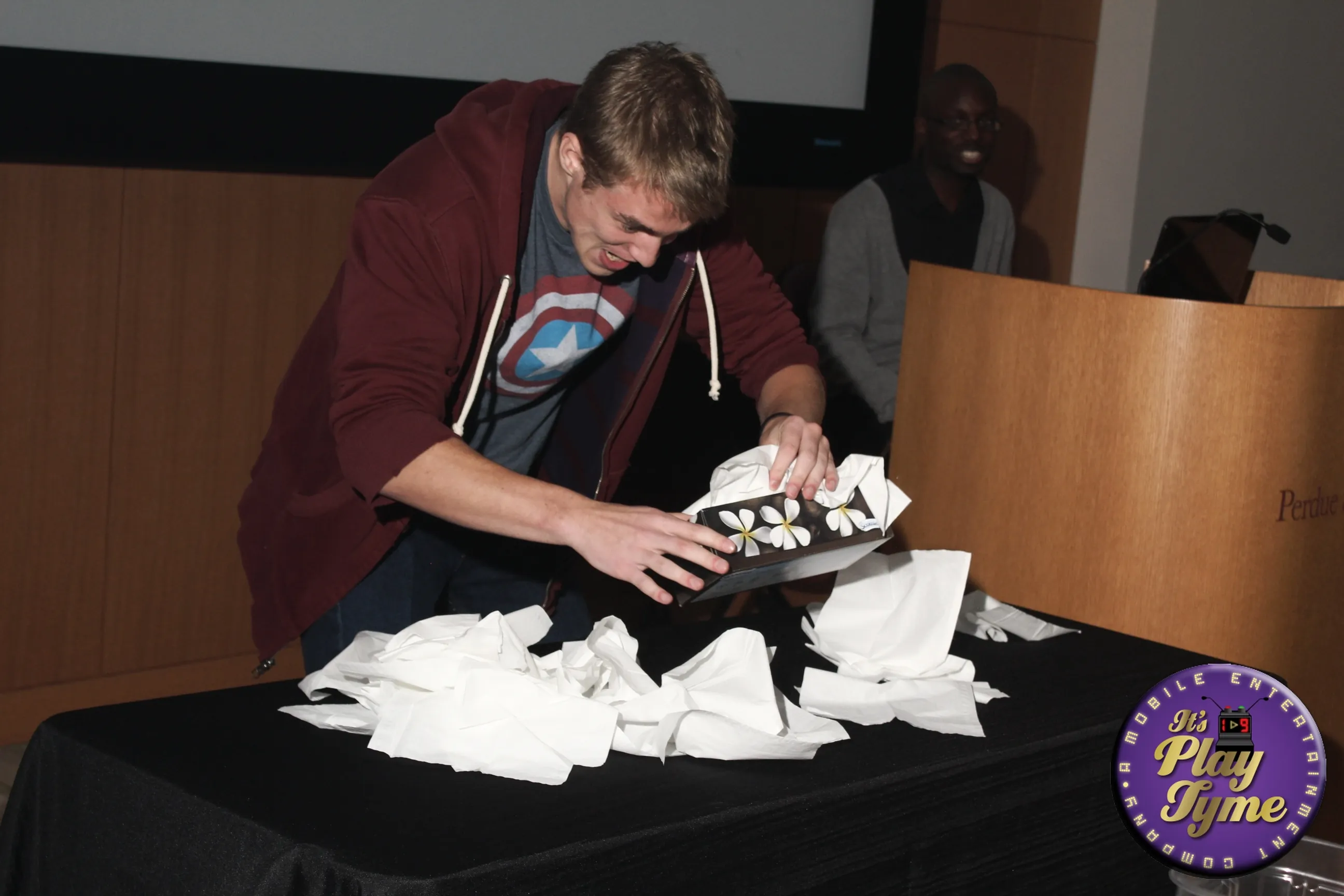
Rules: Strap an empty tissue box to your waist (opening facing backward) filled with 8 ping pong balls. Shake, shimmy, and dance until all 8 balls fall out. No hands allowed.
Group size: Works for any group. Best as a head-to-head race with 2 to 3 people competing at once.
Why it is funnier for adults: There is no dignified way to do this game. Adults who normally maintain a composed, professional presence are suddenly doing full-body hip thrusts in front of their colleagues. The self-awareness makes it exponentially funnier than when kids play it, because adults know exactly how ridiculous they look.
3. Bobblehead
Rules: Attach a pedometer or fitness tracker to your forehead with a headband. Hit 125 “steps” (head nods) in 60 seconds by shaking your head up and down as fast as possible.
Group size: 1 to 4 competitors at a time. Great for elimination rounds.
Why it is funnier for adults: Adults immediately regret volunteering for this one. The neck soreness, the dizziness, and the undignified head-bobbing create a spectacle that has the audience crying with laughter. Post-game complaints about “feeling that tomorrow” add to the comedy.
Head-to-Head Battle Games
These challenges pit two competitors directly against each other. The face-off format builds rivalries and gives the audience someone to root for.
4. Stack Attack
Rules: Stack 36 plastic cups into a perfect pyramid, then collapse them back into a single stack. First person to finish wins. If the pyramid falls mid-build, start over.
Group size: 2 competitors per round. Run a bracket tournament for groups of 16 or more.
Why it is funnier for adults: Adults overthink it. They develop “strategies,” try to go too fast, and watch their pyramid collapse three seconds before the buzzer. The frustration on an adult’s face after a mid-build collapse is something a kid would never produce with the same intensity.
5. Suck It Up
Rules: Transfer 20 M&M candies from one plate to another using only a drinking straw. Suck on the straw to pick up one M&M at a time, carry it to the second plate, and release. Most transferred in 60 seconds wins.
Group size: 2 to 4 competitors simultaneously. Great for groups of 10 to 50.
Why it is funnier for adults: The concentration required turns grown adults into wide-eyed, cheek-sucking statues. When an M&M drops at the last second, adults react with genuine anguish that kids simply do not feel. The stakes feel absurdly high for a candy-transfer game, which is exactly the point.
6. Rapid Fire
Rules: Set up 6 plastic cups on the edge of a table. Using rubber bands stretched and released from your fingers, knock all 6 cups off the table in 60 seconds. Competitors stand 6 feet away.
Group size: 2 competitors side by side. Works well in tournament format for larger groups.
Why it is funnier for adults: Adults who claim to be coordinated discover they cannot aim a rubber band to save their life. The misses (hitting the ceiling, the audience, themselves) generate bigger laughs than the successful shots. Overconfident competitors who talk trash before missing every shot become instant legends.
Team Relay Challenges
Relay-style games get entire tables or departments involved. They build the strongest team bonds because success depends on every member.
7. Dizzy Mummy
Rules: In pairs, one person stands still while their partner wraps them head to toe in a full roll of toilet paper. The paper must cover the torso, arms, and legs. First team to use the entire roll without it breaking wins.
Group size: 4 to 10 pairs competing at once. Scales to groups of 100 or more.
Why it is funnier for adults: Adults are taller, wider, and far less cooperative as “mummies.” The toilet paper tears constantly, wrapping gets tangled, and the finished product looks nothing like a mummy. Coworkers wrapping each other in toilet paper is inherently funnier than kids doing it because of the professional context.
8. Defying Gravity
Rules: Keep 3 inflated balloons in the air for a full 60 seconds. No grabbing, holding, or trapping allowed. Only open-hand taps. If any balloon touches the ground, you are out.
Group size: Run as a team relay where each member keeps the balloons up for 15 seconds before tagging the next person. Works for groups of 8 to 60.
Why it is funnier for adults: Adults in business casual diving across a conference room to save a falling balloon is a visual that never gets old. The panic, the collisions with furniture, and the absolute refusal to lose at something so simple create moments people talk about for months.
9. Chandelier
Rules: As a team of 3, stack plastic cups and paper plates in alternating layers to build the tallest tower in 60 seconds. The structure must stand on its own for 3 seconds after hands are removed.
Group size: Teams of 3, with 4 to 8 teams competing at once. Best for groups of 12 to 40.
Why it is funnier for adults: Adults argue about engineering. Someone always insists they know the “optimal stacking pattern,” overrides their teammates, and watches the tower collapse. The group dynamics (leadership struggles, blame-shifting, triumphant celebrations) mirror office politics in miniature, which makes the whole room laugh.
Crowd Favorite Spectacle Games
These are the games people film on their phones and post to group chats. Save them for the middle or end of your event when the energy is highest.
10. Nose Dive
Rules: Apply a dab of petroleum jelly to your nose. Transfer cotton balls from one bowl to another using only your nose. Hands stay behind your back. Most cotton balls moved in 60 seconds wins.
Group size: 2 to 4 competitors at a time. The audience factor makes this best for groups of 15 or more.
Why it is funnier for adults: Watching a grown adult bob their face into a bowl of cotton balls while coworkers scream encouragement is the kind of moment that defines a great event. The petroleum jelly on the nose, the cotton balls stuck to cheeks and foreheads, and the sheer determination on adult faces make this a guaranteed highlight.
11. Movin’ On Up
Rules: Start with a stack of 10 cups (bottom cup is a different color). Move the bottom cup to the top, one at a time, cycling through the stack until the colored cup returns to the bottom. Complete the full rotation in 60 seconds.
Group size: 2 to 6 competitors simultaneously. Good for any group size.
Why it is funnier for adults: This game looks deceptively simple. Adults who volunteer confidently discover that speed and dexterity do not scale together. Cups fly off the table, stacks topple, and the colored cup seems to never reach the bottom. The gap between expected ease and actual difficulty is much wider for adults, who assume they should be good at this.
12. Tissue Box Tango
Rules: Two players are tied together back-to-back, each wearing a tissue box on their waist filled with 10 ping pong balls. Working together (moving in sync), both players must empty their boxes in 60 seconds. Communication and coordination are everything.
Group size: 2 to 4 pairs competing at once. Best for groups of 20 or more where the audience creates atmosphere.
Why it is funnier for adults: The back-to-back format forces two adults to coordinate hip movements while shouting instructions at each other. Miscommunication, stepping on feet, and wildly different dance styles turn this into a comedy sketch. In a corporate setting, pairing people from different departments adds another layer of hilarity.
Game Category
Best For
Group Size
Energy Level
Setup Difficulty
Solo Showdown (Cookie Face, Junk in the Trunk, Bobblehead)
Openers, finals, shy groups
Any size
High
Easy
Head-to-Head (Stack Attack, Suck It Up, Rapid Fire)
Competitive groups, tournaments
10 to 50
Very high
Moderate
Team Relay (Dizzy Mummy, Defying Gravity, Chandelier)
Department bonding, large groups
12 to 100+
High
Moderate
Crowd Spectacle (Nose Dive, Movin’ On Up, Tissue Box Tango)
Peak moments, social media clips
15 to 100+
Maximum
Moderate
How to Structure a Full Minute to Win It Tournament
Running 12 games back-to-back without structure creates chaos. Here is a proven format that keeps adults engaged for 60 to 90 minutes:
Round 1 (warm-up): Start with 2 solo showdown games to break the ice and set the tone. Pick Cookie Face and Bobblehead because they are visually funny and low-pressure.
Round 2 (competition): Move into 3 head-to-head battles. Run Stack Attack as a bracket tournament if time allows. This is where competitive energy peaks.
Round 3 (team bonding): Shift to team relays. Dizzy Mummy and Defying Gravity work best here because they require coordination and get every person involved.
Round 4 (finale): Close with 2 crowd spectacle games. Nose Dive and Tissue Box Tango produce the biggest audience reactions and end the event on a high note.
Between rounds, a professional host keeps score on a visible leaderboard, plays walk-up music, and interviews competitors. This is the difference between a fun hour and an unforgettable event. It’s PlayTyme’s corporate game show format follows exactly this kind of structure, with a trained host who reads the room, adjusts pacing, and makes sure every person in the group participates.
How to Decide Between DIY and Hiring a Professional Host
If your group is under 15 people and you have someone naturally outgoing who is willing to run the show, DIY works. Grab the props, set a timer on your phone, and have at it. The games themselves are simple enough that anyone with a list of rules and 30 minutes of prep time produces a good experience.
For groups of 20 or more, a professional host changes everything. The energy, pacing, crowd management, and production value (sound system, countdown screen, scoreboard) turn a good activity into the highlight of your corporate calendar. Adults respond to production quality. A visible timer on a big screen with music building to the buzzer creates tension and excitement that a phone timer never will.
It’s PlayTyme Game Shows specializes in exactly this format for corporate teams, holiday parties, sales kickoffs, and team outings throughout New Jersey, NYC, and Connecticut. Their hosts arrive with every prop, run the entire event, and handle all the logistics so your only job is to show up and compete. Get in touch to book a minute to win it event your team will actually remember.
How many minute to win it games should I plan for a one-hour event?
Plan 8 to 10 games for a one-hour event, assuming each game takes about 4 to 5 minutes including setup, explanation, and play. If you are running tournament brackets or team relays, reduce that to 6 to 8 games because multiple rounds per game add time. Always have 2 extra games prepared in case some run shorter than expected.
What supplies do I need for minute to win it games for adults?
The most common supplies are plastic cups, ping pong balls, empty tissue boxes, balloons, sandwich cookies, drinking straws, rubber bands, cotton balls, petroleum jelly, toilet paper rolls, and paper plates. A full 12-game event costs under $40 in supplies from any dollar store. You also need a visible timer (phone, laptop, or projector) and a way to keep score.
Do minute to win it games work for large corporate groups of 50 or more?
Yes, but format matters. For groups over 50, assign teams by table or department and run relay-style or representative challenges where each team sends a champion. A professional host is strongly recommended for groups this size because crowd management, scoring, and pacing require dedicated attention that a volunteer organizer struggles to provide while also participating.
Are minute to win it games appropriate for formal corporate events?
They work best at semi-casual to casual events: team building days, holiday parties, sales kickoffs, retreats, and offsite meetings. For black-tie galas or board meetings, they are not the right fit. The sweet spot is any event where leadership wants people to relax, connect, and have genuine fun together. The games are physical but not athletic, so dress code is rarely an issue beyond suggesting participants skip high heels.
What is the ideal group size for minute to win it games for adults?
The sweet spot is 20 to 60 people. Groups smaller than 10 lack the audience energy that makes the games funny. Groups larger than 80 need a professional host, a sound system, and a structured tournament format to keep everyone engaged. Between 20 and 60, you get enough competitors for variety, a loud enough crowd for atmosphere, and manageable logistics for props and scoring.
Student engagement at school is dropping — and traditional assemblies are part of the problem. A Gallup K 12 survey found that fewer than half of students say their schoolwork positively challenges them. Yet the upside of getting engagement right is enormous: according to Gallup’s follow-up research, the most engaged students are more than four times as likely to strongly agree they have a great future ahead of them.
Pep assembly themes are one of the most direct tools a school coordinator has for turning a gym full of distracted teenagers into a room that actually pays attention. The right theme gives an assembly structure, energy, and a reason for students to participate instead of scrolling their phones under the bleachers.
But choosing the right pep assembly themes is harder than it sounds. Coordinators deal with shrinking budgets, short planning windows, pressure to align with school values, and the reality that what excited students five years ago falls flat today. A theme that works for elementary schoolers bombs in a high school gym. An idea that sounds great in a planning meeting turns out to be impossible to execute with available staff and space. These are real problems, and they deserve real solutions.
Why Pep Assembly Themes Matter More Than a Pre-Game Hype Session
There is a meaningful difference between a pep rally and a pep assembly. A pep rally exists to build excitement before an athletic event. A pep assembly serves a broader purpose: reinforcing school culture, recognizing achievement, building community across grade levels, and delivering messages around character, safety, or academic goals. The theme is what ties the whole event together and gives it purpose beyond “everyone sit in the gym for 45 minutes.”
Strong pep assembly themes also give teachers and staff a framework for participation. When there is a clear theme, faculty know how to dress, what to reference in class beforehand, and how to connect the assembly to ongoing instruction. Students arrive with expectations and context instead of confusion. The theme transforms a scheduling block into a shared experience.
Assembly performance ideas work best when they connect to a theme rather than standing alone. A dance routine, a skit, or a musical number hits harder when it reinforces a message the whole school is rallying around. Disconnected performances feel like a talent show. Themed performances feel like a movement.
Key Issues Coordinators Hit When Planning Pep Assemblies
Planning a pep assembly that actually lands is a coordination challenge. Here are the obstacles that trip up even experienced organizers:
Engagement across grade levels. A theme that captivates sixth graders often bores seniors. Finding assembly performance ideas that bridge that gap requires careful selection.
Budget constraints. Schools rarely have dedicated assembly budgets. Coordinators piece together funding from student council funds, PTA contributions, and whatever they find in the supply closet.
Time pressure. Most coordinators plan assemblies on top of their regular teaching or administrative duties. A theme needs to be executable without weeks of rehearsal or custom set design.
Relevance fatigue. Students see through recycled ideas. The same spirit week formula repeated every semester loses its impact. Fresh pep assembly themes require ongoing creativity.
Measuring impact. Administrators want to know that assembly time is well spent. Without a clear theme tied to school goals, it is difficult to justify pulling students from class.
School Spirit and Pride Themes
The classic category of pep assembly themes centers on school spirit. These work best when tied to a specific moment in the school calendar: homecoming week, rivalry games, or the start of a new school year.
Color Wars
Divide the school by grade level or house and assign each group a color. The assembly becomes a series of competitive challenges (relay races, trivia, cheer-offs) where points accumulate throughout the event. Color Wars assemblies generate visible energy because students have a team to represent.
Decades Throwback
Pick a decade (the ’80s, ’90s, or 2000s work best) and build the assembly around music, fashion, and pop culture from that era. Students and staff dress in costume. Assembly performance ideas include lip-sync battles, decade-themed trivia, and choreographed group dances to era-specific songs.
School Pride Showcase
Dedicate the assembly to highlighting what makes the school unique. Feature student clubs, athletic teams, academic achievers, and community service projects in rapid-fire presentations. This format works especially well at the start of the year when new students need orientation to school culture.
Academic Achievement and Recognition Themes
Pep assembly themes do not have to center on athletics. Some of the most effective assemblies celebrate academic accomplishment and intellectual curiosity.
Academic Awards Ceremony
Turn honor roll recognition into an event students look forward to. Add music, stage lighting, and short video profiles of top achievers. When academic success gets the same production value as a sports pep rally, it sends a clear message about school priorities.
STEM Challenge Assembly
Host a live science or engineering challenge on stage. Teams of students compete to build the tallest tower, solve a logic puzzle, or complete a coding task in real time. The audience watches the clock and cheers for their favorites. This format turns passive viewers into invested spectators.
Character Education and Social Themes
Schools increasingly use assemblies to address character development, anti-bullying, and social-emotional learning. The right theme makes these messages stick without feeling like a lecture.
Kindness Week Kickoff
Launch a school-wide kindness initiative with an assembly featuring student testimonials, a pledge wall, and interactive activities. Students sign a banner, write anonymous compliments to classmates, or participate in a “kindness chain” challenge. The assembly sets the tone for the entire week.
Unity and Inclusion
Celebrate the school’s diversity through student performances representing different cultures, languages, and traditions. This theme works well during heritage months and creates space for students who rarely see themselves represented in school programming.
Game Show and Interactive Performance Themes
Interactive formats consistently outperform passive ones when it comes to student engagement. Game show-style assemblies turn students from an audience into participants, and the competitive energy keeps attention high from start to finish.
It’s PlayTyme Game Shows specializes in exactly this format. Their live, interactive game show assemblies bring professional-grade production (big screens, sound systems, and hosted competition) directly into school gyms across New Jersey, New York City, and Connecticut. What sets them apart is customization: coordinators choose the subject matter (spelling, math, science, history, character education) and It’s PlayTyme builds the game around it. Students compete in teams, answering questions and completing challenges on stage while the entire student body cheers them on.
This format solves several coordinator headaches at once. The production is handled by professionals, so staff are not stuck building sets or running sound. The content aligns with school goals because it is customized to the curriculum. And the game show structure works across every grade level, from elementary through high school, because competition is universally engaging.
Why Game Show Assemblies Work as Pep Assembly Themes
Game shows create natural dramatic tension. Students watch classmates compete, root for their grade or section, and react in real time to correct and incorrect answers. That emotional investment is exactly what traditional assemblies struggle to produce. The format also provides built-in assembly performance ideas: the competition itself is the performance, and every round brings new energy.
Seasonal and Event-Driven Themes
Tying pep assembly themes to the calendar gives coordinators a natural planning rhythm and ensures assemblies feel timely rather than arbitrary.
Back-to-School Rally
Set the tone for the year with an assembly that introduces new staff, previews upcoming events, and gets students excited about the months ahead. Include a mix of performances, competitions, and announcements to establish the school’s energy from day one.
End-of-Year Celebration
Cap the school year with an assembly that highlights the year’s biggest moments: athletic championships, academic milestones, service projects, and memorable events. Student-produced video recaps and live performances make this a send-off students remember over the summer.
Holiday and Seasonal Themes
Winter holidays, spring testing season kickoffs, and fall harvest events all provide natural assembly themes. A winter assembly with a giving-tree initiative combines entertainment with community service. A spring “finish strong” rally builds momentum for final exams.
Picking the Right Pep Assembly Theme for Your School
Choosing between pep assembly themes comes down to four practical questions:
What is the goal? Every assembly should have a purpose beyond filling time. If the goal is school spirit, choose a competitive or pride-based theme. If the goal is character education, choose a values-driven theme. If the goal is academic motivation, bring in an interactive format like a game show that ties competition to curriculum content.
Who is the audience? A K-5 assembly has different energy than a 9-12 assembly. Themes that require audience participation work across age groups. Themes that rely on student-led performances work best when the performers are peers the audience admires.
What are the resources? Some themes require minimal setup (Color Wars needs colored t-shirts and a scoreboard). Others require professional production. Know the budget and staff availability before committing to a theme. Bringing in an outside provider like It’s PlayTyme shifts the production burden off school staff entirely.
How does it connect to the bigger picture? The best pep assembly themes reinforce something the school is already working on. An anti-bullying assembly during kindness week has more impact than the same assembly in isolation. A STEM challenge during science fair season reinforces classroom learning. Alignment multiplies impact.
If you are planning a pep assembly for a school in New Jersey, New York City, or Connecticut and want an interactive, game show-style experience that students talk about for weeks, reach out to It’s PlayTyme to discuss your school’s needs. Their school assembly programs are built to fit your theme, your curriculum, and your schedule.
Frequently Asked Questions (FAQs)
What are the best pep assembly themes for high school students?
High school students respond best to competitive and interactive themes. Color Wars, decade throwbacks, and game show-style assemblies consistently generate high engagement because they give students a role beyond sitting and watching. Themes tied to school rivalries or senior traditions also perform well.
How do pep assembly themes differ from pep rally themes?
Pep rallies focus on building excitement before a specific athletic event. Pep assembly themes serve broader goals: academic recognition, character education, community building, or school culture. Assemblies are structured programs with intentional messaging, while rallies center on energy and school spirit for a game.
What assembly performance ideas work for elementary schools?
Elementary assemblies work best with high-energy, participatory formats. Interactive game shows, sing-alongs, dance-alongs, and live demonstrations keep younger students engaged. Themes around kindness, reading, or science exploration give the performance educational value while keeping the energy high.
How much does it cost to hire a professional assembly provider?
Professional assembly providers typically charge between $500 and $2,500 depending on the format, duration, group size, and customization level. Interactive game show providers like It’s PlayTyme include all production equipment and a professional host, which eliminates the need for schools to rent or set up their own A/V gear.
How often should schools hold pep assemblies?
Most schools benefit from three to five themed assemblies per year, spaced throughout the calendar. Monthly assemblies work for schools with strong student council programs and administrative support. The key is quality over quantity: a few well-produced, themed assemblies have more lasting impact than frequent, unstructured gatherings.
We have some awesome icebreaker games for small groups. They are perfect for getting to know each other quickly. We’re sharing 5 of our best ones we think you’d enjoy.
Icebreaker games are meant to be a fun way to get a group introduced and beginning to know each other. So this corporate team decided to book a cruise on The Spirit Of Philadelphia and hire a game.
Unfortunately, most icebreaker games either only work for medium to large groups, or end up as a total snooze fest!
1. Personal Scavenger Hunt – An Awesome Icebreaker Game
Whether it be in the mall, around the house, or through the neighborhood, we’ve all played a scavenger hunt at some point in life.
The personal scavenger hunt, however, keeps things more local–on your person to be exact.
No need for running shoes or athletic clothes. Stay in, sit down, and learn a little more about those around you!
How it works: take a few minutes (5 minutes is the suggested amount), and find items in your wallet or purse or on your person.
Make sure the items follow something along these guidelines:
An item that…
You’ve had a long time.
You’re proud of.
Reveals a lot about you.
Reminds you of a fun time.
Concerns or worries you.
Have each person share the top few favorites that they found on the list!
2. Heroes – Icebreaker to Bring Small Groups Together
How much do you really know about the person next to you? You might know their name and maybe even a little background info on them. You likely, however, have no clue who their hero is.
Heroes is a good icebreaker activity to do more than just bring agroup together. This activity has the possibility to reveal a lot about each member and really make a small group closer!
Simply ask each member of the group to name 3 people, past or present, which they admire.
Have them explain the reasoning behind it. You’re likely in for a treat!
3. Two Truths And A Lie
Get ready for your pants to be on fire–you’re totally allowed to lie in this game. In fact, it’s part of the rules!
For Two Truths and a Lie, have each member of the group make three statements about themselves.
Two statements should be truthful, and one should be a lie.
The group tries to guess which statement is the lie until they figure it out.
4. Did You Know?
This is one of the icebreaker games that is beneficial for a group that doesn’t know each other well.
You’ll need to do some prep work before the group meets, however, and find interesting facts about each individual member of the small group.
Try to find info that sets each person apart and is the most fun and interesting!
Next, make a sheet with one fact from each person and a blank beside this fact.
Distribute the sheets and allow everyone 5-7 minutes to talk to each other to find who goes in each blank.
When they find the right person for the fact, they must also learn one more fact about that person.
After everyone has filled out their sheet, introduce the group in the order on the list!
5. Game Show Mania
This final icebreaker is a great getting-to-know-you trivia game for small groups that love friendly, fast-paced competition.
“Game Show Mania” is an icebreaker that will have your group laughing immediately because the questions are funny, simple, yet hard to answer. For example, “A Farmer had 17 sheep, all but 5 died, how many lived? The answer is so obvious, most get it wrong. Can you guess the answer? If you said 5 you are absolutely correct.
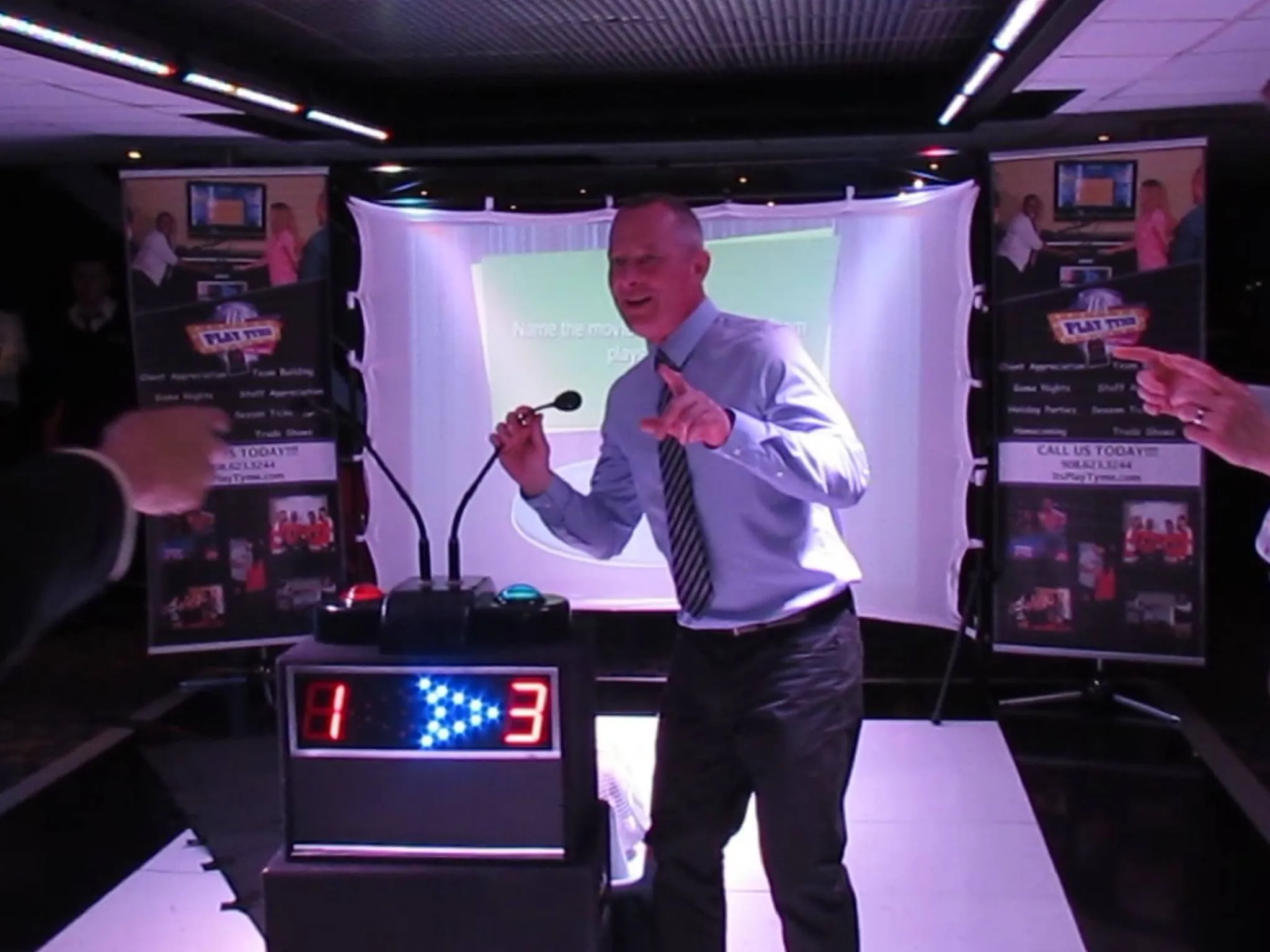
10 people can play this game per round with 5 on each side. Each person has the opportunity to run up to the buzzer to answer a silly question before their opponent.
There’s a video below that will show you exactly how corporate executives behave when good food is provided, a few drinks are flowing and the trivia is entertaining.
The team to get at least 9 questions right, will win the round and move on to either the semi-finals or be crowned as trivia champs.
Medals are given out to the champions and gift cards are provided by the company so the winning team leaves home with some kind of memorabilia.
What icebreaker activity that you’ve participated in has been most memorable for you? Tell us about it in the comment section below.
If your looking for any indoor, onsite activity that won’t break the bank, don’t delay, contact us or call us direct at201-357-2979.