A great scavenger hunt lives or dies on its clues. Easy ones bore the group, impossible ones kill the mood, and the sweet spot keeps adults laughing and arguing in the best way. The stakes are higher than they look. Gallup reports that only 20% of employees feel engaged at work, and a clever shared puzzle does more for connection than another sit-down meeting.
Adults want clues that respect their intelligence and reward teamwork. Pew Research found that most workers value the social side of their jobs, which is exactly what a well-built hunt delivers. Below you will find more than 50 scavenger hunt clues and riddles with answers, organized so you can drop them straight into your next event.
Most organizers wrestle with the same problems. You need clues hard enough to challenge smart adults but clear enough to avoid frustration, a theme that fits your venue, and an answer key so no one argues for 20 minutes. You want the hunt to build teamwork, not just kill an hour. The lists below solve all of that, and the corporate section shows how to scale it for a real office event.
Key Takeaways
Easy clues bore smart adults and impossible ones kill the mood; the sweet spot keeps groups laughing.
Only 20% of employees feel engaged at work; a clever shared puzzle builds connection faster than meetings.
Pew Research found most workers value the social side of their jobs, which a well-built hunt delivers.
The collection includes more than 50 scavenger hunt clues and riddles with answers, sorted by difficulty.
Good adult clues respect intelligence, reward teamwork, and stay clear enough to avoid frustration.
Riddle Clues That Point to Common Objects
These riddles send teams searching for everyday items. Read the riddle, and the answer is the thing to find or photograph.
I have keys but open no locks, I have space but no room, you can enter but not go inside. (A keyboard)
I have a face and two hands but no arms or legs. (A clock)
The more you take, the more you leave behind. What am I? (Footsteps)
I am full of holes yet still hold water. (A sponge)
I get wetter the more I dry. (A towel)
I have a neck but no head, and I wear a cap. (A bottle)
I am tall when young and short when old. (A candle)
I have teeth but cannot bite. (A comb or a zipper)
I run all day but never walk, and I tell you when to talk. (A clock)
I have many rings but no fingers. (A tree, or a notebook)
I am light as a feather, yet no one holds me long. (Breath)
I have a spine but no bones. (A book)
Brain-Teaser Riddles for Sharp Adults
These lean on logic and wordplay. They work as standalone challenges that a team must solve to earn the next location.
What has to be broken before you use it? (An egg)
What goes up but never comes down? (Your age)
What has many words but never speaks? (A book or dictionary)
What can travel around the world while staying in one corner? (A stamp)
What has one eye but cannot see? (A needle)
What gets bigger the more you take away? (A hole)
What can you catch but not throw? (A cold)
What has a thumb and four fingers but is not alive? (A glove)
What invention lets you look right through a wall? (A window)
What belongs to you but others use it more than you do? (Your name)
What has cities but no houses, forests but no trees, and water but no fish? (A map)
The more of this there is, the less you see. What is it? (Darkness)
Location Clues for Office Scavenger Hunts
These clues point to spots inside a workplace. They turn an ordinary office into a puzzle board.
Where ideas brew and the pot is always half empty. (The break room coffee station)
I hold the names of everyone you have met but a face you will never see. (The front desk sign-in or directory)
Cold and humming, I guard your lunch in plain sight. (The office fridge)
Find the place where paper jams and patience disappears. (The copier or printer)
I am the throne of the boss, yet I sit empty most afternoons. (The corner office chair)
Look where the team gathers to argue over deadlines. (The main conference room)
I climb without legs and connect every floor. (The stairwell or elevator)
Sticky and square, I hold a thousand forgotten reminders. (A wall of sticky notes)
I welcome guests but never speak a word. (The lobby or reception sign)
Find the spot where the team posts its wins. (The recognition or bulletin board)
Themed Clues for Outdoor and City Hunts
These suit a downtown or campus hunt. They send teams to recognizable public landmarks and features.
Find a statue and recreate its exact pose as a team. (Photo challenge)
Locate a street name that contains a color or a number. (Observation task)
Find a storefront that has been open since before you were born. (Local history)
Capture a reflection of your whole team in glass or water. (Photo challenge)
Find a bench dedicated to someone, and read the name aloud. (Discovery task)
Locate the oldest date carved or printed anywhere you can find it. (Observation task)
Find something blue that is not the sky. (Quick win)
Capture a photo with a stranger willing to join your team pose. (Social challenge)
Find a menu with a dish none of you have tried. (Discovery task)
Locate a piece of public art and name its likely meaning. (Discussion task)
Where Adult Scavenger Hunts Usually Fall Apart
Even great clues run into obstacles. Naming them early keeps your event on track.
Difficulty balance: Clues that are too easy bore adults, while impossible ones cause quitting. Mix tiers so every team scores some wins.
Disputes over answers: Adults argue. A clear answer key and a designated judge settle calls fast.
Uneven teams: One stacked team ruins the fun. Balance groups by mixing departments and skill sets.
Pacing and time limits: Open-ended hunts drag. A firm clock and a visible scoreboard keep energy high.
Logistics and safety: City hunts need boundaries and check-ins. Set clear zones and a return time before anyone leaves.
Why It’s PlayTyme Game Shows Stands Out
A DIY hunt works for a small crew, but a large corporate group needs structure. It’s PlayTyme Game Shows runs hosted, game show-style competitions across New Jersey, New York City, and Connecticut, with a professional host, scoring, and a tested format that keeps every team engaged. You skip the work of writing clues, judging disputes, and managing the clock.
The hosted approach solves the exact problems that sink homemade hunts. A pro emcee balances difficulty, settles answer calls instantly, and drives the pace so no team stalls. Mixed teams break down department silos, and a live scoreboard turns the room electric. You show up as a participant, not a referee.
What the hosted format adds
Custom clues built for your group and venue.
A professional host who judges and keeps time.
Balanced teams that mix departments on purpose.
Equipment, scoring, and energy handled for you.
Turning a Scavenger Hunt Into Real Team Building
The point of an adult hunt is connection, not just clue-solving. Build it to force collaboration. Require every team member to solve at least one clue, add a round that needs a group photo, and reward creativity alongside speed. Those rules turn a race into a shared story people retell at the office for weeks.
Debrief at the end. Ask which clue stumped each team and how they cracked it. That quick conversation surfaces the problem-solving habits you want carried back into daily work.
Bring a Hosted Hunt to Your Team
Want the fun of a scavenger hunt without the work of running it? Contact It’s PlayTyme to plan a hosted competition, or explore our team building game shows built for groups across NJ, NYC, and CT. One booking covers the clues, the host, and the entire event.
How to Select Between DIY and a Hosted Hunt
Start with your group size and goal. For a small team that loves a challenge, a DIY hunt using the clues above works well, and it costs nothing but planning time. For a larger office event where you want guaranteed engagement and zero refereeing, a hosted game show format is the stronger choice, because it balances difficulty, settles disputes, and keeps everyone moving. Weigh how much time you have to plan, how competitive your group runs, and whether you want to play or manage. Decide early, and your event runs smoothly from the first clue.
Frequently Asked Questions (FAQs)
What makes a good scavenger hunt clue for adults?
A good clue challenges without frustrating, rewards teamwork, and has one clear answer. Mix riddles, location clues, and photo tasks so every team scores some wins. Always provide an answer key to settle disputes quickly.
How many clues should an adult scavenger hunt have?
Aim for 15 to 25 clues for a 60 to 90 minute hunt, scaled to your group size. Too few ends the game early, while too many drags the energy down. A visible time limit keeps the pace sharp.
How do I balance difficulty across a mixed group?
Mix easy, medium, and hard clues so every team earns points. Build teams by combining departments and skill sets to avoid one stacked group. A range of clue types keeps both quick thinkers and detail spotters involved.
Can a scavenger hunt work as a corporate team-building event?
Yes. Require shared solving, add group photo rounds, and debrief at the end to connect the game to real teamwork. A hosted format scales this for large offices and removes the planning burden entirely.
When should we hire a host instead of running it ourselves?
Hire a host once your group passes about 20 people or when you want to play instead of referee. A professional manages clues, scoring, disputes, and timing. That structure keeps large events engaging from start to finish.
Why does a scavenger hunt build team connection better than a sit-down meeting?
Gallup reports only 20% of employees feel engaged at work, and a shared puzzle creates live collaboration that a meeting rarely achieves. Pew Research also found most workers value the social side of their jobs, which a well-built hunt directly delivers.
Looking for team-building game ideas that get your people to engage, laugh, and bond without the usual eye rolls? You’re definitely in the right place.
When someone searches “team building game ideas,” they’re usually on a mission: Find fun, fast, and effective activities that won’t flop in front of the team. Whether you’re planning a department huddle, a company offsite, or a last-minute morale boost, the real goal is deeper than just “fun.” You want better communication, stronger collaboration, and a team that doesn’t just work together, but gets each other.
And here’s the truth: team building doesn’t have to be cheesy or complicated. The right games create shared experiences that break the ice, break down silos, and build trust in ways no memo ever could.
As Ashley Frabasilio, Employee Engagement Manager at Asana, puts it: “Shared experiences help teams build trust and encourage collaboration.” But here’s the catch, not all experiences are created equal.
Keep reading to uncover the team-building game ideas that fire up engagement, not just awkward chuckles.
Key Takeaways
Discover a wide range of team-building game ideas to suit different team needs.
Learn how these activities can improve communication, leadership, and collaboration.
Explore categories such as icebreakers, problem-solving, and virtual team-building activities.
Find fun and engaging activities to enhance team dynamics.
Get insights into creating a more cohesive and productive team environment.
Book a Live Game Show Experience!
[Best Team Building Games – We Come to Your Location – 100% Satisfaction Guaranteed – Click Below – SERIOUS INQUIRIES ONLY]
Team-building games are essential for fostering a collaborative work environment. These activities are a core component of work life that any company invested in developing effective workers should engage in. By providing opportunities for team bonding, organizations can foster friendship and community within the workplace, which helps improve worker satisfaction and happiness.
When team members feel connected, they are more likely to be engaged and motivated. Around 13% of employees assert that they are more productive when happy, making team-building a worthwhile investment. Moreover, team-building events are not a one-time affair but a continuous process necessary to form stronger ties between workers and the company.
These activities can have a significant impact on various aspects of the workplace. They can streamline onboarding, improve communication, boost morale, increase trust, and encourage creativity among team members. When team building is a workplace staple, employees feel valued, which boosts their enthusiasm and confidence.
By investing in team building, management shows that it cares about employee well-being, which can lead to increased job satisfaction. Furthermore, these activities help build reliance on teammates, promoting a sense of unity and cooperation within the team. As a result, team-building games matter because they contribute to a more positive, productive, and collaborative work environment.
Incorporating team-building game ideas into the work culture is crucial for developing a strong, cohesive team. Organizations can reap numerous benefits, from improved communication and collaboration to increased employee satisfaction and productivity.
Quick Icebreaker Team Building Games in Under 30 Minutes
Quick icebreaker games are a great way to initiate meaningful interactions among team members, helping to break down barriers and build rapport.
These activities are designed to be engaging, easy to understand, and simple to execute, making them perfect for teams looking to establish a positive and collaborative environment.
Many of these quick icebreakers double as team-building game ideas that can energize any group and set the tone for stronger teamwork.
Two Truths and a Lie
“Two Truths and a Lie” is a classic icebreaker game that encourages team members to share interesting facts about themselves. To play, each participant tells two true statements and one false statement about themselves. The other team members then have to guess which statement is the lie.
This game is an excellent way to get to know each other on a personal level, promoting laughter and conversation. It’s suitable for teams of any size and can be completed within 15-20 minutes, making it a time-efficient activity.
Penny for Your Thoughts
“Penny for Your Thoughts” is another engaging icebreaker that involves a bit of creativity and interaction. Participants are given a penny (or any coin) and asked to share a thought, memory, or story related to the year stamped on the penny.
This activity not only encourages team members to share personal anecdotes but also fosters a sense of connection through shared experiences. It’s a simple yet effective way to stimulate conversation and can be adapted to fit the size and preferences of the team.
One Word Exercise
The “One Word Exercise” is a straightforward yet powerful icebreaker that asks team members to come up with a single word that describes themselves, their current state of mind, or their expectations from the team. This word can be anything – an adjective, a noun, or even a verb.
By sharing just one word, team members can gain insights into each other’s perspectives and feelings. This exercise is particularly useful for teams looking to understand individual motivations and attitudes, promoting empathy and understanding.
What Do We Have in Common?
“What Do We Have in Common?” is an activity designed for teams of 10 or more people, requiring about 30 minutes to complete. The objective is to divide the team into smaller groups of three to five people and ask them to identify commonalities among the group members.
These commonalities can range from favorite TV shows, disliked ice cream flavors, to shared hobbies. The key is to encourage team members to look beyond superficial similarities and discover meaningful connections. After the group discussions, bring everyone together to share their findings, further strengthening team bonds.
As noted by team building experts, “The more things team members can find that everyone in the group has in common, the better!” This activity not only reunites divided teams by highlighting shared likes and dislikes but also provides a platform for team members to discover commonalities they might not have otherwise noticed.
Communication-Focused Team Building Game Ideas
To foster a more cohesive and communicative team, consider incorporating games that challenge and improve these skills. Effective team communication is crucial for success in any collaborative project. The following games are designed to enhance communication among team members.
Back-to-Back Drawing
This activity involves two team members sitting back-to-back, with one describing a drawing and the other attempting to recreate it based on the description. This game highlights the importance of clear and precise communication.
Birthday Line Up
In this activity, team members are required to line up in order of their birthdays without speaking to each other. They must use non-verbal communication to achieve this. It’s a fun way to encourage team members to think creatively about communication.
Charades
A classic game that involves acting out words, phrases, or characters without speaking. Team members guess what is being acted out. This game promotes understanding and interpretation of non-verbal cues.
Minefield
Minefield is a team-building game that improves trust and partnership between colleagues through clear communication. It’s one of those classic team-building game ideas that’s simple yet incredibly effective. To play this game, around 20 small objects are required to create an obstacle course. Team members work in pairs, with one person blindfolded and the other guiding them through the course using verbal instructions.
The seeing partner must guide their blindfolded teammate through the obstacle course without touching any objects. This exercise builds trust between team members and emphasizes the importance of clear, precise communication. The activity can be made more challenging by adding time constraints or creating more complex obstacle patterns.
Game
Objective
Skills Developed
Back-to-Back Drawing
Recreate a drawing based on a verbal description
Clear communication, listening
Birthday Line Up
Line up in order of birthdays without speaking
Non-verbal communication, problem-solving
Charades
Guess what is being acted out
Non-verbal communication, interpretation
Minefield
Navigate an obstacle course blindfolded with verbal guidance
Trust, clear communication, and teamwork
These games not only enhance communication but also foster a more collaborative and trusting team environment. By incorporating such activities into team-building exercises, organizations can significantly improve overall team performance.
Problem-Solving Team Building Activities
To tackle complex problems, teams can benefit from engaging in problem-solving team-building activities that foster creativity and collaboration. These activities are designed to challenge teams and improve their collaborative problem-solving skills.
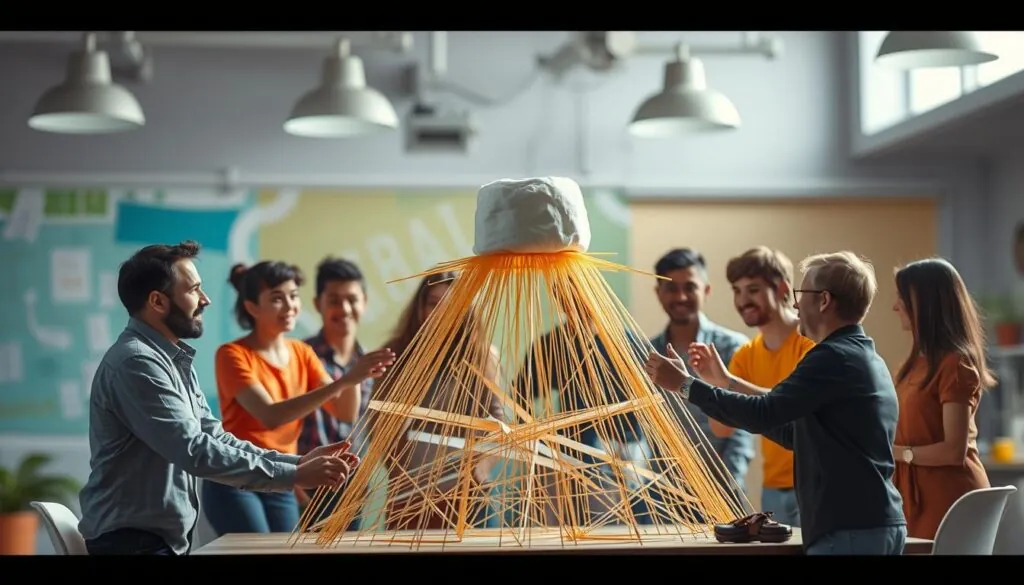
The Marshmallow Challenge
The Marshmallow Challenge is a fun and interactive team-building activity that requires teams to build a structure using limited materials, with a marshmallow on top. The goal is to build a freestanding structure that can hold the marshmallow without it falling.
“Your First Idea” is a team-building activity that encourages teams to generate as many ideas as possible within a set time frame. This activity promotes creative thinking and helps teams come up with innovative solutions.
Spectrum Mapping
Spectrum Mapping is a visual team-building activity that involves mapping out different ideas and perspectives on a particular issue. This activity helps teams to identify patterns, connections, and relationships between different ideas.
What Would X Do?
“What Would X Do?” is a creative problem-solving exercise that encourages team members to approach challenges from different perspectives. In this activity, team members are presented with a problem and asked to come up with a famous person or leader they admire. They then approach the problem as if they were that person, considering how they would think and act.
For a team of 5-10 people, this activity takes around 45-60 minutes. The steps involve presenting a problem, identifying a famous person or leader, and then approaching the problem from their perspective. This exercise helps teams break out of conventional thinking patterns and can lead to unexpected, innovative solutions.
Book a Live Game Show Experience!
[Best Team Building Games – We Come to Your Location – 100% Satisfaction Guaranteed – Click Below – SERIOUS INQUIRIES ONLY]
Trust is a fundamental element in any successful team, and there are several team games designed to foster this essential quality. These activities are crucial for enhancing collaboration, improving communication, and increasing overall team performance. By incorporating trust-building exercises into team-building initiatives, organizations can cultivate a more cohesive and effective team environment.
Human Knot
The Human Knot is a popular trust-building game that involves team members standing in a circle and putting their hands in the center. Each member should grab the hand of someone across from them, not next to them. The team must then work together to untangle themselves without letting go of each other’s hands. This activity promotes communication, problem-solving, and trust among team members.
Blindfolded Square
In the Blindfolded Square game, team members are divided into groups and given a rope or string. The task is to form a square while blindfolded, relying on verbal instructions from their teammates. This activity requires trust, effective communication, and collaboration to achieve the desired outcome.
Swift Swap
Swift Swap is a dynamic trust-building activity where team members stand in two lines facing each other. They are given a task to complete, such as swapping a pen or a small object, without speaking. This game encourages non-verbal communication and trust among team members as they rely on each other to complete the task successfully.
Frostbite
Frostbite is an imaginative team-building game that requires teams to pretend they are in the Arctic and must build a shelter for survival. This activity is designed for groups of five or six people and takes around 20-30 minutes to complete. The necessary materials include sticky notes, toothpicks, thick cardboard boxes, and a fan. Team members democratically elect a leader to guide them through the activity, but the leader is unable to participate physically due to “frostbite.” The team members are blindfolded and must build the structure using the leader’s verbal instructions. This exercise teaches supervisory abilities, instruction-taking skills, time management, and improves communication between leaders and team members. The fan can be used to simulate Arctic conditions, adding an extra challenge to the activity. For more team-building exercises like Frostbite, you can explore additional resources such as team building exercises.
These trust-building games are essential for developing strong, cohesive teams. By incorporating activities like Human Knot, Blindfolded Square, Swift Swap, and Frostbite into team-building initiatives, organizations can promote a culture of trust, collaboration, and effective communication.
Creative Team Exercises
Creative team-building activities are not just fun; they are a strategic way to build stronger, more effective teams. These exercises encourage collaboration, creativity, and problem-solving among team members, leading to a more cohesive and productive team.
Classify This
“Classify This” is an engaging team-building exercise that challenges team members to categorize objects or ideas into different groups. This activity promotes creative thinking and problem-solving. Team members are given a set of items and must decide how to categorize them, encouraging discussion and collaboration.
Sales Pitch
In “Sales Pitch,” team members are tasked with developing and presenting a sales pitch for a product or service. This exercise enhances creativity, public speaking, and persuasion skills. Teams must work together to come up with an innovative pitch, fostering collaboration and innovative thinking.
Mood Pictures
“Mood Pictures” is a creative exercise where team members express their current mood or a given theme through art. This activity encourages self-expression and can provide insights into team members’ emotions and perspectives. It’s a unique way to foster empathy and understanding within the team.
Create Your Own Game
“Create Your Own Game” is a meta-activity that challenges team members to design their own team-building exercises. Suitable for teams of 5-12 people, this activity takes 30-60 minutes to complete. Each team member creates an original problem-solving activity, which can be physical, mental, or creative, and presents it to the group. This exercise is both fun and a real creative challenge, allowing team members to showcase their strengths and providing insight into their problem-solving approaches.
To play, start by giving each team member time to create their activity. Then, have them present their challenges to the group. If time allows, play some of the created games afterward. This exercise not only fosters creativity but also reveals what team members value in collaborative activities.
Virtual Team Building Games for Remote Teams
As remote work becomes the norm, virtual team-building games have emerged as a crucial tool for fostering collaboration and camaraderie among team members.
Show and Tell
“Show and Tell” is a classic icebreaker that can be easily adapted to a virtual setting. Team members take turns sharing an object that holds personal significance, explaining why it’s important to them.
This activity encourages team members to share a bit about their personal lives, fostering a sense of connection and understanding.
Photo Caption Contest
A “Photo Caption Contest” is a fun and creative way to engage remote teams. Share a photo and ask team members to come up with humorous or insightful captions.
This activity not only brings some humor into the virtual workspace but also encourages creativity and teamwork.
Online Group Games
“Online Group Games” can range from virtual escape rooms to collaborative online puzzles. These games are designed to challenge teams and promote problem-solving together.
They are an excellent way to build trust and improve communication among team members.
Virtual Trivia
“Virtual Trivia” is a competitive, educational, and entertaining game that gives remote teams a chance to bond. It can be used to start meetings with energy or as a regular end-of-day event to bring the team together.
To play, start a meeting with a quick game of trivia or host a regular virtual trivia night. The team size can range from 6 to 20 people, and the activity can be tailored to last between 30 to 90 minutes.
You can choose themes such as office trivia about company facts, or other themes like TV shows, music, sports, or geography. Rotating hosts among team members can add variety and give everyone a chance to lead.
Virtual Trivia can be structured as individual competition or team-based challenges, depending on the group size. This activity tests knowledge in a fun way while creating shared experiences that strengthen team bonds.
Find the Perfect Game Show for Your Team
Pick the Ideal Match for Your Team’s Unique Goals and Needs – Click Below
GAME SHOW THEMES
Outdoor Team Building Activities
Outdoor team-building activities offer a unique opportunity for teams to bond and develop essential skills. These activities are designed to foster collaboration, improve communication, and promote problem-solving among team members.
Scavenger Hunt
A scavenger hunt is an engaging outdoor team-building activity that encourages collaboration and problem-solving. Teams are given a list of items to find or challenges to complete, and the first team to finish wins.
A Geocaching Adventure is a high-tech outdoor team-building activity that combines technology with exploration. This exercise helps team members work together to achieve specific goals using GPS technology and problem-solving skills. It’s one of those innovative team-building game ideas that blends fun with strategy in a unique outdoor setting.
To play, teams will need a GPS device or a smartphone app capable of finding geocaches based on coordinates. The activity involves creating a series of hidden items at specific geographic locations, potentially containing clues to a larger puzzle.
This activity promotes problem-solving in a creative way, especially when riddles and puzzles are incorporated into the experience. By working together to navigate through the challenges, team members can develop stronger bonds and improve their collaboration skills.
Indoor Team Building Games
Indoor team-building games are an excellent way to foster collaboration and camaraderie among team members in a relaxed environment. These activities are particularly useful for teams that spend most of their time indoors, providing a much-needed break from the usual work routine.
Office Trivia
Office trivia is a fun and engaging way to challenge team members’ knowledge and promote teamwork. If you create a quiz that includes a mix of work-related and general knowledge questions, you can encourage team members to collaborate and communicate effectively.
To set up an office trivia session, you can either create your own questions, use pre-made quizzes, or hire a company to do it for you. It’s also a good idea to offer small prizes for the winning team to add an extra layer of excitement.
Board Games and Puzzles
Board games and puzzles are simple yet effective indoor team-building activities that promote collaboration in a relaxed setting. They provide a fun spin on teamwork without requiring extensive preparation or special equipment.
There are many options to choose from, including traditional board games, strategy games, cooperative games, or jigsaw puzzles of varying difficulty. For larger teams, you can play multiple games simultaneously or modify the rules to include everyone.
These activities can be set up in break rooms or common areas, allowing team members to engage with them during downtime. Working on puzzles together can reveal different problem-solving approaches and create natural opportunities for conversation.
Moreover, these low-pressure activities allow team members to collaborate in a context completely removed from work tasks, helping to build stronger relationships and improve overall team dynamics.
Team Building Games for Large Groups
For large teams, selecting the right team games is key to enhancing collaboration and camaraderie. When teams are large, it can be challenging to ensure that every member is engaged and feels included. However, with the right activities, large teams can become just as cohesive as smaller ones.
Code of Conduct
Establishing a code of conduct is an essential team-building activity for large groups. This involves creating a set of rules or guidelines that team members agree to follow, promoting a positive and respectful environment. To implement this, divide the large team into smaller groups and ask them to discuss and agree on a code of conduct. This exercise encourages collaboration and helps to establish a shared understanding of the team’s values and expectations.
Common Thread
The “Common Thread” game is an activity designed for groups of 10 or more people, requiring about 30 minutes to play. To play, divide the team into smaller groups of three to five people. Then, ask each group to identify things that everyone in their group has in common. This could be a favorite TV show, a disliked food, a common hobby, or a shared experience. The goal is to find commonalities that are not too superficial or obvious, encouraging team members to discover unexpected connections.
After the groups have identified their common threads, bring everyone together to share their findings. This not only strengthens team bonds but also highlights the diverse experiences and interests within the team. By doing so, “Common Thread” helps large groups discover unexpected connections between team members, fostering a sense of unity and cooperation.
5-Minute Team Building Activities
Quick 5-minute team-building activities are a great way to boost morale, encourage communication, and build trust among team members. These activities are designed to be short, engaging, and effective, making them perfect for busy workdays or as icebreakers before meetings.
Compliment Circle
The Compliment Circle is a simple yet powerful activity that fosters positivity and appreciation within the team. To play, have team members stand in a circle and give each other compliments. This activity encourages team members to appreciate each other’s strengths and builds a supportive team culture.
For example, a team might use this activity to acknowledge a colleague’s help on a project or to celebrate a team member’s work anniversary. The Compliment Circle can be adapted to fit various team sizes and can be completed within a few minutes.
Activity
Duration
Objective
Compliment Circle
5 minutes
Foster positivity and appreciation
One-Word Icebreaker
The One-Word Icebreaker is another effective activity that provides insight into team members’ feelings about work-related topics. This activity involves dividing the team into groups of 4-5 people and asking each member to give a one-word descriptor related to a specific work topic or event.
For instance, the topic might be a new company policy or a recent team project. Each group discusses their chosen words and then selects one word to share with the larger group, prompting broader discussion and helping to “read the room” before diving into more complex topics.
To execute this activity, present the topic and ask each team member to respond with one word that comes to mind. For a deeper exercise, allow groups a few minutes to discuss the reasons behind their chosen words. This simple activity can uncover concerns or questions that need to be addressed, making it a valuable tool for team leaders.
Team Size
Topic
Duration
4-5 people per group
Work-related event or topic
20 minutes (can be condensed to 5 minutes)
Team Building Games for Building Collaboration
Team-building activities are designed to promote unity and cooperation, and certain games stand out for their ability to build collaboration. These games are not just fun; they are carefully crafted to enhance teamwork, problem-solving, and communication among team members.
Egg Drop Challenge
The Egg Drop Challenge is a classic team-building game that requires creativity, problem-solving, and collaboration. The objective is simple: protect an egg from breaking when dropped from a certain height using limited materials.
To conduct this activity, you’ll need a few basic supplies: eggs, various crafting materials (such as straws, tape, scissors, paper), and a surface or structure from which to drop the egg contraptions.
Gutterball is a collaborative team-building activity that requires coordination and communication to achieve a shared goal. In this game, team members are tasked with moving a ball from one end of the room to another using a makeshift “gutter” created from materials like PVC pipe halves, folded cardboard, or paper.
Gutterball is played with 8-20 people and takes approximately 30-60 minutes. Team members must work together, holding their section of the gutter and coordinating with teammates to pass the ball along. To increase difficulty, obstacles such as elevation changes, barriers, or time constraints can be introduced.
This activity emphasizes the importance of coordination, communication, and adapting to challenges as a unified team. By working together to overcome obstacles, team members develop a stronger sense of collaboration and trust.
Book a Live Game Show Experience!
[Best Team Building Games – We Come to Your Location – 100% Satisfaction Guaranteed – Click Below – SERIOUS INQUIRIES ONLY]
In today’s fast-paced work environment, strategic team-building games play a crucial role in aligning team members and promoting a culture of collaboration. These activities are designed to enhance teamwork, improve communication, and drive teams towards achieving their company goals.
Strategic games can range from simple icebreaker activities to complex problem-solving exercises. Two effective examples of such games are “Company Concentration” and “All the News.”
Company Concentration
“Company Concentration” is a strategic team game that focuses on enhancing team members’ understanding of the company’s objectives and their roles in achieving these goals. This activity involves creating a set of cards or a memory game where key company goals, initiatives, or values are written on the cards. Team members then participate in a concentration game, matching the cards to demonstrate their understanding of the company’s strategic objectives.
Activity
Objective
Team Size
Time
Company Concentration
Enhance understanding of company goals
8-20 people
30-40 minutes
All the News
“All the News” is a strategic team-building activity that helps teams envision and get excited about future achievements. It’s one of the more creative team-building game ideas that encourages forward-thinking and goal visualization through storytelling. To play, divide the team into groups of 3–6 members from the same department. Ask each group to create newspaper headlines about potential future accomplishments, written as if these achievements have already happened.
This activity not only fosters a sense of unity among team members but also aligns the team’s vision by generating enthusiasm for upcoming projects and identifying potential pathways to success.
Divide participants into groups of 3-6.
Ask each group to create newspaper headlines about future achievements.
Have groups share their headlines and discuss the measures required to reach these goals.
By doing so, “All the News” becomes a powerful tool for aligning team vision and driving collective effort towards achieving company goals.
“The way to get started is to quit talking and begin doing.”
Long-Term Team Building Activities
Sustained team-building activities can significantly enhance collaboration, creativity, and overall team performance. Unlike one-time events, long-term activities foster a deeper sense of unity and shared purpose among team members.
Quarterly Challenge
Implementing a quarterly challenge is an effective way to keep the team engaged and motivated over an extended period. This involves setting a specific goal or task that the team must work on together over the course of a quarter. The challenge should be meaningful, achievable, and aligned with the organization’s objectives.
For example, a company might challenge its teams to reduce energy consumption or to come up with innovative solutions to a specific problem. The process of working towards a common goal encourages collaboration, creativity, and a sense of accomplishment.
Challenge Type
Description
Benefits
Environmental
Reduce energy consumption by 20%
Promotes sustainability, teamwork
Innovation
Develop new product features
Fosters creativity, problem-solving
Community Service
Organize a quarterly volunteer day
Enhances team bonding, social responsibility
Team Journal
The Team Journal is a long-term team-building activity that creates a living history of your organization’s culture and experiences. By placing a large, blank journal or scrapbook in a common area, you encourage team members to contribute to it over time.
The journal can include prompts or guidelines to ensure that the content is positive and constructive. Team members can write down quotes, note fun events, or include ephemera that reflects the team’s culture.
“The Team Journal becomes a tangible representation of shared experiences and organizational culture that new members can explore.”
To set up the Team Journal, start by selecting a journal or scrapbook that is inviting and accessible. Place it in a common area such as the break room, along with pens, markers, tape, and other items that team members can use to contribute. Establishing clear guidelines is crucial to ensure that the content remains appropriate and respectful.
Encourage team members to write down quotes from readings or from fellow team members.
Suggest including notes about fun work events or milestones achieved.
Invite team members to add photos or other ephemera that capture the team’s spirit and culture.
Over time, the Team Journal will become a valuable resource that reflects the team’s journey, achievements, and culture. It serves as a reminder of how far the team has come and provides new members with a unique insight into the organization’s history and values.
Customizing Team Building Game Ideas for Your Team
Adapting team-building activities to your team’s size, dynamics, and work environment is key to their success. A one-size-fits-all approach often falls short in achieving the desired outcomes, as different teams have unique needs and challenges.
Considering Team Size and Dynamics
The size and dynamics of your team play a significant role in determining the suitability of team-building activities. For smaller teams, activities that foster close relationships and encourage collaboration are often more effective. In contrast, larger teams may benefit from activities that promote departmental or cross-functional collaboration. For instance, a team-building participation strategy could involve dividing a large team into smaller groups for specific challenges.
When planning team-building activities, it’s essential to consider the physical space available. In-office activities should be adapted to the office layout, ensuring that they don’t disrupt the normal workflow. For example, games that require a lot of movement might not be suitable for small or cluttered offices.
Adapting Games for Different Work Environments
Different work environments, such as traditional offices, hybrid workplaces, and fully remote teams, require tailored approaches to team building. For traditional offices, in-person activities like trust-building exercises or problem-solving challenges can be highly effective. Hybrid teams benefit from a mix of in-person and virtual activities, ensuring inclusivity. For fully remote teams, virtual team-building games such as online escape rooms, virtual trivia, or digital scavenger hunts can help foster a sense of unity and collaboration.
To adapt outdoor activities for indoor spaces, consider alternatives that mimic the outdoor experience. For example, an indoor scavenger hunt or virtual outdoor challenges can be engaging alternatives during inclement weather. It’s also crucial to modify activities based on the industry context, as what works for a creative agency might not be suitable for a healthcare team.
Flexibility is key when implementing team-building activities across various work environments. Having backup plans in place can help mitigate any unforeseen challenges, ensuring that the activities remain enjoyable and effective for all participants.
Conclusion – Game Ideas for Teams
As we’ve explored, team-building activities are essential for fostering a collaborative and productive work environment. By implementing the rightteam-building gamesand activities, you can improve communication, increase trust, enhance collaboration, and strengthen relationships among team members.
The most effective team activities are those that align with your team’s specific needs, preferences, and work environment. It’s crucial to make team building an ongoing process rather than a one-time event to maintain and strengthen team bonds. Experimenting with different types of activities will help you discover what resonates most with your unique team.
Even simple, quick activities can have a significant positive impact on team dynamics when done regularly. Start with low-pressure activities and gradually introduce more challenging ones as team comfort levels increase. Try at least one new team building game idea from this article with your team this week and watch your team’s collaboration and productivity grow.
FAQs About Team Building Game Ideas
Q1. What makes a team-building game truly effective for improving team communication?
The best team-building games foster open communication, requiring team members to collaborate and solve challenges together. Activities like “Back-to-Back Drawing” or “Minefield” are excellent examples, as they enhance verbal and non-verbal communication skills.
Q2. How long should a team-building activity last to be effective?
Most team-building games can be effective within 15-60 minutes, depending on the activity. Icebreakers like “Two Truths and a Lie” are quick and impactful, while more elaborate games such as “Scavenger Hunts” or “Problem-Solving Challenges” can take longer to complete.
Q3. What types of games are best for large teams?
For large teams, activities that can be scaled are key. “Face-2-Face Feud” works well with big groups as it promotes friendly competition and teamwork. Alternatively, activities like “Code of Conduct” or “What Do We Have in Common?” can help large teams bond and engage.
Q4. Can team-building games be done virtually for remote teams?
Absolutely! Virtual activities like “Virtual Trivia” and “Photo Caption Contests” are perfect for remote teams. These games foster camaraderie and engagement while being accessible through online platforms, making them great for teams working from different locations.
Q5. How can I measure the effectiveness of a team-building game?
Effectiveness can be measured through team feedback, observing improvements in communication, and seeing how well team members collaborate post-activity. Also, setting clear goals for the game helps track if those objectives were met, such as better collaboration or higher morale.
Q6. How can I customize a team-building game for my company’s specific goals?
Customizing a game to your company’s needs can involve tailoring the questions, challenges, and even game formats to focus on key skills like problem-solving, leadership, or creativity. For example, you can adjust a game like “Company Concentration” to highlight company values or objectives.
Most employees show up, do their work, and leave without ever feeling truly connected to their team. According to Gallup’s State of the Global Workplace report, only 20% of employees worldwide are engaged at work. Meanwhile, SHRM research found that 69% of employees say they would work harder if their efforts were better recognized. A workplace talent show directly addresses both problems: it gives people a stage to be seen and a reason to rally together.
Organizing a talent show at work does take planning, but the payoff in team morale, cross-department bonding, and sheer fun makes it one of the highest-impact events on your company calendar. This guide breaks down every step so you get a packed house and a show worth talking about for months.
Before diving into logistics, it helps to name the real obstacles. Getting employees to volunteer acts is harder than it sounds. Budget questions come up fast. Scheduling around work hours creates friction. And without a clear structure, talent shows drift into awkward territory. The good news: each of these problems has a proven solution, and you do not need event planning experience to pull it off.
What This Comes Down To
Only 20% of employees worldwide are engaged at work, according to Gallup.
SHRM research found 69% of employees would work harder if their efforts were better recognized.
A workplace talent show gives people a stage to be seen and a reason to rally together.
The payoff includes stronger morale, cross-department bonding, and one of the highest-impact events on the calendar.
Getting employees to volunteer acts and managing the budget are the two hardest planning obstacles.
Why a Workplace Talent Show Delivers Real Results
Talent shows reveal who people are beyond their job titles. The quiet developer turns out to be a stand-up comedian. The accountant plays jazz guitar. These discoveries reshape how coworkers see each other, and that shift in perception strengthens working relationships.
The benefits go beyond a fun afternoon:
Cross-department connections. People from different teams interact in a relaxed setting, breaking down silos that slow collaboration.
Recognition and visibility. Performers get applause from leadership and peers. That public recognition satisfies the desire employees have to feel valued.
Shared memories. Inside jokes and favorite moments from the show become part of company culture for years.
Morale boost with staying power. Unlike a catered lunch that ends in an hour, a talent show creates anticipation before and stories after.
What Stalls a Workplace Talent Show Before Day One
Every workplace talent show faces a handful of predictable hurdles. Knowing them ahead of time lets you plan around them instead of scrambling on event day.
Low sign-ups. Many employees want to participate but fear judgment. A structured format with team acts (not just solo performances) lowers the barrier to entry.
Budget uncertainty. Sound equipment, a stage, and prizes add up. Define your budget early and explore options that bundle entertainment and production together.
Scheduling conflicts. Holding the show during work hours means lost productivity. Holding it after hours means low attendance. A lunch-hour or half-day Friday format often hits the sweet spot.
Content concerns. Without guidelines, acts occasionally push boundaries. Publish clear content rules during the sign-up phase and do a brief rehearsal check.
Technical problems. Microphone feedback, laptop cables that do not connect, and playlist mishaps drain the energy. A dedicated AV setup (or a professional host) solves this entirely.
Step 1: Set Clear Goals and Pick a Theme
Start by answering one question: what do you want this talent show to accomplish? Common goals include boosting morale after a tough quarter, celebrating a company milestone, or raising money for a charity. Your goal shapes every decision that follows.
A theme adds energy and makes promotion easier. Consider options like:
Decades Night (acts inspired by a specific era)
Around the World (celebrating cultural diversity)
Battle of the Departments
Lip Sync Showdown
Unplugged (acoustic and spoken-word only)
Themes also help shy employees. “Dress up as your favorite decade and lip sync” feels far less intimidating than “perform your talent in front of everyone.”
Step 2: Build Your Planning Committee
Do not plan this alone. Recruit 4 to 6 volunteers from different departments. Assign clear roles: logistics coordinator, communications lead, talent recruiter, and day-of stage manager. Spread the work so no single person burns out before showtime.
Hold a kickoff meeting at least 6 to 8 weeks before the event. Use this meeting to confirm the date, budget, venue, and theme. Build a shared timeline with deadlines for sign-ups, rehearsals, and promotion milestones.
Your committee also serves as your hype team. When department heads and respected colleagues talk up the event, participation rates climb.
Step 3: Choose the Right Format
The format determines the tone, pacing, and audience experience. Here is a comparison of common talent show formats to help you decide:
Format
Best For
Audience Energy
Planning Effort
Traditional Talent Show
Companies with confident performers
Moderate
Medium
Lip Sync Battle
Getting shy employees involved
High
Low
Game Show + Talent Hybrid
Maximum participation and laughs
Very High
Low (with a pro host)
Variety Show
Mix of acts, skits, and awards
Moderate to High
High
A game show hybrid format works especially well because it keeps the entire audience active, not just the performers on stage. It’s PlayTyme Game Shows specializes in this exact format, bringing professional hosting, sound, lighting, and interactive games that turn passive spectators into enthusiastic participants.
Step 4: Handle Venue, Equipment, and Timeline
Your venue needs enough space for a performance area, audience seating, and basic backstage prep. A company cafeteria, conference hall, or outdoor courtyard all work. If your office lacks space, check nearby community centers or event venues.
Equipment Checklist
Microphone and speakers (wireless mic preferred)
Laptop with HDMI connection for music and video playback
Basic stage lighting (even two spotlights make a difference)
A backdrop or banner with the event name
Scoring cards or a digital voting system for audience judging
Timeline for Event Day
Build your run-of-show with 3 to 5 minute act slots, 30-second transitions, and one intermission halfway through. A 90-minute total runtime keeps energy high without dragging. Assign a timekeeper who signals performers when their slot is ending.
Step 5: Promote the Show and Recruit Acts
Start promoting 4 to 6 weeks out. Use every channel: email, Slack, posters in break rooms, and mentions in team meetings. Create a simple sign-up form (Google Forms works) with fields for act name, description, and any equipment needs.
Aim for 8 to 12 acts for a 90-minute show. If sign-ups are slow, try these tactics:
Allow group acts. Performing with coworkers feels safer than going solo.
Add low-pressure categories. Best dad joke, best TikTok recreation, or best air guitar lowers the bar.
Recruit department heads first. When a VP signs up, everyone else follows.
Offer prizes. Gift cards, extra PTO hours, or a trophy for the winner’s desk generates real motivation.
Send a “last call” reminder one week before the sign-up deadline. This final push typically brings in 30% of your total acts.
Step 6: Run the Event and Keep Energy High
The host makes or breaks the show. A great emcee keeps the pace moving, fills transition gaps with crowd interaction, and handles technical hiccups without awkward silence. If nobody on your team is a natural entertainer, bring in a professional.
This is where a company like It’s PlayTyme Game Shows transforms the experience. Their professional hosts manage the entire flow of the event, from opening energy to final awards. They bring their own sound and lighting equipment, run interactive audience games between acts, and keep the crowd engaged from start to finish. Instead of hoping your talent show goes smoothly, you get a produced event with guaranteed energy.
Other tips for event day:
Have snacks and drinks available (people stay longer when fed).
Set up a photo booth or selfie station for social media moments.
Record the performances so you have content for the company newsletter.
Announce winners with a proper awards ceremony at the end.
What to Ask Before Hiring a Talent Show Partner
If you want a talent show that runs like a professional production without the stress of managing every detail yourself, partnering with an entertainment company is the smartest move. Look for a provider that offers:
An experienced live host (not a DJ reading from a script)
All-inclusive AV equipment so you do not scramble for cables and speakers
Interactive formats that involve the whole audience, not just performers
Proven experience with corporate groups in your area
It’s PlayTyme Game Shows checks every box. They run corporate game shows and team-building events across New Jersey, New York City, and Connecticut, and their format blends perfectly with a talent show structure. Contact their team to discuss how they customize the experience for your company’s size, goals, and venue. You also find details on their full range of corporate event programs.
Frequently Asked Questions (FAQs)
How far in advance should I start planning a workplace talent show?
Begin planning at least 6 to 8 weeks before the event date. This gives you time to book a venue, recruit acts, promote the show, and handle logistics. Larger companies with 200 or more employees benefit from starting 10 to 12 weeks out.
What is the ideal number of acts for a talent show at work?
Aim for 8 to 12 acts for a show lasting 60 to 90 minutes. This keeps the pace energetic and prevents the audience from losing interest. Shorter acts (3 to 5 minutes each) work better than longer performances.
How do I get reluctant employees to participate?
Offer group act options so people perform with friends rather than alone. Add low-pressure categories like lip sync, trivia, or best impression. When leadership signs up first, it signals that participation is encouraged and safe.
Do I need a professional host for a company talent show?
A professional host dramatically improves the experience. They manage pacing, engage the audience, and handle unexpected moments with confidence. Companies like It’s PlayTyme Game Shows provide trained hosts who specialize in corporate entertainment.
Managers shape the employee experience more than any other single factor in an organization. According to Gallup research, managers account for at least 70% of the variance in employee engagement scores across business units. That statistic puts enormous responsibility on leaders who plan team activities: the questions you ask before, during, and after a team building event determine whether the experience produces lasting change or fades by Monday morning.
The data reinforces why this matters financially. Gallup’s meta-analysis of over 2,600 business units found that highly engaged teams show 21% greater profitability compared to disengaged ones. Team building is not a perk or a checkbox. It is a strategic investment, and the return depends on how intentionally you approach it.
Yet most managers schedule a team building event, show up, participate, and move on without asking a single targeted question. They miss the chance to uncover communication gaps, identify isolated team members, and understand what actually motivates their people. The result: money spent, time consumed, and no meaningful insight gained. If you want team building to drive real improvements in collaboration, trust, and performance, you need a structured question framework that spans the full lifecycle of the event.
Why the Right Team Building Questions to Ask Employees Actually Matter
Asking the right questions transforms a team building event from entertainment into a diagnostic tool. When managers ask targeted questions before an activity, they surface hidden dynamics: who feels left out, what collaboration barriers exist, and which team relationships need attention. These insights allow you to select activities that address real issues rather than generic icebreakers that ignore the team’s actual state.
During the activity, observation questions help you see your team in a low-stakes environment where authentic behavior emerges. After the event, reflection questions capture what shifted and what needs follow-up. Without this three-phase approach, team building becomes reactive instead of strategic.
It’s PlayTyme Game Shows builds its corporate programs around this exact principle: structured engagement that gives managers observable, actionable moments with their teams across New Jersey, New York City, and Connecticut.
Questions to Ask Before a Team Building Event
The pre-event phase is where most managers leave value on the table. These questions help you design the right experience and set expectations with your team.
Questions About Team Dynamics
“Which colleagues do you rarely interact with, and what gets in the way?”
“Where do you see communication breaking down on our team?”
“What does a productive working relationship look like to you?”
“Do you feel comfortable sharing ideas in group settings? What would make it easier?”
Questions About Preferences and Comfort
“What types of group activities energize you, and which ones drain you?”
“Is there anything that would make you uncomfortable during a team activity?”
“Do you prefer competitive or collaborative formats?”
These questions accomplish two things. First, they give you data to select the right activity format. Second, they signal to employees that their input shapes the experience, which increases buy-in before the event even starts.
Questions to Ask During a Team Building Activity
During the event itself, your role shifts from facilitator to observer. The questions you hold in mind while watching your team interact are just as important as anything you ask directly.
Observation Questions for Managers
Who steps into leadership roles naturally, and who holds back?
Which team members gravitate toward each other, and who stays on the periphery?
How does the group handle disagreement or competing ideas?
Who asks clarifying questions, and who charges ahead without checking understanding?
In-the-Moment Questions to Ask the Team
“What strategy is working for your group right now?”
“How did you decide on that approach?”
“What would you do differently if you started over?”
Game show formats are particularly effective here because they create natural pressure, decision points, and moments of collaboration that reveal authentic team behavior. The competitive structure gives managers clear windows to observe dynamics that stay hidden in day-to-day work.
Questions to Ask After a Team Building Event
The post-event debrief is where the real value gets captured or lost. Most managers skip this step entirely. A short, structured follow-up within 48 hours locks in insights while the experience is fresh.
Reflection Questions
“What surprised you about how our team worked together?”
“Did you connect with anyone you don’t normally work with? What did you learn about them?”
“What moment during the activity felt most like how our team operates at work?”
“What one thing from today would you want to carry into our daily workflow?”
Forward-Looking Questions
“What is one collaboration habit we should start based on today’s experience?”
“How frequently should we do activities like this?”
“Is there a specific team challenge you think our next event should address?”
Document the answers. Share a summary with the team. Reference it in your next one-on-one meetings. This closes the loop and shows employees their feedback drives real decisions.
Why Employees Give Surface-Level Answers to Team Questions
Even well-intentioned managers run into obstacles when trying to gather honest feedback from their teams around team building activities.
Employees give surface-level answers. When people sense their responses are being evaluated, they default to safe, generic replies. Combat this by asking specific, scenario-based questions instead of broad ones. “What frustrated you about our last group project?” produces better data than “How do you feel about teamwork?”
The manager-employee power dynamic filters honesty. Some employees will not share real concerns directly with their boss. Anonymous pre-event surveys and peer-facilitated debriefs reduce this barrier. Consider having a neutral facilitator run the post-event reflection.
No follow-through erodes trust. If you ask great questions but never act on the answers, your team stops engaging honestly. The fastest way to kill participation is to collect feedback and let it disappear. Commit to at least one visible change after every event.
Choosing the wrong activity undermines the process. When the event format does not match the team’s needs or comfort level, even the best questions produce shallow insights. This is where working with an experienced team building partner makes a measurable difference: they match formats to your goals and create environments where real behavior surfaces.
How to Turn Employee Answers into Action
Collecting team building questions to ask employees is only the first step. The competitive advantage comes from what you do with the answers. Here is a practical framework:
Categorize responses into themes: communication, trust, role clarity, inclusion, or motivation. Look for patterns across multiple employees rather than reacting to individual outliers.
Identify one priority per quarter. Trying to address every piece of feedback simultaneously dilutes impact. Pick the theme that appears most frequently and design your next team building event around it.
Share what you heard. Present anonymized, aggregated findings back to the team. This transparency builds trust and shows that answering honestly produces results.
Measure progress. Repeat selected questions after 90 days to see if the needle moved. This creates a feedback loop that makes each subsequent event more targeted.
When you treat team building as an ongoing diagnostic process rather than an isolated event, the questions become a management tool with compounding returns.
What to Look for in a Team Building Partner
Factor
What Strong Partners Offer
Red Flags
Customization
Activities tailored to your team’s specific goals and dynamics
One-size-fits-all packages with no pre-event consultation
Facilitation
Professional hosts who manage energy, participation, and pacing
Self-run kits with no live support
Observation Support
Structured moments for managers to observe team behavior
Pure entertainment with no debrief component
Format Range
Multiple formats (game shows, trivia, collaborative challenges) to match different objectives
Only one activity type regardless of team needs
Logistics
On-site setup, AV, and coordination handled for you
Manager expected to handle production and facilitation simultaneously
It’s PlayTyme Game Shows checks every column in the “strong partners” list. Their corporate game show programs are built for teams ranging from 20 to 300+ participants, with professional hosts who keep energy high while giving managers space to observe and engage.
What to Consider When Selecting Questions for Your Team
Not every question fits every team. The right set depends on your team’s maturity, size, and current state. A newly formed team benefits from questions about preferences, working styles, and comfort levels. An established team that has grown stale needs questions that challenge assumptions and surface unspoken friction.
Start with these filters:
Team tenure: new teams need discovery questions; veteran teams need disruption questions.
Recent changes: if you have had turnover, restructuring, or a difficult project, focus questions on trust and psychological safety.
Event format: competitive formats (game shows, trivia) naturally generate conversation about strategy and decision-making. Collaborative formats surface communication and inclusion dynamics.
Your blind spots: ask questions about areas where you suspect issues but lack data. The team building event creates a safe context for honest answers.
The best team building questions to ask employees are the ones you are prepared to act on. Choose fewer questions, listen carefully, and follow through visibly.
Ready to plan a team building event that gives you real insight into your team? Contact It’s PlayTyme Game Shows to discuss your goals and find the right format for your group. Their team works with managers across New Jersey, NYC, and Connecticut to design team building activities that deliver both engagement and actionable feedback.
What are the best team building questions to ask employees before an event?
Focus on questions that reveal current team dynamics and individual preferences. Ask about communication barriers, collaboration comfort levels, and what types of group activities employees find energizing versus draining. These answers help you select an activity format that addresses real needs rather than guessing.
How do I get honest answers from employees about team building?
Use anonymous surveys for pre-event questions and peer-facilitated debriefs for post-event reflection. Employees give more honest responses when the power dynamic is reduced. Most importantly, act visibly on the feedback you receive so your team sees that honesty produces results.
How soon after a team building event should I ask follow-up questions?
Conduct a structured debrief within 48 hours while the experience is still fresh. Ask reflection questions about surprises, new connections, and moments that mirrored real workplace dynamics. Follow up again at 90 days with the same questions to measure whether the insights translated into lasting behavioral change.
How often should managers plan team building activities?
Quarterly events work well for most teams because they provide enough frequency to build momentum without creating fatigue. Teams going through significant change (mergers, rapid hiring, leadership transitions) benefit from monthly touchpoints. The right cadence depends on your team’s specific needs, which your pre-event questions will reveal.
What type of team building activity gives managers the best observation opportunities?
Competitive, structured formats like game shows and trivia challenges create natural decision points, time pressure, and group strategy discussions. These moments reveal leadership tendencies, communication patterns, and conflict resolution styles that stay hidden during normal work. Professional facilitation frees the manager to observe instead of running the activity.
Workplace relationships directly shape whether employees stay, produce, and collaborate. According to Gallup’s State of the Global Workplace report, employees who strongly agree they have a best friend at work are significantly more likely to be engaged, with business units in the top quartile of engagement realizing 23% higher profitability. Meanwhile, research published by Harvard Business Review found that a face-to-face request is 34 times more successful than an email, demonstrating that physical presence carries a persuasive and connective power that digital channels simply do not replicate.
These numbers point to something that many HR leaders and managers already sense: real relationships form faster and run deeper when people share the same physical space. Team building for workplace relationships is not a nice-to-have perk. It is a strategic investment that drives measurable business outcomes.
Yet most organizations struggle with this reality. Hybrid and remote policies have scattered teams across zip codes and time zones. Employees who once built rapport over coffee or hallway conversations now default to Slack threads and scheduled video calls. Spontaneous moments of connection have all but disappeared for distributed teams. The result is a workforce that collaborates on tasks but fails to build the trust, empathy, and social cohesion that make teams resilient under pressure.
What Hybrid Work Does to Workplace Bonds
The shift to hybrid work created a paradox. Teams have more communication tools than ever, yet relationship quality has declined. Here are the specific challenges organizations face when trying to strengthen workplace bonds.
Screen Fatigue Replaces Real Connection
Video calls demand sustained visual attention without the natural rhythms of in-person conversation. People multitask, mute themselves, and disengage. The format rewards efficiency over warmth, making it nearly impossible to build genuine rapport through a webcam.
Spontaneous Interaction Has Vanished
Some of the strongest workplace relationships form through unplanned moments: a joke in the elevator, a shared lunch, a quick sidebar after a meeting. Remote and hybrid schedules eliminate these organic touchpoints entirely. Every interaction becomes scheduled, which strips away the casual vulnerability that builds trust.
New Hires Feel Isolated
Employees who joined during or after the remote-work shift often have shallow professional networks. They know their immediate team through project tasks but lack the broader organizational relationships that support career growth, mentorship, and belonging.
Existing Relationships Erode Over Time
Even teams that once worked closely in an office find that months of limited face-to-face contact weaken their bonds. Without regular shared experiences, colleagues drift into transactional communication patterns. Trust does not disappear overnight, but it does fade when it is not reinforced through physical presence.
Why Face-to-Face Contact Builds Stronger Relationships Than Virtual Interaction
The advantage of in-person interaction is not nostalgic preference. It is rooted in neuroscience and behavioral psychology. Understanding why physical presence strengthens relationships explains why It’s PlayTyme Game Shows and other in-person team building providers deliver results that virtual alternatives consistently fail to match.
Neural Synchrony Requires Physical Proximity
When two people interact face to face, their brain activity begins to mirror each other, a phenomenon neuroscientists call neural synchrony. This synchronization increases during shared laughter, collaborative problem-solving, and moments of surprise. It is the biological foundation of rapport. Video calls produce significantly less neural synchrony because the brain processes screen-mediated faces differently than live human faces.
Body Language Carries the Majority of Social Information
Researchers have long established that nonverbal cues (posture, gesture, facial micro-expressions, eye contact, proximity) carry more social and emotional information than words alone. On a video call, most of these signals are invisible or distorted. A two-dimensional headshot on a screen does not communicate the same warmth, openness, or trustworthiness that a full-body, in-room presence delivers.
When people move through the same space, react to the same stimuli, and physically participate in the same activity, their brains encode the experience as a shared emotional memory. These memories become the foundation of inside jokes, mutual respect, and group identity. A virtual trivia game does not produce the same neurological imprint as standing side by side, competing together, laughing at the same moment, and high-fiving after a win.
Spontaneous Humor Bonds People Faster Than Any Icebreaker
Laughter that arises naturally during a shared physical experience triggers oxytocin release, the same hormone associated with trust and bonding. Scripted icebreakers on Zoom rarely produce genuine laughter. In-person activities, especially ones that involve friendly competition, physical movement, and unexpected moments, generate authentic humor that accelerates relationship formation.
What Makes In-Person Team Building Effective for Relationship Outcomes
Not every in-person gathering builds relationships. A mandatory conference room lecture does not create bonds any more than a video call does. Effective team building for workplace relationships requires specific design elements.
Shared challenge: The activity puts people in a situation where they must collaborate, communicate, and rely on each other. This creates mutual dependence, a fast-track to trust.
Low stakes, high energy: The best relationship-building activities feel like play, not work. When the stakes are fun (bragging rights, a team trophy) rather than professional (performance reviews, promotions), people drop their workplace personas and interact authentically.
Physical co-presence: Everyone occupies the same room, reacts in real time, and shares the sensory experience. This is what triggers neural synchrony and emotional memory encoding.
Inclusive participation: Activities where everyone participates equally (not just the extroverts) ensure that quieter team members also form connections. Game-show formats work well here because the structure gives everyone a role without requiring anyone to perform a monologue.
Surprise and novelty: Novel experiences are encoded more deeply in memory. When people experience something unexpected together, the shared “I was there” moment becomes a lasting relational anchor.
How Game Show Experiences Strengthen Workplace Bonds
Interactive game shows like Face-2-Face Feud combine every element listed above into a single, high-energy experience. It’s PlayTyme Game Shows specializes in bringing this format to corporate events, team-building sessions, and company gatherings across New Jersey, New York City, and Connecticut.
Here is why the game-show format is particularly effective for building workplace relationships:
Teams form instantly. Participants are grouped into teams (often mixing departments or seniority levels), which forces interaction between people who rarely work together.
Competition triggers engagement. Friendly competition raises adrenaline and emotional investment. People remember who they competed alongside far longer than who they sat next to in a meeting.
Humor emerges organically. Wrong answers, dramatic reveals, and playful rivalries generate genuine laughter without forced icebreaker scripts.
Everyone participates. Game-show formats give every person a buzzer, a whiteboard, or a role in the team’s strategy. No one sits on the sideline.
The experience is shared and physical. Standing at a podium, huddling with teammates, cheering after a correct answer: these moments create the exact type of emotional memories that build lasting relationships.
Interaction Format
Neural Synchrony
Body Language Visible
Spontaneous Humor
Shared Emotional Memory
Relationship Impact
In-Person Game Show
High
Full
Frequent
Strong
Deep, lasting bonds
In-Person Workshop
Moderate
Full
Occasional
Moderate
Moderate improvement
Virtual Team Activity
Low
Limited (head only)
Rare
Weak
Minimal lasting impact
Video Call Meeting
Minimal
Limited
Rare
Very weak
Transactional only
Slack/Email Communication
None
None
None
None
No relationship growth
The Business Case for Investing in In-Person Relationship Building
Strong workplace relationships are not just a morale booster. They translate directly into business performance. Teams with high relational trust communicate problems earlier, resolve conflicts faster, and collaborate without the friction of guarded self-interest.
Employee retention also improves. People do not leave companies; they leave relationships (or the absence of them). An employee who has genuine friendships at work, people who know their name, remember their stories, and celebrate their wins, is far less likely to accept a recruiter’s call.
For hybrid organizations, periodic in-person team building serves as a relational reset. It rebuilds the social capital that erodes between office visits. A single well-designed game-show event produces enough shared memory and goodwill to sustain team cohesion for weeks or months of remote work that follow.
Common Mistakes Organizations Make with Team Building
Many companies invest in team building but fail to see relationship improvements because they make one of these errors:
Treating attendance as the goal. Getting people in the same room is step one, not the finish line. The activity itself must create the conditions for genuine interaction.
Choosing passive experiences. Watching a speaker, attending a happy hour where cliques form immediately, or sitting through a PowerPoint does not build new relationships. Active participation is required.
Doing it once a year. Relationships need regular reinforcement. A single annual retreat is not sufficient. Quarterly or seasonal team-building events maintain the momentum.
Defaulting to virtual because it is cheaper. The cost savings of a virtual activity disappear when you measure the outcome. A $500 Zoom trivia session produces a fraction of the relational value of a professionally hosted in-person experience.
Ignoring cross-departmental mixing. Team building that only groups people with their existing teams reinforces silos. The greatest relationship value comes from connecting people who rarely interact in daily work.
Matching Team Building Format to Your Organization
Selecting the right approach depends on your team’s size, location, and the specific relational outcomes you want. Start by asking three questions:
1. What relationship gaps exist?
If new hires feel disconnected, prioritize formats that mix tenure levels. If departments operate in silos, choose activities that blend teams. If morale has dipped after layoffs or restructuring, opt for high-energy, low-pressure experiences that let people laugh together.
2. How distributed is your team?
If your team spans multiple locations, bring them together physically for the event. The travel investment pays for itself in relational outcomes that no virtual platform replicates. For teams already in one metro area (New Jersey, NYC, Connecticut), an on-site game show at your office or venue eliminates logistical barriers entirely.
3. Do you want entertainment or transformation?
A professionally hosted game-show experience from It’s PlayTyme Game Shows delivers both. The entertainment value ensures high energy and participation. The interactive, team-based format produces the shared experiences, spontaneous humor, and physical co-presence that neuroscience identifies as the building blocks of lasting relationships.
If your organization is ready to move beyond virtual icebreakers and invest in the kind of face-to-face team building that produces real, measurable relationship outcomes, reach out to It’s PlayTyme Game Shows to discuss your next corporate event. Their interactive game-show experiences are designed to do exactly what the science says works: put people in the same room, give them something fun to do together, and let the relationships take care of themselves.
Why is in-person team building more effective than virtual team building for workplace relationships?
In-person interaction triggers neural synchrony, allows full body-language reading, and generates spontaneous humor, all of which accelerate trust and bonding. Virtual formats limit these signals to a small screen and eliminate the shared physical experience that encodes lasting emotional memories. Research consistently shows that face-to-face communication produces stronger relational outcomes than any digital alternative.
How often should organizations schedule team-building activities to strengthen relationships?
Quarterly events produce the best sustained results for most organizations. Relationships need regular reinforcement, and a single annual retreat is not enough to maintain social cohesion across months of remote or hybrid work. Seasonal game-show events or interactive experiences keep relational momentum alive between in-person gatherings.
What types of team-building activities are best for building authentic workplace relationships?
Activities that combine shared challenge, inclusive participation, physical co-presence, and spontaneous fun produce the strongest relational outcomes. Interactive game shows, collaborative competitions, and hands-on group experiences outperform passive formats like lectures, happy hours, or watching presentations. The key is active, equal participation in a novel shared experience.
How does team building for workplace relationships affect employee retention?
Employees with strong workplace friendships are significantly less likely to leave their organization. Gallup data shows that having a best friend at work is one of the strongest predictors of engagement and retention. Team-building activities that create genuine bonds give employees a reason to stay that no salary increase fully replaces.
What is the best team-building format for hybrid teams that rarely meet in person?
For hybrid teams, periodic in-person events deliver disproportionate relational value precisely because face-to-face time is scarce. A professionally hosted game-show experience during a quarterly gathering produces enough shared memories and trust to sustain team cohesion through weeks of remote work. The investment in bringing people together physically outweighs the convenience savings of virtual alternatives every time.
How does physical presence affect the depth of workplace relationships?
Harvard Business Review research found that face-to-face requests are 34 times more successful than email, showing that shared physical space builds a connective depth that digital channels cannot replicate.