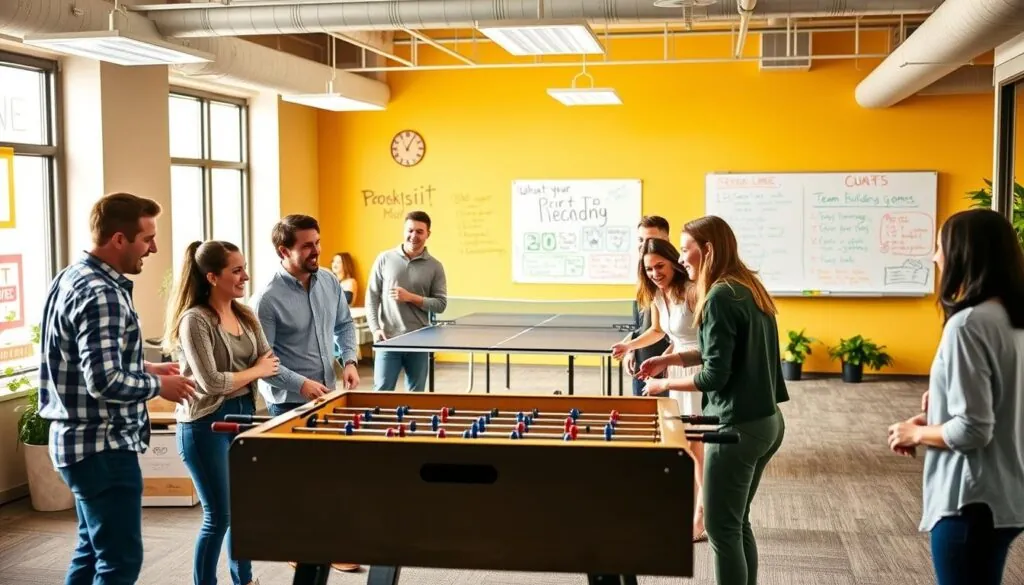
Low morale costs businesses more than most leaders realize. According to Gallup’s 2024 workplace report, only 31% of U.S. employees are actively engaged at work, the lowest rate in a decade. Meanwhile, research from Oxford’s Saïd Business School shows that happy employees are 13% more productive than their disengaged peers.
Fun office games to boost morale are one of the fastest, most affordable ways to close that engagement gap. For teams across New Jersey and New York City, the right game turns a sluggish Tuesday afternoon into the highlight of the quarter.
Most offices deal with the same frustrations. Routines get stale. Departments stay siloed for months without a single cross-team conversation. And the last “team bonding” event felt more like a mandatory meeting than a celebration. Employees want real laughter, genuine competition, and activities that respect their time. The challenge is finding games that deliver all three without dumping extra work on an already stretched HR team.
Looking for office games to boost morale in NJ or NYC? We host game shows for 20 to 300+ people at your office or venue.
Only 31% of U.S. employees are actively engaged at work, the lowest rate in a decade.
Happy employees are 13% more productive than disengaged peers, per Oxford research.
Fun office games break down department silos and combat stale workplace routines.
The right game turns a sluggish Tuesday afternoon into the highlight of the quarter.
NJ and NYC offices use game shows to create real laughter and genuine competition.
Why Fun Office Games to Boost Morale Actually Work
Games change the social dynamics in a room within minutes. When a marketing coordinator squares off against the CFO in a trivia round, job titles stop mattering. Conversations flow across departments. Inside jokes form. Those connections carry over into everyday collaboration long after the buzzer sounds.
Shared positive experiences also build psychological safety. Teams that laugh together communicate more openly. They ask for help sooner, give feedback more directly, and resolve conflict faster. Games create those shared moments without requiring a six-week leadership retreat or a consultant’s invoice.
The effect compounds with repetition. A single event lifts spirits for a week. Monthly games build a culture where people genuinely look forward to showing up.
Challenges That Drain Office Morale Before Friday
Repetitive daily routines are the biggest morale killer in most offices. When every week looks identical, motivation fades. Employees disengage not because they dislike the work, but because nothing breaks the pattern.
Disconnected departments make it worse. People sit 20 feet apart for years and never learn each other’s names. That isolation breeds “us vs. them” attitudes that slow projects and erode culture from the inside.
Forced fun backfires too. Mandatory icebreakers, trust falls, and awkward happy hours often push people further apart instead of bringing them together. The best office games succeed because participation feels voluntary, competitive, and genuinely entertaining. When the activity is good enough, people opt in on their own.
Start With a Professional Game Show
It’s PlayTyme Game Shows runs fully hosted, live game show experiences for corporate teams across New Jersey, NYC, and Connecticut. A professional host arrives with buzzers, sound effects, scoring screens, and themed rounds (think Family Feud, Jeopardy-style trivia, Minute to Win It challenges). Your team shows up and plays. That’s it.
This format works for groups of 20 to 300+. It eliminates the two biggest barriers to office fun: planning time and participation anxiety. Nobody on your team has to organize anything. The game show format gives every personality type a way to contribute, whether they are the loudest person in the room or prefer to strategize quietly behind the scenes.
Companies across the tri-state area that book corporate team building events through It’s PlayTyme consistently report higher energy and stronger cross-department relationships in the weeks following the event. The professional production value makes the experience feel special, not like another pizza party in the break room.
Quick DIY Games That Take 15 Minutes or Less
Not every morale boost requires a full production. These quick games fit into a lunch break or the start of an all-hands meeting.
Two Truths and a Lie (Work Edition)
Each person shares three statements about themselves. The group votes on which one is false. Keep rounds to 60 seconds each. The workplace remix: all statements must relate to something that happened at the office. Rounds move fast, and the reveals always get laughs.
Desk Scavenger Hunt
Call out items one at a time (“something with a logo on it,” “an item older than five years”). The first person to hold up the item wins the point. Five rounds, five minutes, zero prep required.
Speed Networking Bingo
Create bingo cards with squares like “has worked here over 3 years,” “speaks two languages,” or “has never had coffee.” Employees mingle and fill squares by finding coworkers who match. First full card wins a prize.
Want a morale boost the whole office feels? Our hosts run team rounds, scoring and prizes from start to finish.
Trivia is the most versatile office game format. It scales from five people in a conference room to 200 in a banquet hall.
Pop Culture Trivia: Movies, music, and TV shows from the last 30 years. Participation stays high because everyone has opinions.
Company Knowledge Quiz: Questions about company history, product facts, and team milestones. This doubles as an informal onboarding tool for new hires.
Industry Trivia: Test how well your team knows the broader market. Great for sales and marketing departments looking for a competitive edge.
For the best experience, assign a dedicated host or emcee. A flat, monotone quizmaster kills the energy in seconds. If your team lacks a natural entertainer, a professional game show host from It’s PlayTyme makes all the difference.
Physical and Movement Games for the Office
Sitting for eight hours drains energy faster than any deadline. Movement-based games break that cycle and reset focus for the rest of the afternoon.
Minute to Win It Challenges: Stack cups, bounce ping pong balls into cups, or balance cookies from forehead to mouth. Cheap supplies, huge laughs, and genuine suspense.
Office Olympics: Chair races, paper airplane distance contests, and rubber band archery. Divide into country teams for extra rivalry and bragging rights.
Lip Sync Battle: Departments pick a song and perform. Judged by audience applause. Save this one for teams with existing comfort and rapport.
Games for Hybrid and Remote Teams
Remote employees are often the first to feel disconnected from company culture. Virtual games keep them involved without forcing awkward video calls with no structure.
Online Trivia Platforms: Tools like Kahoot or TriviaMaker let remote players compete in real time alongside in-office teammates on a shared leaderboard.
Virtual Escape Rooms: Teams solve puzzles together over video chat. These work best in small groups of 4 to 8 people.
Show and Tell: Each person shares something from their workspace or home office. Simple, personal, and surprisingly engaging for distributed teams.
For hybrid events, team building activities that blend in-person energy with virtual participation create the most inclusive experience for everyone on the roster.
Game Format
Best For
Group Size
Setup Time
Energy Level
Professional Game Show
Large teams, corporate events
20 to 300+
None (fully hosted)
High
DIY Trivia
Lunch breaks, small teams
5 to 30
10 minutes
Medium
Minute to Win It
Afternoon energy boosts
10 to 50
5 minutes
High
Virtual Games
Remote and hybrid teams
Any size
15 minutes
Medium
Scavenger Hunts
Cross-department mixing
10 to 100
15 minutes
Medium to High
How to Choose the Right Fun Office Games for Your Team
The best game depends on three factors: group size, available time, and your team’s comfort level with each other.
For large groups (50+), go with a professionally hosted game show. The host manages energy, pacing, and participation so nobody sits on the sidelines watching. For smaller groups under 20, DIY trivia or scavenger hunts deliver big laughs with minimal effort and zero budget.
If your team is new or includes people who have never met, start with low-pressure options like bingo or trivia. Save the lip sync battles for teams with existing bonds. Frequency matters too. One annual outing does far less for morale than monthly 15-minute games woven into regular meetings.
Consider your remote employees in every plan. Any game strategy that ignores hybrid workers reinforces the very disconnect it aims to fix. Choose formats that give virtual participants an equal role, not just a spectator view of in-office fun.
Ready to bring real energy to your next team event in New Jersey, NYC, or Connecticut? Contact It’s PlayTyme Game Shows to book a fully hosted corporate game show experience your team will talk about for months.
What are the best fun office games to boost morale?
Professional game shows, trivia competitions, Minute to Win It challenges, and scavenger hunts consistently deliver the highest engagement. The best choice depends on your group size and how much setup time you have. For large teams, a hosted game show removes all the guesswork.
Do office games work for groups over 100 people?
Yes, but format matters. DIY icebreakers fall flat with 100+ people because coordination breaks down. Professional game shows are designed for large audiences. A trained host keeps the energy high and ensures every table or section stays engaged throughout the event.
Are professional game shows worth the investment for corporate teams?
Companies that invest in professional entertainment see measurable returns in engagement, retention, and cross-team collaboration. A hosted game show eliminates planning stress, guarantees high participation, and creates a shared experience that strengthens working relationships well beyond the event itself.
New Jersey sits at the center of the Tri-State region, giving corporate teams access to beaches, state parks, farmland, and urban green spaces within a short drive. That geographic advantage makes outdoor team building activities in New Jersey a practical, year-round investment for companies serious about strengthening culture and reducing turnover.
But planning outdoor events across four distinct Northeast seasons brings real obstacles. Weather swings from 95-degree July humidity to sub-freezing January winds. Finding venues that handle groups of 30, 80, or 200 requires county-by-county knowledge. And choosing activities that actually build collaboration (not just fill an afternoon) takes more thought than booking a park pavilion and hoping for the best. This guide breaks it down season by season, with venue recommendations across New Jersey counties and formats that deliver measurable team results.
Planning outdoor team building in New Jersey? Our hosted game shows work at parks, picnics and outdoor venues across the state.
Only 21% of employees worldwide feel engaged, costing organizations billions in lost productivity annually.
Fifty-one percent of employees are likely to leave within a year when their employer ignores workplace culture.
New Jersey’s location gives teams access to beaches, state parks, and farmland within a short drive.
Outdoor team building in NJ is a practical, year-round option for Tri-State companies.
Four distinct seasons create real planning obstacles, from summer humidity to sub-freezing winter conditions.
Why Outdoor Team Building Activities in New Jersey Deliver Stronger Results
Indoor conference rooms create predictable, low-energy environments. Moving teams outside changes the dynamic immediately. Physical movement increases dopamine and serotonin levels, which sharpen focus and improve mood. When employees solve problems together on a field or trail instead of around a boardroom table, they form stronger interpersonal bonds.
New Jersey offers a unique advantage: extreme variety within a compact geography. Bergen County gives you suburban parks minutes from Manhattan-based teams. The Jersey Shore provides beach venues for summer events. The Pine Barrens and northwestern highlands open up rugged terrain for adventure-style challenges. No other state in the Northeast packs this much venue diversity into such a small footprint.
Companies that invest in regular outdoor team building see direct improvements in communication speed, cross-department collaboration, and employee satisfaction scores. The return is measurable, not theoretical.
What to Plan for Before Booking Outdoor Team Events
New Jersey’s four-season climate is both an asset and a complication. Here are the obstacles event planners face most often:
Unpredictable weather windows: Spring rain, summer heat advisories, and early fall cold snaps force last-minute changes. Without a backup plan, an entire event falls apart.
Venue permit requirements: County and state parks require group permits weeks in advance. Popular locations like Liberty State Park or Branch Brook Park book months ahead for large groups.
Activity mismatch: A ropes course works for a sales team of 15 but fails for a department of 120. Choosing the wrong format for the group size wastes budget and frustrates participants.
Accessibility gaps: Not every outdoor venue accommodates all mobility levels. Inclusive planning requires advance site visits and activity modifications.
Engagement drop-off: Free-form “fun days” without structured competition or goals become forgettable. Teams need a framework that drives real interaction, not just proximity.
Spring: Scavenger Hunts and Lawn Olympics (March Through May)
Spring is the reset button for New Jersey outdoor events. Temperatures climb into the 50s and 60s, trees leaf out, and teams are ready to break out of winter routines.
Best Spring Activities
Corporate scavenger hunts: Teams navigate parks or downtown districts solving clues, completing photo challenges, and racing against the clock. These work for groups from 20 to 200+.
Lawn Olympics: Relay races, tug-of-war, sack races, and obstacle courses on open fields. Simple to set up, high energy, and naturally competitive.
Outdoor trivia and game shows:It’s PlayTyme Game Shows runs live, TV-style game show competitions that work on patios, pavilions, and outdoor event spaces, bringing structured fun with professional hosting and AV equipment.
Top Spring Venues by County
Bergen County: Overpeck County Park (80 acres of open fields and waterfront space), Van Saun County Park
Essex County: South Mountain Reservation, Branch Brook Park (especially during cherry blossom season)
Morris County: Lewis Morris County Park, Loantaka Brook Reservation
Monmouth County: Thompson Park, Holmdel Park
Summer: Field Days and Charity Builds (June Through August)
Summer is peak season for outdoor team building activities in New Jersey. Long daylight hours and school vacations open up venues that are otherwise restricted. The trade-off is heat: plan for morning or late-afternoon start times and build in shade and hydration breaks.
Best Summer Activities
Corporate field days: Full-scale athletic competitions with stations (water balloon tosses, kickball tournaments, three-legged races). Best for groups of 40 or more.
Charity build events: Teams assemble bikes, care packages, or playground equipment for local nonprofits. These combine teamwork with purpose and generate strong post-event morale.
Beach team challenges: Volleyball tournaments, sandcastle competitions, and relay races on the Jersey Shore. Sandy Hook and Island Beach State Park offer group-friendly beach access.
Outdoor game show showdowns: It’s PlayTyme brings its full game show setup to outdoor corporate picnics and summer outings, with formats like Face-2-Face Feud and trivia competitions that keep large groups engaged.
Top Summer Venues by County
Monmouth County: Sandy Hook (Gateway National Recreation Area), Allaire State Park
Ocean County: Island Beach State Park, Double Trouble State Park
Hunterdon County: Round Valley Recreation Area, Spruce Run Recreation Area
Hudson County: Liberty State Park (Manhattan skyline views, large event lawns)
Fall: Harvest Challenges and Pumpkin-Patch Games (September Through November)
Fall in New Jersey is visually stunning and temperature-friendly, with crisp air in the 50s and 60s. It is also the busiest quarter for corporate events as companies push to use remaining team-building budgets before year-end.
Best Fall Activities
Harvest relay challenges: Apple-picking races, corn-maze navigation contests, and hayride-based trivia. Farms across New Jersey open their grounds to corporate groups in September and October.
Pumpkin-patch team games: Pumpkin-carving competitions, gourd-bowling, and scarecrow-building contests. These low-cost, high-laugh activities work for all fitness levels.
Fall hiking challenges: Timed team hikes with checkpoint tasks along trails with peak foliage. The Palisades, Delaware Water Gap, and Watchung Reservation offer excellent routes.
Top Fall Venues by County
Warren County: Delaware Water Gap National Recreation Area, Jenny Jump State Forest
Sussex County: High Point State Park, Stokes State Forest
Somerset County: Duke Farms, Lord Stirling Park
Passaic County: Garret Mountain Reservation, Rifle Camp Park
Worried about weather? Our game shows move indoors easily, so your event stays on schedule rain or shine.
Winter: Indoor-Outdoor Hybrids That Keep the Energy High (December Through February)
New Jersey winters bring freezing temperatures, snow, and short daylight hours. Purely outdoor events become impractical for most groups. The solution: hybrid formats that start outside (when weather cooperates) and move indoors for the main event.
Best Winter Activities
Short outdoor warm-ups: 20-minute icebreaker activities in a parking lot, courtyard, or hotel entrance area before moving inside. Quick relay challenges, team photo scavenger hunts around a building exterior, or snowball-target competitions on snowy days.
Indoor game shows (the winter go-to): This is where It’s PlayTyme Game Shows stands out as the clear choice for winter team building. Their professionally hosted, TV-style game shows (Family Feud-style competitions, Jeopardy-format trivia, music rounds, and custom-themed games) run inside any venue: hotel ballrooms, conference centers, restaurants, or your own office. No weather dependency, no outdoor logistics, and groups from 20 to 300+ stay fully engaged.
Escape-room style challenges: Indoor problem-solving events that put small teams against the clock. These pair well with a game show finale for larger groups.
Top Winter Venues by County
Bergen County: Hotels and conference centers along Route 17 and Route 4 corridors, the Teaneck Marriott at Glenpointe
Middlesex County: Heldrich Hotel (New Brunswick), Pines Manor (Edison)
Essex County: The Wilshire Grand Hotel (West Orange), Montclair Art Museum (private event space)
Union County: The Grand Summit Hotel, Kean University conference facilities
Matching Activities to Group Size and Goals
Group Size
Best Format
Season Fit
Energy Level
Setup Needs
10-25
Scavenger hunt, hiking challenge
Spring, Fall
Medium-High
Minimal
25-60
Lawn Olympics, charity build
Spring, Summer
High
Moderate
60-150
Field day, game show competition
Any season
High
Professional AV
150-300+
Game show (It’s PlayTyme), multi-station field day
Any season
Very High
Full production
Choosing the Right Outdoor Format for Your Group’s Goals
Start with three questions before you book anything. First: what is the actual goal? If you need to break silos between departments, choose competitive formats that force mixed teams (game shows, relay races, scavenger hunts). If you want to reward a team after a tough quarter, go with lower-pressure activities (farm outings, beach days, charity builds). Second: what is the realistic group size and fitness range? A ropes course excludes participants with mobility limitations. A trivia-based game show includes everyone. Third: what is your weather backup? Any outdoor event in New Jersey between October and April needs an indoor pivot plan.
It’s PlayTyme’s New Jersey team building programs solve the backup problem entirely. Their game show format runs outdoors on a patio or lawn in good weather and moves inside a ballroom or conference room when conditions change. The content, energy, and competitive structure stay identical either way. For companies that want guaranteed engagement regardless of forecast, that flexibility is the deciding factor.
Ready to lock in your next outdoor team building event in New Jersey? Reach out to It’s PlayTyme Game Shows to discuss your group size, preferred season, and venue options. Their team handles the production, hosting, and customization so your only job is showing up.
What are the best outdoor team building activities in New Jersey for large groups?
For groups over 60 people, professionally hosted game show competitions and multi-station field days deliver the strongest engagement. It’s PlayTyme Game Shows specializes in large-group formats (up to 300+) that keep every participant actively involved through team-based rounds and scoring.
When is the best time of year for outdoor team building in New Jersey?
Late spring (May) and early fall (September through mid-October) offer the most reliable weather with comfortable temperatures in the 60s and 70s. Summer works well for beach and water-based activities if you schedule morning or late-afternoon start times to avoid peak heat.
How do you handle bad weather during an outdoor team building event in NJ?
Always book a venue with indoor backup space or choose a provider like It’s PlayTyme that runs the same program indoors or outdoors. Hotels with outdoor terraces and indoor ballrooms give you both options at a single location. Confirm the backup plan at least two weeks before the event date.
How much does outdoor team building cost in New Jersey?
Costs range from $500 for a self-run scavenger hunt to professionally produced game show events with full AV, a live host, and custom content, which start at $3,595 for a 90-minute show (see our pricing estimator). Venue rental, catering, and permits add to the total. Request quotes from providers early, especially for peak months (May, June, September, October).
Do outdoor team building activities actually improve employee engagement?
Yes. Structured team building activities that include competition, collaboration, and shared goals produce measurable gains in communication, trust, and job satisfaction. The key is choosing formats with clear objectives and professional facilitation rather than unstructured social events that lack direction.
Only 20% of employees worldwide are actively engaged at work, according to Gallup’s latest State of the Global Workplace report. That disengagement feeds directly into one of the most common frustrations managers face: getting teams to actually participate in team building. A SHRM analysis of employee engagement drivers found that meaningful social connection and trust in leadership rank among the top factors determining whether workers invest in their workplace or quietly check out.
For HR leaders and managers, overcoming resistance to team building is not about forcing enthusiasm. It is about understanding why the resistance exists in the first place, then building programs that earn genuine buy-in rather than eye rolls.
If your team groans every time you announce a group activity, you are not alone. Employees who have endured awkward icebreakers, irrelevant trust falls, or poorly timed “fun” events during crunch periods develop a deep skepticism toward anything labeled “team building.” That skepticism is rational. It grows from repeated experiences where activities felt disconnected from real work, took time from pressing deadlines, or ignored how adults actually prefer to interact. The good news: resistance is not permanent. It is a signal that your approach needs recalibrating.
Facing pushback on team building? Our hosted game shows win over skeptics, on site anywhere in NJ, NYC and CT.
Resistance rarely comes from a dislike of coworkers. It comes from a pattern of negative experiences. Understanding the root causes is the first step toward overcoming resistance to team building in your organization.
Forced Fun Syndrome
When participation is mandatory but the activity feels juvenile or pointless, employees resent the obligation. Adults do not want to be told to have fun on command. The disconnect between “you must attend” and “this will be enjoyable” creates immediate pushback.
Irrelevant Activities
Trust falls and blindfolded obstacle courses have no connection to how a sales team collaborates on a quarterly target. When activities bear zero resemblance to actual work dynamics, employees see them as a waste of time.
Poor Timing
Scheduling team building during a product launch, end-of-quarter push, or staffing shortage tells employees that leadership does not understand their workload. The activity becomes a source of stress rather than relief.
Introvert Exclusion
Many traditional team building formats favor extroverts: loud competitions, public performances, group sharing circles. Quieter team members feel exposed rather than included, which breeds resentment.
What Drives Team Building Cynicism in the Workplace
The surface-level complaints (“it’s a waste of time”) mask deeper organizational challenges that managers must address directly.
Trust deficit: If employees do not trust leadership’s motives, they interpret team building as performative. They wonder whether it is a box-checking exercise for HR metrics rather than a genuine investment in the team.
No follow-through: Teams that participate in an event but never reference or build on the experience afterward learn that these activities are disposable. Without a debrief or connection to ongoing work, the event evaporates from memory within a week.
One-size-fits-all programming: A warehouse crew and a marketing department have different communication styles, physical abilities, and interests. Identical programming for both signals that nobody thought about who is actually in the room.
History of bad experiences: One cringeworthy event poisons the well for years. Teams carry institutional memory of the time they were forced to do karaoke in front of the CEO, and that memory becomes the default association with “team building.”
Involve Your Team in the Planning Process
The single most effective strategy for overcoming resistance to team building is giving employees a voice in what happens. When people help choose the activity, they feel ownership rather than obligation.
Start by surveying your team with a short, anonymous questionnaire. Ask three questions: What types of activities do you enjoy outside work? What skills would you like to develop with your team? What has gone wrong at past team events? The answers reveal preferences you would never guess from a conference room.
Form a small planning committee of volunteers (not appointees) from different departments or levels. Give them a real budget and real decision-making power. When the invitation comes from peers rather than management, attendance feels like a choice rather than a mandate.
Choose Purposeful Activities That Connect to Real Work
The best team building activities mirror the collaboration skills teams actually use on the job. Problem-solving under time pressure, communicating across groups with incomplete information, negotiating competing priorities: these are the dynamics that transfer back to Monday morning.
It’s PlayTyme Game Shows builds its corporate programs around exactly this principle. Their interactive game show formats put teams into fast-paced rounds that require strategic thinking, clear communication, and quick consensus. The format works because it feels like genuine entertainment while exercising the exact muscles teams need at work. Groups compete, laugh, and strategize together without ever feeling like they are sitting through a training module.
The key distinction: purposeful activities have a visible connection between what happens during the event and what the team does every day. Employees notice this connection, and it transforms their perception from “wasted afternoon” to “surprisingly useful.”
Time It Right and Keep It Reasonable
Timing determines whether your event is welcomed or resented. Follow these guidelines to protect your team’s goodwill:
Schedule during natural lulls in the work cycle, not during peak periods.
Keep events between 60 and 90 minutes for in-office activities. Full-day offsite events work best on a Friday or the day before a holiday.
Give at least two weeks’ notice so people can plan around the event rather than scrambling.
Never schedule team building as a replacement for time off or a reward that was promised.
Respecting people’s time is the fastest way to signal that this event is different from the ones they dreaded before.
Want an event even the doubters enjoy? Our game shows are easy to join and never put anyone on the spot.
A debrief turns a fun hour into a lasting behavioral shift. Without one, the event is entertainment. With one, it becomes development.
Keep the debrief to 10 or 15 minutes, immediately after the activity while energy is still high. Ask three open-ended questions:
What did your team do well together during the activity?
Where did communication break down, and why?
What is one thing from today that you want to carry into next week’s work?
Document the answers and reference them in the next team meeting. This creates a thread of continuity that separates a meaningful program from a forgettable outing. When employees see their own words reflected in future decisions, they recognize that the activity had purpose.
Address Skeptics Directly (Not Dismissively)
Every team has vocal skeptics. Dismissing them with “just give it a chance” confirms their suspicion that leadership does not care about their perspective. Instead, recruit them.
Pull your most skeptical team members aside before the event. Acknowledge their past experiences honestly: “I know previous events have not been great. I want this one to be different, and I want your input on how to make that happen.” Give them a specific role, whether it is helping select the format, acting as a team captain during the event, or leading the debrief discussion afterward.
Skeptics who become advocates are your most powerful asset. Their endorsement carries more weight with the rest of the team than any management directive.
Measure What Matters and Share the Results
If you want sustained buy-in for team building, demonstrate that it produces results. Track concrete metrics before and after your events:
Metric
How to Measure
When to Check
Team communication quality
Pulse survey (1-5 scale)
1 week before & 2 weeks after
Cross-department collaboration
Number of cross-team project requests
Monthly
Employee sentiment toward events
Post-event anonymous feedback form
Within 48 hours
Voluntary participation rate
Attendance count vs. team size
Each event
Retention correlation
Turnover rate in participating vs. non-participating teams
Quarterly
Share the findings openly. When teams see that communication scores improved by 20% after a well-run event, the next invitation meets far less resistance. Data turns opinion into evidence.
Which Format Fits Your Team’s Size and Personality Mix
Not every team needs the same type of event. The right format depends on your group’s size, personality mix, and the specific collaboration gap you are trying to close.
For teams that struggle with communication, choose formats that require rapid information exchange: trivia competitions, game shows, or relay-style challenges where each person holds a piece of the answer. For teams that lack trust, start with lower-stakes social activities (a shared meal, a casual outing) before introducing competitive or vulnerable formats. For newly formed teams, structured activities with clear rules and roles reduce the anxiety of “forced socializing” and give everyone a defined way to contribute.
Consider your team’s mix of introverts and extroverts. The best programs offer multiple ways to participate: some people lead, some strategize quietly, some contribute through written input. It’s PlayTyme Game Shows designs events that naturally accommodate different personality types because their game show format gives every participant a distinct role within the team, from buzzer-hitters to behind-the-scenes strategists.
Ready to turn your team’s skepticism into genuine enthusiasm? Reach out to It’s PlayTyme Game Shows to plan an event built around your team’s specific needs, serving companies across New Jersey, New York City, and Connecticut.
Employees resist team building because of past negative experiences, including forced participation in irrelevant activities, poor timing during busy periods, and formats that feel juvenile or disconnected from real work. The resistance is a rational response to programs that failed to respect their time or preferences.
How do you get reluctant employees to participate in team building?
Give reluctant employees a voice in the planning process through anonymous surveys and volunteer planning committees. Address their concerns directly rather than dismissing them. Assign skeptics specific roles during the event so they feel ownership rather than obligation.
What are the best team building activities for skeptical teams?
Game show formats, trivia competitions, and problem-solving challenges work well for skeptical teams because they feel like genuine entertainment rather than forced exercises. Activities that mirror real workplace collaboration skills (communication, strategy, consensus-building) earn credibility with resistant groups.
How do you measure whether team building is actually working?
Track pulse survey scores for communication and trust before and after events. Monitor cross-department collaboration frequency, voluntary participation rates at future events, and post-event feedback scores. Sharing these results openly builds the case for continued investment.
How often should companies do team building events?
Quarterly events strike the right balance for most organizations. This frequency is enough to build momentum without creating fatigue. Supplement larger quarterly events with brief, informal touchpoints (shared lunches, 15-minute team challenges) to maintain connection between major activities.
What role does trust in leadership play in overcoming team building resistance?
SHRM research identifies trust in leadership as one of the top factors determining whether employees invest in their workplace or quietly check out. When workers doubt leadership’s intentions, even well-designed team building can feel performative. Addressing that trust deficit before announcing group activities increases the likelihood of genuine participation over reluctant compliance.
The difference between a program people respect and one they quietly mock comes down to design. A fair process, clear criteria, and a celebration that feels genuine turn recognition into momentum. This guide covers how to build a program that works, then shows how to amplify it with a company-wide event that everyone enjoys.
Many recognition programs run into the same trouble. The winner always seems to come from the same department. Criteria are fuzzy, so people suspect favoritism. The award is a quick email nobody reads. And the recognition feels disconnected from the work the company actually wants to see more of. Solving these issues is what separates a program that motivates from one that breeds cynicism.
Want to celebrate your Employee of the Month in style? A hosted game show turns recognition into a team event, anywhere in NJ, NYC and CT.
Only 20 percent of employees worldwide are engaged, making recognition one of the strongest levers managers have.
Low engagement costs the global economy roughly $10 trillion a year, per Gallup estimates.
Fair criteria, a clear process, and genuine celebration separate respected programs from ones people quietly mock.
Pairing monthly recognition with a company-wide event extends impact beyond one individual to the whole team.
Set Clear, Fair Selection Criteria
Fairness is the foundation. If people cannot see how winners are chosen, the program loses trust fast. Define criteria that tie directly to company values and observable behavior, then publish them.
Tie criteria to values: name the behaviors you want, such as helping teammates or solving customer problems.
Mix measurable and behavioral: combine results with how the work got done.
Rotate eligibility: make sure every department and role has a real path to win.
Document the reason: announce why each winner earned it, with specifics.
Use a Transparent Nomination Process
Peer nominations beat top-down picks because they spread ownership and surface contributions leaders miss. Open a simple nomination form to everyone, then have a small rotating committee review entries against the published criteria. Transparency in the process is what makes the recognition believable.
Keep it balanced
Allow peer and manager nominations, not just one source.
Rotate the review committee so no single group controls outcomes.
Cap how often one person wins, so recognition spreads across the team.
Make the Reward Meaningful
The prize matters less than the meaning behind it, but a thoughtful reward still helps. Offer a mix that respects different preferences: extra paid time off, a development budget, a charitable donation in the winner’s name, or a genuine experience. Avoid rewards that feel cheap or generic, since a token nobody wants undercuts the honor.
Announce It With Real Visibility
Recognition that happens in private does little. Make the moment public and specific. Announce winners in an all-hands, share the story of what they did, and let peers add their own praise. Visibility multiplies the effect, because the whole team learns exactly what excellent work looks like.
Build a Simple Communication Rhythm
A program people forget about cannot motivate anyone. Keep it present with a steady drumbeat of communication that reminds the team it is active and fair.
Open nominations on a fixed date each month so the routine becomes familiar.
Share a short profile of each winner, with the specific behavior that earned the honor.
Post a running wall of past winners so recognition accumulates and stays visible.
Invite the team to add comments and congratulations, which spreads the good feeling.
Consistency is what turns a program from a forgotten policy into a habit your people actually value and watch for each month.
Ready to make recognition fun? We can build game rounds around your winners and team wins.
Recognition programs fail in predictable ways, and planning for them keeps yours healthy. Popularity contests creep in when criteria are vague. The same high-visibility roles win repeatedly while quiet contributors go unseen. Programs grow stale when the format never changes. And recognition can feel hollow when it arrives by form email with no real celebration.
Guard against each one. Anchor selection to published criteria so it stays objective. Rotate eligibility and cap repeat wins so recognition reaches the whole company. Refresh the format and rewards each year. Most of all, pair the monthly moment with celebration that feels human, so the honor lands with weight instead of fading into the inbox.
Pair Recognition With a Team Celebration
The most memorable recognition programs connect individual honors to a shared celebration the whole company joins. This is where It’s PlayTyme Game Shows turns a routine announcement into an event. Imagine an awards show style reveal night, or a game show where the winner is announced between rounds while the whole team cheers. The recognition gains energy because everyone shares the moment.
A hosted celebration also solves the visibility problem. Instead of a forgettable email, the winner is honored in front of colleagues having a great time together. The format scales from a quarterly milestone to an annual recognition gala, and it makes the program something people look forward to rather than tune out.
Awards show reveal: announce winners with a host, applause, and a spotlight moment.
Game show night: weave recognition into a high-energy event the whole team plays.
Annual gala: roll up the year’s winners into one celebration that builds loyalty.
Bring Your Recognition Program to Life
A fair program with clear criteria earns trust, and a shared celebration gives it lasting energy. To turn your monthly recognition into a company moment, use the contact page and explore the corporate events formats built for teams across New Jersey, New York City, and Connecticut. The right celebration makes every winner feel honored and every employee want to be next.
Getting Your Recognition Program Format Right the First Time
Match the design to your size and culture. Small teams do well with simple peer nominations and a quarterly celebration. Larger companies benefit from a rotating committee, published criteria, and an annual recognition event that ties the year together. Whatever the scale, keep selection transparent, spread eligibility across roles, and pair the honor with a celebration people genuinely enjoy. That combination is what turns recognition into motivation.
Frequently Asked Questions (FAQs)
How do you keep an employee of the month program fair?
Publish clear criteria tied to company values, use open peer nominations, and have a rotating committee review entries. Cap how often one person wins and announce the specific reasons behind each choice so the process stays transparent.
What are good rewards for employee of the month?
Offer a mix that respects different preferences, such as extra paid time off, a development budget, a charitable donation in the winner’s name, or a memorable experience. The meaning behind the reward matters more than its dollar value.
How do I stop the same people from always winning?
Rotate eligibility across departments and roles, cap repeat wins, and tie selection to published behaviors rather than visibility. Peer nominations also surface quiet contributors that top-down picks usually miss.
Should recognition be public or private?
Public recognition has far more impact. Announce winners at an all-hands or a hosted event, share the story of what they did, and let peers add praise so the whole team learns what excellent work looks like.
How can a team event improve our recognition program?
A hosted celebration turns a forgettable email into a shared moment. Announcing winners during an awards show reveal or game show night gives recognition energy and visibility, which makes the whole program something people look forward to.
Only about one in three U.S. employees are actively engaged at work, according to Gallup’s State of the Global Workplace report. That disengagement costs the global economy an estimated $10 trillion in lost productivity each year. Meanwhile, the American Psychological Association’s Work in America Survey found that 57% of workers experienced negative effects from work-related stress, including reduced motivation and emotional exhaustion. Companies see those numbers and scramble to fix the problem with pizza parties, trust falls, and mandatory happy hours. The intention is good. The execution, too often, is not.
That scramble frequently turns into what employees call forced fun at work: mandatory activities dressed up as optional but carrying an unspoken attendance requirement. The phrase carries weight because it reflects genuine frustration, and it shows up in search engines, Reddit threads, and exit interviews with striking consistency.
If your organization deals with low participation rates at team events, visible eye-rolls during icebreakers, or post-activity surveys that read more like complaints than praise, you are facing a design problem. Employees are not opposed to enjoying themselves at work. They are opposed to being told when, where, and how to enjoy themselves. Recognizing that distinction is the first step toward planning events that actually build connection instead of breeding resentment.
Want team events people choose to join? Our hosted game shows make it easy to play and easy to cheer, on site in NJ, NYC and CT.
Forced fun at work takes many shapes, but the common thread is obligation masked as celebration. It includes mandatory after-hours dinners where attendance is “strongly encouraged,” icebreaker games that require personal disclosure in front of colleagues, and theme days that ignore the fact that not everyone wants to wear a costume to a Tuesday morning meeting.
The problem is not the activity itself. Trivia nights, group outings, and team lunches are fine in isolation. The problem surfaces when attendance becomes a condition of being seen as a “team player.” Employees who skip are quietly noted. Employees who attend do so with clenched smiles. Neither group is building genuine camaraderie, and both groups know it.
Forced fun also tends to favor a narrow definition of social interaction. Introverts, parents with after-hours obligations, employees with disabilities, and remote workers are often left out or made uncomfortable. What management calls “inclusive bonding” frequently excludes the people who need connection most.
What Goes Wrong When Workplace Events Are Mandatory
Organizations that default to mandatory team-building face several overlapping challenges:
Trust deficit: When employees do not trust leadership, forced fun feels like surveillance dressed as socializing. People perform enthusiasm rather than experiencing it.
Time pressure: Workers already stretched thin view mandatory events as stolen hours. The activity competes with deadlines, personal obligations, and the simple need for a break from social performance.
One-size-fits-all programming: A karaoke night that thrills the sales team terrifies the engineering department. Activities chosen without employee input signal that leadership values compliance over comfort.
Measurement vacuum: Most companies never measure whether their team events improve collaboration, retention, or morale. Without data, the same ineffective formats repeat quarter after quarter.
Cultural disconnect: Diverse teams include people with different cultural relationships to alcohol, physical contact, and public performance. Mandatory events built around any one of these put certain employees in an impossible position.
These challenges are not signs that your team is broken. They are signs that the format is wrong.
Why Forced Fun Backfires on Team Morale
The psychology is straightforward. Self-determination theory, one of the most well-supported frameworks in motivational research, identifies autonomy as a core human need. When you remove choice from an activity, you remove the intrinsic motivation that makes it enjoyable. Fun that is assigned stops being fun by definition.
Mandatory activities also trigger what psychologists call reactance: the instinct to push back against perceived threats to personal freedom. Tell an employee they have to attend a bowling night, and that employee will find a reason to resent bowling. The activity did not fail. The framing failed.
There is also a compounding effect. Each forced fun event that lands poorly makes the next one harder to sell. Employees develop a learned skepticism toward anything HR labels as “team bonding.” That skepticism does not disappear with better snacks or a nicer venue. It only disappears when the model shifts from mandatory attendance to genuine invitation.
Signs Your Team Events Feel Like an Obligation
You do not always need a survey to diagnose the problem. Watch for these signals:
Attendance drops each time the same event repeats.
Employees leave early, cluster with existing friends, or stay on their phones throughout.
Calendar invites for “optional” events come with follow-up emails from managers checking who has RSVP’d.
Post-event feedback is generic (“it was fine”) rather than specific (“I loved the trivia round”).
Remote employees consistently opt out, and no one follows up to understand why.
The phrase “do we have to go?” circulates on Slack before every event.
These patterns tell you that employees see the event as a cost, not a benefit. No amount of budget increase fixes a participation problem rooted in obligation.
What Voluntary Engagement Looks Like Instead
The opposite of forced fun at work is not zero fun. It is structured, voluntary, high-energy engagement where the activity itself generates its own attendance. People show up because the event sounds genuinely exciting, not because their manager is tracking headcount.
Trait
Forced Fun
Voluntary Engagement
Attendance
Mandatory or implicitly required
Genuinely optional with strong appeal
Activity Selection
Chosen by management alone
Employee input shapes the format
Energy Level
Performative enthusiasm
Organic excitement and competition
Inclusivity
Favors one social style
Multiple ways to participate
Outcome
Resentment, checked boxes
Genuine connection, shared memories
The best team events share a few qualities: they are easy to say yes to, they give everyone a role, and they create shared stories that outlast the event itself. Game shows, team competitions, and interactive experiences hit these marks because they are designed for group energy, not forced intimacy.
Ready to swap forced fun for real participation? Tell us about your team and we will plan a game show they will want to attend.
How It’s PlayTyme Game Shows Replaces Obligation with Excitement
It’s PlayTyme Game Shows builds corporate events around a simple principle: if the activity is good enough, you do not need to make it mandatory. Their interactive game show format, available across New Jersey, New York City, and Connecticut, turns a room of skeptical employees into competing teams within minutes.
The format works because it taps into familiar, low-barrier entertainment. Employees recognize game show mechanics from television. There is no awkward sharing circle, no trust fall, and no mandatory karaoke. Instead, teams answer questions, solve puzzles, and compete for bragging rights. Introverts contribute through strategy. Extroverts contribute through energy. Everyone has a role, and no one is put on the spot.
It’s PlayTyme brings professional hosts, AV equipment, and a fully produced experience to your venue. That removes the planning burden from internal teams and eliminates the “homemade” feel that makes employees suspicious of HR-organized events. When an event looks and feels like real entertainment, attendance takes care of itself. Browse their full lineup of corporate game shows to see the range of formats available for groups of every size.
Practical Ways to Shift from Forced to Voluntary Fun
Moving away from forced fun at work does not require eliminating team events entirely. It requires rethinking the framework. Here is how to start:
Give Employees a Voice in Planning
Send a short poll with three to four format options before booking anything. When people vote on the activity, they invest in its success. Participation rates rise because employees feel ownership over the choice.
Make Attendance Genuinely Optional
This means no passive-aggressive follow-ups, no manager check-ins, and no visible tracking of who attends. Truly optional events with high-quality content attract more people than mandatory events with mediocre content.
Choose Formats with Built-In Energy
Interactive competitions, game shows, and team challenges generate momentum on their own. A professional game show host creates an atmosphere that pulls people in. Static activities like group dinners rely entirely on the existing social dynamics in the room, which is exactly what struggling teams lack.
Schedule During Work Hours
After-hours events punish parents, caregivers, and anyone with a life outside the office. Hold team events during the workday. If the activity is worth doing, it is worth doing on company time.
Debrief and Iterate
After every event, ask two questions: what did you enjoy, and what would you change? Use that feedback for the next event. Teams that see their input reflected in future planning become advocates rather than critics.
Choosing a Team Event People Would Attend Voluntarily
The right team event passes a simple test: would employees attend if it were entirely voluntary? If the answer is no, the format is wrong. Start by eliminating any activity that requires personal disclosure, physical contact, or public performance from individuals. Those formats exclude more people than they include.
Next, prioritize activities that are competitive but low-stakes, inclusive but energizing, and structured but not scripted. Professional game show events check every box because the format is inherently democratic: everyone knows how a game show works, everyone gets a buzzer, and the host does the heavy lifting.
Consider your audience. A 200-person corporate retreat needs a different format than a 15-person department lunch. Providers like It’s PlayTyme scale their shows to fit groups of nearly any size, with formats ranging from trivia to survey-style competitions to custom-branded experiences.
Finally, pick a provider that handles production. Internal planning committees burn out. Professional event companies bring equipment, energy, and expertise so your team focuses on participating, not organizing. Ready to see what a voluntary, high-energy team event looks like? Reach out to It’s PlayTyme to start planning an event your employees will actually talk about afterward.
Forced fun at work refers to mandatory or implicitly required social activities organized by employers, such as team-building exercises, office parties, or group outings. Employees use the term when these events feel more like obligations than genuine opportunities to connect. The “forced” label comes from the lack of real choice in attending.
Why do employees resist mandatory team-building activities?
Employees resist because mandatory attendance removes autonomy, which is a core driver of intrinsic motivation. When fun is assigned, it stops feeling like fun. Many mandatory events also favor one type of personality (typically extroverts) while making others uncomfortable, which deepens disengagement rather than fixing it.
How do you make team events voluntary but well-attended?
Choose formats that generate their own appeal, like interactive game shows or team competitions. Give employees a voice in selecting the activity, schedule it during work hours, and make attendance genuinely optional with no tracking or follow-ups. High-quality events with built-in energy attract participants naturally.
Are employers allowed to require attendance at team-building events?
In most U.S. states, employers are allowed to require attendance at work-related events during paid hours. However, requiring after-hours attendance without compensation raises legal and morale concerns. The better question is whether mandatory attendance produces the connection and morale the event was designed to create, and the evidence says it does not.
What are effective alternatives to forced fun at work?
Professional game show events, volunteer days with multiple project options, and team competitions with low-stakes prizes all outperform traditional mandatory activities. The common thread is choice: employees opt in because the activity sounds appealing. Companies like It’s PlayTyme Game Shows specialize in formats designed to draw voluntary participation through high-energy, inclusive entertainment.
How does work-related stress contribute to forced fun backfiring?
The APA’s Work in America Survey found that 57% of workers experience negative effects from work-related stress, including reduced motivation and emotional exhaustion. When companies respond to that stress with mandatory activities, employees often experience the response as another obligation rather than relief, deepening the frustration forced fun was meant to address.
What does employee disengagement actually cost a business?
Gallup estimates that disengaged employees cost the global economy roughly $10 trillion in lost productivity each year. For individual organizations, that translates into reduced output, higher turnover, and a workforce going through the motions rather than contributing fully.