The budget is approved. The date is on the calendar. Now you have to pick something people will not quietly slip out of by 7 p.m.
You want new hires talking to 10-year veterans. You want two departments that never email each other sharing a table. You want your team remembering each other’s names on Monday morning.
Most summer parties never get there. Planners book a scenic venue, order good catering, and expect the setting to do the work. Instead everyone clusters with the same three coworkers they eat lunch with every day. Gallup puts global employee engagement at 20% in 2025, its lowest level since 2020 and roughly $10 trillion in lost productivity. Gallup also reports that only two in 10 U.S. employees strongly agree they have a best friend at work, and employers that move that number see 12% higher profit.
Connection is the entire point of a summer party. Here are six interactive team event formats that produce it, and the exact spot where each one breaks down.
Why Most Summer Office Parties Fall Flat
Planning a company summer outing for 50 to 200 adults across New Jersey, New York City, New York State, or Connecticut takes more than food and an open bar. Without structure, the same 10 problems show up every year.
Passive formats: a cover band or a stand-up set points every chair at a stage. Your team watches instead of talking.
Fragmented groups: a large beer garden or park pavilion lets departments claim separate tables and stay there all night.
Patronizing openers: a forced opening activity makes adults feel managed. Trust does not come from a name game.
Weather risk: an all-outdoor field day in August invites thunderstorms and heat advisories. Get the indoor fallback in writing before you sign.
Venue rules: hotels and clubs route audio and video through in-house vendors, add labor minimums, and require a certificate of insurance. Those line items surface after you have committed.
Hybrid attendees: remote staff who join a physical party by video spend an hour watching a room they cannot hear.
Organizer burnout: do-it-yourself activities put the planner on duty all night. You run the party instead of attending it.
Drink-led programming: when the open bar is the schedule, employees who do not drink, who are pregnant, or who are in recovery have nothing to do but stand near people who are drinking. Give the room a reason to gather that is not the bar.
Physical accessibility: obstacle courses, long walking routes, and unpaved fields quietly exclude employees who use a mobility aid, are recovering from surgery, or cannot stand for two hours in August heat. Ask about seating, shade, and step-free access before you hold the date.
Off-site transportation: a suburban venue turns a two-hour party into a five-hour commitment once you add parking, carpools, or a chartered bus. Every added transfer costs you attendance.
What to Weigh Before You Book
Judge every option against the outcome you want, not the photos on the venue website.
Participation beats scenery: an engaged room in a banquet hall beats a bored team on a rooftop. What happens in the room matters more than the room.
Match the format to headcount: a format built for a 15-person retreat collapses at an all-hands of 150.
Insist on a professional host: a hosted format frees you to play alongside your team instead of running a schedule from the side of the room.
Read the payment terms: vendors who stand behind the result do not need every dollar before the doors open.
Here is how the six formats compare on group size, hosting, and published price.
Chef-led cooking competition in a commercial kitchen
Hands-on teams under 60
Chef-led
$159 to $229 per person plus 20%
1. Live Hosted Game Shows (It’s Playtyme Game Shows)
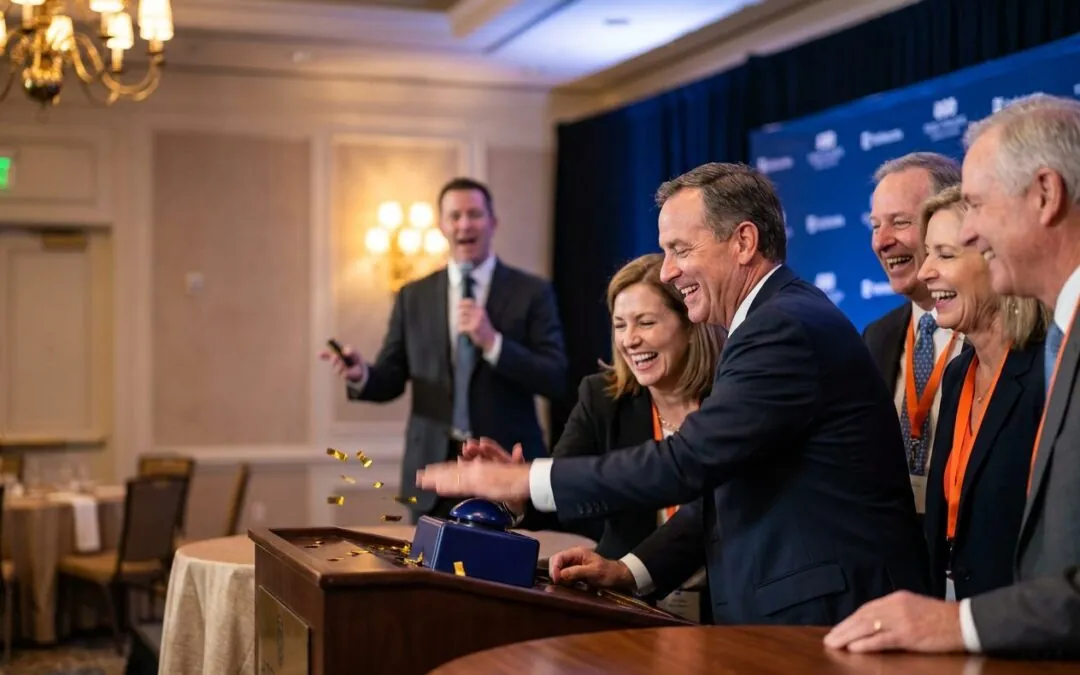
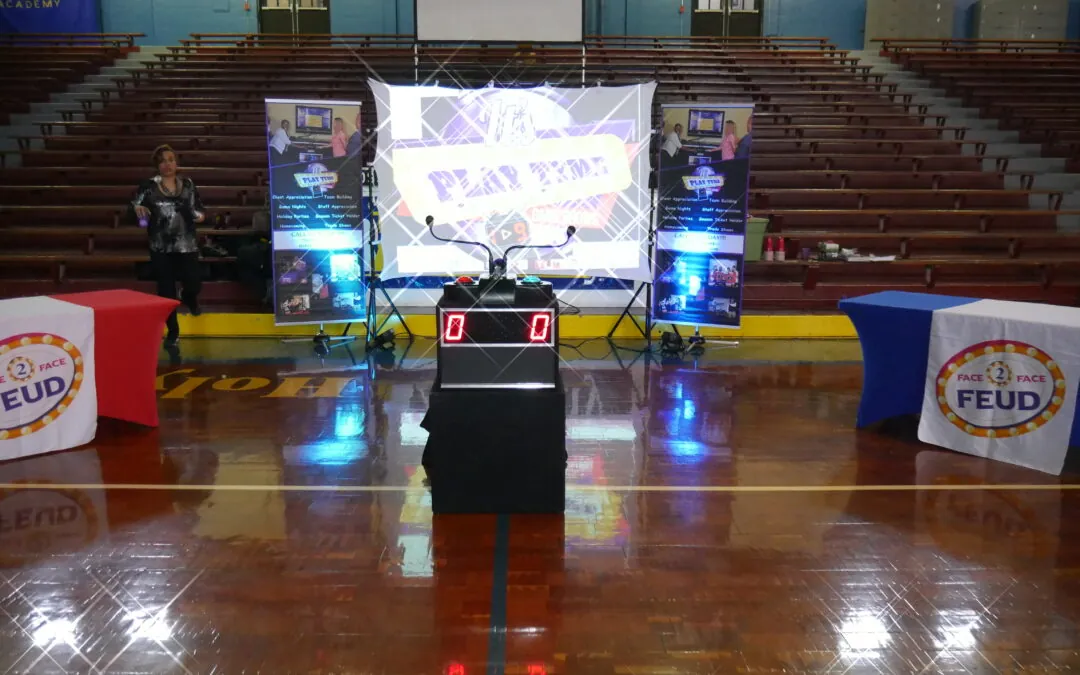
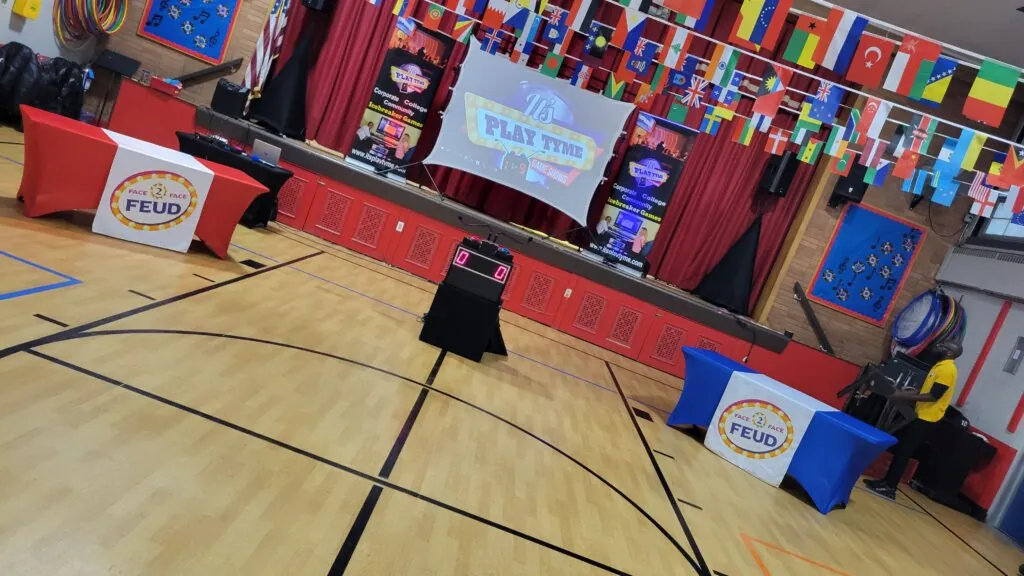
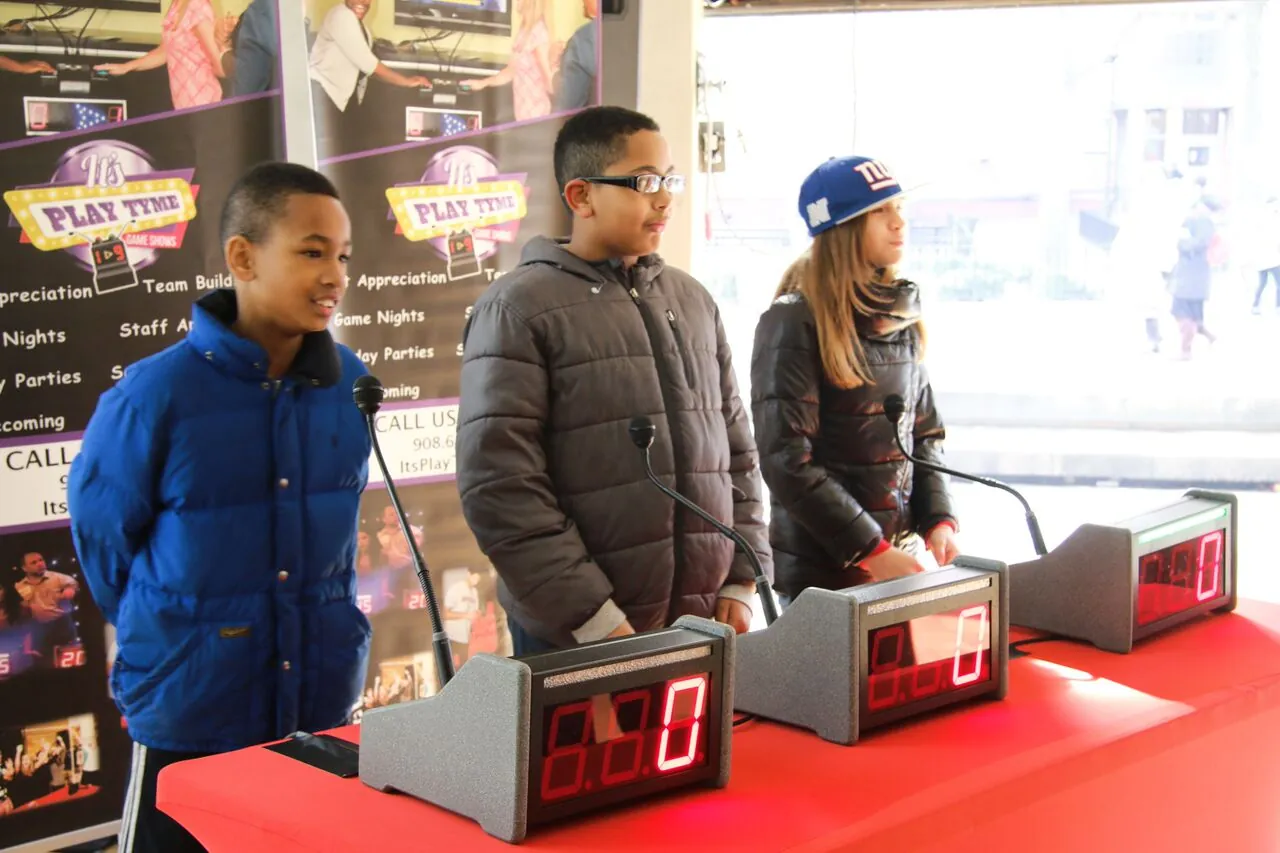
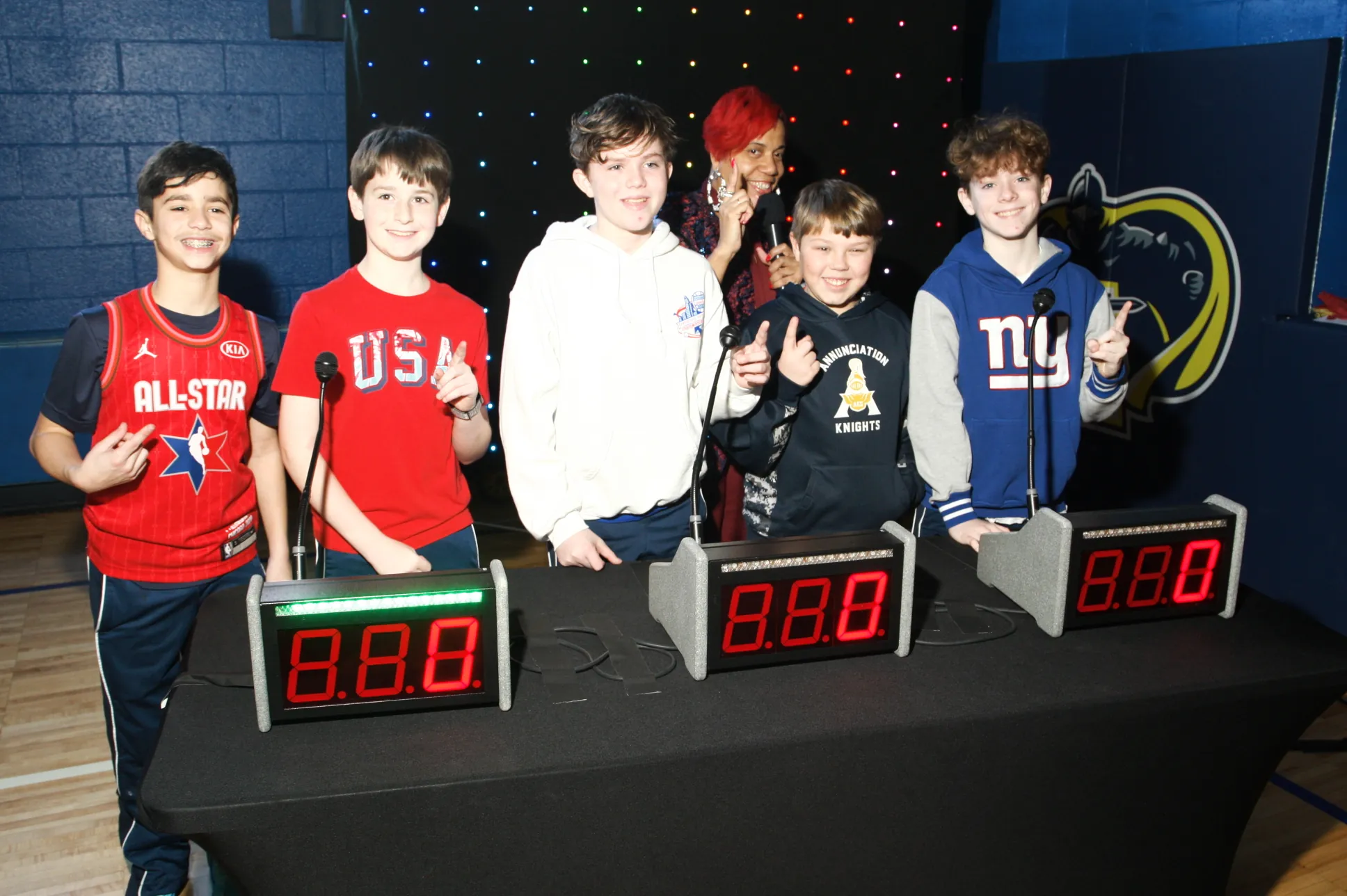
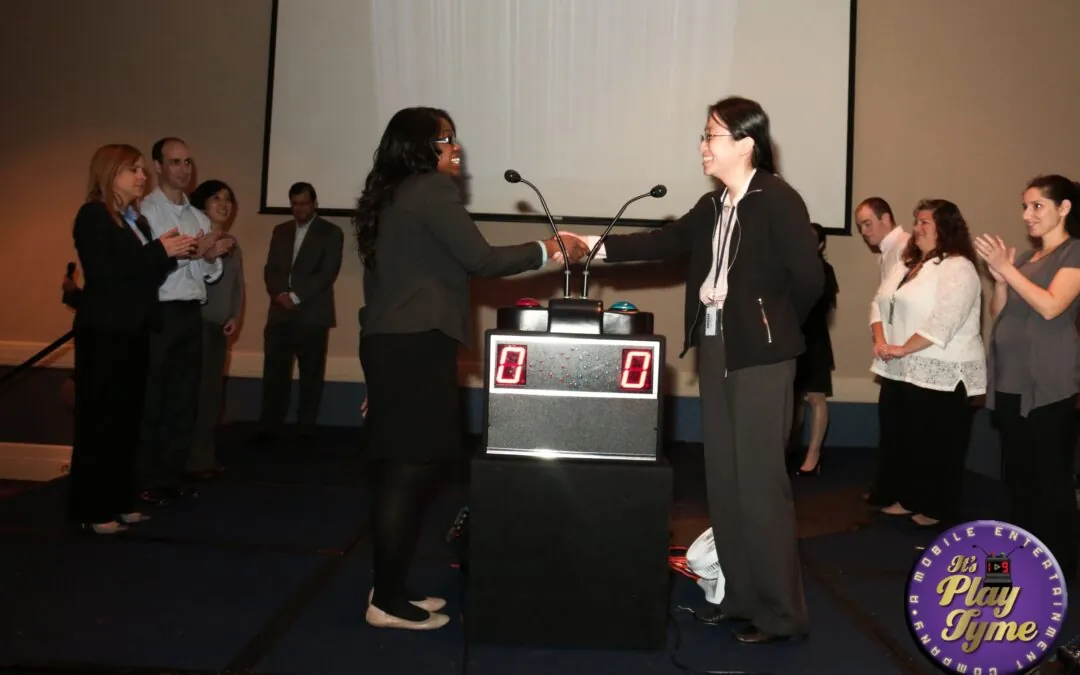
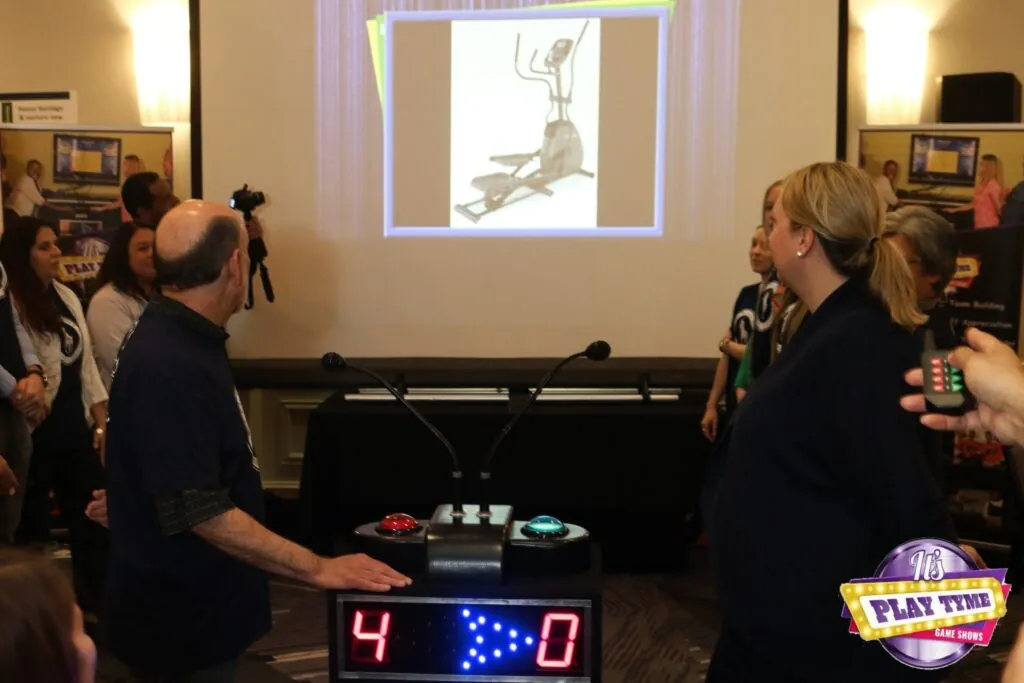
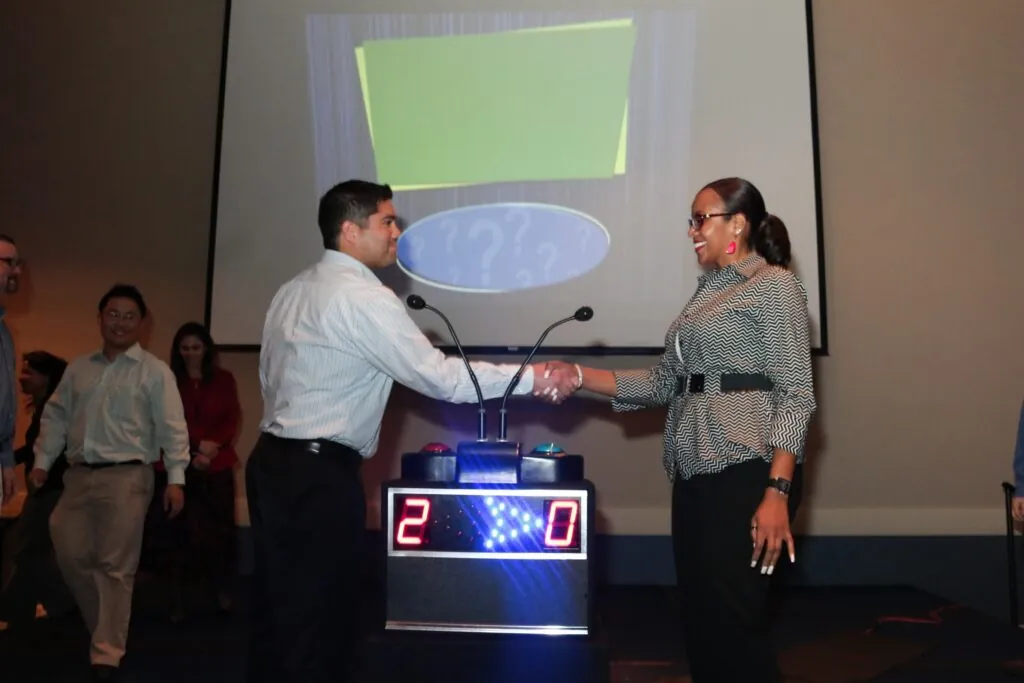
We bring a fully hosted game show to your venue across New Jersey, New York City, New York State, and Connecticut. We supply the professional host, the podiums, the digital scoreboards, the sound system, and the music. Your committee sets up nothing.
The game show is the vehicle, not the point. It gets 200 people laughing, competing, and shouting for a coworker they met an hour earlier. Nobody has to volunteer a fun fact about themselves, and nobody needs a drink in hand to be part of it. We run corporate team-building events for companies and schools, and the same formats carry both rooms.
Best for: corporate and school groups of 20 to 300 where everyone plays.
Published price: starts at $2,995 for a 60-minute show and $3,595 for a 90-minute show. Groups of 300 or more receive a custom quote. See full pricing. Price does not include setup and breakdown, travel, customization, or gratuity.
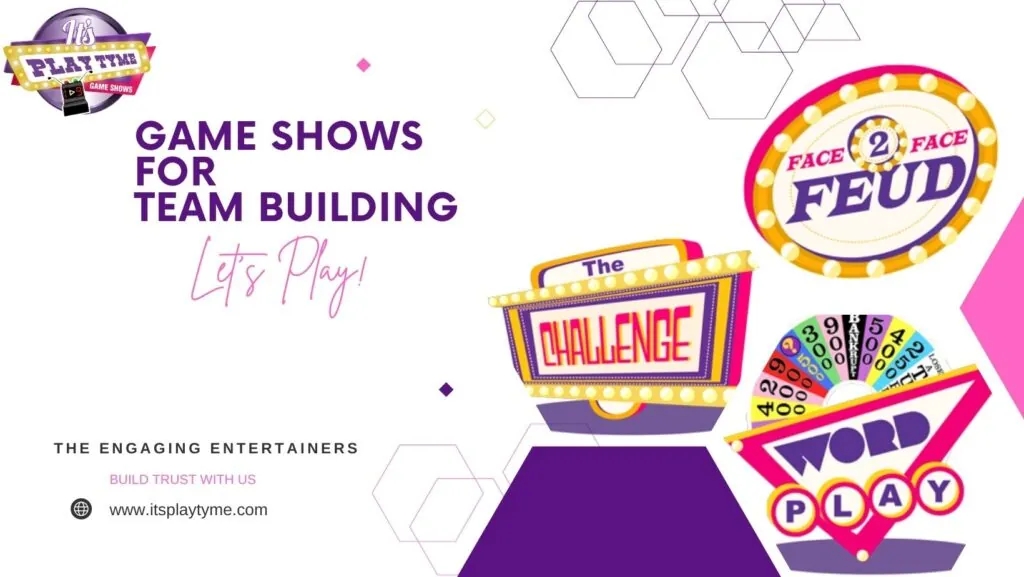
Formats: The Challenge, Face 2 Face Feud, Word Play, Game Show Mania, and 60 Seconds of Fame.
What works: everyone plays at once, so the room has no spectators. Every show is backed by our 100% Satisfaction Guarantee, so the risk sits with us, not your budget. Your planning committee carries nothing heavier than the prize bag. Because we travel to your office or banquet room, nobody has to solve parking or coordinate a bus.
The Escape Game runs heavily produced puzzle rooms, including a Midtown Manhattan location and a New Jersey location at American Dream in East Rutherford. Teams work a themed room and have to talk constantly to beat a 60-minute clock. The sets look like film sets.
Best for: single departments and small leadership teams.
Published price: not listed publicly. Group rates come by quote.
Standout: detailed set design, a live game guide, and air conditioning in August.
What works: it forces fast communication under a deadline and keeps your team out of the heat.
Where it breaks down: room capacity splits a large company into separate groups that never meet, and enclosed spaces with a countdown clock genuinely stress some employees.
Classic Harbor Line sails yachts and schooners out of Chelsea Piers in New York City. The fleet includes Schooner America 2.0, and the company runs architecture tours, sunset sails, and private charters past the Statue of Liberty.
Best for: mid-sized groups marking a company milestone.
Published price: not listed publicly. Charters are quoted by vessel, catering, and duration.
Standout: harbor and skyline views, open decks, and bar service.
What works: the setting feels like a reward, and nobody slips out early.
Where it breaks down: a rough forecast changes the whole evening, and a cruise stays passive. People sort into the same groups they always sit with, just with better scenery. Boarding times also force the whole company to arrive at one pier at one moment.
Boundless Adventures operates an outdoor adventure park in New York State built around aerial obstacle courses and zip lines. Teams climb, cross, and coach each other through the elements at height.
Best for: active teams comfortable outdoors and off the ground.
Published price: not listed publicly. Ask for corporate group rates.
Standout: a physical challenge nobody can fake their way through.
What works: teammates end up loudly supporting each other, which is hard to manufacture indoors.
Where it breaks down: it sidelines anyone with a mobility limit or a fear of heights, August heat and rain both threaten the date, and the park sits far enough out that you are organizing carpools.
Foods of NY Tours has run private group tours since 1999 through neighborhoods such as Greenwich Village and Chelsea. A guide walks your group between vetted eateries and fills the blocks in between with neighborhood history. Their corporate client list includes LinkedIn, Google, and Meta.
Best for: small teams who prefer conversation to competition.
Published price: not listed publicly. Private groups are quoted directly.
Standout: a mix of seated and standing tastings plus real neighborhood history.
What works: walking between stops creates conversation without anyone forcing it, the spend supports local restaurants, and nothing about the format depends on alcohol.
Where it breaks down: it does not scale to an all-hands, the walking route rules out anyone who cannot cover a couple of miles, and serious dietary restrictions take weeks of advance coordination.
My Cooking Party hosts private and corporate cooking events in New York City. Chefs split your group into kitchen teams, run a competition such as Dinner Duel or Battle of the Bites, and the night ends with everyone eating what they cooked.
Best for: mid-sized teams who want to build something together.
Published price: $159 per person plus 20% for the hors d’oeuvres program, rising to $229 per person plus 20% for the catered-meal program. Programs carry minimum headcount requirements.
Standout: commercial kitchens, professional instruction, and competition formats.
What works: every person owns a task, and entertainment and catering come out of one line item.
Where it breaks down: the per-head math gets steep past 50 people, standing kitchen stations are hard on anyone who cannot be on their feet for hours, and your team travels to the kitchen instead of the event coming to your office.
How to Pick the Right Summer Event for Your Headcount
Start with the number of people, not the theme. A team of eight fits a cooking class or a food tour. Logistics stay simple, everyone hears everyone, and nobody disappears into a crowd.
Past 20 people, the math changes. You need one centralized activity that scales, or the group splits into the same clusters it walked in with. Comparing corporate entertainment ideas by group size is the fastest way to rule out formats that cap out below your headcount.
Then check the calendar and the room. Book an indoor or covered option in August, or price the weather risk before you sign. Check step-free access and seating while you are asking. Then count the transfers: every address your team has to drive to costs you people who were going to come.
Finally, confirm who runs the event minute to minute. If the answer is you, you are not attending your own party.
Ready to book a summer event your team actually wants to attend? Get a quote and we will bring the host, the podiums, and the scoreboards to your venue anywhere in New Jersey, New York City, New York State, or Connecticut.
Frequently Asked Questions (FAQs)
What are the best summer office party ideas for large groups?
For 50 people or more, pick formats built on structured participation. Live hosted game shows, private charters, and hosted trivia hold a large room together. They give the group one focal point, which stops a big party from splitting into departmental tables.
How do you get employees to participate without it feeling forced?
Use a professional host and a format people already know. A team game like Face 2 Face Feud removes the pressure of small talk because the rules do the work. Adults play willingly when the game is familiar, the pace is fast, and nobody is asked to share feelings in front of colleagues. Putting a game at the center rather than an open bar also keeps employees who do not drink fully in the room instead of standing at the edge of it.
What are the best indoor summer office party ideas in NYC and NJ?
August heat and thunderstorms make an indoor or covered room the safer default. In New York City and New Jersey, the formats that hold up are a live hosted game show brought to your own office or banquet room, a chef-led cooking competition in a commercial kitchen, and a timed escape room. All three run on schedule whatever the forecast does, and the first one travels to you, so nobody has to solve parking at a second address.
How much should we budget for summer office party entertainment?
Budget by format and headcount. A fully hosted game show from It’s Playtyme Game Shows starts at $2,995 for a 60-minute show and $3,595 for a 90-minute show, with a custom quote for groups of 300 or more. See full pricing for details. The price excludes setup and breakdown, travel, customization, and gratuity. Per-head formats such as a chef-led cooking competition start at $159 per person plus 20%.
Where does It’s Playtyme Game Shows perform?
We bring the show to your venue across New Jersey, New York City, New York State, and Connecticut. We supply the host, the podiums, the scoreboards, and the sound. You supply the room and the people.
Every annual sales kickoff carries the same risk. You book a full day of slides, and by mid-morning your top closers are answering email under the table. Gallup’s latest global workplace research found that only 20% of employees worldwide were engaged in 2025, a decline that costs the world economy roughly $10 trillion. Passive listening does not move that number.
The second worry is booking something that feels forced. Sales professionals reject cringeworthy team exercises faster than anyone else in the building. They want real interaction, and genuine connection at work is rarer than most leaders assume. Gallup also reports that a mere two out of 10 U.S. employees strongly agree they have a best friend at work. Your headcount then decides the format, because 25 regional leaders and 300 field reps need very different vehicles.
Key Takeaways
Match the format to the headcount. What lands with 25 executives falls apart with 300 field reps.
Measure the event by how many people play, not by how many show up.
Hire a professional host instead of running a DIY activity. Competitive sales teams punish amateur delivery.
Open the day with the high-energy activity. Burying it at 5 p.m. wastes it.
For hybrid teams that gather once a year, structured competition beats an open mixer every time.
Why Most Sales Kickoffs Lose the Room
The passive listening trap
Sales teams run on action, competition, and dialogue. Eight hours of slide decks kills all three. Once laptops open, you have lost the afternoon and the product updates land on nobody.
Forced networking nobody enjoys
Unstructured cocktail hours and sharing circles push the work onto your attendees. Introverts drift to the corners while three extroverts run the conversation. A structured competition gives everyone a reason to talk and removes the small-talk tax.
The wrong format for your headcount
Small-group problem solving with 200 people turns into noise. Twenty executives on a large stage feels empty. Sorting corporate entertainment ideas by group size catches that mismatch before you sign anything.
Hybrid teams that only meet once a year
For most distributed sales organizations, the SKO is the single day the remote half of the team stands in the same room as the office half. Field reps arrive as names on a Slack channel. Left to an open mixer, they orbit the two people they already speak to daily and fly home no better connected. Assigned, mixed teams solve that in the first ten minutes.
A sales floor that spans four generations
Your newest SDR and your longest-tenured enterprise rep may be 40 years apart. A trivia set built on 1980s pop culture loses one group; a format built entirely on app-based scoring loses the other. Formats that mix question categories, or that run on teams rather than individuals, keep both ends of the roster scoring.
Fun scheduled last
Entertainment parked at the end of a nine-hour agenda competes with flights, dinner reservations, and inbox backlog. Half the room leaves early. Put it first and the energy carries the content that follows.
Venue and audio-visual charges nobody quoted in New Jersey and New York City
New Jersey and New York City venues bill house labor, power drops, and rigging after the contract is signed. Most also require a certificate of insurance from every vendor. Get those line items in writing before you compare quotes side by side.
No numbers to defend the budget with
Finance defends next year’s line item, not the memory of a good night. When your CFO asks what the entertainment block returned, “everyone had a great time” is not an answer. Track participation rate, post-event survey scores, and how many cross-team names reps can recall the following week, then bring those three figures to the budget conversation.
Sales Kickoff Entertainment Compared by Group Size and Budget
Six formats, six very different planning loads. Published pricing is rare in this category, so treat any verbal quote without a written scope as a starting point.
Our philosophy at It’s Playtyme Game Shows is simple. Great events aren’t measured by how many people attend. They’re measured by how many participate. Since 2012, our founder and hosting team have run more than 3,000 events using live game shows as the vehicle for competition, laughter, and connection.
This is a fully hosted opening act. We bring the host, the sound engineer, the equipment, and the pacing, and your reps compete in teams from the first minute. Formats include Face 2 Face Feud, The Challenge, Word Play, 60 Seconds of Fame, Trivia Mania, and PlayPad Mania. We serve corporate and education groups across New Jersey, New York City, New York State, and Connecticut.
Best for: high-energy opening or closing sessions for 25 to 300 people.
Pricing: starts at $2,995 for a 60-minute show and $3,595 for a 90-minute show. Groups of 300 or more receive a custom quote. See full pricing. Price does not include setup and breakdown, travel, customization, or gratuity.
What works well:
Turnkey execution, so your sales operations team plans nothing.
Everyone plays. No one sits on the sidelines watching four volunteers.
Team assignments mix regions and departments, which breaks the usual seating cliques.
Competitive Strategy Simulations
Reps love to solve problems and beat a clock. Strategy simulations drop teams into a fictional market where they allocate budget, negotiate with other tables, and outmaneuver their peers. It channels daily selling skills into a low-stakes contest and works as a midday reset.
These exercises live or die on facilitation. Clear rules keep the room moving, and a good facilitator adjusts difficulty to the seniority in the room. Watch the clock, because rule explanations eat more time than most planners budget.
Best for: mid-sized sales departments of 50 to 100 people who want an analytical challenge.
Pricing: not publicly listed. Cost tracks the facilitation firm and the physical materials.
What works well:
Puts negotiation and resource allocation skills to direct use.
Holds the attention of analytical team members who tune out of party formats.
Where it falls short:
Long setup and rule briefing before anything fun happens.
Reads like actual work unless the theme is strong.
Peer Recognition Awards Dinners
Celebrating wins matters to sales teams, and a certificate handout does not count as celebrating. A peer recognition dinner hands the awards to teammates rather than to the org chart. Managers write the categories, colleagues present them, and the room does the rest.
Keep the humor positive and specific to the person. The best version of this format produces inside jokes your team still repeats at the next kickoff.
Best for: evening sessions and larger sales organizations of 100 to 300 people.
Pricing: not publicly listed. Catering, venue, and award production drive the number.
What works well:
Creates shared references that outlast the event itself.
Adapts to your culture without a vendor rewriting anything.
Where it falls short:
Every category needs vetting so the jokes stay professional and inclusive.
People sit with the same team all night, so departments never mix.
Interactive Pitch Competitions
A kickoff is the right moment to sharpen product messaging under pressure. Split the room into random teams, hand each one an absurd fictional product, and give them 20 minutes to pitch a panel of executive judges. The randomized teams do the networking work for you.
The ridiculous product removes the fear of getting it wrong. Reps practice structure, objection handling, and close, and the audience gets a genuinely funny hour.
Best for: intimate sales teams up to 25 people, or regional breakouts inside a larger kickoff.
Pricing: not publicly listed. Run in-house, it needs props, a timer, and a block on the agenda.
What works well:
Real presentation practice inside a comedic setting.
Entertaining for everyone watching, not just the presenters.
Where it falls short:
Extroverts take the mic and quieter reps end up as scribes.
Executives have to block real time to judge it properly.
Trivia Tournaments
Trivia is the most flexible energy tool on this list. Mix company history with pop culture, sports, and industry questions, and the whole room has a shot at scoring. Buzzers or a scoring app add a competitive edge that a whiteboard cannot.
Trivia scales from a small breakout to a full ballroom and asks nothing physical of attendees, which keeps it comfortable for every person in the room. The tradeoff sits in delivery: the questions are only half the show, and the host is the other half.
Best for: fast opening sessions or the post-lunch slump, at almost any headcount.
Pricing: not publicly listed for DIY platforms. Cost depends on whether you hire a host or run software yourself.
What works well:
Scales from a 20-person breakout to a ballroom crowd.
Teams confer quietly, then shout the answer, so nobody is exposed alone.
Where it falls short:
DIY software versions stall on Wi-Fi and flat delivery.
People stay seated, so the room never mixes.
Charity Build Challenges
Pairing competition with a cause gives a kickoff a second payoff. Teams race to assemble bicycles, care packages, or wheelchairs for a local nonprofit, then hand them over on site. The shared deadline forces collaboration between people who rarely work together.
The handoff moment is the point. When the charity representatives walk in to collect the donations, the room gets a reason to care beyond the quota slide.
Best for: mid-sized to large organizations that want a purpose-driven afternoon block.
Pricing: not publicly listed. Materials and the donation itself usually make this the priciest option here.
What works well:
Delivers something tangible to the local community.
Pulls attention away from internal metrics for an hour.
Where it falls short:
Logistics and charity coordination start weeks ahead.
The pace is too gentle to open a kickoff.
How to Choose Sales Kickoff Entertainment That Fits Your Room
Two factors settle it: the exact headcount and where the activity sits on the agenda. A format built for 25 will not hold 300, and the best activity in the world dies in a 5 p.m. slot. Confirm the final headcount before you shortlist anything, then hold the opening block on the agenda rather than the closing one. If half your reps work remotely, weight the decision toward formats that assign mixed teams instead of formats that hope people mingle. Then pick corporate team-building that guarantees participation without putting your planning committee on stage. When the host, equipment, and pacing arrive with the vendor, your sales leaders get to play alongside their teams instead of running the show.
Want a kickoff where the whole room plays? Book your event and we will bring the host, the format, and the equipment to your venue. Every show is backed by our 100% Satisfaction Guarantee.
Frequently Asked Questions (FAQs)
How much does a live game show cost for a sales kickoff?
Pricing starts at $2,995 for a 60-minute show and $3,595 for a 90-minute show. Groups of 300 or more receive a custom quote. See full pricing for details. The price does not include setup and breakdown, travel, customization, or gratuity.
What is the best opening activity for a sales conference?
The best opener creates immediate interaction without putting anyone on the spot. A professionally hosted game show does that in the first five minutes, mixes teams across regions, and sets the energy level for the sessions that follow.
How do you handle large sales kickoff events in New Jersey and New York City?
We scale the format so participation stays high. Large rooms use team-based answering, rotating on-stage players, and faster pacing, which keeps a crowd of 300 locked into the same competition. We bring the full setup to your hotel ballroom, conference venue, or office across New Jersey, New York City, New York State, and Connecticut.
Why does a live hosted format work better for hybrid sales teams?
Remote reps who see each other once a year need structure, not an open room. A hosted game show assigns mixed teams on arrival, so a field rep from Connecticut is competing beside someone from the New York City office within minutes. The connections happen inside the game instead of depending on who is willing to introduce themselves.
Are these activities suitable for introverted team members?
Yes, and often better than open networking. The rules are clear, the attention sits on the game rather than the person, and everyone plays inside a team. Nobody has to walk up to a stranger and start a conversation cold.
Senior leaders are the toughest room at any offsite. They run large divisions, make expensive calls, and have no patience for forced interaction or a mandatory trust fall. Get the first evening wrong and the rest of the agenda feels like a chore.
The problem runs deeper than one awkward hour. Gallup’s 2026 State of the Global Workplace report found manager engagement dropped five points between 2024 and 2025, from 27% to 22%, the largest year-over-year decline it recorded. Connection is scarce too: Gallup reports that a mere two out of 10 U.S. employees strongly agree they have a best friend at work.
So the entertainment slot is not filler. It is the one hour where leaders stop presenting and start talking to each other. Here are six executive offsite entertainment ideas that respect a senior audience and still get every person in the room playing.
Key Takeaways
Respect the audience: Senior leaders reject exercises that feel juvenile. Pick formats that treat them like adults and protect their time.
Participation beats attendance: Great events are not measured by how many people show up. They are measured by how many actually play.
Hand off the hosting: Groups of 10 to 50 executives do best with a professional host, so no one on your team runs the room instead of joining it.
The activity is the vehicle: The product is the group dynamic you carry into the next morning’s strategy session.
Why Most C-Suite Retreats Derail Before Dinner
Planning for the C-suite comes with obstacles a standard vendor never sees. These people command rooms for a living, which makes them a hard crowd. Here is what goes wrong most often with corporate event entertainment at a leadership retreat:
Fear of looking foolish: Executives protect their reputations. If the opening activity feels silly, they check out and reach for their phones.
Watching sold as participating: A comedian or a guest speaker fills the hour. The room sits in the dark, nobody interacts, and nobody learns anything new about a peer.
Cynicism toward soft exercises: Most of these leaders have already sat through a psychological-safety workshop. Any format that announces its own purpose gets heard as a lecture, and the room quietly opts out.
Three voices owning the floor: Unstructured networking hands the evening to the most outgoing people in the division. Everyone else nods along and leaves knowing nothing new about a peer.
DIY hosting: Handing the HR director or the CEO a trivia deck turns a participant into a stage manager. They referee scoring disputes instead of playing.
Formats that do not scale down: What fills a 500-person all-hands lands flat with 20 senior vice presidents. Small rooms need different pacing.
Venue costs nobody quoted: Hotels and conference centers in New Jersey and New York City add audio and video minimums, union load-in labor, power drops, and certificate-of-insurance requirements after you sign.
Split arrivals: Flights slip and board calls run long. Any format that needs all 30 people seated at 6:00 sharp will not survive contact with an executive calendar.
Hybrid attendees left watching: Two regional leaders on a laptop screen see the whole evening happen without them unless the format includes them by design.
Nothing carried into Monday: The offsite ends, everyone flies home, and nothing from the evening shows up in the next quarter’s operating rhythm. With no owner for the follow-through, the invoice reads as a cost line and the retreat gets cut next year.
Fixing this takes structure. You want an experience organized enough to remove the awkwardness and competitive enough to hold sharp minds for a full hour.
Executive Offsite Entertainment Compared by Format, Venue & Price
Use this to shortlist fast. Published pricing is listed where a provider publishes it.
1. Professionally Hosted Game Shows by It’s PlayTyme Game Shows
It’s PlayTyme Game Shows runs experiential executive team building activities for organizations across New Jersey, New York City, and Connecticut. Founder Lisa Lawrence started the company in 2012 after 20+ years as a choreographer, watching the same pattern at event after event: a handful of people participate and everyone else spectates. The live game show is the vehicle. Participation is the product.
For a leadership group of 10 to 300, a hosted show works as the opening-night activity. Executives step up to a podium, hit a buzzer, and answer fast questions in front of their peers. Titles come off for 60 or 90 minutes.
Formats include fast-paced buzzer rounds like Face 2 Face Feud and a head-to-head knowledge format called The Challenge. A professional host, sound engineer, game-show set, audio and video equipment, keypads, and prizes come with the booking, so the organizer sits down and plays. Tell the team your date, room size, and goal, and we will set up a quick discovery call. No deposit required. More than 3,000 live events since 2012 back that process.
Pricing: shows start at $2,995 for a 60-minute experience and $3,595 for a 90-minute experience. Groups of 300 or more receive a custom quote. See full pricing. Setup and breakdown, travel, customization, and gratuity are not included.
Best for: executive teams of 10 to 300 who want a turnkey evening where every person plays.
2. Facilitated Culinary Challenges by My Cooking Party
My Cooking Party runs corporate cooking classes and team-building events out of its New York City kitchens. A cooking competition puts senior leaders shoulder to shoulder outside their operating roles. The CFO and the head of marketing have to produce one dish on one clock.
Professional chefs judge and coach at the same time. The kitchen strips out formality fast. People chopping vegetables and watching a hot pan drop their meeting personas within ten minutes.
Best for: small leadership groups of roughly 10 to 20 who like hands-on work.
Pricing: not publicly listed.
Pros:
Flattens the hierarchy without anyone announcing that it will.
Forces real-time problem solving under a hard deadline.
Cons:
Requires travel to a commercial kitchen venue.
Loses the leaders who dislike cooking or getting messy.
3. Private Corporate Tastings by City Winery
City Winery hosts private corporate events at its New York City and Hudson Valley locations. A guided tasting gives leaders somewhere to land after a heavy day of strategy work. An open bar sends people back to the colleagues they already know. A tasting gives the whole room one thing to talk about.
A sommelier walks the group through history, flavor, and production. The tone reads premium, which matters with this audience. The instruction carries the evening.
Best for: evening wind-down after a dense day of board sessions, roughly 15 to 60 people.
Pricing: not publicly listed.
Pros:
Relaxed pace leaves room for side conversations.
Feels premium and exclusive.
Cons:
Sidelines anyone who does not drink.
No competitive element, so quieter leaders stay quiet.
4. Strategic Museum Tours by Museum Hack
Museum Hack runs unconventional, fast-paced guided tours of New York City museums, and offers corporate versions built around storytelling. Guides pull leadership and history threads out of the exhibits rather than reciting placards. The audience is adult, curious, and highly educated, and the tours are written for exactly that.
Leaders walk, look, and react instead of sitting. Guides keep the energy up across a full tour. It produces conversations a boardroom dinner never starts.
Best for: intellectually curious executive teams meeting in New York City, roughly 10 to 40 people.
Pricing: not publicly listed.
Pros:
No venue booking or setup for the organizer.
Combines movement with strong storytelling.
Cons:
The team has to travel to a public building.
Less private than a closed corporate space.
5. Philanthropic Build Events by TeamBonding
TeamBonding has run corporate team-building events for 35 years and lists New York among its featured locations. Its charitable build events give a senior team something physical to finish together. Groups assemble bicycles for local charities, build wheelchairs, or pack care kits.
Executives are competitive people. Put a real recipient at the end of the build and the room commits inside of five minutes. Teams read instructions, split the manual work, and test what they made.
Best for: mid-sized leadership groups of 30 to 50 with a social-responsibility goal.
Pricing: not publicly listed.
Pros:
Ends with a finished product the team is proud of.
Delivers something to the local community.
Cons:
Needs a large amount of open floor space.
Setup and assembly eat a big block of the agenda.
6. High-End Escape Rooms by The Escape Game
The Escape Game operates locations at New Jersey’s American Dream and in Brooklyn and Midtown Manhattan, with 60-minute adventures built for groups. The rooms ask executives to do what they already do well: read messy information, delegate, and solve under a clock. Teams decode locks, open boxes, and assemble a storyline before time runs out.
Nobody escapes alone. The CEO has to trust three colleagues to work three problems at once. You learn a lot about a team by watching who takes the pen.
Best for: analytical teams that enjoy pressure, split into room-sized squads.
Pricing: not publicly listed.
Pros:
Mirrors fast collaborative problem solving.
Immersive sets hold attention completely.
Cons:
The timer stresses some participants.
Room capacity limits split larger leadership groups apart.
How to Choose the Right Executive Offsite Entertainment for Your Senior Team
Match the format to the outcome, not to the brochure. If you want the group talking by breakfast, choose the option where all of them play at once rather than one where they rotate through stations.
Four questions settle it. Does every person participate, or do some watch? Does someone on your payroll have to run it? Does it hold up if six people walk in twenty minutes late? And can you name, before you book, the one thing you want leaders doing differently in the next quarterly session?
A professionally hosted event answers the first three outright. It removes the hosting burden, ends the awkward mingling, and gets the whole room competing on the first night. The fourth is yours to decide, and writing it down before the offsite is what keeps the evening from evaporating on the flight home.
Ready to give your leadership team an evening they actually join in on? Book your event with It’s PlayTyme Game Shows. Every show is backed by our 100% Satisfaction Guarantee.
Frequently Asked Questions (FAQs)
What makes a good opening activity for a senior leadership team?
The best opening activity removes the pressure of working the room and puts everyone on equal footing. It should feel structured, competitive, and adult. Anything that reads as juvenile or patronizing loses this audience in the first two minutes.
Can a game show work for a small group of 15 executives, and how long should it run?
Yes. Hosted formats scale down well, and in a room of 10 to 20 leaders every person gets multiple turns at the buzzer. Plan on 60 or 90 minutes, depending on the format, which is long enough to break the ice and still leave the dinner reservation intact.
How much does executive offsite entertainment cost in New Jersey and New York City?
Published pricing for a fully hosted game show starts at $2,995 for a 60-minute show and $3,595 for a 90-minute show. Groups of 300 or more receive a custom quote. See full pricing. Setup and breakdown, travel, customization, and gratuity are quoted separately. Most other tri-state providers quote per event rather than posting rates, so ask what the number includes before you compare. For a wider breakdown of the market, see how much corporate team building costs.
What are the best executive offsite activities for hybrid teams?
Choose a team-based format with a single shared scoreboard rather than one built on individual spotlights or room-by-room rotation. Remote leaders join a table by video and answer the same rounds on the same clock, so they compete instead of spectating. The same structure pulls in quieter executives, who contribute what they know without performing alone in front of the room.
Do you travel to offsite venues across New Jersey, New York City, and Connecticut?
Yes. It’s PlayTyme Game Shows is based in Teaneck, New Jersey and brings the full production to your hotel, conference center, or office across New Jersey, New York City, and Connecticut. Travel is quoted separately from the show price.
Quick Answer: What Are the Best Interactive School Assembly Games?
The best interactive school assembly games keep students actively involved instead of sitting quietly and watching. High-energy formats like trivia competitions, game shows, audience-response challenges, music games, and team-based activities help increase participation, improve focus, and create stronger student engagement during school assemblies.
Interactive assemblies work best when they:
involve the entire audience
reduce social pressure
encourage teamwork and school spirit
match the age group of the students
move at a fast pace to prevent disengagement
For schools in New Jersey, NYC, and Connecticut, live game show-style assemblies are especially effective because they combine structured participation, friendly competition, and entertainment in a way students already understand and enjoy.
Whether you are planning a back-to-school kickoff, Red Ribbon Week, SEL program, or school culture event, interactive games help students connect, participate naturally, and stay engaged from beginning to end.
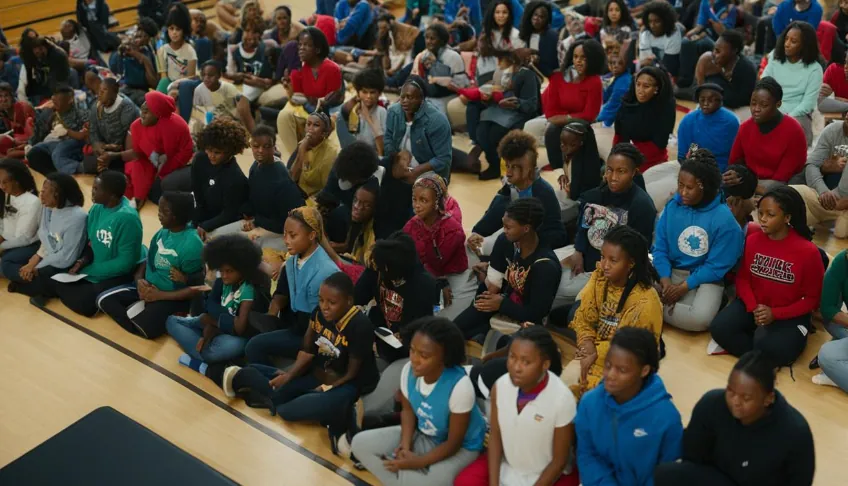
School assembly games are quickly becoming the go-to solution for Principals, PTO leaders, and school administrators who are tired of watching students mentally check out just minutes into a traditional assembly.
Instead of sitting through another lecture, today’s K-12 audiences respond to something very different; they want to be part of the experience. That’s where interactive, game-based assemblies come in, designed to engage elementary, middle, and high school students in ways that actually hold their attention.
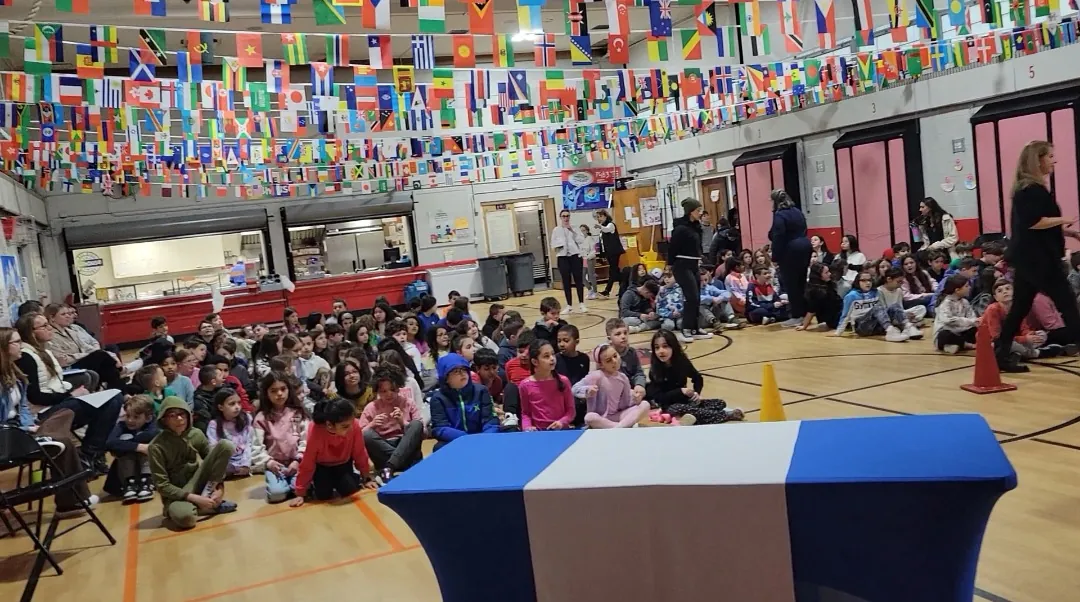
If you’ve ever planned a school assembly in New Jersey or New York City and felt the energy drop before the first slide even finished, you already know the challenge. The truth is simple: students don’t connect with long speeches or one-way “motivational talks.” They connect through interaction, competition, and shared moments.
That’s why high-energy, game-style assembly experiences work: they turn large groups into active participants rather than passive spectators, creating real engagement from start to finish.
×
Need a School Assembly Program That Students Will Actually Participate In?
Get a fast quote for a live game show experience designed for teams across New Jersey, NYC, and Connecticut.
That’s where live, game-show-style school assemblies change everything. These assemblies combine learning with competition, laughter, and teamwork, creating an experience where students are cheering, collaborating, and thinking on their feet all at the same time. The result is higher engagement, stronger social confidence, and a noticeable boost in school spirit.
This isn’t entertainment for entertainment’s sake. It’s fun with a purpose, designed to hold attention, encourage positive behavior, and create shared moments students actually remember long after the assembly ends.
In the next section, we’ll break down proven school assembly game ideas that schools across NJ, NYC’s five boroughs are using to keep students off their phones, on their feet, and fully locked into the experience. These are the formats that work, especially for large groups without adding more work to your plate.
Age-appropriate formats ensure success for elementary, middle, and high school assemblies.
Incorporating interactive activities that create a positive and engaging environment.
Interactive school assembly games in NJ that enhance students’ cognitive abilities, improve critical thinking skills, and reinforce important subject matter.
Implementing interactive games is easier than you think.
How to Implement Interactive School Assembly Games That Actually Work
If you’re ready to upgrade your assemblies, here’s what successful schools focus on.
1. Start With the Outcome, Not the Activity
Before selecting any game, clarify what you want the assembly to accomplish. Are you aiming to:
Increase student engagement?
Encourage teamwork across grade levels?
Reinforce social skills or school values?
Energize students before or after a long academic block?
When the objective is clear, the right game format becomes obvious, and the assembly feels purposeful, not random.
2. Keep Teachers in Their Role and Not as Event Managers
Teachers and staff shouldn’t be responsible for running games, managing equipment, or keeping the pace moving. The most effective assemblies allow educators to observe, support, and participate, not troubleshoot.
When games are clearly explained and professionally facilitated, students follow the structure naturally: reducing behavior issues and pressure on staff.
3. Choose Games Designed for Large Groups
Not every activity works in an assembly setting. The best interactive school assembly games are:
Easy to understand within minutes
Inclusive of different personalities and abilities
Successful assemblies run smoothly because logistics are handled in advance. That includes:
Clear team structures
Defined time blocks
Audio and visual support that works in large spaces
A flow that keeps momentum high
When these details are planned upfront, the assembly runs smoothly, and students stay focused on the experience, not the setup.
5. Set Expectations Clearly for Students
Students engage more when they understand the rules and goals. Clear instructions, simple scoring, and visible structure help students jump in confidently.
When expectations are clear, participation increases, and discipline issues decrease.
Why More School Leaders Are Booking Interactive Assembly Games Over Traditional Assemblies
If you’re a Principal, PTO President, or School Administrator, you already know the truth: traditional school assemblies don’t hold students’ attention anymore. Long, boring lectures, slide decks, and one-way talks lose the room fast, especially in large NJ, NYC, and Connecticut schools where student energy is high, and attention spans are short.
Instead of asking students to sit quietly and listen, these assemblies invite them to participate, collaborate, and compete, turning the entire room into part of the experience. The shift is instant. Energy rises. Focus sharpens. Students lean in instead of tuning out.
And this isn’t just about making assemblies more fun.
Interactive Assembly Games Support Real Educational Outcomes
When schools book educational assembly games, learning stops feeling abstract. Concepts come to life through movement, teamwork, and problem-solving. Students aren’t just hearing information: they’re using it. That hands-on involvement leads to stronger retention and a deeper connection to the lesson.
Just as important, these games naturally reinforce skills schools care about:
Collaboration and teamwork
Communication and listening
Confidence and positive peer interaction
Respect for different perspectives
Unlike classroom settings where the same students often dominate, game-based assemblies level the playing field. Every student can participate: regardless of academic performance, learning style, or social confidence. That inclusivity is exactly why schools across New Jersey and the NYC metro area are choosing this format.
A Better Solution to the Student Engagement Problem
If you’ve noticed assemblies failing to capture students’ imagination, you’re not alone. Most schools want to break the monotony. They just don’t want chaos, awkward activities, or gimmicks that miss the mark.
Well-designed school assembly games strike a balance. They’re structured, purposeful, and high-energy. They are designed to entertain and educate simultaneously. From team-based challenges to fast-paced game show formats, students stay engaged because they’re part of the action.
If your goal is to keep students engaged, reinforce positive behaviors, and create an assembly experience they actually talk about afterward, interactive school assembly games aren’t a risk; they’re the upgrade.
Find the Perfect Game Show for Your School
Pick a Live Game Show Experience Your School’s Goals and Needs – Click Below
GAME SHOW THEMES
The Real Benefits of Fun School Assembly Games
Fun school assembly games aren’t just about entertainment; they’re a strategic way to solve some of the biggest challenges schools face today: low engagement, limited student interaction, and assemblies that don’t leave a lasting impact.
When students actively participate in structured, game-based assemblies, something important happens. They stop being passive listeners and start becoming active contributors. That shift alone changes how information is processed, retained, and remembered.
Well-designed assembly games naturally support:
Teamwork and peer collaboration
Clear communication and active listening
Critical thinking and fast decision-making
Confidence in speaking up and participating
Instead of forcing students to “pay attention,” games earn their attention. Learning becomes something they’re part of, not something happening to them.
Book a Fun Interactive Game For Your School
Call us today. Live Game Shows are our specialty. Let’s Play!
Examples of Assembly Games Students Actually Respond To
Not all games are compatible with an assembly setting. The most effective school assembly games are fast-paced, inclusive, and easy for large groups to understand.
Here are proven formats schools consistently use with success:
1: The Great Science Race
This fun and engaging game challenges students to work together in teams to complete a series of science experiments before time runs out.
Not only does it foster team building and collaboration, but it also reinforces important scientific concepts and principles.
Incorporating various subjects and themes into the questions creates a fun and inclusive competition that educates and entertains.
3: Interactive Dance-Off and LIP Sync Challenge
Get the school assembly up and moving with an interactive dance-off and lip sync challenge game that challenges students to create and perform routines.
Not only does it improve coordination and physical fitness, but it also encourages self-expression and creativity.
4: Multimedia Presentations
Taking advantage of modern technology, multimedia presentations engage students with visual aids to enhance learning.
Combining text, graphics, images, and video footage, these presentations offer interactive opportunities to introduce new concepts, promote conversations, debates, and ask questions.
5: Creative Writing Challenge
Encourage students to express their creativity and showcase their writing skills by incorporating a creative writing challenge into your school assembly.
The challenge could include writing short stories, poems, or a group collaborative writing assignment that encourages teamwork and creativity.
6: Student Debates
Encourage critical thinking, public speaking, and decision-making skills with student debates.
Select a divisive topic relevant to the students or current events, establish the foundations of debate in a respectful and fair manner, and allow students to take charge and make their case.
7: Virtual Field Trips
Experience history, culture, and nature through an interactive and virtual perspective, using technology to transport students to other places virtually.
An excellent tool for creating memorable and engaging assemblies where students can efficiently travel for social studies, geography, and science lessons.
Incorporating such engaging assembly activities can make a huge difference in the overall educational experience of students.
Use these examples as inspiration and create your own exciting and engaging games for your next school assembly!
8: Real World Simulation Game
Interactive scenarios where students work through challenges like launching a business, solving community problems, or managing resources.
These activities build practical thinking skills while exposing students to real-life applications of what they learn in school.
9: Team Construction Challenge
Hands-on games where students collaborate to build structures or solve physical challenges using everyday materials.
These activities strengthen communication, leadership, and problem-solving: without singling anyone out.
The common thread is that every student can participate, regardless of academic level or personality type.
Game Show Theme Ideas For School Assemblies
1. Face-2-Face Feud (School Edition)
A fast-paced twist on Family Feud where two teams battle it out answering hilarious, school-friendly survey questions.
2. Majority Rules For Students K-12
Students guess the majority vote on funny or thought-provoking questions. The majority wins! It sparks big laughs and even bigger debates.
3. Word Play K-5
Think spelling bee meets Wheel of Fortune. A vocabulary-based game with clues, puzzles, and brain-busting buzzers for elementary school kids.
4. Match Game For Kids
Great for upper and middle school grades, where students try to match answers with popular responses or even their teachers!
5. Minute To Win It: School Style
Simple challenges using everyday items, high-speed games that test skill, focus, and teamwork in 60 seconds or less.
6. Are You Smarter Than a 5th Grader?
Teachers vs. students in an academic showdown that’s as funny as it is educational.
7. Name That Tune
From cartoons to TikTok, kids try to guess the song in the fewest seconds, perfect for music lovers.
8. Brain Games
STEM-inspired activities and riddles get kids thinking on their feet while having fun with logic and problem-solving.
9. Quiz Showdown
Classic trivia with a buzzer system, categories like pop culture, math, science, and school life make it super engaging.
10. Finish the Lyrics
Turn the gym into a concert, and students sing the next line of a song. Think karaoke meets competition!
What Interactive School Assembly Games Really Teach
Interactive school assembly games do more than keep students entertained; they quietly introduce team building in a way that feels natural, fun, and stress-free.
Most schools don’t set out to host a “team-building assembly.” They’re simply looking for engaging school assembly ideas that won’t lose students halfway through. The surprise is that the best interactive assembly games automatically create teamwork, even when that’s not the original goal.
Here’s why these games work.
Instead of asking students to sit and listen, interactive assembly games place them into shared challenges. Students collaborate, communicate, and problem-solve together, often without realizing they’re building skills that usually take weeks to develop in the classroom.
In a traditional assembly, only a handful of students stay mentally engaged. The rest fade into the background. Interactive games flip that experience by giving students:
A clear role
A shared objective
A reason to pay attention
That structure keeps large, multi-grade assemblies focused, energized, and inclusive, especially in NJ, NYC, and CT schools where assemblies can include hundreds of students at once.
The Hidden Benefits Schools Don’t Expect
When schools introduce interactive games into assemblies, they consistently see:
Stronger communication between students
Natural collaboration across grade levels
Improved problem-solving under time pressure
Increased creativity without sacrificing structure
A more positive, respectful school environment
And for students who struggle socially or hesitate to participate? Team-based games lower the pressure. Students contribute as part of a group instead of standing alone, building confidence in a safe, supportive way.
The best part, it doesn’t feel like team building.It feels like fun, and that’s exactly why it works.
Got School Assembly Games? – PRESS PLAY! #nomoreboringschoolassemblies
How Interactive Assembly Games Strengthen Student Thinking
Interactive school assembly games sharpen key cognitive skills in real time: skills that directly support academic success.
Students practice:
Focus and attention under stimulating conditions
Memory recall through fast-paced challenges
Processing information quickly and accurately
Critical thinking and decision-making
Because these skills are exercised through play, students stay engaged longer and absorb more than they would through passive instruction alone.
Just as importantly, team-based games encourage communication and collaboration. Students learn how to listen, contribute, and problem-solve with peers: skills that matter far beyond the assembly.
How These Games Create a Positive, Inclusive Assembly Experience
Interactive assembly games also shape the emotional tone of the room. When students participate together, the atmosphere shifts from passive to positive.
These experiences promote:
Respect for peers
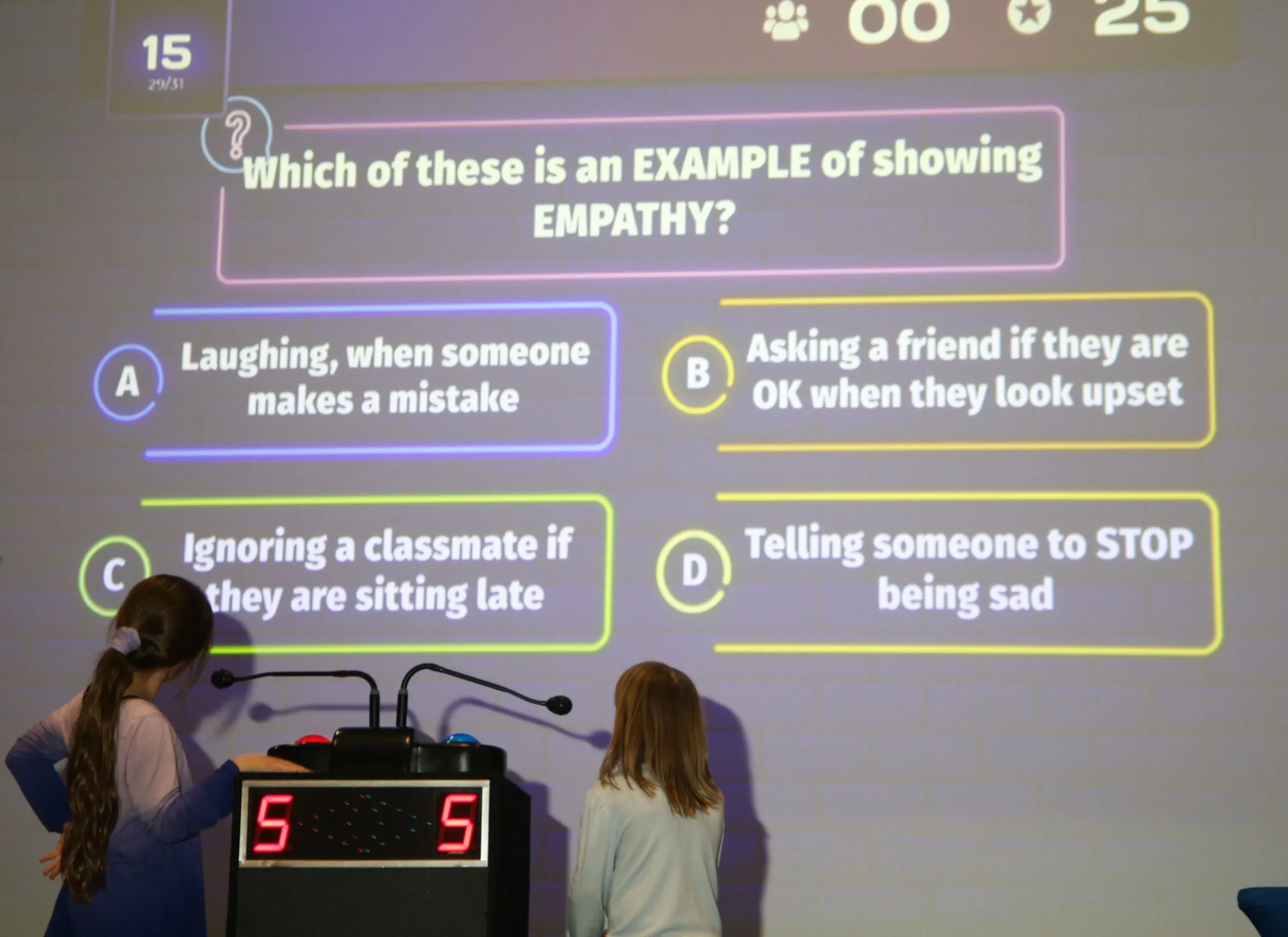
Empathy through teamwork
A sense of belonging across grade levels
Confidence in speaking up and participating
When students feel connected to each other and to the experience, they’re more likely to enjoy school and carry that positive energy back into the classroom.
Interactive school assembly games don’t just make assemblies more exciting. they create moments that strengthen school culture without adding pressure or extra work for educators.
Why Team-Building Assembly Games Work for Large, Multi-Grade
Team-building assembly games aren’t just classroom activities scaled up: they’re one of the most effective ways to engage multiple grade levels at once without losing control of the room.
In a traditional assembly, only a small percentage of students are truly engaged. The rest sit quietly, disengaged, or overwhelmed. Team-based assembly games flip that dynamic by giving students a shared goal and a clear role, which keeps participation high and behavior focused.
When schools incorporate structured team-building games into assemblies, they consistently see:
Stronger communication and collaboration among students
Better problem-solving and critical thinking in real time
Increased creativity without disrupting structure
A more positive, respectful school atmosphere
Greater empathy and peer-to-peer support
These outcomes matter most in large NJ and NYC’s 5 boroughs, where assemblies include students with different learning styles, energy levels, and social confidence.
How Schools Successfully Plan Interactive Assembly Games (Without the Stress)
Planning an interactive school assembly doesn’t mean reinventing your program, juggling extra responsibilities, or turning teachers into event coordinators. The most successful assemblies follow a simple formula: clear goals, the right game format, and a plan that runs itself once the assembly starts.
Schools that struggle with assemblies usually don’t lack good intentions; they lack a structure that works at scale. Interactive school assembly games solve that by providing built-in engagement, clear rules, and controlled energy that keeps students focused instead of overwhelmed.
The Smart Way to Introduce Interactive Assembly Games
Instead of relying on videos, slide decks, or loosely guided activities, interactive assemblies work best when games are designed specifically for large groups. These formats don’t interrupt learning: they enhance it.
Hands-on challenges, team-based games, and live game show-style activities allow students to:
Participate without being singled out
Apply concepts instead of just hearing them
Stay engaged from start to finish
The key is choosing games that are structured enough to maintain order, but flexible enough to keep students excited.
Book Your School Assembly Game Show
Call us today! Bring in a live, interactive game show that keeps K-12 students engaged
Challenges That Derail School Assemblies (and How to Solve Them)
Assemblies rarely fail because of the content. They fail on logistics, participation, and pacing. These four problems account for most of it.
1. The gym swallows the sound
A gymnasium with hard floors and high ceilings turns a single speaker into an echo, and students at the back stop listening within five minutes. Book a program that brings its own sound system and wireless microphones rather than relying on a ceiling-mounted PA built for announcements.
2. Only a handful of students take part
Calling six volunteers to the stage leaves 400 students watching. Formats built on class-versus-class or grade-versus-grade scoring keep every seat involved, because each student has a team to cheer for even when they are not holding a buzzer.
3. The schedule slips into lunch
Assemblies that start late collide with lunch waves and bus schedules, and staff spend the last 10 minutes managing the clock instead of the room. Build in a 10-minute buffer for seating, and confirm a hard stop time with the host before the day.
4. Older students refuse to engage
Middle and high school students will not participate if they risk looking foolish alone. Team-based rounds solve this, because the group absorbs the attention. The same principle applies to staff in-service days, where teachers respond to the same structured formats used in workplace team-building activities.
Match the Assembly Format to Your Group
Age band and room size decide the format more than the theme does. Use this as a planning baseline.
Grade Band
Group Size
Format That Works
Run Time
Watch For
K to 2
50 to 200
Call-and-response rounds, simple prompts
30 minutes
Attention drops past 30 minutes
Grades 3 to 5
100 to 400
Team trivia with rotating stage volunteers
45 minutes
Keep every class represented
Middle school
150 to 300+
Feud-style head-to-head rounds
45 minutes
Peer pressure suppresses volunteers
High school
200 to 800
Buzzer rounds, class versus class
45 to 60 minutes
Needs real sound reinforcement
Staff in-service
20 to 120
Staff-versus-staff game show
60 minutes
Schedule away from grading deadlines
Whole-school pep rally
300 to 1000
Music and lip-sync competition rounds
30 to 45 minutes
Gym acoustics need a pro system
How to Choose the Right Assembly Format for Your School
Interactive school assembly games don’t succeed because they’re flashy. They succeed because they’re structured, intentional, and easy to execute.
When assemblies are planned with the right format, students stay engaged, teachers stay supported, and administrators get an experience that delivers real value, without adding more work to their day.
The right interactive assembly doesn’t feel complicated. It feels like the smartest decision you made all year.
Making the Assembly Count: Curriculum Links, SEL Goals and the Room You Actually Have
An assembly that is only entertaining keeps students quiet for a period. One that is built on what they are studying is still paying off a week later. The simplest way to get there is to share your current units before the event. A fourth grade show can pull fractions, state history and the week’s ELA vocabulary, while a seventh grade show can lean on earth science, ratios and civics. The buzzer and the countdown do the rest, because recalling an answer under a little friendly pressure is exactly the kind of practice that sticks.
Game show formats also line up neatly with the social-emotional learning goals most districts already track, which helps when an assembly has to be justified at budget time. Teams have to negotiate one answer together, which builds relationship skills. Mixed-grade teams ask an older student to listen to a younger one, which builds social awareness. A ticking clock makes a group weigh its options and commit, which is responsible decision-making in action. Naming those links in your planning notes gives administrators a clear reason the period was well spent.
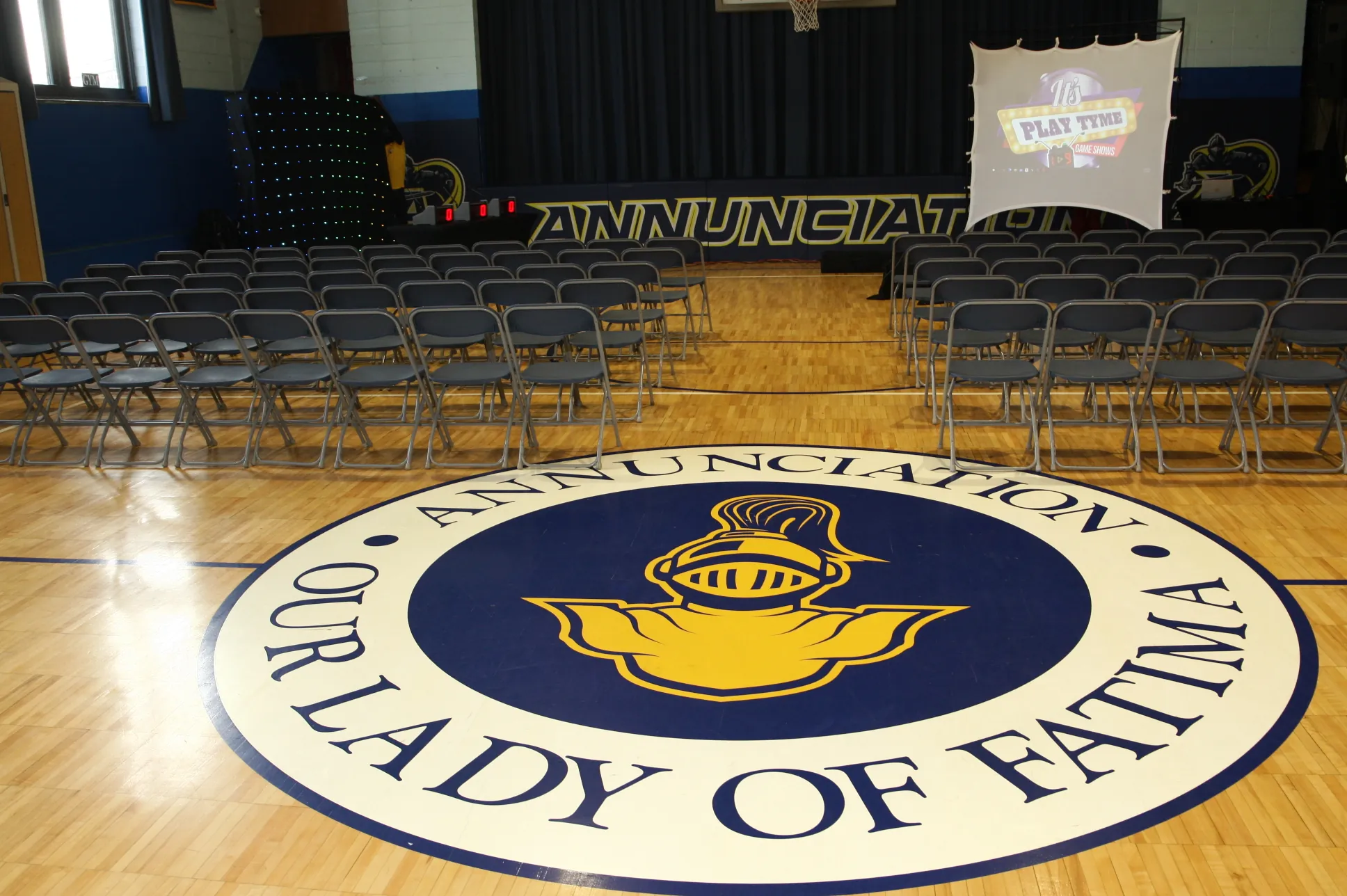
Finally, plan for the room you really have. Many schools, especially older buildings in New York City, hold assemblies in a gym, cafeteria or multipurpose room rather than an auditorium, and share that space with lunch or PE on the same day. Ask any provider exactly what they bring and what they need from you, make sure setup and breakdown fit around the bell schedule, and brief teachers on the format a few days ahead so they arrive ready to cheer on their teams instead of managing the room.
Quick Answers for Planners
Can the questions match what our students are studying right now?
Yes, and that is what separates an educational assembly from a filler period. Send over your current units and key vocabulary well ahead of the date so the rounds reinforce classroom work instead of generic pop culture.
We don’t have an auditorium. Will a gym or cafeteria work?
Usually, yes. Game show assemblies run well in gyms, cafeterias and multipurpose rooms. Settle early where power is available, how sound will carry in a large hard-walled space and how long the room is free before and after your period.
Should we run one big assembly or split students by grade band?
A skilled host can scale content for a room that spans a few grades. When the gap is wide, such as kindergarten through eighth grade, two shorter sessions by grade band usually keep everyone more engaged than one long one.
How do we explain the value of a game show assembly to district leadership?
Tie it to goals the school already reports on. Team play builds relationship skills, mixed-grade teams build social awareness and timed answers practice decision-making, so the assembly supports your SEL plan rather than taking time away from it.
How soon will we see a plan after we reach out?
It’s PlayTyme sets up a quick discovery call before preparing your proposal, and no deposit is needed to hold a date.
Frequently Asked Questions – School Assembly Games
What are the best school assembly games for large groups?
The best school assembly games for large groups are fast-paced, easy to understand, and designed for full-room participation. Trivia battles, name-that-song challenges, team problem-solving games, and live game show-style formats work especially well for multi-grade assemblies in NJ and NYC because they keep attention high while maintaining structure.
How long should an interactive school assembly game program be?
Most interactive school assembly programs run 45 to 60 minutes, which is ideal for maintaining engagement. For larger schools or special events in New Jersey and the NYC metro area, some assemblies run 60 to 90 minutes with multiple rounds to keep energy consistent and prevent attention drop-off.
Do interactive assembly games work for elementary, middle, and high school students?
Yes. Interactive assemblies are designed with age-appropriate formats for elementary, middle, and high school students. Younger students engage with visual and movement-based games, middle schoolers respond to team competition, and high school students benefit from leadership and strategy-driven challenges.
Can school assembly games be educational and still fun?
Absolutely. Educational assembly games work best when learning is built into the game mechanics instead of a lecture. Trivia can reinforce curriculum topics, simulation games can build real-world thinking, and team challenges can strengthen communication and problem-solving: all while keeping students excited to participate.
What equipment do we need for interactive school assembly games?
Most schools need a microphone, speakers, and a screen or projector if visuals are used. For gym or auditorium assemblies in NJ and NYC, clear audio matters most. If you’re booking a live game show-style assembly, the provider typically brings the game materials and production setup so staff are not stuck managing tech.
How do interactive assembly games support student behavior and school culture?
Because the games are structured and team-based, students stay focused and engaged instead of restless and disruptive. The format encourages respectful competition, teamwork, and participation, which helps strengthen school spirit and improves the overall tone of the room during large assemblies.
Do you travel to schools in New Jersey, NYC, and Connecticut?
Yes. Many schools book interactive school assemblies that are brought directly to their gym or auditorium in New Jersey first, then New York City. The benefit is simple: your school gets a turnkey experience without staff having to build an assembly program from scratch.
Where can we book a live, game show-style school assembly program?
If your goal is maximum student engagement with minimal planning stress, book a live school assembly program designed around interactive game formats. For details and booking options, visit the School Assemblies page here: https://itsplaytyme.com/school-assembly-programs/.
What if your NJ or NYC team could boost morale by 73% in just 30 minutes? Sounds wild, but Gallup research backs it up: teams who engage in light, competitive activities like team building trivia show a huge spike in job satisfaction and problem-solving abilities.
Whether you’re leading a crew in Jersey City, Newark, Paramus, or right in the heart of Manhattan, trivia challenges that blend company culture with clever, customized questions are more than just fun—they’re strategic. Teams who laugh together through fast-paced games build stronger bonds and bounce back faster under pressure—23% faster, according to the Journal of Applied Psychology.
Looking for game-changing trivia questions tailored for corporate events in Bergen County, Hudson Yards, or anywhere in the NYC metro? Keep scrolling, we’ve got you.
Key Takeaways
Team building trivia is a powerful tool for improving team dynamics and overall productivity.
Team building trivia can be adapted to suit a variety of workplace settings and objectives.
Team building trivia promotes open communication, trust, and collaboration among team members.
Want to boost morale and collaboration in your New Jersey or NYC workplace? Team building trivia is a fast, fun way to bring your team together, whether you’re based in Newark, Jersey City, Paramus, or Midtown Manhattan.
These high-energy games spark communication, build trust, and create moments of connection that go beyond the boardroom. From outdoor scavenger hunts in local parks toindoor live trivia challenges, there’s something for every setting and team size.
Even virtual teams across NYC and the tri-state area can get in on the action with customized trivia that blends company culture and laughter, boosting morale without skipping a beat.
Breaking down workplace barriers starts with better teamwork—and trivia can lead the way. Whether your team is based in Hackensack, Brooklyn, or New Brunswick, engaging group activities help coworkers connect, collaborate, and support one another.
From problem-solving games to interactive team-building workshops, these experiences spark fresh energy and reduce silos across departments.
Incorporating fun, fast-paced activities like trivia showdowns into your NJ or NYC office culture boosts morale, strengthens communication, and inspires your people to show up as their best selves.
Find the Perfect Game Show for Your Team
Pick the Ideal Match for Your Team’s Unique Goals and Needs – Click Below
With the increasing popularity of remote work, it’s important to find ways to keep your team connected and engaged even when working from different locations.
Team building trivia can be adapted to virtual settings, allowing teams to engage in interactive games and activities that promote communication and collaboration.
Team Morale – Employee Appreciation
Interactive Team Building Games
One great way to build connections and foster collaboration among remote teams is through interactive team-building games.
These games can be played virtually and adapted to various group sizes.
Some popular interactive team-building games that incorporate trivia include:
Game
Description
Virtual Trivia Night
Host a trivia night over video call with questions tailored to your team’s interests
Use a collaborative online platform to play Jeopardy using questions related to your team’s work
Strategies for Virtual Team Building
Aside from interactive team-building games, there are other strategies you can use to promote virtual team building. Some effective strategies include:
Regular video calls for team meetings and check-ins
Online team-building activities and icebreakers
Virtual team building challenges, such as virtual escape room challenges
By incorporating these strategies into your virtual team-building efforts, you can foster collaboration and teamwork among remote team members, resulting in a more engaged and productive team overall.
Igniting Healthy Competition – Game Show Challenges
When it comes to team-building activities, incorporating game show challenges is a great way to spark healthy competition and build camaraderie among team members.
By participating in team-building challenges, employees can push themselves outside their comfort zones and learn to work together in new ways.
This fosters cooperation, teamwork, and trust and helps build a more collaborative working environment.
Corporate team-building events can take the form of exciting outdoor adventures or engaging indoor activities that challenge employees both physically and mentally.
Consider hosting a team building challenge that requires collaboration and communication skills to complete successfully, like an escape room or treasure hunt.
These activities encourage employees to work together, helping to build bonds between co-workers while promoting a sense of shared achievement.
Outdoor adventure challenges, such as camping or hiking trips
Indoor challenges, such as escape rooms or murder mysteries
Obstacle courses and team-based sports like tug of war or relay races
Scavenger hunts or treasure hunts
Incorporating team-building challenges into your corporate team building events can help to break down barriers between team members and promote a more positive working environment.
By encouraging healthy competition, boosting employee morale, and developing valuable skills, team building challenges can have a lasting impact on your team and organization.
Book a Live Game Show Experience!
[Best Team Building Games – We Come to Your Location – 100% Satisfaction Guaranteed – Click Below – SERIOUS INQUIRIES ONLY]
Are you looking for exciting team-building ideas that will engage your team and promote collaboration? Look no further! Here are some engaging team activitiesyou can tailor to suit your team’s interests and objectives.
Activity
Description
Escape Rooms
Work together to solve puzzles and escape a locked room within a set time limit. This encourages communication and teamwork, as each member’s skills are put to the test.
Scavenger Hunt
This classic activity requires teamwork and problem-solving skills, as teams race to complete a list of tasks or find hidden items in a set amount of time.
Charitable Work
Participating in community service or charitable work as a team can foster a sense of purpose and empathy, while also building teamwork skills.
Cooking Challenge
Divide your team into small groups and challenge them to cook a meal with specific ingredients or guidelines. This fun and engaging activity encourages problem-solving and teamwork, while also providing a delicious reward!
Remember, the key to successful team building is to have fun while fostering a sense of unity and collaboration among team members.
fun-trivia-for-adults – engaging activities
Building Stronger Connections
Stronger teams start with stronger connections—and trivia helps build them fast. Whether you’re planning an event in Paramus, Morristown, or Brooklyn, the right icebreakers set the tone for authentic teamwork. From quick games like Two Truths and a Lie to immersive challenges like Escape Rooms, these activities spark real conversation, trust, and collaboration.
Team building trivia is especially effective—it’s inclusive, fast-paced, and full of those unexpected “aha!” moments that help coworkers relate beyond their roles. When NJ and NYC companies incorporate these playful experiences into the culture, they build teams that actually want to work together.
Boosting Employee Engagement
Engaging team-building activities can significantly improve employee engagement in the workplace.
Corporate team-building sessions that are interactive, exciting, and meaningful can help employees feel more invested in their work and strengthen their sense of belonging to their organization.
One way to achieve this is through team-building trivia, which encourages employees to interact and collaborate with each other while having fun.
Whether virtual or in-person, team-building activities can be customized to fit the unique needs and objectives of your team.
Innovative Ideas for Engaging Team Building Activities
Here are some innovative ideas to make your team-building activities more engaging:
Create challenges that require employees to work together to accomplish a specific goal
Have an office scavenger hunt to help employees get to know their workplace better
Organize a talent show where employees can showcase their skills and talents
The Benefits of Corporate Team Building
Corporate team building is an effective way to improve employee engagement, collaboration, and overall workplace morale.
By creating engaging team-building activities, companies can foster a positive work culture and create lasting memories among employees.
To achieve this, it’s important to plan team-building sessions that are tailored to your team’s interests and objectives.
This can help ensure that employees remain engaged and enthusiastic throughout the experience.
“Team building events are a fun way to get to know your colleagues outside of the workplace.
It helps build stronger connections and fostering a sense of community within the workplace.” – Rachel Smith, HR Manager at Acme Corporation
By boosting employee engagement through engaging team-building activities, companies can create a more productive and enjoyable work environment for their employees.
Strengthen Bonds
Spicing Up the Workplace
Team building doesn’t have to be all work and no play. With fun team-building exercises and games, you can inject excitement and creativity into the workplace environment.
Not only do these activities help break the monotony, but they also create a positive work culture where employees feel more engaged and motivated to succeed.
One of the best ways to incorporate team-building games into the workplace is through trivia. Not only is it fun and interactive, but it also helps employees learn more about each other and the company they work for.
“Our team loves playing trivia games during our weekly team building sessions.
It’s a great way to relax and have fun while still promoting teamwork and collaboration.” – John Smith, Human Resources Manager at XYZ Company
Some examples of team-building games include:
Game
Description
Office Olympics
A day-long event where teams compete against each other in various games and challenges, such as chair racing and paperclip archery.
Escape Room
Teams work together to solve puzzles and clues to “escape” a themed room within a certain time limit.
Build a Tower
Using only a set of materials, teams compete to see who can build the tallest and sturdiest tower within a given time frame.
Remember, the key to successful team building is finding activities that are not only enjoyable but also promote collaboration and teamwork.
Incorporating fun team-building exercises into your workplace can re-energize your team, increase employee engagement, and ultimately lead to a more productive and creative work environment.
Office Trivia – Creating Lasting Memories
Team-building activities are essential to creating lasting memories and building strong bonds between team members.
Engaging team-building activities like team building trivia are an excellent way to foster collaboration, trust, and open communication.
When planning team-building activities, it’s crucial to consider the interests and personalities of your team members to ensure maximum participation and engagement.
The more engaged your team is in the activities, the more meaningful the experiences will be, and the stronger the bonds will become.
One way to create lasting memories is to plan team-building activities that take place outside of the workplace.
Consider activities like outdoor retreats, group hikes, or even volunteer opportunities.
Not only will these activities promote teamwork and collaboration, but they will also provide an opportunity for your team to bond and create memories outside of the office.
Remember, the key to creating lasting memories is to plan engaging team-building activities that foster communication, collaboration, and positive energy.
Teamwork Makes The Dream Work
Example: Team Building Activity Ideas
Activity
Description
Escape Room Challenge
Work together to solve puzzles and escape a locked room in a set amount of time.
Scavenger Hunt
Divide into teams and compete to find clues and complete challenges around the city or office.
Paint and Wine Night
Create artwork while enjoying a glass of wine and bonding with your team.
Corporate Social Responsibility Event
Volunteer as a team to give back to the community through a charity event or service project.
These are just a few examples of engaging team-building activities that can create lasting memories and strengthen bonds between team members.
Be creative and tailor your activities to the unique needs and interests of your team for maximum impact.
Book a Live Game Show Experience!
[Best Team Building Games – We Come to Your Location – 100% Satisfaction Guaranteed – Click Below – SERIOUS INQUIRIES ONLY]
How to Build a Trivia Night That Includes the Whole Team
The difference between a trivia night people remember and one they sit through is usually structure. Start with a theme that suits a mixed room. A decades night gives every age group a round it owns, a company history round builds belonging, and a general knowledge mix keeps things fair when you are not sure who will turn up.
Then choose formats that make people work together. Mixed teams of four to six, drawn across departments, put colleagues side by side who rarely talk. Asking each team to submit one agreed answer means quieter members shape the result instead of watching the two loudest players. A wager on the final question sparks the best conversations of the night, because the whole team has to agree on how much to risk. Picture and audio rounds, such as logos, album covers or a few seconds of a song, change the pace and give a different set of people a chance to shine.
Give the evening an arc. Open with an easy round so every team gets points on the board, move through medium rounds across varied categories, drop in a picture or audio round when energy dips, and close with a harder final round and the wager. Keep scores visible between rounds so trailing teams always have a reason to fight back.
Fair scoring prevents the arguments that sour a night. Write the accepted answer beside every question beforehand, decide on a tie-breaker in advance, and keep prizes light. A traveling trophy and bragging rights motivate as well as anything expensive.
The hidden cost of running it yourself is the organizer, who spends hours writing questions and then reads, scores and referees instead of playing. A hosted show hands all of that to a professional so everyone on the team gets to compete.
Quick Answers for Planners
How many trivia questions do we need for an hour?
Around five rounds of six questions fills an hour with room for scoring and banter. Keep one tie-breaker question in reserve in case two teams finish level.
How do we stop a few people from answering everything?
Use written team answers instead of shouting out, mix teams across departments, and include picture or music rounds that reward different kinds of knowledge.
Can the trivia questions be about our own company?
Yes. Rounds on company milestones, departments and the year in review are often the most talked-about part of the night. Mix them with general knowledge so newer employees can still score.
What works for a trivia event with a few hundred people?
Compete by team, not by individual, and make sure the room has real sound, big screens and a host to hold attention. At It’s PlayTyme, large groups answer from their tables on wireless PlayPad keypads so every team answers every question. See how that works in our office trivia games.
FAQ – Team Building Trivia in NJ, NYC & Tri-State Area
Do you offer team-building trivia events in New Jersey?
Yes! We host interactive team-building trivia games in NJ cities including Newark, Jersey City, Hoboken, and Paramus. We bring everything to your location.
Can we book live trivia team-building events in NYC?
Absolutely. We serve all five boroughs of New York City—Manhattan, Brooklyn, Queens, the Bronx, and Staten Island—with fast-paced trivia sessions tailored to corporate groups.
Can remote team members join a trivia game?
Yes. Our shows are live and in person, and on request we can add a hybrid option so remote colleagues play alongside the room.
Can we customize trivia questions to match our industry?
Definitely. You can choose from our trivia library or create custom questions based on your company’s culture, industry, or inside jokes.
How far in advance should we book a team-building trivia event?
We recommend booking at least 2–3 weeks in advance for NJ or NYC. For larger groups or custom formats, 4–6 weeks gives us time to tailor the experience.